Image source: wikiart.org
Introduction
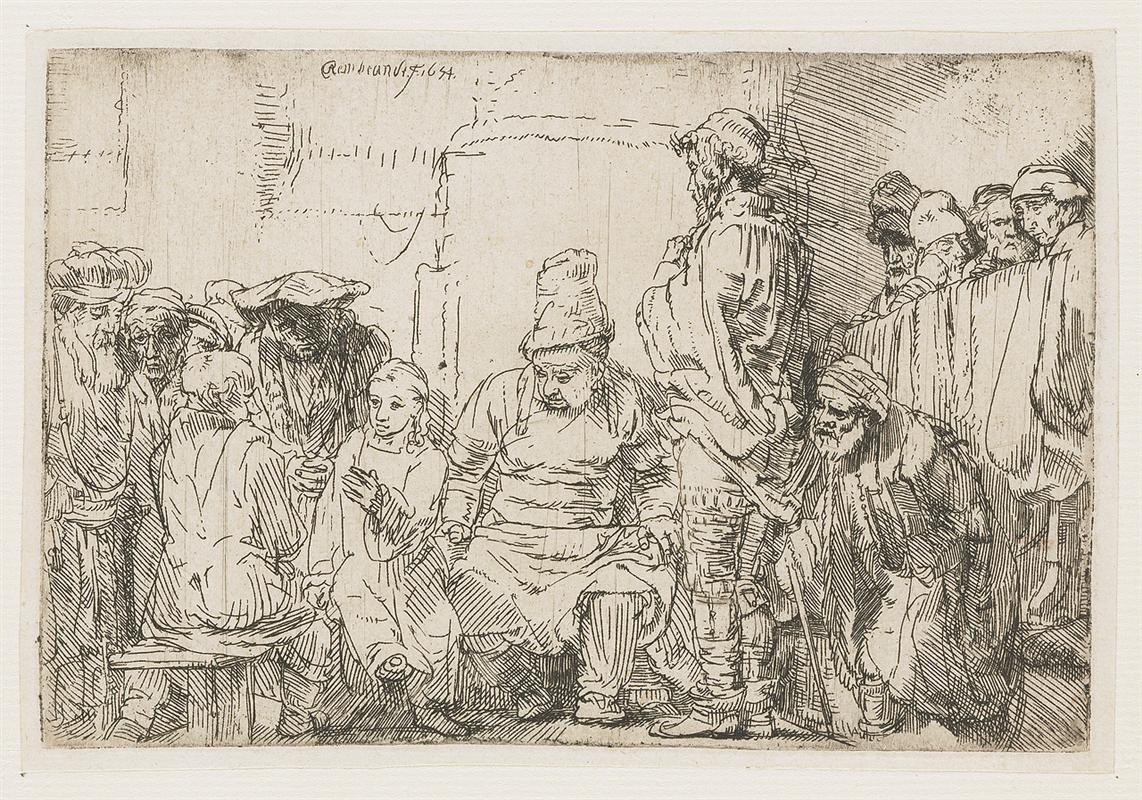
“Christ Seated Disputing with the Doctors” (1654) is one of Rembrandt’s most incisive explorations of youthful intelligence meeting worldly authority. Etched with quick, decisive strokes, the scene compresses a dense crowd into a shallow chamber where the twelve-year-old Jesus sits among scholars, questioning and answering with a composure that unsettles every adult in the room. Rembrandt resists grand theatricality; instead he builds tension through proximity, posture, and the nervous energy of line. The print breathes like conversation: murmurs gathering, a question landing, a counterpoint rising, eyes shifting, hands opening and closing. We witness a moment when knowledge is not transferred from master to pupil but discovered in the living exchange between wonder and tradition.
The Gospel Episode and Rembrandt’s Chosen Instant
Luke’s narrative describes the Holy Family’s Passover visit to Jerusalem. After the caravan departs, Mary and Joseph realize Jesus is missing; they find him in the Temple, “sitting among the teachers, listening to them and asking them questions,” and everyone is amazed at his understanding. Rembrandt selects the instant when the room is most densely charged with attention. The boy is seated, not on a throne but on a humble bench, slightly off center, surrounded by a ring of men whose faces oscillate between curiosity, skepticism, and admiration. By depicting Christ in mid-discourse—mouth slightly parted, hand lifted in measured emphasis—Rembrandt captures the spiritual poise that invites authority to listen rather than merely to lecture.
Composition and the Pressure of the Crowd
The composition is a compressed frieze of bodies. Rembrandt stacks heads and shoulders in staggered layers that curve gently around the child. A tall figure at right stands, hip cocked, becoming a vertical hinge that locks the throng into a semicircle. On the far right a line of onlookers peeks over a parapet, deepening the sense that conversation has drawn a wider audience. The space is shallow, the architecture only lightly indicated by a few bounding lines and a textured wall; almost all the paper is filled with people. This closeness is crucial. The boy is not isolated by a halo or stage; he is pressed by attention. The eye never escapes the press of listeners, and so it cannot escape the question: why are they listening to him?
Christ’s Presence and the Grammar of Youth
Rembrandt’s Jesus is plausibly twelve. The face is soft, the nose small, the hair pulled back, the shoulders narrow under a simple tunic. Yet the child sits with articulated purpose. One hand opens in a restrained, almost diplomatic gesture; the other rests near the lap as if anchoring thought to body. There is no precocious swagger. The boy’s confidence is quietly radical: authority rooted not in age or office but in truth that clarifies as he speaks. By giving Christ the lowest seat and the calmest posture, Rembrandt inverts the hierarchy of the room. The center of gravity is low, steady, and luminous—qualities that have less to do with power than with attention.
Faces, Hands, and the Music of Skepticism
The doctors’ faces form a chorus of responses. At the left, bearded elders lean in, brows furrowed, their mouths folded into lines that read like the consonants of dispute. A figure with a broad, hat-like turban tilts forward protectively, shielding his interest from the others. Near the center, one heavyset scholar hunches over his knees, eyes down, as if digesting a point he is not ready to concede. To the right, a shorter man stoops with a grin that may be cynical or delighted, the ambiguity catching the mood of a crowd unsure whether to mock or marvel. Hands punctuate the rhythm: fingers counting objections, palms pressing into thighs while minds race, a fist on a hip asserting jurisdiction that the child’s words have temporarily displaced. Rembrandt’s needle turns gesticulation into melody; one can almost hear the counterarguments, the asides, the sudden hush when a phrase lands.
Space as Listening
Architecture is minimal—just enough to situate us in an interior—because this is a room built of attention. The blankness of the upper wall functions like silence into which speech is thrown. Over that quiet field Rembrandt lays only the faintest construction lines, perhaps a doorway or a niche, which remain unresolved so they do not pull us from the human knot. Even the standing figure at right shades into the wall with long hatch strokes, as if authority itself were blending into background while listening rises into the foreground. The space is not for spectacle; it is for hearing.
Light, Tonal Balance, and Moral Emphasis
There is no theatrical beam, yet the child reads brighter than those around him. Rembrandt achieves this by keeping the tunic relatively open—few crosshatches, sparing indications of folds—so that the paper’s own whiteness lifts. The surrounding garments are dense with parallel lines, absorbing ink and printing darker. The eye instinctively seeks the lighter center and then circles back through the dark, textured periphery. This tonal organization carries moral weight without announcing it: the room’s massed learning surrounds a core of clarity that does not shout.
The Language of Line and the Etching’s Tactile Charge
Rembrandt’s late etching manner is visible everywhere. He varies pressure and direction so the plate becomes almost audible. Quick verticals across the wall read like the scratch marks of time. Short, skittering crosshatches in beards and fur collars create a woolly buzz of voices. The child’s face is built from a handful of delicate strokes—so few, so right—that we experience the miracle of personality emerging from minimal means. The lines sit lightly on the plate in some areas and bite deeper in others, producing a hierarchy of blacks that lets the crowd breathe rather than coagulate. The drawing looks improvised, but the improvisation is masterly—every looseness strategic, every omission a gift of air.
The Standing Figure and the Threshold of Authority
The tall man at right, planted with one leg forward, is a significant invention. He might be usher, guard, or senior scholar—his exact office is unimportant. What matters is that he represents institutional height. He listens while occupying the posture of oversight. Rembrandt refuses to caricature him; there is no sneer. Yet by placing the boy seated and the official standing, the artist flips the normal vector of instruction. The print captures a threshold moment when institutions first encounter a voice they cannot classify. Recognition has not yet congealed into belief; it glimmers as possibility in a room of procedures.
Comparison with Other Depictions of the Subject
Many artists render this scene as a clean, symmetrical debate set in a palatial Temple court. Rembrandt chooses a crowd scene that feels closer to a workshop or guild hall. The difference is more than stylistic. It signals a conviction that wisdom appears within ordinary rooms, that sacred insight sounds like a question asked plainly. He is less concerned with ecclesiastical grandeur than with the anatomy of understanding. The result aligns this work with his Emmaus images and domestic gospel scenes, where revelation arrives through intimacy rather than spectacle.
Theological Undercurrent Without Emblems
There are no haloes, tablets, or inscriptions. The theological claim—Christ as wisdom in the midst of teachers—exists as social choreography rather than iconography. Youth sits, age gathers; clarity loosens the grip of habit; the room bends around a center that is not power but truth. The lack of emblem makes the image porous to viewers across confessions. One need not decode symbols to understand the stakes; they are written in the bodies and the air.
Psychology of the Crowd and the Ethics of Disputation
Rembrandt’s crowd is not a mob. It is a community of professionals engaged in their craft. He honors their seriousness even as he reveals its limits. Some listen to understand; others listen to reply. Some are delighted by the prodigy; others feel their authority pricked. The boy does not dominate them as a prodigy on display; he participates in their work at a deeper pitch. The print thus models disputation as an ethical practice: good when animated by the search for truth, dangerous when governed by vanity or fear. That ethical reading would have resonated in Amsterdam’s marketplace of ideas, where argument was a civic habit.
Material History and the Breath of the Plate
The plate’s margins hold faint smudges and uneven wiping marks characteristic of Rembrandt’s hand-inked impressions. In some pulls, plate tone veils the upper field so the figures emerge like a relief from haze; in cleaner impressions the line reads crisp, underscoring the drawing’s speed. This variability is not incidental. It allows the print to live like conversation itself—sometimes airy, sometimes dense—without ever losing the core encounter of eyes and hands around the child.
Dutch Eyes on an Ancient Story
The clothing and hats feel frankly Northern. Rembrandt translates the Temple scene into the visual language of his own century, a choice that serves understanding rather than archaeology. Viewers recognize the types: the cautious elder, the practical scribe, the sharp young assistant, the official securing order. By making the scene a neighborly gathering, he asserts that the drama of truth versus habit recurs in every age and place, including his own.
A Contemporary Reading
The print remains sharp because it reflects perennial dynamics of classrooms, boardrooms, and communities. New insight arrives from an unexpected voice; those invested in the old frame oscillate between curiosity and self-protection. The image invites us to ask how we respond when truth speaks from youth, from outsiders, or in tones that do not confirm our status. Rembrandt does not scold the doctors; he empathizes with their bewilderment while gently showing the dignity of listening.
Conclusion
“Christ Seated Disputing with the Doctors” condenses an intricate moral world into a few square inches of copper and ink. The scene is dense with people yet generous with air, argumentative yet tender, historical yet contemporary. Rembrandt gives us not a spectacle of prodigy but a portrait of attention: a child centered in quiet confidence, a ring of seasoned minds pushed into honest reconsideration, and a room rearranged by the gravitational pull of truth. In its economy of means and richness of feeling, the print exemplifies the late Rembrandt gift—turning the drama of recognition into line, and teaching us to see argument as a path toward wisdom rather than a weapon of pride.
