Image source: wikiart.org
Introduction
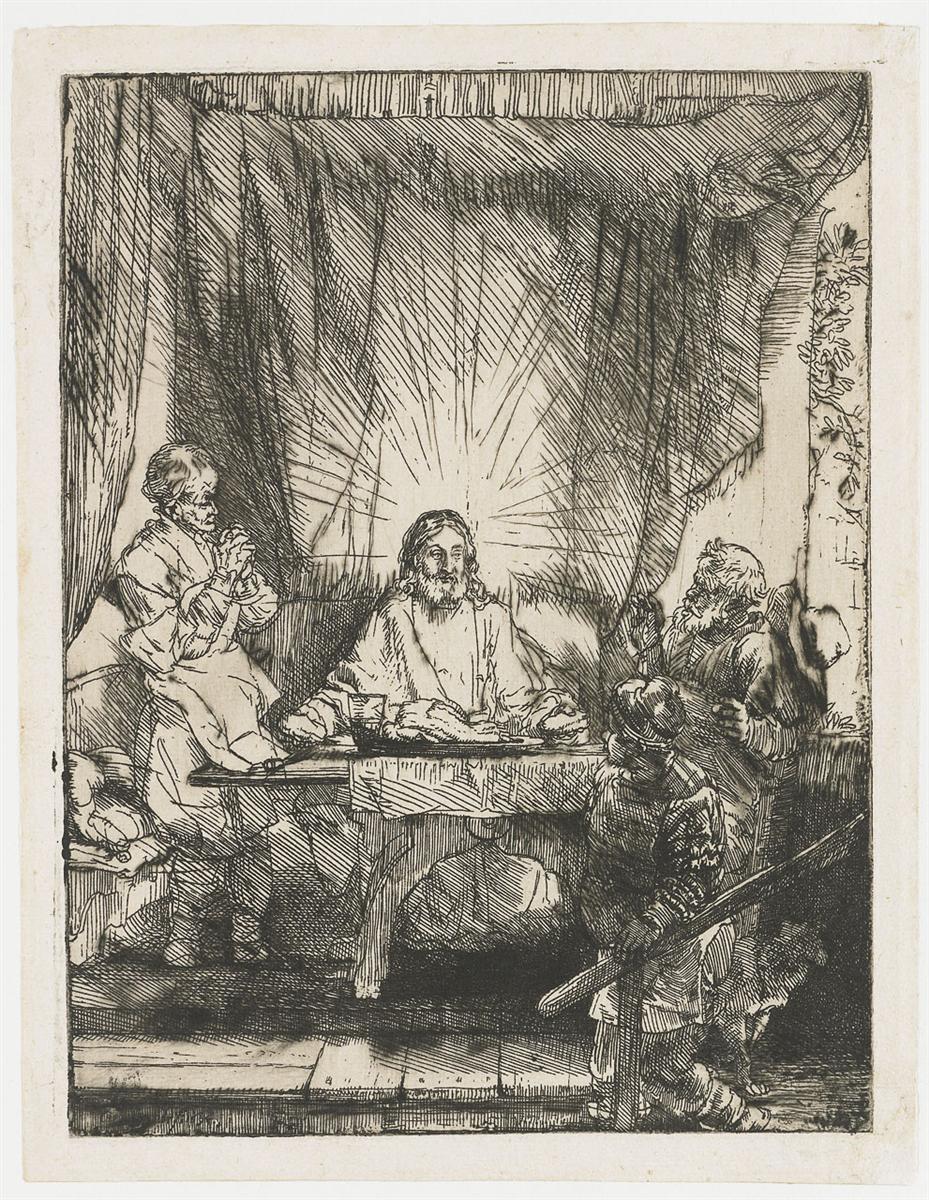
“Christ at Emmaus” (1654) is one of Rembrandt’s most intimate meditations on revelation made tangible. The scene is small in scale yet vast in implication: a humble table inside an inn becomes a stage where recognition shatters ordinariness. With taut, economical etched lines, Rembrandt turns bread, cloth, and evening light into instruments of theophany. He compresses the gospel narrative to the instant when the risen Christ is finally known in the breaking of bread, and arranges everything—the drapery, the table, the disciples’ bodies, even the inn servant—so that the viewer experiences the recognition with them.
The Biblical Moment and Rembrandt’s Choice
The story from the Gospel of Luke tells of two disciples who meet a stranger on the road to Emmaus after the Crucifixion. They speak of recent events, their hearts “burn within,” yet they fail to know him until he sits at table, blesses the bread, and breaks it. Rembrandt selects precisely that hinge between ordinary hospitality and unveiled presence. The stranger has become the Lord: Christ sits at the center, hands over bread, and the radiance that emanates behind him clarifies what the mind is still catching up to. The disciples’ gestures split along a subtle axis—one gathers the body to pray, the other recoils in astonishment—and the viewer is placed at a respectful near distance, more guest than spectator.
Composition and the Architecture of Intimacy
The composition is shaped by a big swath of drapery that hangs like an indoor sky. It drops from a high rod and pitches forward, forming a canopy that encloses the table. Beneath this canopy a shallow space opens: floorboards run toward us, a plain table sits slightly off-center, and Christ is positioned behind it like an altar’s living center. The figures are scaled generously within the room, creating a theater-in-the-round that keeps the viewer close enough to sense breath and voice. The rectangle of the tabletop becomes a visual fulcrum; its edges conduct the eye to Christ’s hands and then back to the disciples, completing a circuit that never leaves the sacred action.
Light as Recognition
Rembrandt draws recognition quite literally into existence with light. Behind Christ a fan of radiating lines cuts through the dark canopy, pushing illumination outward in fine, urgent strokes. This is no decorative halo: it is a visual equivalent to understanding expanding in the disciples’ minds. The rest of the room remains comparatively subdued—shaded hatching on the left, deeper crosshatching on the drapery, and grounded shadows beneath the table—so that the beams appear both plausible and miraculous. Light does not flood the scene; it bursts from its center, as if truth were a pressure the room cannot contain.
The Drapery as Theatrical and Theological Device
The hanging cloth carries double duty. Theatrically, it is a backdrop that concentrates attention by blocking any distracting architectural recession; the eye cannot escape the room and therefore must stay with the event. Theologically, it reads as a veiled temple curtain reopened. Its heavy folds suggest the old order’s weight, while the radiant breach behind Christ implies the veil torn and a new access made. The decision to fill so much of the plate with drapery is bold, almost abstract, and it pays off by creating a chamber of meaning that feels protective, like a womb of revelation.
Gestures and the Human Drama
The first disciple at left folds his hands and pitches his body forward, an instinctive motion of prayer born from sudden comprehension. His shoulders compress, and the face turns into the glow with gratitude and alarm. The second disciple, on the right, draws backward, one hand raised and the head twisting away while the eyes remain fixed on Christ. Between these responses—adoration and astonished recoil—Rembrandt maps the emotional topography of recognition. Christ, by contrast, is still. His hands hover over bread and tablecloth in a calm rhythm that anchors the surrounding agitation. He does not grasp or present dramatically; he blesses and breaks.
The Servant as Unknowing Witness
At the right edge stands a young servant, perhaps an inn boy, holding a long spit or staff. He looks toward the disciples rather than the radiance, his face caught in the habits of work, with no sense of the disclosure at the table. Rembrandt loves this figure because he grounds the scene in everyday life. The servant is not foolish, only unaware; he becomes a mirror of the world that can stand inches from grace without perceiving it. His presence also slows the narrative pace, letting the revelation feel more internal than spectacular. The sword-like spit cuts diagonally across the foreground, echoing the thrust of the radiating lines and quietly tying ordinary labor to holy event.
Space, Scale, and Proximity
The room is shallow, the furniture plain, the figures large relative to the space. This compresses air around the event so the viewer feels near without intrusion. The table’s near edge slightly overhangs the floorboards, a trick that makes the tabletop practically touch our space. This closeness is essential: Emmaus is a domestic sacrament. Rembrandt refuses architecture that would monumentalize the scene; instead, he builds intimacy that persuades. The sense of scale, with the drapery towering and the table homely, helps the paradox land: a vast mystery enacted in a poor room.
Etching, Drypoint, and the Language of Line
The plate is a conversation of lines. Rembrandt’s needle hatches the drapery in long, swift swathes that feel like falling fabric. Around Christ he employs shorter, denser strokes to thicken the aura. The tablecloth is described by sure, parallel lines that cross just enough to suggest weight. Drypoint accents likely deepen certain darks—under the table and in the servant’s clothing—adding velvety burr that absorbs ink and prints soft blacks. The characters’ faces are mapped with economical notations, proving how little is required to conjure a soul when placement and pressure are right. Even the floorboards are expressive; their converging stripes not only suggest perspective but guide the eye back toward the center.
Plate Tone and Atmosphere
Rembrandt often left a veil of plate tone to create air. In impressions with more tone, the room breathes like dusk; in cleaner wipes, the beams behind Christ read crisper, like dawn breaking indoors. Either way, the atmospheric film softens transitions, making the light seem to grow rather than sit on the paper. This painterly control through inking, rather than purely through bitten line, is part of the late Rembrandt signature and explains how such simple means can carry complex emotion.
Comparison with Earlier Emmaus Treatments
Artists traditionally depicted Emmaus as a balanced supper scene modeled on Last Supper prototypes, with elaborate table settings and distant architectural vistas. Rembrandt strips away the banquet and the décor. His earlier painted “Supper at Emmaus” already pointed in this direction, but the 1654 print is more severe and more tender. The entire narrative is collapsed into gesture and illumination. By centering Christ’s quiet blessing, he shifts the image from spectacle to encounter, and by eliminating backstory he intensifies the viewer’s role as participant.
The Economy of Props and the Theology of Bread
The props are minimal: bread, cloth, cup, table. Bread is the hinge. The gospel says the disciples knew him “in the breaking of the bread,” and Rembrandt makes the loaf both literal and symbolic without distorting either. It is ordinary food—scored with a few lines to suggest torn edges—yet it also becomes a sign of continuity between the Last Supper and the risen presence. The tablecloth’s small fold that drapes toward us echoes the downward motion of a priest’s hands at blessing, turning the whole table into a domestic altar without pomp.
Emotion, Time, and the Instant Before Disappearance
Luke adds that Christ “vanished from their sight” after recognition. Rembrandt appears to paint just before that vanishing, when seeing and losing overlap. The disciples’ motions have just begun; the servant has not looked up; the bread is still intact enough to bless. This is a fraction of time stretched into an image, and the stretching allows the viewer to dwell where the text races forward. The print is therefore a machine for contemplation—time slowed until meaning can soak in.
Dutch Domesticity and Universal Address
Although the story is ancient, the room, table, and clothing feel recognizably Northern and near to Rembrandt’s world. The “Dutchifying” of the gospel is not a provincial move; it is a universalizing one. By placing revelation in a recognizable home, the image suggests that recognition is always local, always arriving at someone’s table in the texture of their own life. The disciples are not costumed saints but tired travelers who have carried disappointment, confusion, and flickers of hope all day. Their world is ours.
The Face of Christ and the Balance of Humanity and Glory
Rembrandt’s Christ is neither masked by stylized ideal nor crushed by realism. The features are human and approachable—soft beard, patient mouth, tired eyes—and yet set within a nimbus that signals more than human. The balance is delicate: too much glory would tip the scene into pageantry, too little would flatten the miracle. He finds the middle by letting the light declare divinity while the face keeps brotherhood. The Christ who blesses here is the one who walked the road with them unrecognized.
The Viewer’s Position and the Ethics of Seeing
The viewer is seated opposite Christ, sharing the disciples’ vantage. Rembrandt avoids voyeurism by arranging bodies so that we look not at a victim or a spectacle but at a gift being offered. Our attention is trained: first to the hands and bread, then to the faces of the disciples, then back to Christ. The eye’s rhythm becomes a liturgy of looking—receive, respond, return. We are invited into the recognition without being forced; there is room in the frame for our hesitation as well as our assent.
Technique as Meaning
Every technical choice carries meaning. The canopy’s heavy hatch speaks of a world once thick with law. The burst of straight rays behind Christ speaks of a clarity that does not abolish weight but pierces it. The scraped highlights on bread and cup speak of tactile immediacy. The edges of the plate, with small lapses and irregularities, keep the image from feeling too polished; it remains close to the breath and warmth of drawing. Technique and theology converge into a single, persuasive voice.
Afterimage and Legacy
When one looks away from the print, the afterimage is not a face or a prop but a glow from within a room and the two contrary gestures that greet it. That afterimage has shaped how the Emmaus story has been imagined ever since: not as a lavish supper but as a quiet unveiling. The print’s simplicity makes it portable across centuries and traditions. It also shows why Rembrandt’s late graphic work matters so much—he achieves grandeur with a few strokes and allows a whole world to enter through a door left ajar.
Conclusion
“Christ at Emmaus” offers a chamber-sized revelation where nothing is extraneous and everything is eloquent. A cloth becomes a sky, a table becomes an altar, bread becomes recognition, and ordinary people become witnesses. Rembrandt compresses narrative, doctrine, and human feeling into a single instant and renders it with lines that sound like breath. The print does not explain a mystery so much as stage the conditions under which it is received: proximity, hospitality, hunger, and the patience to let light dawn from the center outward. In that sense, the image continues to work on us the way the story worked on the disciples, turning a meal into a meeting and a familiar room into the house of God.
