Image source: wikiart.org
Introduction
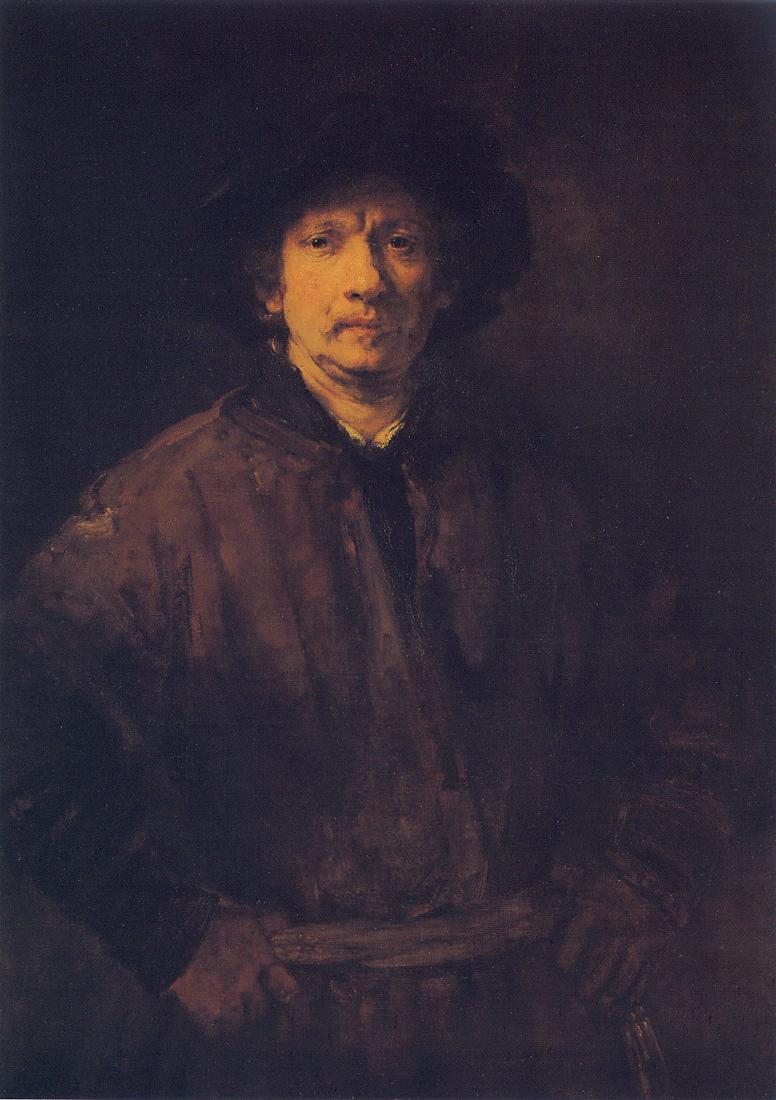
Rembrandt’s “Large Self-portrait” of 1652 is not simply a likeness; it is a reckoning. In a dark field that swallows almost everything, a man stands half length, hands planted on his hips, a broad hat widening the silhouette of his head, and a rough working coat belted at the waist. Light catches the planes of his forehead, nose, and cheek, slips along the ridge of his knuckles, then dies into the dusk of the garment. The pose is assertive, even heroic, but the costume is humble—more workshop smock than courtly attire. This friction between authority and austerity is the painting’s voltage. In it Rembrandt gathers decades of self-examination and declares, with characteristic candor, the sovereignty of experience over ornament.
A Mid-Career Pivot In Paint And Life
The year 1652 sits at a turning point. Rembrandt was approaching his late forties, established yet bruised: a widower, a father, a studio master, a man living beyond his means and ahead of a financial collapse that would come a few years later. The bravura costumes and theatrical self-inventions of the 1630s and early 1640s give way to a more stripped, concentrated kind of self-portraiture. The “Large Self-portrait” marks that shift. He no longer performs as a gentleman or a biblical hero; he appears as a painter—unidealized, work-clad, a man whose authority derives from the right to look and to record. The scale of the canvas amplifies this change. It is large enough to meet the viewer at human size, making the encounter a conversation rather than a glance.
Composition And The Architecture Of Presence
The design is simple and immovable. A triangular arrangement binds hat, face, and hands into a stable figure that resists the surrounding darkness. The hands at the belt are not a flourish; they are structural anchors, creating a low horizontal that counterweights the head’s centrality. The left hand, more exposed, becomes a second focal point after the face, a reminder that vision and making are linked. The body leans slightly forward, as if bridging the gap between painter and viewer. At the same time, the broad coat spreads outward, a tent of shadow that states, “I occupy this space.” The figure does not perform movement; it performs endurance.
The Psychology Of The Gaze
Rembrandt looks straight at us, but not with the fixed glare of a posed portrait. His eyes are steady yet edged with thought. The mouth is neutral—neither tight with judgment nor slack with fatigue—yet the set of the lips carries a hint of stubbornness. Eyebrows lift ever so slightly, imparting a questioning openness that keeps the painting from hardening into self-celebration. This ambiguity is the artist’s hallmark: the face is a live instrument capable of many moods across minutes, and the paint holds that mutability. You sense a man performing his own inspection, allowing you to witness it.
Light, Shadow, And The Moral Weather
The chiaroscuro is mature Rembrandt: light concentrated where character resides, shadow everywhere else. Illumination falls from the left, modeling the forehead and cheekbones, and catches on the knuckles. The coat absorbs it, leading our attention back to the head. The darkness is not nothingness; it is a material presence built from deep browns and umbers, textured with soft strokes and scumbles. This is not theatrical spotlighting. It is ethical lighting—an economy of vision that tells us what matters. The painter identifies his tools: a thinking face and working hands.
The Costume As Statement
The coat is plain, almost shapeless, belted with a robust strip of cloth. Its bulk suggests a studio garment rather than a sitter’s finery. The hat, broad and dark, serves both practical and pictorial ends. Practically, it is the painter’s protection against glare; pictorially, it is a shadow factory, shading the brow and intensifying the concentration of the eyes. The ensemble strips away status indicators in favor of function. Rembrandt does not deny his past self-portraits in silk and chain; he counters them. Here the authority of the painter is not borrowed from costume but generated by labor.
Brushwork And The Intelligence Of Touch
Standing close, you see that the face integrates two speeds of painting. Around the eyes and mouth, Rembrandt works with small, responsive strokes that pick up the micro-topography of skin—minute ridges of paint catch the light like the raised grain of paper. Along the cheeks and forehead he lets broader, softer strokes fuse into living flesh. The coat is something else again: a field of large, confident swathes, dragged and broken to suggest nap and weight. The hands are built from shorthand—thick and thin accents that model bone and tendon without pedantry. The brush remembers the energy with which it moved, and that memory becomes part of the image’s truth.
Color As A Quiet Chord
The palette is restrained: umbers and red-browns dominate, relieved by the pale lights in flesh and the cooler gray of the undershirt’s triangle. There is little chromatic display, but there is exquisite temperature control. Warmth rises in the cheek and nose; cooler notes temper the jaw shadow and eye sockets; the hands carry a ruddy hue that makes them believable as working flesh. These quiet chords stabilize the mood. The viewer does not surf color; the viewer listens to it the way one hears a cello sustain a line.
The Hands At The Belt
Rembrandt’s choice to rest both hands on the belt gives the picture its groundedness. The gesture is both practical and symbolic. Practically, it opens the body, preventing the arms from collapsing into the torso and creating negative spaces that keep the figure legible in the dark. Symbolically, it reads as a craftsman’s stance: ready, braced, the body’s tools at rest but available. The belt itself—wide, utilitarian, arguably paint-spattered in earlier states—becomes a metonym for studio life: a strap that binds the garment, a line that binds the composition, a modest stand-in for the painter’s trade.
The Surface As Record Of Time
Rembrandt’s paint surfaces often show pentimenti—shifts in contour and emphasis that reveal hesitation and correction. In this self-portrait you can sense where the hat was widened, where the shoulder line was reconsidered, where the hand was reinforced. These alterations are not flaws; they are evidence. The painting becomes a diary of looking, each layer a day’s conversation with the mirror. That temporal depth resonates with the subject matter: a middle-aged man for whom self-scrutiny has been a lifelong practice.
Dialogue With Earlier And Later Self-portraits
The “Large Self-portrait” looks backward to the costumed performances of the 1630s and forward to the monumental canvases of the later 1650s and 1660s. Compared with the elegant Self-portrait of 1640, where Rembrandt quotes Renaissance prototypes, the 1652 canvas is stripped and frontal, impatient with frills. Compared with the grand 1658 self-portrait painted in the wake of financial catastrophe, this earlier image is smaller in ego and perhaps more searching. Where the later portrait enthrones the painter on a chair, scepter-like cane in hand, the 1652 work shows a man still negotiating the terms of his authority, insisting on craft over ceremony.
The Studio As Invisible Setting
No studio objects appear—no mahlstick, palette, easel, or canvas edge—yet the room is present. The darkness reads as studio air, the coat as working gear, the hat as a practical tool. The light resembles north-window daylight tempered by a curtain. Even the pose, with hands anchoring the belt, is the posture of someone who has stepped back from the easel to measure what he has done. By refusing explicit props, Rembrandt keeps the emphasis on encounter rather than illustration. The room exists, but it is not the subject; the person in it is.
A Public Image Built From Private Looking
Self-portraits are paradoxes: intimate in origin, public in effect. Rembrandt navigates this expertly. The painter’s stare is not a private confession; it is a measured offering of self-knowledge. He gives enough to invite identification but keeps opacity where dignity requires it. That balance—between revelation and reserve—is why his self-portraits feel inexhaustible. They do not solve the person; they keep him available.
The Ethics Of Unflattering Truth
The face is not improved. The nose is firm and a touch bulbous; the lower lids swell; the mouth shows wear; the skin bears the unevenness of middle age. Yet the overall effect is beautiful because the painting’s truth aligns with the pleasure of recognition. Rembrandt refuses flattery as a matter of principle. To honor the life lived is to honor the signs of living. In the seventeenth-century Dutch culture that valued honesty and substance, such straightforwardness was not merely stylistic; it was moral.
Gesture, Scale, And The Viewer’s Body
At human scale, the painting interacts with the viewer’s body. Standing before it, you align your own hands with his, feel your shoulders respond to his stance, and meet his gaze at eye level. This is not the pin-sized self-scrutinizer of a cabinet picture; this is a full-bodied interlocutor. The canvas makes you conscious of your own posture and time, and in doing so it converts likeness into relationship. You do not simply see Rembrandt; you stand with him.
The Poetics Of Dark Ground
The ground’s darkness is active. Its depth shifts across the surface—sometimes velvety, sometimes translucent, punctuated by faint warm glows where underpaint breathes through. That variability saves the background from emptiness. It also lets the figure’s edges dissolve and reappear, a favored Rembrandt effect that simulates the way sight actually works at low light: the periphery softens, the focus sharpens, and forms breathe into atmosphere. This poetics of dark ground allows the painter to hold grand scale without clutter.
Comparison With Contemporary Portraiture
While other Dutch portraitists celebrated wealth through crisp textures, gleaming lace, and polished wood, Rembrandt here chooses the counter-aesthetic of matter subdued by shadow. He is not uninterested in surfaces; he is uninterested in surfaces that distract from character. The lace collar of a prosperous burger, the satin of a merchant’s wife, the silver of a goblet—these are absent by design. Instead, his textures are those of life: skin, wool, hat felt, rough belt—materials that carry touch rather than glare.
The Work As Self-Advocacy
Many of Rembrandt’s self-portraits functioned as professional calling cards: advertisements of skill and demonstrations of the expressive range painting could achieve. The “Large Self-portrait” advocates for a particular conception of the artist—a worker who commands light and darkness, who tests truth against his own face, who asks viewers to value presence over spectacle. In an art market that often rewarded flattery and finish, Rembrandt argues for depth.
Close Readings Of Key Passages
Look at the ridge of paint where the nose catches the light. It is small but decisive; remove it mentally and the head loses its axis. Notice the way the lower lid is modeled with a dim, cool gray that gives the eye its moist depth. Track the long curve from the hat’s brim down the shadowed cheek; the brush softens there, letting the boundary wander into the darkness like smoke. Study the left hand’s knuckles: impastoed highlights pattern a topography of use. Even the belt has its poetry—the dragged stroke that defines its upper edge looks like old leather creased by years of tightening and loosening. Each passage is a lesson in selective emphasis.
Memory, Mortality, And The Long Project Of Self
Rembrandt’s self-portraits form a chronological autobiography painted in flesh tones. This one, at mid-life, carries the memory of earlier bravado and the premonition of later gravity. You feel the decades before and after. The gaze seems to contain both a younger man’s curiosity and an older man’s patience. That temporal layering is why the painting so often prompts viewers to consider their own years—what they have kept, what they have lost, what kind of authority they wish to claim without costume.
Conclusion
“Large Self-portrait” is Rembrandt’s declaration that art’s deepest subject is not wealth, costume, or even anecdote, but presence tested by time. In a plain coat and working hat, with a steady gaze and hands ready at a belt, he stages a confrontation with himself that doubles as an invitation to the viewer. The dark ground is not empty; it is the vastness against which a person proves his continuity. The brushwork is not merely virtuosic; it is the trace of a mind refusing flattery. The painting stands where confession meets craft, where private looking becomes a public statement about how to live and see. To stand in front of it is to feel a companionable gravity: a human being, nothing more or less, claiming his art and his years.
