Image source: wikiart.org
Introduction
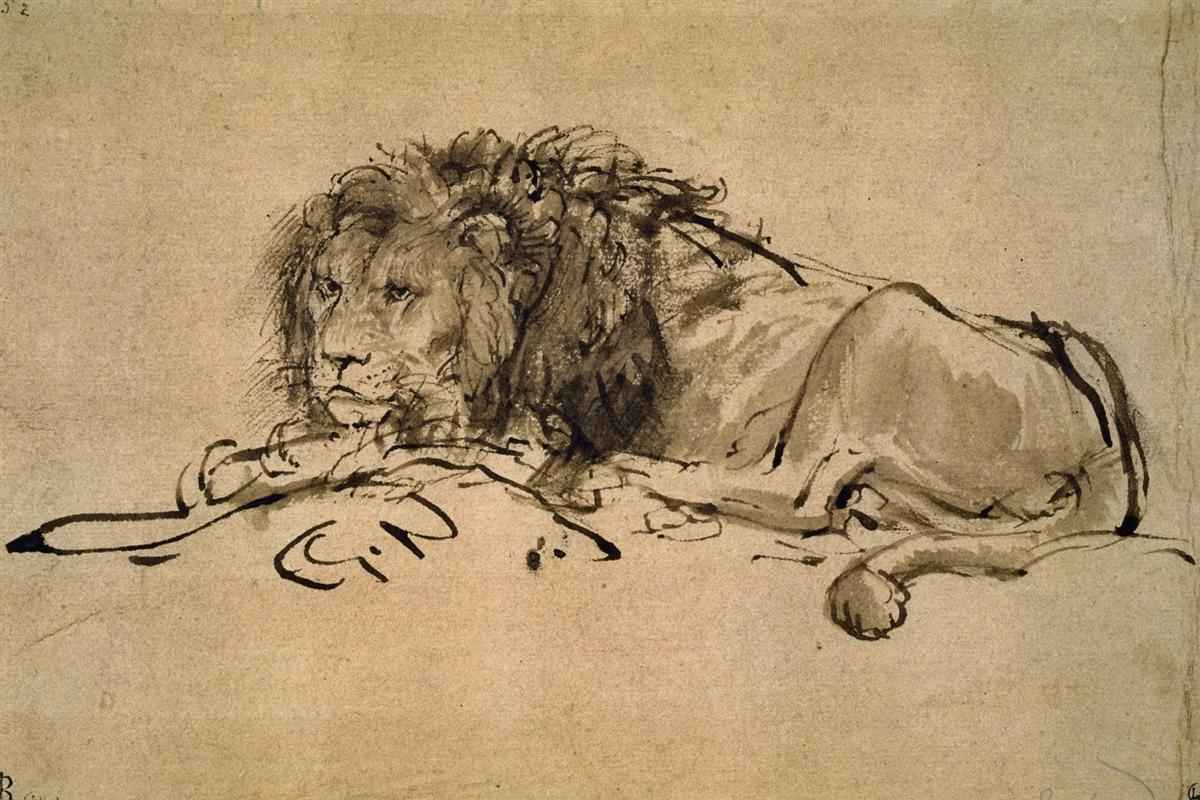
Rembrandt’s “Lion Resting” (1652) is a drawing that feels as alive as a heartbeat. With a handful of calligraphic strokes and liquefied shadows, he turns a sheet of paper into warm hide, heavy bone, a mane that seems to absorb light, and the watchful calm of a predator at ease. The animal lies stretched from left to right, forepaws crossed, head lifted, eyes level and alert. Nothing in the sheet is ornamental. Every mark is functional—an economy of line that carries anatomy, weight, texture, and mood all at once. In this deceptively simple study, Rembrandt demonstrates how drawing, at its best, is not the record of seeing but the act of seeing itself.
What We’re Looking At
The image is a pen-and-ink and wash study on paper, built from two complimentary systems of mark-making. First come the decisive black outlines that map the lion’s contour and joints, written with the confidence of someone who has watched the animal settle and breathe. Then wash—brown and gray—slides over the skeleton of lines to establish mass and temperature. The combination is fast and responsive. You can read the sequence of the artist’s attention: the head and mane are described with dense, almost furry strokes; the barrel of the body is laid in with broader, quieter pools; the tail and far leg are the last things to be decided, left to a few slurred accents that dissolve into paper. The result is neither polished nor tentative. It is drawing as performance, the mind moving through an animal.
A Lion In Seventeenth-Century Amsterdam
Rembrandt did not invent his lion from imagination. Amsterdam in the mid-seventeenth century had access to exotic creatures through traveling menageries and princely collections, and several surviving studies show he sketched lions from life more than once. The 1650s were a period when his attention to the tangible—hands, heads, shells, trees, and, here, a lion—was especially intense. “Lion Resting” belongs to that moment: a sheet made in proximity to a breathing animal, tuned to the rhythms of observation, and free of narrative framing.
Composition And The Long Body’s Diagonal
The composition is a study in restful tension. The lion’s body forms a long diagonal that stabilizes the page, punctuated by the vertical lift of the head and the slight down-sweep of the tail. Rembrandt leaves large fields of paper empty, letting the animal occupy not just space but silence. The forepaws lie crossed at the left, anchoring the composition; the head hovers above them like a weight borne lightly. Because the body occupies the lower band of the sheet, there is an expanse of untouched paper above—it feels like air the lion could breathe into. That architecture of space keeps the image from becoming merely descriptive; it is an environment for attention.
Head And Mane: Drawing The Seat Of Character
All of Rembrandt’s energy gathers at the head. The eyes are not petty dots; they are small, shaded pools under a heavy brow, set far enough apart to give breadth and seriousness. The mane is a concert of short, erratic hatches and smudged wash that do more than depict hair; they announce density and heat. Around the muzzle, stroked whisker pads and a soft shadow under the chin produce the feeling of warm breath dampening fur. The mouth is quiet, neither yawning nor baring teeth. This is not a lion performing ferocity; it is a lion considering the room, a sovereign in his own stillness. Rembrandt respects that gravity. He draws the head as if he were drawing a human face—never sentimental, always precise.
Paws, Joints, And The Grammar Of Weight
The front paws are a masterclass in economy. A small curve indicates the big pad; two or three short lines break to suggest toes; a darker notch marks the claw’s sheath. Yet the weight is unmistakable. You can feel bones stacked under muscle, skin thickened by use, and fur lying in different directions. The rear leg is described with long, supple strokes that run over the curve of the thigh and tuck into the powerful hock. At the belly, streaks of wash hint at the shallow breathing of sleepiness rather than deep rest. The entire body reads as heavy yet relaxed, a monument taking a nap.
Line And Wash: Two Kinds Of Intelligence
Pen line is analytic; wash is empathic. Rembrandt uses the pen to declare structure—where the shoulder sits under the mane, where the ribcage turns toward the flank, where the tail emerges. The wash attends to volume and mood: it rounds the ribs, darkens the mane, cools the recessed paw, warms the near haunch. When he wants to keep the drawing quick, he lets a single ribbon of wash slide along a contour to imply reflected light. This duet of marks creates a drawing that feels both exact and spontaneous, stable and alive.
Negative Space And The Art Of Restraint
Half of the lion’s power lies in what Rembrandt refuses to touch. The ground is indicated by a handful of almost calligraphic strokes under the forepaws; elsewhere, it is simply the paper itself. No rocks are listed, no habitat is built. The absence of setting directs attention to the animal as event rather than specimen. A scrawl near the paws—often read as an abbreviated annotation—works like a flourish of breath, an autograph of presence rather than a label. The empty space around the lion is not empty; it is charged with the room’s quiet, with the time that allows a body to settle.
Speed, Revision, And The Drawing’s Honesty
Look closely and you can feel the order in which Rembrandt worked. The head and mane bear the densest evidence of labor—hesitations, layered strokes, and corrections that thicken into character. The torso is a wash laid once, maybe twice, with a few confirming lines; it feels like a decision made swiftly and rightly. The tail curves back with a single confident sweep. Where a mark misses, Rembrandt rarely erases. He lets the misfires live as velocimetry, proof that the lion shifted or that the artist’s hand sought and then found the form. The drawing is honest about its making; that honesty is part of its beauty.
Anatomy Seen, Understood, And Simplified
The sheet testifies to Rembrandt’s understanding of anatomy without turning into a textbook. The foreleg’s ulna and radius are implied, not diagrammed; the scapula bulges under mane; the pelvis smuggles its mass into the curve of the flank; the spine is a soft, slow arc you feel rather than see. This simplification is not ignorance. It is respect for how much information a viewer needs to believe. The artist delivers just enough. The brain, delighted to be trusted, adds the rest.
The Lion As Emblem And As Creature
For Dutch viewers, the lion carried national overtones. The “Leo Belgicus” personified the Low Countries in maps and emblems, and the animal symbolized strength, vigilance, and civic courage. Rembrandt knew that symbolic freight; he had staged lions before in biblical scenes, most famously when imagining Daniel in their den. Yet here the lion is not a coat-of-arms animal; it is a creature. By insisting on the cat’s heaviness, breath, and inattention to us, Rembrandt returns emblem to life. The drawing’s quiet says: power does not always roar; sometimes it watches.
The Mood Of Watchfulness
Is the lion asleep? Not quite. The eyes are open and level, the ears forward, the head propped on the forepaws in the classic posture of détente. Anyone who has watched a big cat recognizes the mood: not hunting, not playing, not guarding—just occupying the world with unarguable authority. Rembrandt’s marks mimic that energy. They are contained but ready, calm with the capacity for sudden movement. The drawing’s rhythm—dense here, airy there—feels like the animal’s own metabolism at idle.
Paper As Light, Ink As Temperature
Because the sheet is largely untouched, the paper itself becomes light. The lion’s body is a warm object laid in a sunlit field. Inked contours cool where they thicken (shadow at the belly, recesses of the mane) and warm where they thin (the edge of the back, the near foreleg). The washes act like temperature maps of the body: darker over the mane’s heat sink, paler over the long muscles of the flank. Such modulation is more than technique; it is empathy at the level of material.
Kinship With Rembrandt’s Other Animal Studies
Rembrandt’s notebooks and loose sheets include dogs, horses, cattle, and even an elephant, but the lion drawings form a special cluster. Compared with his more detailed studies, “Lion Resting” is exceptionally spare; compared with quicker jotting, it is unusually weighted and resolved. It sits in the middle path where his best drawings live—enough finish to convince, enough openness to breathe. In this it resembles his landscape studies and human heads from the period: images that feel like real time preserved rather than studio inventions.
The Viewer’s Place And The Ethics Of Looking
Where does the sheet position us? Low and close, perhaps on the other side of a rail, close enough to feel the hush that falls when a large animal pays you no mind. That vantage carries an ethics. We are not invited to dominate the lion with our gaze or to reduce it to a symbol for ourselves. We are asked to attend. To look with patience is to grant the creature its sovereign privacy even as we draw near. The drawing models that kind of looking, and in doing so it refines the viewer.
The Calligraphic Gesture And The Hint Of Signature
Near the paws, a looping mark curls like an abbreviated annotation. Whether shorthand for the pose or a quick note to self, it functions visually as a flourish—an echo of the tail’s curve and a counterweight to the heavy head. Rembrandt often let such pen gestures remain; they tie his sheets to the rhythm of the hand that made them. Here they also inject a whisper of humor: a lion nonchalantly sprawled on the artist’s very scribble.
Why The Drawing Feels Contemporary
The modern eye is saturated with images of animals, yet “Lion Resting” startles with freshness. It is the opposite of overproduction: one sheet, a few strokes, a living presence. Its restraint reads as contemporary minimalism; its fluidity, as immediacy. It joins the long conversation about how to represent nonhuman life without anthropomorphizing it and shows that reverence and curiosity can live in the same touch. The drawing’s smallness—physically modest, spiritually large—suits a twenty-first-century appetite for objects that repay long looking.
Close Looking: Passages Of Particular Brilliance
The shadow under the jaw is a soft wedge that does three jobs at once: it lifts the head from the paws, rounds the throat, and deepens the muzzle. The near shoulder—really a dark tangle of mane and a few confident arcs—reads perfectly as a joint in repose. The tiny notch inside the ear, one quick jab of the pen, brings the entire auricle into focus. The pad of the near forepaw bears two diagonal scratches that magically become old calluses. The line that carries the back from shoulder to rump is interrupted twice, and those gaps are what make the haunch convincing; the eye bridges them as skin over muscle. These micro-decisions reveal an artist who trusts the viewer’s intelligence and rewards it.
Conclusion
“Lion Resting” is a distilled demonstration of Rembrandt’s lifelong belief that drawing is a moral as much as a visual art. It asks for attention, patience, and a willingness to accept the world’s forms without overexplaining them. With ink and wash he builds a body that breathes, a head that watches, and an aura of time unhurried. The lion’s ease is contagious; look long enough and your own breathing changes. In a career filled with saints, merchants, landscapes, and scenes of spectacle, this modest sheet stands as a quiet marvel: a sovereign creature, fully itself, occupying a page with dignity and calm—and an artist meeting it with the same.
