Image source: wikiart.org
Introduction
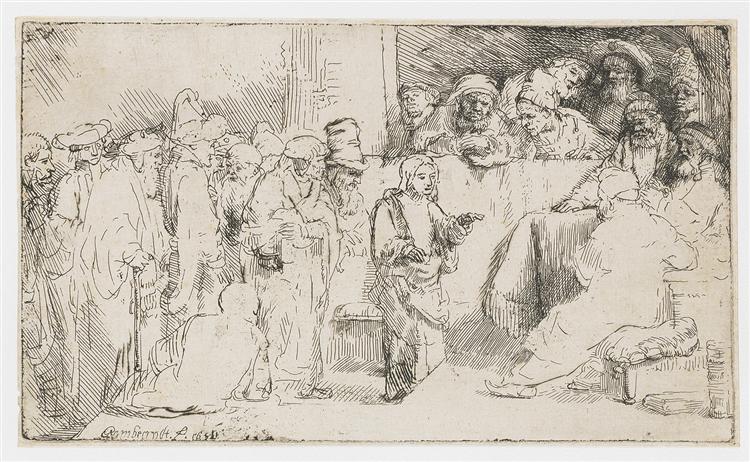
Rembrandt’s “Christ Disputing with the Doctors” condenses an entire chapter of intellectual and spiritual history into a sheet alive with voices. The print stages the moment from the Gospel of Luke when the twelve-year-old Jesus, having remained in Jerusalem after the Passover, is discovered in the Temple “sitting among the teachers, listening to them and asking them questions.” Rembrandt takes the biblical source at its word: everyone is listening and asking, and truth is arriving not as thunder but as conversation. The child stands, small and poised, in the center. Around him the elders lean, calculate, frown, scribble, whisper, and weigh. The plate is a theater of thought where line replaces speech, gesture becomes grammar, and the audience at the back presses forward in a semicircle of curiosity.
The Choice Of Scale And The Democracy Of Attention
The first surprise is scale. This is not a massive historical pageant; it is an intimate panorama. The sheet invites the eye to roam from micro-drama to micro-drama without losing the chord that binds them. Rembrandt refuses hierarchy. The boy’s head is scarcely larger than a thumb, yet he holds the middle of the stage. The elders at the right, partly veiled by the table’s heavy cloth, are no larger than those at the back wall whose faces bloom out of shadow, but each receives individuated attention. The economy of etching—spare lines, nicks of burr, abbreviated forms—is perfectly matched to a narrative where thinking is the event.
Composition As Argument
The composition itself behaves like an argument. A bright vertical rectangle of wall anchors the center, its plainness setting off the subtle halo of space around the boy. To the left, a dense crowd of scholars and bystanders compresses into a column of linked silhouettes, a visual chorus of precedent and tradition. To the right, the table and dais lift a few seated doctors into prominence, representing institutional authority. Christ stands between crowd and dais, an axis that turns the whole room. The viewer registers a gentle tension between massed authority and focused listening, between accumulated knowledge and living question.
The Boy’s Gesture And The Rhetoric Of Hands
Christ’s hands are the print’s quiet epicenter. He holds them slightly forward, one open, one half-closing as if to measure a thought. This is not declamation; it is inquiry. The boy’s body leans neither in challenge nor retreat, but in a poised neutrality that lets others lean toward him. The rhetoric of hands extends outward in ripples. A scholar at the right rubs his temple with two fingers. Another pinches a beard in thought. A scribe lifts his stylus just off the page, suspended between quotation and revision. Rembrandt composes an orchestra of hands that together perform the music of interpretation.
Light And The Ethics Of Seeing
Light in this print does not descend from heaven; it circulates among faces and pages. The central wall is left bare, an illuminated void that functions as intellectual air. Against it the boy becomes legible without theatricality. The tablecloth at right receives a soft wash of lines, allowing the seated doctors to detach from the wall’s brightness without dissolving into dark. The back row of heads emerges from a gentle dusk, as if the room itself—thick with breath and debate—were part of the learning. Rembrandt’s light is democratic and humane. It insists that understanding happens where people look closely at one another.
The Crowd As A Choir Of Minds
Rembrandt gives each head its way of thinking. There are minds built from skepticism, with eyebrows raised and mouths compressed; minds that rest in the pleasure of complicating a point; minds warmed by sudden sympathy; minds that preen; minds that calculate. No caricature rules. The variety reads as a portrait of a culture that prizes argument as a path to truth. The back row leans like a hedge of curiosity, each head tilting at a slightly different angle, building a rhythm that keeps the eye moving. The crowd is not a barrier; it is the room’s organ, pumping attention toward the center.
The Table, The Book, And The Authority Of Objects
Rembrandt’s interiors are often as much about objects as about people, because objects express institutions. Here the broad table at right does the work of a bench or lectern, supporting authority while softening it. Its heavy cloth hangs like a curtain, dignified but not pompous. A large codex lies open near the seated doctor, its pages quick with parallel strokes that suggest both written lines and the flutter of leafing. The open book signals a tradition that welcomes being read and reread. Authority is not a throne; it is a surface large enough to hold texts and elbows and debate.
Drawing As Thinking
This etching is an essay in how to think with a needle. Rembrandt does not model form through laborious cross-hatching; he composes the room through sentences of line. A few scratches call a turban into being; a quick volley knits a beard; three parallel streaks set a shoulder turning. The energy of the line communicates mental energy. The artist uses pauses—areas of paper left clear—as emphatically as he uses marks. The drawing becomes the visual equivalent of good reasoning: concise, provisional, open to amendment, confident without arrogance.
The Young Voice And The Old World
One of the plate’s pleasures is the way it locates youth within the pressures of age. The boy is not isolated on a pedestal; he stands at the eye-level of men who have lived long with texts and worries. Some bend toward him, acknowledging surprise; others test him with their posture, guarding their authority even as they listen. Rembrandt thus resists an easy moral. The elders are not foils; they are partners and future adversaries. The conversation feels generational without becoming a scolding. In this room oldness and newness share a page.
Space As Social Architecture
The architecture is barely described, yet it determines the social geometry. A shallow dais, a balcony-like darkness at back, the clean wall panel at center, and the table’s weight together shape an arena. We understand where authority sits, where the public stands, and where the subject of the hour must take his place. Such spatial clarity is part of Rembrandt’s gift. He casts a few strokes, and an entire civic order springs up, large enough to hold argument without violence.
Sound, Breath, And The Sensory Atmosphere
Though silent, the sheet hums. The viewer can hear the grain of voices—some roughened by age, some quick and youthful. You can feel the moist air of a crowded room, the crisp rustle of paper, the blunt clack of a stylus against a board, the slightly abrasive drag of cloth on bench. These sensory cues arrive because the etched line carries tactile memory. It scratches, pauses, and doubles back the way a voice breaks or a thought returns to amend itself. The print breathes.
Theology Without Pageantry
Rembrandt refuses the shortcut of a glowing nimbus or a heavenly break in the roof. The boy’s difference is ethical and intellectual, not decorative. His centrality is achieved through placement, posture, and the converging force of attention, not through special effects. This restraint is not mere taste; it is theology. The Gospel’s claim is that wisdom can be recognized by those who listen. Rembrandt stages that claim by making listening visible. Sanctity here is the human capacity for understanding shared in common.
The Scribe And The Moment Of Notation
Among the most telling passages is the small scribe at Christ’s side. He kneels with his tablet half turned, caught between taking down a quotation and looking up to see the boy’s face. The scribal pause is everything: it enacts the shift from rote copying to learning that requires the whole person. The figure mirrors the viewer, who must alternate between reading Rembrandt’s lines and looking through them toward living presence.
A City Of Learning In A Page-Sized Room
Seventeenth-century Amsterdam prized scholarship, disputation, and the circulation of texts. Rembrandt’s print belongs to that civic breath. Though the subject is ancient Jerusalem, the atmosphere feels recognizably Dutch: crowded benches, speakers who are also listeners, books that travel from hand to hand, a respect for words that is practical rather than ornamental. The sheet becomes a little city of learning, bound to time and yet renewing itself wherever people assemble to argue toward better light.
The Viewer’s Position And The Ethics Of Witness
We stand at the edge of the crowd, level with the boy and close enough to see a bead of light along the opened codex. The vantage carries responsibility: we must listen, not merely consume spectacle. Rembrandt refuses to entertain us from a distance; he drafts us into the circle of witnesses, with all the implied obligations—patience, charity, readiness to be surprised—that true witnessing entails.
Comparing Rembrandt’s Treatments Of Christ
Rembrandt alternated between grand manifestations—miracles enveloped in chiaroscuro—and intimate scenes where Christ is one body among many. “Christ Disputing with the Doctors” belongs to the latter current. It shares with the “Hundred Guilder Print” the preference for social complexity over theatrical climax, and with small etched episodes such as the Supper at Emmaus the commitment to psychological truth. In this sheet, Christ is learned through conversation rather than through spectacle; the divine is a mode of attention.
Line As Voice And The Poetry Of Economy
One could strip this sheet down to a taxonomy of lines—long, short, tremulous, adamant, staccato—and each would correspond to a human voice. The boy’s contour is clear and unforced; the scholar’s beards are layered hesitations; the tablecloth is a sustained hum. Such analogies are not fanciful; they explain why the print sounds in the mind. Rembrandt’s economy—no more line than needed—keeps the chorus intelligible. The viewer hears the whole without losing the persons.
The Moment Between Question And Answer
What, exactly, is the instant depicted? It is the gap after a question lands and before speech resumes. The boy’s hands hold the measure of a thought just completed; the elders tilt as if to reply; a scribe’s stylus hovers. Rembrandt understands that intellectual life occurs in these pauses where minds reconfigure around a new point. By freezing the gap, he honors not only the boy’s wisdom but the work of thinking itself.
Why This Print Still Feels Contemporary
Modern audiences recognize the room. It resembles classrooms, committee hearings, town halls, editorial meetings—anyplace where ideas are tested by tongues and eyes. The small figure who speaks clearly among entrenched experts remains a perennial type, and Rembrandt treats him without sentimentality. The print advocates for conversation’s dignity at a time when polemic often outshouts listening. It is a quietly radical image of how communities might pursue truth.
Close Readings Of Key Passages
Attend to the doctor in profile at far right, whose hat leans like a question mark. His hand, half-clenched, rests on the table’s lip as if resisting being pulled into assent. Slide left to the young man with a high cap who tilts forward with open curiosity, his lips slightly parted. Note the elder just behind Christ who looks not at the boy but at his own tablet, processing the thought internally. Study the cluster of heads on the balcony-like upper right; three faces overlap in a chain of attention, each mouth and brow registering a different intellectual temperature. These micro-stories accumulate until the room hums with argument’s life.
Conclusion
“Christ Disputing with the Doctors” is Rembrandt’s love letter to the human act of understanding. With nothing but etched line and the orchestration of space, he turns a biblical scene into a civic ideal: truth born in conversation, authority refined by questions, tradition honored by being asked to answer. The boy’s hands measure sense; the elders lend their faces to the slow drama of minds changing; the open book on the table keeps the past present as living text. What the print finally offers is a method: stand in the light you have, listen well, ask well, and let the room become wiser than any one of its occupants.
