Image source: wikiart.org
Introduction
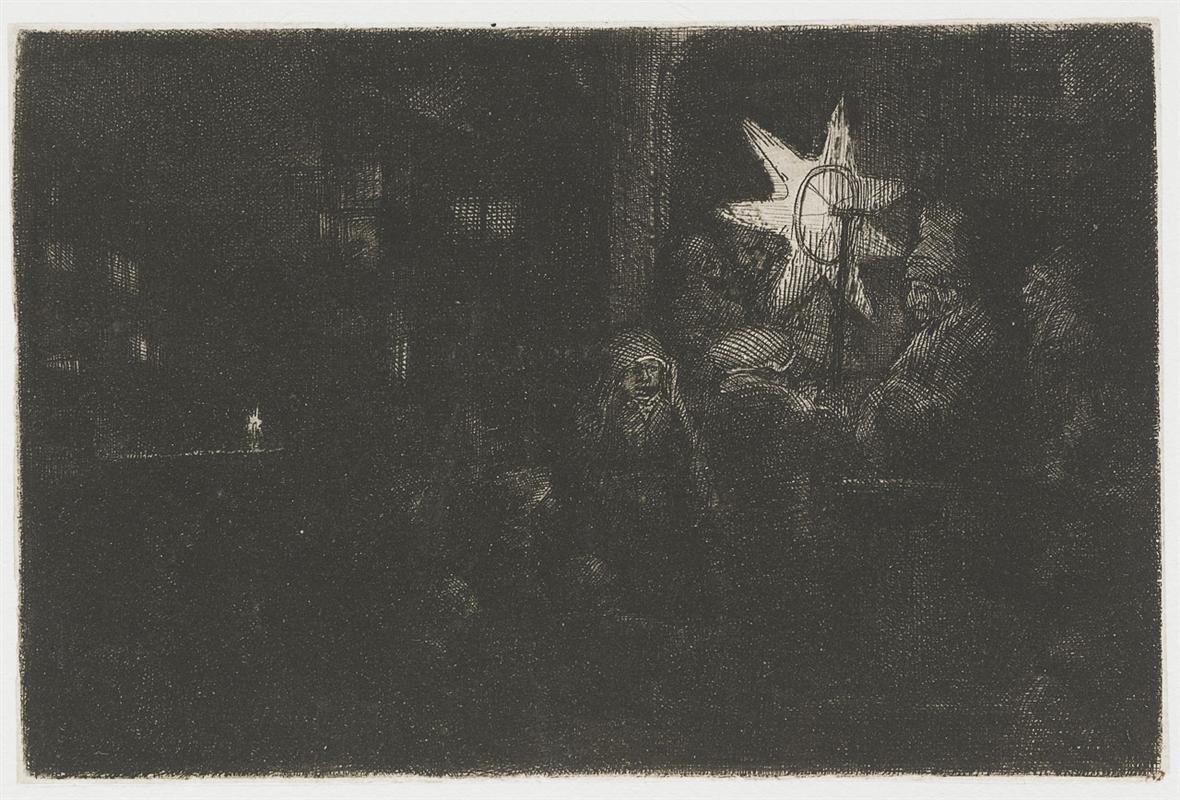
Rembrandt’s “The Star of the Kings” is one of the most haunting nocturnes in European printmaking. The sheet is submerged in darkness, so saturated with rich plate tone that the first encounter feels almost blind; then, as your eyes adjust, a startling constellation appears at the right edge—a radiant star-shaped lantern, its ribs and ring clearly drawn, surrounded by the huddled profiles of winter carolers. A single distant light glimmers far left, a pin dropped in a sea of night. Between these poles of brightness lies the print’s true subject: how communities make meaning together in the dark.
A Winter Ritual And Its Place In Dutch Life
The title refers to a living tradition in the Low Countries: during Epiphany, groups of singers—often children but not only—paraded through streets or from house to house with a paper star lantern, performing hymns that celebrated the visit of the Magi and the revelation of Christ to the nations. The practice braided Christian devotion with neighborly sociability. It was musical, seasonal, and civic at once. By choosing this subject, Rembrandt paints not a biblical episode but a contemporary ritual in which ordinary people become bearers of symbolic light. The image aligns with his persistent interest in locating spiritual grace within everyday gestures and familiar streets.
Composition As Constellation
The composition reads as two constellations of light within a near-black field. At the right, the star lantern anchors a tight cluster of faces, shawls, and hats—forms drawn with crisp etched lines that cut through the inked darkness. At the far left, an isolated glow hovers, perhaps a candle in a window or a second procession slipping around a corner. Rembrandt leaves the middle swath of the plate almost entirely veiled, converting that darkness into active space. Your eye moves from group to spark and back again, tracing an arc that doubles the movement of carolers through the city. The imbalance—brilliant right, whispered left—gives the composition its tension and its breath.
Light, Darkness, And The Meaning Of Plate Tone
The print’s drama is almost entirely tonal. Rembrandt inked this plate with an unusually heavy plate tone, wiping sparingly so that velvety black pools over most of the surface. The darkness is not a mere backdrop; it is a material presence that absorbs and releases light. Against it the star is not just bright; it is cut out of night like a hole. Drypoint burr around head outlines deepens shadows into a soft fuzz, making the glow feel warmer by contrast. The handling of tone visualizes the theology of Epiphany: revelation appears not as daylight banishing darkness, but as a particular light that finds its way through it.
The Star As Object And Sign
Rembrandt draws the star lantern exactly—points scalloped by paper folds, a hoop and handle, a central cavity where a candle’s flame would live. This specificity matters. The star is not a miraculous radiance; it is a homemade thing that neighbors carry. Its glow is the glow of community craft. Yet even as an object, it remains emblematic: the star that once guided Magi now guides song and fellowship. Rembrandt loves that double meaning. The star is both paper and promise, both winter handiwork and a sign of cosmic story.
Faces At The Edge Of Light
Tilt the sheet and you meet faces kept deliberately small and intimate. One singer leans forward, lips parted in chant; another turns sideways, cheekbone catching light; a hooded figure peers from under a heavy scarf with the weary joy of someone long in the cold. They are not grand types; they are neighbors. Rembrandt’s etched line caresses the curve of a nose or the brim of a cap with the same care he gives to saints. The equality of attention is the print’s ethics: light is for everyone present.
A City Made Of Murmurs
Unlike Rembrandt’s dilated cityscapes, this night offers only hints of architecture: a few gridlike window lattices floating in the dark, a faint arch where the carolers cluster, a plane of pavement caught at the lower edge. The city becomes an acoustic room rather than a diagram—streets that echo singing, windows that listen. By withholding built detail, Rembrandt lets sound and light define place. You sense the hush of cold air, the crunch of feet on frost, the tremor of voices rising and falling around a familiar melody.
The Distance Light And The Idea Of Elsewhere
That little spark at far left is one of Rembrandt’s slyest devices. It is so small that viewers often miss it at first. Once noticed, it expands the world: other singers are out there, or a listener has lit a candle in response. The print is no longer a single group in isolation but part of a network of lights that punctuate the night. The city becomes a fabric of calls and answers, of separate circles of song stitched together across streets.
The Star’s Halo And The Poetics Of Glare
Look closely at the star and you’ll see not only the points but a subtle envelope of brightness—tiny scraped or wiped passages where ink thins and the paper breathes. That halo is not sentimental; it is optical. Anyone who has squinted into a winter lantern knows the way light bleeds into cold air. Rembrandt’s mastery lies in reproducing the phenomenon without overdescribing it. A few paler strokes around the star persuade the eye that it dazzles. The effect is physical: you almost blink.
Gesture, Posture, And Collective Motion
Because the print is so dark, gestures read like silhouettes, simple and eloquent. A figure at the right edge seems to cup a hand around the candle to keep wind from stealing it. Another bends slightly toward the star, as if drawing warmth. A child-sized head peeps lower than the others. These arrangements give the group a pulse. The procession is not just standing; it is moving slowly, singing, adjusting, protecting the flame. Rembrandt knows that community is a choreography of small caretaking acts.
Epiphany As Urban Practice
The image refuses a distant Bethlehem. Revelation arrives here, in a Dutch street, carried by people who might stop at your door. This choice aligns with Rembrandt’s broader project of situating sacred feeling inside contemporary life. He treats Epiphany as a neighborhood practice that renews meaning annually through song and shared light. The result is pastoral: the print consoles by asserting that old stories are kept alive not by spectacle but by repetition, memory, and the hands that hold a lantern.
Darkness As Sanctuary
The darkness in this sheet is not threatening. It is thick, protective, almost acoustic. It cradles the singers and gives the star a stage. Rembrandt’s black is a sanctuary where attention sharpens and small lights matter. In a cultural climate that often equated moral clarity with brightness, the print argues for another truth: we learn to see by navigating the dark together. The star does not end night; it helps us keep company within it.
Technique And The Pleasure Of Ink
The plate is a demonstration of how inking can become composition. Each impression of this print would vary subtly depending on how the printer wiped plate tone and how richly the burr held ink. The velvety field is not just drawn; it is printed into existence. The viewer senses the physicality of the process—copper bitten by acid, ink pressed into tooth, paper drinking it up. That material pleasure intensifies the image’s theme: light made by human craft and care.
Comparison With Rembrandt’s Other Night Scenes
Rembrandt returned to the drama of nighttime in several prints and paintings—torchlit soldiers, candlelit interiors, moonlit rivers. “The Star of the Kings” is one of the most extreme in its devotion to darkness, closer in spirit to his deepest plate-tone experiments than to the more evenly lit nocturnes. Where many artists treat night as a backdrop for a single brilliant event, Rembrandt treats it as a world with its own ethics, its own rituals. The star procession belongs to that world naturally, without special effects.
Space, Scale, And The Intimacy Of the Right Margin
The crowd hugs the right margin not by accident but by design. It crowds into our space like a group rounding a corner, abruptly present. The leftward expanse of dark becomes the street ahead or behind, a field into which the song travels. The asymmetry also sets up a story: the star will move left, the little light will be met, the song will gather other windows to itself. A sheet this small manages to feel open-ended because Rembrandt composes direction into the darkness.
Winter And The Sense Of Breath
Though the print supplies little meteorology, the feeling of winter is strong. The singers’ hunched shoulders, the chunky headgear, the drawn scarves—all speak of cold. The star’s brightness seems sharpened by frosty air. The tiny diffusion around silhouettes reads like breath. By leaning on these sensory cues, the print calls up memory: how sound carries on cold nights; how lamplight corrugates in mist; how neighborhoods grow briefly intimate when doors open to carols.
Community, Charity, And The Exchange Of Light
Epiphany rounds often had economic dimensions: singers might receive treats or alms. In that sense, the procession was both celebration and redistribution. Rembrandt does not show coins or gifts, but the ethic of exchange underlies the scene. The star gives its light to the people; the people give their song to the city; the city gives back welcome. The far window glows because someone inside answered. The print condenses that circular economy into tone and gesture.
The Viewer’s Role In The Procession
Where, exactly, do we stand? The star is so near the right edge that we might be at the doorway the singers approach. Our own threshold is the stage. The sheet positions us as the next household to hear the song. That invitation is one of the print’s enduring charms. We are not mere observers of a picturesque custom; we are participants taken into its orbit. The star comes to us.
Quiet Humor And Human Warmth
Even within the solemn darkness, there is humor: the exaggeratedly pointy star, the bundled figures whose hats become shapes as distinctive as faces, the faint suggestion of someone peeking from under a too-large cap. Rembrandt’s affection for ordinary people dissolves piety’s stiffness. The procession is tender without being sentimental, dignified without pomp. That warmth keeps the image alive long after the holiday has passed.
Why The Print Still Speaks
Contemporary viewers recognize themselves in the scene’s premise: in uncertain seasons we gather, we carry small lights, we sing. The print’s minimalism models how to build community with very little—paper, flame, voices, night. It also anticipates modern visual culture’s love of high contrast: a graphic image reduced to a few essential lights. Yet it remains richer than any poster because its darkness is handmade and its light is social.
Close Looking At Key Passages
Return to the faint gridded rectangles that drift in the central dark. They could be windows shuttered for the night or simply residues of plate tone catching against the plate’s tooth. Either way, they act like memory in a city—ghosts of rooms, hints of other lives. Look at the fine etched circle around the star’s center; it is not necessary for the lantern, yet it acts like a mechanical halo, turning a folk object into a precise icon. Study the small face under a hood just below the star: two or three strokes suffice to capture a person listening as much as singing, the whole story of attention in a few lines.
Conclusion
“The Star of the Kings” condenses Rembrandt’s humanistic vision into a night the size of a hand. With plate tone as deep as wool, a single crafted star, and a clutch of bundled singers, he turns a local Epiphany round into a meditation on how communities carry meaning through darkness. The print refuses spectacle in favor of lived ritual; it treats light not as conquest but as companionship. Its two points of brightness—one near, one far—turn the city into a field of calls and answers, inviting the viewer to open a door and let the star in. Few images say so much with so little, or so gently remind us that revelation often arrives as a song at our own threshold.
