Image source: wikiart.org
Introduction
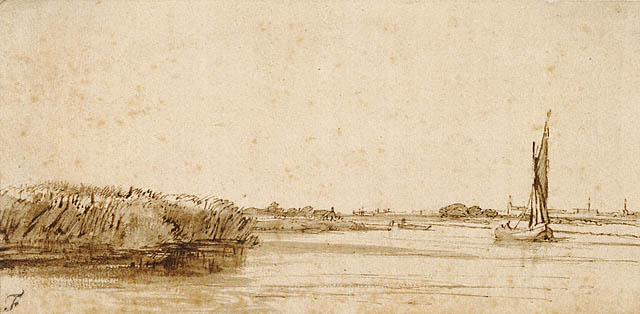
Rembrandt’s “A River with a Sailing Boat on Nieuwe Meer” distills the Dutch landscape to its most eloquent essentials: a sweep of water under a high sky, a reed bed ruffling at the left margin, and a single sailboat gathered to the right like a vertical signature. The scene is unforced and deeply atmospheric. Instead of forcing the eye toward a set-piece landmark, Rembrandt allows light, air, and slow movement to do the narrative work. Executed with pen and brown wash, the drawing captures both a geographic place—the Nieuwe Meer, just southwest of Amsterdam—and a way of seeing rooted in patience, closeness to nature, and respect for the humble rhythms of everyday life.
The Geography Of Nieuwe Meer And Why It Matters
Nieuwe Meer belongs to the watery perimeter that shaped Amsterdam’s identity in the seventeenth century. These lakes and channels formed the city’s breathing room, providing routes for transport, fisheries, and recreational sailing while also serving as buffers in the constant negotiation with water that defined Dutch engineering. By choosing this site, Rembrandt sidesteps urban spectacle in favor of threshold space—a liminal zone where reeds, wind, and boats articulate a quiet prosperity. The drawing records not a dramatic event but the ongoing collaboration of human craft and natural forces.
First Impressions And The Lay Of The Scene
The composition meets the viewer with three broad registers. In front stretches the reflective plane of water, a lattice of thin hatchings and diluted wash that implies barely puckered ripples. At the left margin the reed bank rises, its tufted tops rendered with brisk, calligraphic strokes that read as breeze. Toward the right, a small sailing boat rests nearshore, mast and furled sail forming a slim column of vertical energy against the low horizon. Farther back, a thin chain of trees and shoreline details dissolves into the luminous emptiness of sky. The eye glides from reed to boat to horizon with almost tidal ease.
Composition And The Poise Of Asymmetry
Rembrandt organizes the sheet through a dynamic asymmetry: dense vegetation anchoring the left, concentrated human presence at the right, and open water mediating between them. The diagonal splay of the reed bed points inward, acting like a natural proscenium leading us onto the stage of the river. The boat, positioned off-center, answers that thrust with a vertical chord. Between these two masses the broad water creates a calm, horizontal field that quiets the composition and amplifies the sense of distance. Nothing is exactly centered, and that slight imbalance keeps the scene alive, as though wind and current might rearrange it at any moment.
The Language Of Pen And Wash
The drawing’s touch is frank and economical. Pen lines, sometimes crisp and sometimes skipping across the paper’s tooth, build edges and accents: the frayed silhouette of reeds, the slender rigging of the boat, the stitched contour of the far bank. Wash does the heavy lifting of atmosphere. Rembrandt floats pale layers over the water to build tone and then allows reserves of the paper to glint through as reflections. Where depth is needed—a shaded notch under the reed clump or the dark pocket at the boat’s bow—he strengthens the wash or crosshatches with the pen. The net effect is a living surface that feels both spontaneous and carefully judged.
Light And Weather As Protagonists
The sky, left almost untouched, is a reservoir of light. Its vast negative space gives the entire sheet buoyancy and sets the tonal key—cool, even, and breathable. The reed tops lean, the water’s micro-lines drift at a slant, and the boat’s furled sail gathers like fabric responding to a breeze. It is weather rendered without spectacle, the familiar maritime mix of wind and high cloud that Dutch painters knew intimately. Because the illumination is so even, shadows are soft and shallow, more like moisture than drama, which turns the viewer’s attention to transitions—where bright water meets the darker band near shore, where reed thicket gives way to open channel.
Space, Distance, And The Pleasures Of Interval
Rembrandt conjures distance not through vanishing-point geometry but through intervals and overlaps. The reed bank stands in front of the water’s plane; the boat sits across that plane with a small wedge of shadow at its base; the far shore is demoted to a delicate seam of tone and line. Each layer is calibrated to the next, stepping the eye back without strain. The amplitude of the water—its long, nearly unbroken span—produces a psychological spaciousness disproportionate to the drawing’s modest size. The sheet feels as if it contains breathing room, a quality that makes the view contemplative rather than descriptive.
Reading The Reed Bank
The thicket at left is a small masterclass in shorthand. Short vertical jabs suggest stalks; hooked and tufted strokes indicate the seed heads; darker pools at the base give weight and wetness. Rembrandt avoids counting reeds. Instead, he provides a rhythm that the eye accepts as multiplicity. The bank’s shadow stains the water like tea, an effect achieved by dragging the brush lightly and letting it feather outward. This compact passage establishes a tactile foreground without cluttering the composition, and it gives the boat across the water something to answer visually.
The Boat As Human Measure
The sailing boat is deliberately small, yet its vertical thrust makes it commanding. The mast, boom, and furled canvas form a calligraphic unit of straight lines and ragged edges against the sky. The vessel’s hull is suggested with a few, sure strokes and a hush of wash that tucks it into the water. It is not a portrait of a specific craft so much as a type: sturdy, shallow-draft, made for inland waterways. Its scale gives the scene a human measure, allowing viewers to imagine themselves aboard, feeling the wind shift, the hull nudge against the ripple. In a landscape defined by openness, the boat concentrates purpose.
Rhythm, Repetition, And The Pulse Of Motion
Rembrandt animates the quiet with subtle repetitions. The water’s surface registers in parallel lines that slacken and gather like breath. The far horizon repeats low bumps of foliage and roofs. Even the short dashes that articulate the shoreline arrive in phrases, with rests between. This rhythmic language translates motion—the ripple of wind, the slow drift of a moored boat—without literal depiction. The drawing beats at an andante tempo appropriate to a place of work and passage rather than drama.
Season, Time Of Day, And Sensory Temperature
Though the drawing avoids explicit cues, its mood implies a mild season. The reeds are full, the trees at the horizon leafy, and no hard winter light cuts the scene into shards. The illumination feels like a high-cloud day—late morning or midafternoon—when glare is modest and reflections are gentle. The sensory temperature is temperate: you can almost hear water lapping at the bank and canvas giving a soft crack as wind touches it.
Infrastructure By Inference
Windmills are absent here, as are city towers, yet the picture still narrates Amsterdam’s infrastructure by inference. The navigable width of the channel, the steady shoreline, and the kind of boat Rembrandt draws all imply a managed water system—dredged shallows, maintained banks, and routes known to local sailors. The Nieuwe Meer view, therefore, contributes to the artist’s broader portrait of a city sustained by humble, continuous labor. The drawing chooses to show the result—usable water and safe passage—rather than the machinery, which remains offstage.
The Poetics Of Omission
What the drawing leaves out is as telling as what it includes. There are no crowds, no grand architecture, no anecdotal figures to fix a storyline. The omissions create a kind of meditative clarity. With the stage stripped of distractions, the viewer’s attention falls on elemental relationships: vertical against horizontal, solid against fluid, texture against smoothness. This poetics of omission is one of Rembrandt’s modern-seeming gifts. It trusts the viewer to supply narrative and to find meaning in the meeting of a boat, a bank, and a bright expanse of water.
The Ethics Of Ordinary Beauty
Rembrandt’s affection for ordinary things—reeds, sails, ripples—reflects an ethic of attention. He locates dignity in the workaday landscape that underwrites prosperity and leisure alike. The small boat is not heroic, yet it is rendered with the care of a portrait; the reed bed is not picturesque ornament, yet it receives loving specificity. The result is a democratic image in which beauty lies in usefulness and in the honest textures of a world made navigable by habit and skill.
Relationship To Rembrandt’s Other Waterside Views
This sheet belongs to a family of river and lake drawings made in the late 1640s and early 1650s in which Rembrandt pushes the horizon low and lets air dominate. Compared with more built-up views over the Amstel, the Nieuwe Meer drawing is even more elemental: the city recedes to a faint punctuation, and water becomes protagonist. It shares with other landscape notes Rembrandt’s confidence in minimal marks, but it stands out for the breadth of its water plane and the eloquence of the isolated vessel.
Material Presence And The Intelligence Of Touch
One of the drawing’s pleasures is how openly it shows its making. You can see the pen nib skate and occasionally skip in the reeds, the wash gather slightly at the pool of shadow under the bank, and a few exploratory lines along the far shore left in place like thoughtful hesitations. These traces of process are not distractions; they are part of the work’s voice, telling us that the image emerged through looking, testing, and settling on just enough.
Contemporary Resonance
Modern viewers accustomed to saturated images and towering skylines may find this drawing bracing in its restraint. It asserts that a coherent world can be built from three things—air, water, and a bit of human craft—and that calm can be an artistic achievement equal to drama. It also models a sustainable imagination: the boat is small, the water open, the horizon low, the sky generous. In an age worried about environmental limits, the image’s scale and modesty feel like wisdom.
Conclusion
“A River with a Sailing Boat on Nieuwe Meer” is a hymn to elemental balance. Rembrandt arrays reed, water, and sail in a poised triangle and lets the sky carry the emotional register. With sparing lines and tender washes, he summons a place that breathes, works, and waits. The drawing’s serenity is not emptiness but sufficiency—enough detail to persuade, enough openness to invite contemplation. It is a portrait of a Dutch day distilled to essentials and a reminder that art’s deepest power often lies in attending carefully to the ordinary.
