Image source: wikiart.org
Introduction
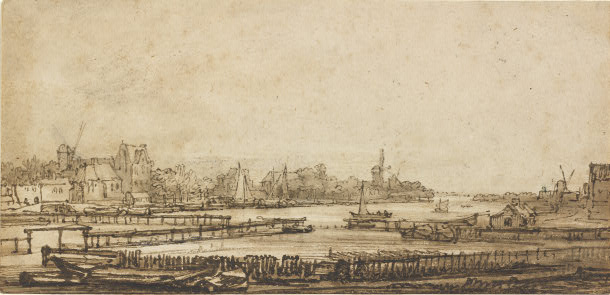
Rembrandt’s “View over the Amstel from the Rampart” presents Amsterdam not as a grand spectacle but as a living organism stitched together by water, docks, mills, and modest façades. The long horizontal sheet is perfectly tuned to the river’s breadth. Barges idle in the foreground, thin walkways and piers spider across the channels, and the far bank rises in a soft procession of roofs, treetops, and towers. The sky, left largely untouched, hovers like a reservoir of pale air against which every darker mark registers as life. With ink and wash alone, Rembrandt composes a portrait of civic metabolism—slow, steady, and continuous.
Historical Setting And The Meaning Of The Rampart
In 1650 Amsterdam’s defensive ramparts ringed the city with earthworks and bastions that doubled as promenades and vantage points. From this elevated lip of land, citizens could look out across the Amstel and read the city’s pulse in sails and smokestacks. Rembrandt often chose such edges because they condensed multiple stories: the martial history of the ramparts, the engineered waterway of the river, and the daily commerce animating both. His vantage from the rampart transforms the drawing into a civic self-portrait. It is the view a city has of itself, measured and honest, the opposite of triumphal pageantry.
First Impressions And The Lay Of The River
The eye first meets the dark bar of barges and moored boats that occupy the bottom strip of the sheet. Above them, a picketed fence line and an irregular fringe of reeds set a contrapuntal rhythm. Then the mid-river opens—a shimmering band interrupted by piers, a small sailing vessel, and long work platforms. The far bank forms a low, continuous silhouette punctuated by gables, mill sails, and a tower rising from a cluster of trees. Nothing dominates, yet everything belongs. The drawing moves like the river itself, in long phrases, with a few emphatic beats where chimneys, masts, and spires break the horizon.
Composition And The Architecture Of Bands
Rembrandt’s composition organizes the city into horizontal registers: foreground barges and shore, mid-river activity, and the far urban edge. These bands do more than distribute space; they narrate distance. The nearest band is handled with the darkest, most calligraphic strokes, anchoring the viewer in the here-and-now of wood and rope. The middle band thins and lightens, its forms more open and provisional. The far band compresses into a delicate, continuous line that reads as settlement against sky. This architecture of bands is punctuated by verticals—mast, tower, windmill post—that act like rivets binding the picture’s length.
The Language Of Ink And Wash
The sheet is a demonstration of restraint. Pen lines—sometimes steady, sometimes tremulous—describe hulls, palings, and roofs, while diluted wash lays quiet tonal fields across water and vegetation. Rembrandt allows his pen to stutter where it meets rough paper, translating that friction into sparkle on the river and texture on the bank. Where the water needs depth, he drags a slightly darker wash along the channel, then stops short to let paper light flare as reflection. The result is a river made from intervals and omissions rather than from descriptive detail.
Barges, Piers, And The Grammar Of Work
The foreground barges are drawn with a practical eye: blunt bows, low freeboards, coiled lines. They feel heavy even on paper, as if their mass presses into the river. The picket-like fence and the strung-out piers echo the labor rhythms that define a port—loading, mooring, repairing, waiting. Rembrandt resists anecdote. No stevedores populate the scene, yet the objects stand like actors ready to work the instant the curtain rises. Their presence situates the viewer at the city’s operational edge rather than its ceremonial center.
The Far Bank And The Idea Of Community
Across the water, buildings gather into a gentle ridge—roofs breaking into gables, gables softened by trees, and here and there the assertive geometry of a tower or the angled arms of a windmill. This distant chain of forms suggests organized refuge without lapsing into picture-postcard charm. The city reads as community rather than as monument, its scale human and its variety unforced. The mixture of foliage and masonry tempers the industrial with the domestic, promising a place of work that is also a place of living.
Light, Weather, And The Dutch Atmosphere
Rembrandt leaves the sky a vast zone of pale paper. In Dutch landscape this is not emptiness; it is substance—a humid, mutable medium through which everything else is seen. The paleness cradles the river’s light and modulates the edges of buildings and trees. The washes on the water have a faintly diagonal drift, implying breeze and tidal slip. Nothing in the drawing announces a specific hour, yet the soft shadows and even tone suggest a day of high cloud when glare is gentle and air spacious. The weather is not subject but condition, the slow breath in which the city moves.
Space, Depth, And The Art Of Suggestion
Depth here is not built through geometric perspective grids; it grows from overlaps, register shifts, and changes in mark density. The nearest barge occludes the picket fence; the fence occludes the river; the river’s pier occludes a vessel; that vessel partly hides the far bank. These small acts of covering deliver a convincing sense of spatial order with minimal information. Rembrandt’s genius lies in knowing how little is needed to conjure a world and how to place those little things so that space blooms between them.
Windmills, Towers, And The Civic Silhouette
The shore’s vertical accents carry symbolic charge. Windmills stand for the city’s practical intelligence—machines that transmute wind into civic endurance by grinding grain or pumping water. The tower, likely part of a church or defensive structure, adds a note of collective identity and spiritual or municipal center. Their smallness on the horizon is telling. Rembrandt refuses to inflate them to dominance; he lets them function as punctuation within a long syntax of daily life. The city is defined as much by its interstitial spaces—yards, quays, channels—as by its celebrated structures.
Rhythm, Repetition, And The Pulse Of Passage
The drawing’s energy comes from repeated elements that establish rhythm: the near pickets stepping along the shore, the piers skipping across the water, the rooflines toggling up and down, the rigging lines angling in counterpoint. This rhythm is neither mechanical nor decorative; it translates the city’s daily pulse into visual music. Even the wash on the water, pooled and then thinned, reads as alternating measures—rest, motion, rest—like oars entering and leaving the river.
The Rampart As Stage And Threshold
The title’s rampart matters. As a defensive structure turned promenade, it is both wall and walkway, both limit and invitation. From this stage, citizens could watch arrivals and departures, gauge weather, and feel the scale of the community set against open sky. The drawing adopts that citizen’s vantage, implicitly aligning the viewer with a public that knows its city from the edges inward. The rampart makes the picture social: we are not a solitary tourist but part of an urban chorus, accustomed to this view and alert to its changes.
The Ethics Of Attention To The Ordinary
Rembrandt’s art repeatedly dignifies the ordinary—the worn garment, the modest cottage, the rough plank. Here he extends that ethic to the city’s river apparatus. By spending ink on a fence line and the blunt shapes of barges, he asserts that these supports of communal life deserve as much consideration as noble façades. The effect is not polemical; it is affectionate. The drawing loves the parts that make a city run and invites the viewer to love them too.
Movement Without Incident
The image contains no singular event: no storm, no ceremony, no crash of light. Its movement is incremental—boats drifting, ripples spreading, clouds thinning. This kind of motion is the motion of continuity, the life a city must sustain on most days. The absence of drama becomes a principle of truthfulness. By refusing spectacle, the drawing persuades us of the scene’s reality and, paradoxically, makes it memorable.
Material Presence And The Beauty Of Process
Because the surface is so lightly worked, the viewer feels the grain of the paper, the way pen nib skipped in places, the pooling of wash near the edges of strokes. These material traces keep the image open and alive. One senses the artist’s hand moving briskly yet decisively, editing in real time, allowing small accidents to stand when they serve the larger impression. The modest scale contributes to the intimacy; this is a view meant to be held near, like a thought.
Relationship To Rembrandt’s River Views
Rembrandt returned often to the Amstel and its environs in drawings and etchings. Many of those sheets exploit low horizons and a sweeping sense of air, as this one does, but the present drawing is particularly attentive to the built fringe—piers layered like scaffolds, barges splayed like tools along a bench. Compared to views that privilege a single dominant landmark, “View over the Amstel from the Rampart” diffuses attention across interlocking systems. Its center of gravity is the river itself, the organizing current of the city.
The Far Shore As Narrative Promise
Look long at the distant silhouette and micro-stories begin to form. A small sail angles toward the left bank where a narrow quay awaits; a squat building near the right seems busy with the business of loading; the tower acts as rendezvous point, a civic coordinate known to all. Rembrandt supplies just enough geometry for the imagination to take over. The far shore is never locked down into diagram; it remains porous to possibility.
The Sky As Measure Of Scale
By granting so much of the sheet to sky, Rembrandt lets air establish the measure by which we read everything else. Human constructions, however essential, occupy a small percentage of the world. This proportion is not a rebuke but a comfort: the city lives within a larger envelope, and that envelope is generous. The spaciousness is part of Amsterdam’s identity, a city oriented to water and weather, its dignity tied to horizons rather than to height.
Time Of Day And Seasonal Temperature
The calm, even tone evokes a day without extremes. It could be a late-morning or mid-afternoon interval of bright cloud when reflections are soft and distances clear. Vegetation at the far bank suggests a leafed season; there is no winter bareness. The sheet—light, quiet, modulated—feels like May or June, when the river is busiest and the windmills grind in cooperative breezes.
Contemporary Resonance
Modern viewers live with infrastructures so large they often vanish from view. This drawing restores visibility by showing a city in terms of its connective tissues—ports, banks, workboats, paths. It models a way of looking that values systems over spectacles. In an era that tends to fetishize skylines, Rembrandt’s river-wide, eye-level horizon feels corrective and humane. It asks us to recognize the everyday apparatus of shared life and to find beauty there.
Conclusion
“View over the Amstel from the Rampart” is a study in civic poise. In a few bands of ink and wash, Rembrandt composes a long breath of a city balanced between work and weather, land and water, nearness and distance. Nothing shouts, yet everything speaks. The barges ground us, the piers lead us, the far bank welcomes us with a line of roofs and trees, and the sky holds it all in a calm, luminous bracket. The drawing’s modesty is its power. It teaches that a city’s truth lies in the ordinary continuity of its river, the unassuming geometries of its docks, and the steady silhouettes that mark home on the horizon.
