Image source: wikiart.org
Introduction
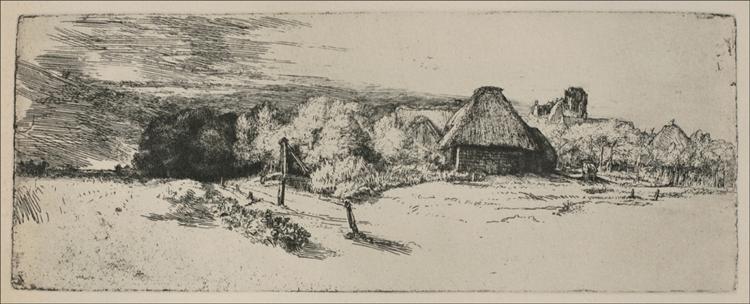
Rembrandt’s “Landscape with a Ruined Tower and a Clear Foreground” (1650) is a slender, horizontally stretched etching that turns spaciousness into drama. The plate is divided between a luminous, nearly featureless foreground and a richly described middle strip where thatched buildings, scrubby trees, and the stump of a ruined tower hold the eye. At far left a dark copse broods beneath weather-streaked clouds; to the right, a humble cottage sits like a warm coal among silvery foliage. Nothing sensational happens—and yet the print brims with feeling. It is a meditation on emptiness and habitation, on what time takes away (the tower) and what human care keeps going (the cottage, the fences, the path). In a few inches of copper Rembrandt articulates a whole ethics of looking: attend to the quiet; trust the ordinary; let space speak.
Composition: A Stage of Air and a Band of Life
The first thing the viewer registers is the vast, clean band of foreground. It is not blank; it is clear—lightly brushed plate tone and a few tender strokes indicate tufted grass, cart ruts, and a small, leaning fence that ambles into the scene. This white stage pushes the inhabited band of the middle distance back, granting the cottages and trees a sense of seclusion and the tower an air of memory. At the extreme right edge the foreground gently curves into shadow, so the white does not feel harsh but inhabited by air. Rembrandt balances this large clarity with denser work along the horizon: the thatch, leaves, and masonry draw the eye, then release it back into the open. The result is a visual breath—inhale (empty ground), exhale (detailed life), inhale again (high, pale sky).
The Ruined Tower: Time’s Vertical
The tower rises modestly, not as a heroic ruin but as a blunt reminder of time. Its upper courses have collapsed; the silhouette suggests a threaded opening and battered corners. It is set behind the thatch and trees, half hidden: history doesn’t dominate life, it shadows it. Rembrandt renders the stone with small, insistently straight strokes and broken edges—a different language from the soft, feathery foliage around it—so the viewer senses hardness and age. This vertical element gives the landscape a hinge. Against the tower’s endurance the transience of plowed fields and seasonal leaves gains poignancy, and against the living cottage the tower’s silence becomes eloquent.
The Cottage and the Community of Things
At center-right the thatched building anchors the scene. Its roof droops heavily; the eaves cast a dense shadow; a small dark door or opening invites entry. The thatch is etched with clustered hatchings that fray at the edges, catching light like animal fur. Around it, low fences, garden patches, and perhaps a trough or ditch gather, forming the intimate economy of a smallholding. Rembrandt’s sympathy for such structures is palpable. He avoids picturesque cuteness: this is shelter that grew in place, mended and thickened by use. The cottage is the opposite of the ruin—present tense instead of pluperfect—and the dialogue between them is the print’s quiet story.
The Foreground as Ethical Space
Why give so much of the plate to unencumbered ground? Because Rembrandt wants the land to arrive before the anecdote. The pale field makes the viewer feel the room between things, the margin people need to move, work, and breathe. It also slows looking; one crosses this ground with the eyes as a walker would, readying oneself for the small world beyond. In an age when landscapes often stacked up delights, Rembrandt’s restraint is radical. He makes space the first subject, then lets habitation unfold naturally within it. The “clear foreground” is not absence—it is hospitality.
Light, Plate Tone, and the Weather of Value
Value design carries the atmosphere. The darkest mass sits at left: a brooding stand of trees and hedgerow rendered with thick cross-hatching and burr. From there values lighten across the foliage belt, reach a mid-tone at the thatched cottage, then pale further toward the right. Above, the sky gathers into striated streaks—Rembrandt’s quick horizontal hatch showing wind-scudded cloud—before fading into near emptiness at the top. The plate tone is wiped with finesse: a faint veil remains over the left sky, amplifying the impending feel of weather, while the foreground is wiped nearly clean, making the ground luminous. The entire print feels like that hour when the light breaks through after a sweep of cloud: crisp, tender, and still.
Line, Burr, and the Tactility of Surfaces
Rembrandt’s etching needle speaks multiple dialects. For thatch, he uses layered, short strokes that overlap irregularly; for foliage, clustered loops and flicks that mass into convincing leaves; for the tower, straighter, more architectural cuts; for the foreground, wispy strokes and lifted lines that barely graze the copper. Where he presses harder, burr rises and prints as velvet, deepening shadows around eaves and in the left-hand trees. The fence posts in the foreground are marvels of economy: a few bold verticals with small grounding shadows turn into timber sturdy enough to lean against. These contrasts make surfaces tactile—you can feel the crisp straw, the rough stone, the springy hedge, the sandy ground.
Path, Fence, and the Logic of Use
The low fence that jogs into the foreground and the faint track that slips around it are not decorative lines; they narrate the land’s use. The fence marks an enclosure or a drainage; the path translates habit into geometry. Their crookedness is not sloppiness but accommodation—to slope, to soft soil, to what already exists. Rembrandt delights in that pragmatic intelligence. Dutch landscapes were made by decisions like these, not by design manifestos. By giving these humblest elements pride of place in the clear foreground, he elevates everyday ingenuity to the dignity of subject.
The Dark Copse and the Weight of Left
Balancing the big white field, Rembrandt stacks darkness at far left: a block of foliage that acts as visual ballast. The mass is chiseled with cross-hatching so dense it almost swallows ink. That black-green wedge stops the eye from sliding off the sheet and throws the bright field into relief. It also gives the sky a foil; the striated cloud feels more luminous because of that saturated dark. Compositionally, it is the bass note that lets the rest of the landscape sing.
The Middle Distance as Acoustic
Between the white foreground and the pale sky lies the belt of living detail—trees, gardens, buildings, tower. Think of it as the acoustic of the image: the place where sound would carry, where birds would chatter, where tools would clink. Rembrandt pitches its values carefully so it neither advances too much nor sinks back. The landscape therefore breathes in three layers: present air (foreground), human habitat (middle distance), and unfixed weather (sky).
Time, Season, and the Sense of Day
The etching’s foliage suggests late spring or summer; thatch is dry; fields are not waterlogged; paths are firm. The tower’s ruin—stripped and stump-like—adds a longer time signature: years, not weeks. As for the hour, the clear foreground and low, glancing shadows imply sun at an angle—morning or late afternoon. The weather lines in the sky read as a front passing or wind at height, while the ground remains calm. In short: a working day without hurry, a good day for fence mending, for carrying milk, for patching a roof.
Human Scale Without Figurines
No large foreground figure strides through the scene; if any people are present, they are absorbed into the middle distance as dots at a gate or darks near a doorway. This choice keeps the landscape itself primary while preserving human scale. You measure the tower by imagining a person at its base; you feel the cottage’s volume by thinking of standing in its shadow. The effect is deeply humane: a landscape about living, not about spectacle.
The Ruin and the Cottage: A Dialogue
The most moving conversation in the print is the one between the ruin and the cottage. The tower’s purpose—watch, defense, pride—belongs to another era; it persists as silhouette and rubble. The cottage’s purpose—shelter, work, continuity—belongs to every era; it persists as warmth and smoke. Rembrandt places them within sight of each other, neither dominating, each granting the other meaning. The gently comic fact that the cottage is visually fatter than the tower delivers a quiet verdict: in this country, daily life outlasts stone ambitions.
The Sky’s Language
Rembrandt’s skies often speak with one or two brushstrokes of meaning. Here the horizontal hatch in the upper left reads as moving cloud, while the right is left blank—air rinsed clean. The transition—storm to calm, density to clarity—echoes the print’s ground-to-life-to-sky structure. It is also narrative: the weather has passed, the day resumes. The etcher’s grammar is minimal, but the effect is meteorological truth you can feel in your shoulders.
The Viewer’s Path
The print organizes a walk. You enter over the pale field from the bottom edge, navigate the fence, cross the shallow ruts, and arrive at the belt of trees and thatch; you glance left at the dark wood and up at the tower; you drift right again where the light opens and the line of cottages fades. This movement is slow and companionable. Rembrandt never shoves the eye; he guides it with indications that feel like memory—“here is where we turn,” “here the path softens,” “here the land widens.”
Printmaking as Weather Control
Rembrandt’s presswork matters. In richer impressions, plate tone left in the sky deepens the left clouds and adds sheen to the thatch; in very clean pulls the foreground gleams, turning the print almost into a study of sunlight on pale sand or clay. Because these differences are created at the moment of printing, each impression reads like a different hour. The subject—space, habitation, ruin—remains; the mood shifts like weather.
Relation to Rembrandt’s Other Landscapes
This plate belongs to Rembrandt’s late-1640s/early-1650s stream of landscapes that privilege long formats, one anchoring motif, and the eloquence of emptiness. Compare it to “Landscape with a Cow Drinking,” where blank sky functions like an inhalation, or “A Peasant Carrying Milk Pales,” where a winding dike road unspools through a broad field. Here the innovation is the extremely clear foreground: not water, not road, simply open land. It is perhaps the most confident statement of his belief that space itself carries feeling.
The Ethics of Modesty
In a century that loved ornament, Rembrandt’s rural images argue for modesty and use. He draws the cottage with as much care as any palace; he allows the ruined tower dignity without romance. The print treats fences, tracks, and thatch as worthy of attention. That egalitarian eye is part of what keeps these images fresh: they mirror how life actually feels—made of errands, repairs, wind shifts, and the satisfaction of ground underfoot.
Lessons for Looking (and Drawing)
For viewers, the print teaches patience: stand in the white; let your eye gather the small darks; feel distance emerge. For artists, it teaches editing: hold large areas in reserve; vary line to separate materials; use one or two bold masses to balance light; let one vertical sing (the tower) while horizontals distribute calm. Above all, trust that suggestion plus structure can achieve more than inventory.
Why It Still Speaks
“Landscape with a Ruined Tower and a Clear Foreground” endures because it offers repose without emptiness and meaning without noise. It is a picture of survival—the survival of shelter, of ordinary paths, of light after weather—and a demonstration that the simplest arrangement of values can make a world. In a hurried age, its wide field of air feels like permission to breathe. In an age of spectacle, its small ruined tower and working cottage feel like wisdom.
Conclusion
Rembrandt’s 1650 landscape opens with space and ends with time: open ground that invites us in, a lived middle distance where a cottage keeps company with trees, and a far tower that remembers what has fallen. Between them the wind moves, the sky clears, and a day resumes. The etching’s genius is the courage to leave so much pristine—to let paper be light, to let a few poles and ruts beckon, to let a ruin and a roof exchange quiet truths about endurance. Look long, and the small plate becomes a place: a breath held and released, a promise that ordinary life can outlast the proudest stones.
