Image source: wikiart.org
Introduction
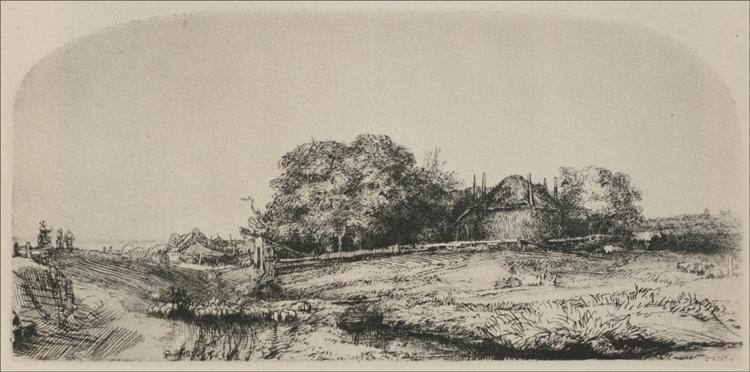
Rembrandt’s “An Arched Landscape with a Flock of Sheep” (1650) is a long, low etching that captures the Dutch countryside at a moment of unhurried balance. A shallow stream curves through the foreground, the cart track sways across a gentle rise, and a compact flock noses along the bank while a thatched farmstead and a dense stand of trees hold the middle distance. The arched corners of the plate echo the large, untroubled sky that floats above it all. Nothing clamors; everything breathes. With a few hundred supple lines, Rembrandt composes a world where labor, weather, and animal life cohere without fuss, and where the viewer is invited to travel the scene at the pace of sheep.
The Long Horizon and the Arc of Space
The first sensation is breadth. Rembrandt chose a panoramic format and then softened the plate corners into an arch, so that the composition feels housed under a vault of air. Within that arch, the land rises and bends. The track that enters from the lower right curves toward the farm and then meanders off toward the left horizon, a drawn-out S that animates the low country without breaking its calm. Parallel to this, a watercourse scribbles a brighter path, its surface catching light in short, horizontal strokes that punctuate the broader glides of ink. Trees mass at center like a green-black anchor, and behind them the thatch of the farmhouse swells and tucks under an irregular roofline. The whole space is built from curves; there is not a hard, insistent axis anywhere. This is a geography learned by feet and hooves rather than by rulers.
Chiaroscuro as Weather
Tonal design is the quiet engine of the print. Rembrandt stacks his darkest hatching in the tree crown and undergrowth, lets mid-tones describe the farmhouse and track, and reserves the palest values for the sky and far fields. The result is an atmospheric gradient that reads as late morning or late afternoon—those hours when shadow is present but tempered, when air has the clarity to push distances thin and bright. This chiaroscuro is not showy; it is meteorological. It gives the sense of a mild wind and steady light, the kind of weather in which chores extend themselves without haste.
The Flock as Moving Center
The title points us to the sheep, and rightly so. The flock is small, just a cluster of compact backs and bent heads near the stream, with a few stragglers fingering the path. Rembrandt does not render wool curl for curl; he uses abbreviated loops and blunt marks to suggest a living parcel of animals, their attention distributed across grass and water. What matters is motion. The flock invites a slow read of the foreground: the lowering of muzzles to drink, the push of fleece against fleece, the tiny stagger of a lamb negotiating the bank. Their scale is perfect—large enough to register as protagonists, small enough to keep the world expansive. In their company, the viewer’s eye walks and grazes rather than leaps.
The Farmstead and the Ecology of Shelter
Behind the flock, the farmhouse sits among a cluster of trees and hedges. It is a working structure, not a picturesque confection: thatch thickly laid, low walls patched, a fence line stitched together from what was available. Poles or stakes punch up through the roof to secure bundles, and the chimney is nothing like monumental—just enough to say warmth lives there. Trees are windbreak and larder, shade for animals and fuel for cooking. Rembrandt’s lines here are practical and affectionate, a carpenter’s grammar described with a draughtsman’s ease. He shows a home in terms of the ecology that sustains it.
The Road as Human Script
If the flock shapes our pace, the track shapes our narrative. Cut by cartwheels and hooves, softened by grass, the road is a legible record of use. It arcs toward a small bridge or culvert at left where stones knuckle out of the ground, then climbs to the horizon where tiny figures hint at neighbors going about their business. The track is neither ruler-straight nor wilderness-random. It is a negotiation with slope, ditch, and soil—the signature of a community that knows how to wear the land kindly. Rembrandt’s long, elastic strokes turn this negotiation into calligraphy.
Water, Reflection, and the Arable Edge
The stream at the lower left delivers one of the print’s loveliest passages. Rembrandt lays a low bed of parallel lines and then interrupts them with darker bars where banks or tufts interrupt flow. Reflections fall as soft reversals of the trees and stones above, never stiff, always slightly disrupted by ripple. This water is not scenic dressing; it is the hinge on which the pasture turns. It waters sheep, drains the field, and draws reeds and insect life into the scene’s natural music. The pastoral becomes practical without losing lyricism.
The Arched Corners and the Idea of a Window
The plate’s rounded corners are more than a design flourish. They turn the etching into a window whose top edge imitates the sky’s curve. This arched framing doubles the theme of shelter: as the farmhouse tucks under the trees, so the landscape tucks under the paper’s vault. The effect is intimate. The viewer does not stand before an endless panorama but inside a specific, bounded gaze, as if leaning on a sill. Within that gentled frame, small incidents—the way light kisses the water, the way the track lifts over a rise—gain tenderness.
Line, Burr, and the Voice of the Copper
Rembrandt’s line here is many-voiced. In the trees, strokes are layered and varied, some pressed hard to raise burr that prints as velvety shadow, others grazed lightly to suggest leaves catching sun. The pasture’s grasses are quick, lifted marks that feather toward nothing at the edge of the bank. Stones and bridgework receive short, crosswise cuts that build up a masonry weight. In the sky, Rembrandt mostly abstains; he lets the plate speak softly through near-blankness. The alternation of talkative line and quiet paper creates an acoustic that feels like the countryside itself: pockets of sound, long bands of air.
Animals, People, and the Scale of Life
Human figures are tiny—perhaps a shepherd near the bridge, perhaps a passerby at the far left horizon. Their smallness is not dismissal; it is proportion. In this world, people are part of a larger weave that includes animals, weather, and watercourses. The sheep dominate because their need organizes the moment: find grass, drink, move on. That focus keeps the scene free of allegorical noise. This is not a generalized Arcadia populated with the rhetoric of shepherds; it is a day’s work observed from a kindly distance.
Rhythm and Repetition
The print sings in repeated motifs. Sheep backs echo the hummock of the near bank. Tree crowns repeat as overlapping bubbles. The track’s ruts double the stream’s flow. Fences restate the line of the horizon in miniature. This rhythm ties disparate textures together and lends the scene the feel of a well-composed sentence: clauses repeating key sounds, a cadence that invites memory. It is impossible to look only once and be done; the eye wishes to travel the sentence again to savor the pattern.
Season, Time of Day, and Weather Sense
Everything suggests late spring or summer: foliage in full leaf, animals unblanketed, water running easy rather than swollen, and air clear enough to push the far horizon delicate and pale. The absence of long, fierce shadows indicates a moderate sun—not noon’s vertical glare, not evening’s drama. The print soaks in this temperate weather; the flock’s slow progress and the unhurried pattern of the track feel appropriate to a day that neither threatens nor demands. Rembrandt’s moderate values paint a humane climate.
The Ethics of Modesty
Like many of Rembrandt’s rural etchings around 1650, this plate refuses spectacle. The pastoral is unencumbered by mythic staffage or theatrical cloud. The technique, though masterly, never struts; it serves the subject. This modesty is ethical. The print honors work, habitation, and animal life without sentimentalizing or exploiting them. It offers attention as its main gift—attention to where water bends, to how a flock clusters, to the way thatch sits heavy on a roofline. The effect is restorative: a viewer leaves the image not dazzled but steadied.
The Viewer’s Path and Embodied Looking
The etching asks to be read with the body. Begin at the lower left where water collects; step across the little bridge; follow the flock along the contour; lean a moment beneath the trees; then take the track up and out toward the horizon. This choreography is not imposed; it arises from the land’s own invitation. The viewer’s eyes become feet and lungs, moving and breathing the distances that Rembrandt has arranged. In that embodiment lies the image’s deepest hospitality.
Comparisons Within Rembrandt’s Landscape Etchings
Set beside works like “Landscape with a Cow Drinking” or “A Peasant Carrying Milk Pales,” this plate shares a love of long horizontals and a preference for one anchoring motif around which a world coheres. What distinguishes it is the arched framing and the flock’s gently communal motion. Where the cow or milk-bearer anchors a narrative on an individual’s needs, the sheep suggest collective quiet—many small lives moving as one through a landscape shaped to their measure. The difference is subtle but powerful: it turns the page into a meditation on community.
Micro-Stories at the Margins
The image rewards slow inspection with minute incidents. A kinked post stands near the bridge like a hitching point. A stone spill suggests a culvert. A strayed sheep wanders a bit farther up the track. Each micro-story adds veracity without cluttering the whole. Rembrandt knows where to annotate and where to let the field rest.
Printmaking as Weather Control
Across impressions, Rembrandt’s wiping decisions can make the day shift. A light film of plate tone in the upper corners intensifies the arched effect and can read as thin overcast; a cleanly wiped plate makes the sky sharper, the air crisper. He often leaves a touch more tone over the tree mass, thickening shade and pulling the middle ground forward so the foreground water can glitter by contrast. The print thus becomes a set of closely related weathers rather than a single frozen instant.
Pastoral Without Pretense
Seventeenth-century Holland produced many ravishing pastorals; some stray toward ornamental sweetness. Rembrandt’s is different. It is pastoral by necessity, not by theater—a shepherd’s reality, not Arcadia’s fiction. The sheep graze because they must; the farm stands where shelter and water justify it; the road repeats habit. Nonetheless, beauty suffuses the scene, arising not from decoration but from right relation. Everything is where it belongs, doing what it was made to do. That quiet order delights more deeply than staged charm.
Why It Still Feels Fresh
The etching feels modern because it trusts omission, celebrates process, and honors the unremarkable. Large zones of paper remain untouched, and yet the air is convincing. Lines never pretend not to be lines, and yet rocks, wool, and thatch become tactile. The subject is a flock of sheep near a ditch; the experience is a lesson in how attention, economy, and empathy can make a small world complete. For viewers hungry for images that soothe without dulling, this print continues to offer the genuine calm of a tended field under an open sky.
Conclusion
“An Arched Landscape with a Flock of Sheep” is Rembrandt’s hymn to communal quiet. Under a sky arched by the plate itself, a farmhouse keeps company with trees, a stream feeds a pasture, a road remembers feet and wheels, and a flock moves as one small weather system across the land. No hero strides here; no storm threatens. Instead there is a rightness that asks to be noticed: the way water folds around stones, the way sheep cluster at a bank, the way thatch and foliage press together against wind. The more one looks, the more the etching becomes a place to rest the mind—a room made of field and sky where labor, creatureliness, and shelter meet without strain.
