Image source: wikiart.org
Introduction
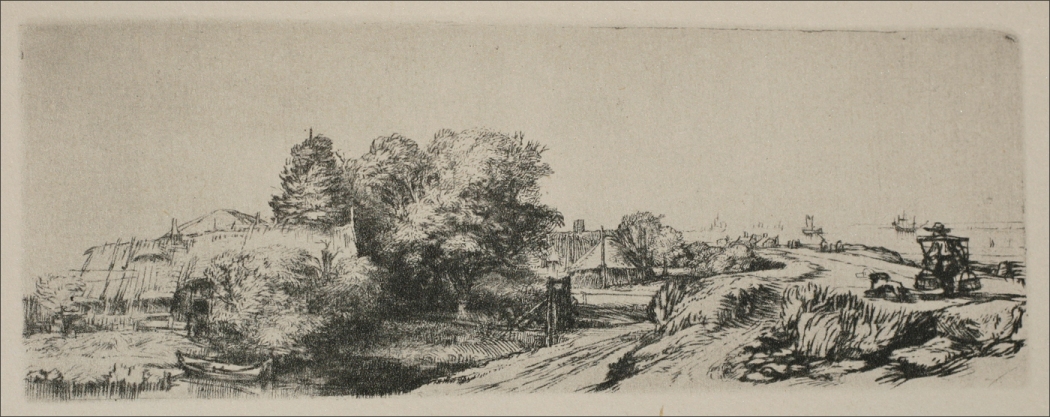
Rembrandt’s “A Peasant Carrying Milk Pales” (1650) is a quiet, horizontal etching that unfolds like a remembered walk along a Dutch dike. The sheet is panoramic yet intimate: a winding track climbs from the foreground to the far right, edging reeds and sandy rises; trees knit together a dark mass at center-left; sheds and low cottages tuck beneath foliage; a small boat hugs a shallow bank; and to the right, a tiny figure moves along the path with a yoke across the shoulders, a pair of milk pails swinging. Farther still, a windmill and vague silhouettes of towers and masts soften into the distance. The drama is minimal and humane—work, weather, distance—and Rembrandt renders all of it with lines that breathe like air over water.
Composition and the Long Sweep of Space
The composition reads left to right in a single sweep. Rembrandt clusters weight at the left in the dark copse of trees and the thatched structures that nestle against them. From that anchor, the path rises gently toward the right, where the marks thin, values lighten, and motifs become spare. This spatial choreography does two things at once. It encourages the viewer to travel with the peasant on the road to market and it enacts the daily rhythm of labor—leaving the shaded farm, stepping into open wind, and entering the social world of the village that waits at the horizon. The watercourse at the extreme left and the ditch that accompanies the path provide parallel, stabilizing horizontals, while the rutted track knits foreground and distance into one continuous breath.
The Peasant as Punctum
Though small, the peasant with milk pails is the print’s emotional center. The yoke arcs across the shoulders like a simple architectural span, and the two hanging pales swing in implied countertime to the step. Rembrandt uses only a handful of strokes to describe the figure, trusting gesture over detail: a bent head, a forward-leaning torso, legs planted with purposeful stride. This economy pays off. The tiny body anchors the vastness, giving everything else a human measure. The viewer immediately senses weight—the slosh of milk, the pinch of the yoke—and, with it, the dignity of ordinary work.
Chiaroscuro and Atmospheric Gradation
The tonal logic is classic Rembrandt. Dense cross-hatching and layered bites build darks at the tree mass and the sheds; the middle ground breaks into variegated mid-tones; the distance recedes into a pale haze where architecture and masts are scarcely more than notations. This gradient is not merely pictorial; it is meteorological. The etching feels like a day swept clean by a mild wind, cloud-scrim thin enough to bleach the far horizon and leave the near foliage heavy with shadow. The long band of pale sky across the top isn’t empty; it is a reservoir of quiet that lets foreground accents—gate, cart track, yoke—sound with clarity.
Line, Burr, and the Voice of the Plate
Rembrandt’s etched line here is unusually conversational. He tosses long, dry strokes to build the road’s sandy ridges, then presses down for plush burr in the leaves that catch shade. In the sheds and fences, short verticals and horizontals thicken into a carpenter’s grammar of planks and posts. Water is a handful of horizontal glides with darker, feathery accents that act as reflections. At no point does the line lose its character as line; there’s no illusionistic overreach. The plate speaks, and its voice is that of a practiced walker who sketches with his whole body—shoulder for long sweeps, wrist for reeds, fingertips for fence-wire detail.
Architecture and the Ecology of Shelter
The farm buildings at left are neither picturesque ruins nor grand houses. They are working structures: sloped roofs patched with thatch, low walls braced against wind, simple doors, a gate that hangs from improvised hinges. They huddle beneath trees not for romance but for shelter. The tree mass itself is ecological infrastructure—windbreak, shade, and a source of fuel. By folding architecture into vegetation so intimately, Rembrandt sketches a lived relationship between people and land. The houses shape the copse, the copse protects the houses; together they cradle a family economy that sends milk to market along the road.
The Road as Social Artery
The gently rising path is the picture’s narrative engine. Its grooves are cut by hooves and cartwheels; grass is worn to the roots in the middle, thicker at the edges where footsteps shy from mud. Because the peasant strides on it and small animals graze by it, the road reads as a social artery—the line that carries work to exchange. Rembrandt’s insistence on its meandering contour is vital. A straight road would suggest control and rule; this living path suggests accommodation—of slope, ditch, and soil—and, in that believability, it becomes an emblem of practical intelligence.
Windmill, Masts, and the Republic of Labor
At the far right, a small windmill stands like a compact engine of necessity, its sails at rest or caught in a light air. Beyond it, faint notations hint at ships and distant towers. These marks widen the social world of the print from farm and hamlet to the Dutch republic of water and trade. Milk might be bound for a neighbor or for a market that connects, by a chain of barges, to cities and sea. Rembrandt never hammers this point; he lets distant signs whisper it. The peasant’s step participates in a larger economy whose horizon the viewer can feel but not count.
Water, Reflection, and the Poetics of the Left Edge
The quiet water at lower left does more than mirror reeds and boat. It inserts pause into the composition, like a held note before the melody of the road begins. The small skiff tied along the bank hints at other tasks—netting, ferrying, tending a weir. Its presence affirms a truth of Dutch land: roads and waterways are partners, and the simplest economies often rely on both. Rembrandt renders the boat with a few curving outlines and a dark bar for the gunwale; it is enough to make the wood read as weight and the water as support.
Time of Day and Season
The print has the feel of morning or late afternoon, when shadows are present but not aggressive and when the air is clear enough to push far distances pale. Foliage is full, suggesting late spring or high summer. The peasant’s route to market implies early day; the milk is fresh, the work begun before the sun gained height. These temporal cues, gentle but legible, make the landscape breathe with human time rather than operate as a generalized pastoral.
The Ethics of Attention
As in many of Rembrandt’s rural etchings, the subject is humility perfected. There is no grand vista or theatrical weather, no allegorical staffage; only a person doing necessary work in a world built by hands and seasons. The artist’s attention consecrates that world. The yoke’s curve, the fringe of reeds, the haphazard fence, the clean edge where path meets ditch—all are looked at with hospitality rather than extraction. This ethic of attention becomes the print’s moral center: life is worth our best seeing even when it is small, repetitive, and quiet.
The Viewer’s Path and Embodied Looking
The long format tempts the viewer to read the image as one reads a sentence—left to right, clause by clause. Rembrandt uses this reading rhythm to synchronize our bodies with the peasant’s stride. Our eyes begin at the shaded farm, step onto the track, crest the low rise, and drift toward the mill and masts the way legs would. That embodied looking is part of the pleasure. The plate doesn’t ask us to admire from a balcony; it asks us to walk.
Comparisons within Rembrandt’s Landscape Etchings
“A Peasant Carrying Milk Pales” belongs with Rembrandt’s intimate, horizontal landscapes of the late 1640s and early 1650s where a single motif—cow drinking, farmhouse, roadside pollard willow—crystallizes an entire habitat. Compared to the turbulent, storm-charged “Three Trees,” this sheet is gentle and civic; compared to panoramic plates with complex staffage, it is pared down and narrative. In each case, Rembrandt favors the felt truth of place over catalog detail. The milk-bearer is kin to the cow at the water or the walker on a dike: anchors around which a world arranges itself.
Printmaking as Weather
Rembrandt’s handling of plate tone across impressions often functions like weather control. In richer pulls, a faint gray veil hangs over the left sky, deepening the copse and giving the cottages a cool, damp presence; in cleaner impressions, the right-hand openness becomes pure air, the mill sharper, the horizon farther. Such variability means the landscape can feel like different days without a single line being altered. The print thus refuses to be one moment; it is a type of day, a route traveled many times.
Micro-Narratives at the Margins
The sheet rewards slow looking with tiny stories. A gate stands half-open where a path enters the copse; a figure may be barely discernible near a shed; the boat’s bow cuts a small wedge of reflection; a dog or goat sniffs near the mill. These small notes let the viewer imagine a web of errands and habits nested within the milk-bearer’s larger errand. The road is never empty; it is simply waiting for the next footfall.
Materiality and the Pleasure of Paper
The print’s pleasures are tactile. You can feel where the needle bit deeper, raising burr that prints as velvet around tree trunks; you can feel the skitter of drypoint across sandy ruts; you can feel the smooth, barely-inked sky. Rembrandt’s restraint—leaving large zones of paper almost untouched—invites the viewer to register the paper as sunlight. In a media age obsessed with saturating every inch, this spaciousness reads as grace.
Work, Freedom, and the Open Horizon
There’s a gentle paradox at the heart of the image. The peasant’s task is bounded—two full pails, a defined destination—yet the space around the figure is expansive. The road curves toward an open horizon that belongs to wind and water; the sky’s width promises weather beyond anyone’s control. Rembrandt holds necessity and freedom in balance: the dignity of work within the gift of space. That balance may be why the print feels restful even as it narrates effort.
Why It Still Speaks
This etching continues to resonate because it records something permanent in human life: the walk from home to obligation through a landscape made by communal care. It honors modest competence; it treats land not as spectacle but as partner; it sees a person less as symbol than as neighbor. The print’s quiet confidence—that attention itself is a kind of praise—feels contemporary in its humility and exactness.
Conclusion
“A Peasant Carrying Milk Pales” is a hymn to the ordinary road. In one continuous sweep of lines and light, Rembrandt gives us sheltering trees, patched sheds, water that waits, a path that remembers feet, a windmill that keeps faith with wind, and a single figure whose bent shoulders hold the day’s first chore. The etching’s spacious sky and thinning marks carry our gaze forward until work merges with horizon. No monument announces itself, yet the scene is monumental in the truest sense: it stands for many days and many lives. The peasant’s step is steady; the pails are full; the path continues.
