Image source: wikiart.org
Introduction
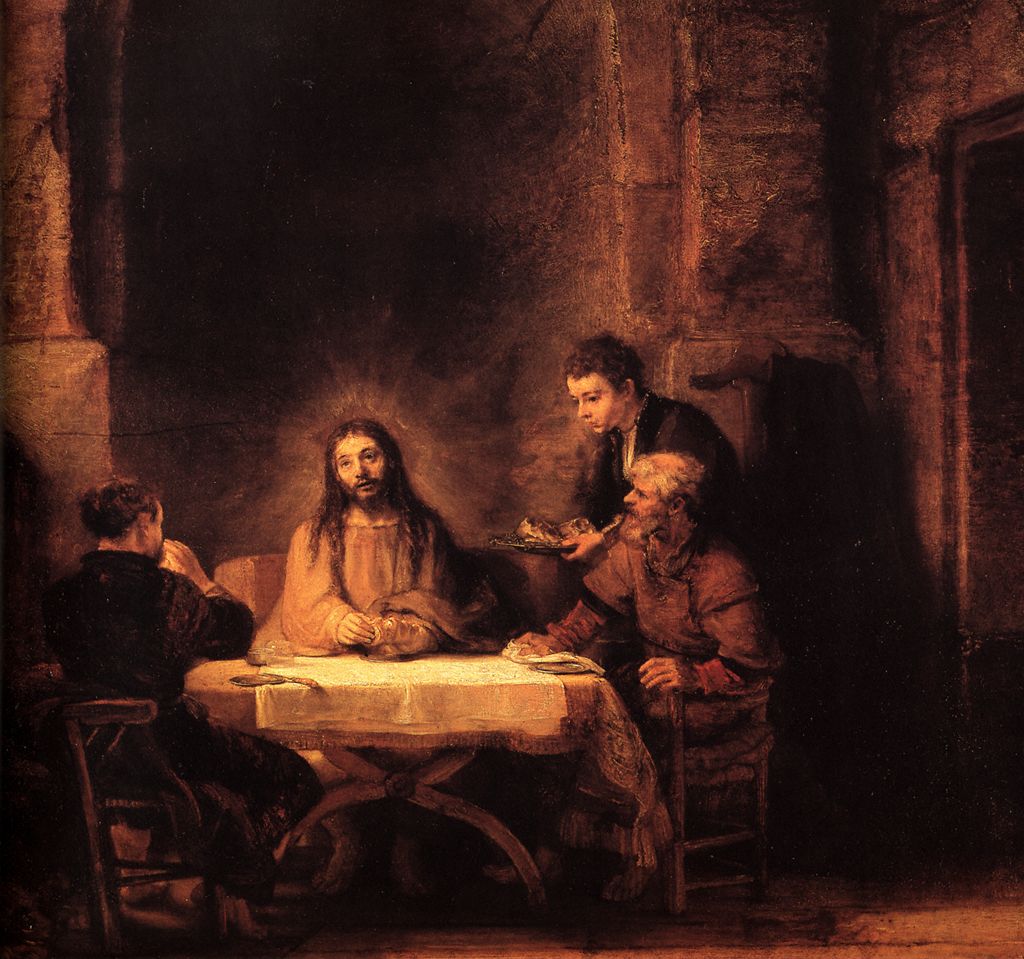
Rembrandt’s “The Supper at Emmaus” of 1648 distills a moment of revelation into a scene of intimate, domestic quiet. Two disciples sit with the risen Christ at a small table; a servant leans in with a platter; a deep, ruddy darkness presses around them like night gathering at the edge of a modest room. The painting belongs to Rembrandt’s mature period, when his art shifts from theatrical narrative to concentrated psychological drama. Everything here is pared down—few figures, little ornament, almost no landscape or architecture—so that the revelation takes place not in spectacle but in seeing. The image is about recognition, about the instant when ordinary light becomes meaning and a shared meal becomes the sign of a transformed world.
The Biblical Narrative and Rembrandt’s Chosen Instant
The subject comes from the Gospel of Luke, which recounts how two disciples, walking to the village of Emmaus on the day of the Resurrection, meet a stranger who explains the scriptures to them. They invite him to stay, and at table he takes bread, blesses it, and breaks it; in that act they recognize him as the risen Christ. Rembrandt chooses the second of these moments—the quiet after the blessing, as the bread lies ready to be shared and the disciples’ minds tilt toward awareness. Christ’s hands rest on the tablecloth; his gaze is gentle and searching; one disciple has already drawn back in astonishment while the other leans forward, on the cusp of understanding. The scene is still, yet charged, like the pause between inhale and exhale.
Composition as a Theater of Recognition
The composition gathers the figures into a tight semicircle around a small, round-topped table. Christ sits centrally, his head slightly higher than the others, framed by an arching shadow that functions like a natural halo. The disciple at left turns inward, hands raised in prayer or shock; the one at right twists in his chair, chin lifted toward the light on Christ’s face. A servant stands behind, leaning in with a plate, caught between household duty and dawning awareness. The tablecloth, crisp and pale, forms an illuminated plane that binds the group and directs the eye to Christ’s hands—hands that bless, break, and give. This ring of bodies and table is surrounded by a deep envelope of darkness, a compositional device that renders the room a vessel for revelation.
Light, Chiaroscuro, and the Aura of Presence
Rembrandt’s light arrives as an inward glow. Christ’s head is encircled by a soft nimbus, not a metallic halo but a breathing radiance that dissolves into the surrounding dusk. The disciples receive lesser illumination; their coats, hair, and faces catch flickers that tell us where they are in the moral weather of the moment. The tablecloth becomes a reflective surface that lifts the light back toward Christ’s hands and the disciples’ faces, turning the meal into a lamp. This chiaroscuro is not a trick of drama; it is theology translated into paint. Light proceeds from recognition—when Christ is known in the breaking of bread, illumination unfolds outward, touching those ready to see.
Gesture and the Psychology of Awakening
The painting tells its story through small motions rather than large acts. The disciple at left holds his hands together near his mouth, as if sudden comprehension were a kind of prayer. His body draws back, chair legs angled, signaling the shock of grace. The disciple at right is all leaning energy, forearms tense on the table’s edge, mouth open, eyes locked on the figure before him. Christ’s gesture is restraint itself: his hands rest with a tenderness that suggests possession and offering at once, the bread cradled as the sign of himself. The servant, absorbed in his task, leans forward with a platter and only then begins to register the change, his face tilted down the arc of light. Every posture records a different stage of recognition—astonishment, anticipation, serenity, and gradual understanding.
The Humble Setting and Its Moral
Unlike many Renaissance versions of the subject that revel in elaborate architecture and sumptuous still life, Rembrandt gives us a plain interior. Rough walls stand close to the table; a cloak hangs on a peg; the doorway is unadorned; the furniture is serviceable. This choice does not deny beauty; it locates it. The painting argues that holiness appears in the everyday room and at the ordinary meal. The smallness of the space enhances the vulnerability of the figures and focuses attention on their faces and hands. By stripping the scene of luxurious detail, Rembrandt aligns the Emmaus moment with the domestic routines of his Amsterdam audience and with his own preference for truth over display.
Color and Tonal Harmony
The palette is restrained and warm: earth reds, browned umbers, ochres, and the creamy whites of linen. These tones produce a dusk that is more hearth than night, a human warmth rather than cosmic darkness. The small notes of color—Christ’s rose-ochre tunic, the servant’s pale collar, the faint gleam of pewter on the platter—are chosen for their capacity to absorb and reflect light modestly. No hue bristles against the whole; everything contributes to a tonal concord that feels like calm after turmoil. The chromatic restraint is part of the painting’s argument: revelation is not noise but clarity.
Bread, Table, and the Sacramental Axis
At the heart of the scene lies bread. It is not a still-life showpiece but the hinge of recognition. Christ’s fingers rest near it; the cloth against which it sits is crisply painted, as if the painter wanted the viewer to feel its weave. The table itself is round-topped and supported by crossed legs, a humble form that echoes the cross without insisting on symbolism. Cloth falls at the near edge, spilling into the viewer’s space like an invitation. Rembrandt thereby establishes a sacramental axis: light, bread, and human faces meet across a surface designed for sharing. The altar is a household table; the miracle is a meal.
The Servant and the Poetics of Witness
Rembrandt rarely forgets the persons who wait at the edges of biblical events. The servant here is crucial. He carries a dish—perhaps roasted meat or vegetables—and bends toward the table with the alertness of service. His expression is open but puzzled, as if the atmosphere had changed before he knew why. He stands for all the practical people who keep the world running while grace does its work. In narrative terms, he is the last to understand; in painterly terms, he is the bridge between us and the scene, the figure whose everyday task grounds the miracle in plausible life.
The Arc Between Speech and Silence
One of the most striking features of the image is its quiet. There is no gesticulating preacher; there is no crowd. Rembrandt isolates the Emmaus moment as a movement between speaking and silence. The disciples have just heard scripture explained; now they understand without words. Christ’s mouth is closed; his eyes are steady. The painting embodies the paradox of faith as knowledge that arrives when argument ceases. The heavy walls and curtained dark intensify this stillness, enclosing the table in a womb of listening.
Comparison with Rembrandt’s Earlier Treatments
Rembrandt treated Emmaus more than once, notably in a dramatic early canvas where Christ appears as a radiant apparition and a servant faints under the shock. The 1648 version is quieter, deeper, and more interior. The miracle is not a burst of outward light but a change in perception. This evolution mirrors Rembrandt’s broader development—from youthful bravura to late introspection—and corresponds to changes in his own life around the 1640s, when financial and personal losses gave his art a hardened tenderness. The later Emmaus asks viewers to recognize the divine in the ordinary rather than in the extraordinary.
Brushwork, Surface, and the Craft of Feeling
Matter matters in this painting. The tablecloth is layered with thick, opaque strokes that catch the room’s light; Christ’s hair is dragged and scumbled into soft threads; the stone wall behind is built from roughened, scraped paint that feels as old as the house itself. Faces are modeled with a mix of thin, glowing glazes and denser touches that pick out noses, brows, and lips. This variety of surface creates tactile empathy: you can feel the cloth, the wall, the grain of wood, and, most acutely, the softness of human skin. The craft is never fussy; it aims to render how light finds its way across things rather than to display detail for its own sake.
Theology in the Language of Light
The Emmaus story is about Christ made known “in the breaking of bread.” Rembrandt articulates that theology through his grammar of illumination. Christ’s head is ringed by a mild radiance, but the strongest lights in the picture land on the table and on the hands that will receive. Grace, in this scheme, passes through giving and eating; it is not an external blaze but an interior recognition that moves across a common object. Even the servant’s dish carries a soft glimmer, acknowledging that ordinary provisions participate in the revelation. The light is ethical: it honors those who are present and prepared.
The Viewer’s Seat at the Table
The near edge of the table is close to the picture plane, and the cloth tumbles over it in a way that invites the viewer forward. We are offered a seat—perhaps the place of the reader who recognizes Christ afresh in each telling. That spatial intimacy changes how the image works. It is not a tableau to be admired from afar but a dinner to be entered with attention and gratitude. The more one looks, the more one senses the warmth of bodies in a small room and the soft sounds of shared eating. The painting cultivates participation, not merely observation.
Time, Memory, and the Slow Arrival of Meaning
The Emmaus narrative takes place after a day of walking and teaching. Rembrandt compresses that long arc into a single moment rich with memory. The disciples’ faces hold traces of disappointment, debate, and dawning joy; the servant’s bend captures the ongoing flow of household time; Christ’s steady gaze carries the long history of promise fulfilled. The picture therefore rewards contemplation. Meanings arrive slowly, like night deepening around the house while a small table becomes a place of recognition. The painted darkness is not threatening; it is the canvas upon which memory can settle and illuminate.
The Painting’s Place in Rembrandt’s Late Ethics
By the late 1640s, Rembrandt’s art embodies a humanism grounded in sympathy, mortality, and the dignity of common life. “The Supper at Emmaus” is a manifesto of that ethic. It honors food, hands, conversation, and the small rooms where people live. It insists that revelation is not an interruption of the ordinary but its perfecting. This outlook explains the painting’s enduring appeal across confessions: viewers sense in its warmth and restraint a vision of the sacred woven into daily practice.
Legacy and Continuing Resonance
The image continues to shape how artists and viewers imagine the Emmaus scene. Its influence can be traced in later paintings and prints that favor intimate interiors and subdued light over spectacle. Museums often use this work to introduce audiences to Rembrandt’s late style, where thick paint and humble settings yield spiritual depth. For anyone who has ever recognized something momentous happening in an unremarkable hour, the painting feels contemporary. It captures the way truth steals upon us at tables, in kitchens, and in conversations we did not know would change our lives.
Conclusion
Rembrandt’s 1648 “The Supper at Emmaus” is a study in quiet revelation. Through a restrained palette, luminous chiaroscuro, and a choreography of hands and glances, the painter turns a small meal into a vision of presence. Christ sits with friends, bread is blessed and readied, and a servant keeps the world running as comprehension dawns. The room is poor, the figures ordinary, the light gentle, and yet the scene carries the force of a world remade. The painting asks the viewer to sit close, to let perception ripen, and to find the extraordinary truth that waits at the edge of the everyday.
