Image source: wikiart.org
Introduction
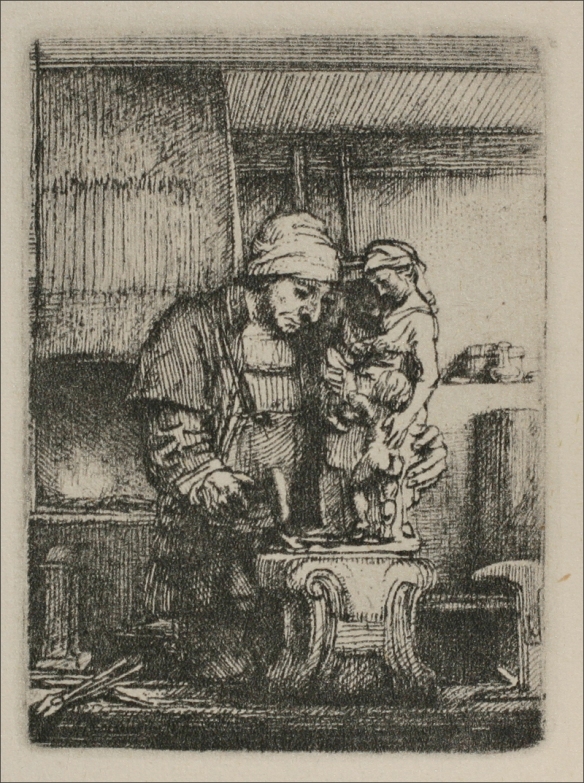
Rembrandt’s “An Artist Drawing from the Model,” dated 1648, is a compact yet remarkably eloquent meditation on how images come into being. Although it is commonly grouped with his paintings, the work is an etching, and its scale is intimate—small enough to fit in the palm, but dense with information about craft, concentration, and the studio’s everyday poetry. Rembrandt pares the scene to essentials: an artist bends toward a model placed on a pedestal; a warm fire or furnace glows at left; a tabletop with vessels, tools, and scraps anchors the right. Everywhere the copperplate speaks in quick, incisive strokes that register not only what things look like but how they feel under the hand of a person who lives among them.
The Subject and Its Human Drama
The subject is deceptively simple. A working artist studies a model—here rendered as a small statuette of a mother and child—while pressing a stylus to his drawing surface. The model is close enough to touch. The artist’s spine curves in an arc of attention; his head inclines, almost touching the figure; his left hand steadies the pedestal while the right hand draws. The entire scene reads as a choreography of nearness. Rembrandt’s choice of a sculptural model rather than a living figure tells us this is an exercise in translation: solid form to quick line, weight to contour, three-dimensional mass to two-dimensional notation. That translation, performed countless times in any studio, becomes the drama of the print.
Composition as a Machine for Focus
Rembrandt organizes the small rectangle to drive the eye where it needs to be. The great block of the hearth at left creates a stabilizing vertical that counterbalances the delicate model and pedestal at center. The artist’s body forms a diagonal that points our attention down to the tip of his stylus and up again to the model’s head. Background horizontals—ceiling boards, a rear beam, the shelf at right—quietly grid the space, keeping the intimacy from collapsing into clutter. The result is a composition that moves like a breath: in toward the model, out toward the room, back in again to the artist’s hands.
Chiaroscuro and the Atmosphere of Work
The light is warm and localized. It seems to emanate from the unseen blaze of the hearth, swelling across the artist’s cap and cheeks, catching the ridges of his sleeves, and flaring softly on the stone model. Shadows fall in short, legible hatches, darkening the alcove at left and the recesses between pedestal and floor. Because the print is small, every contrast matters: a single deep bite around the artist’s collar renders the density of cloth; a cluster of short strokes under the model’s feet locates weight. The chiaroscuro is not theatrical but practical. It recreates the kind of light a maker chooses for long hours—a light that clarifies edges without dazzling the eye.
The Model on the Pedestal
The statuette is itself a picture within the picture. A woman holds a child; their forms are simplified but legible, their relationship tender. Rembrandt invests the small figure with real sculpture-ness: a twist in the torso, a turn of the head, a stacked rhythm of hips, legs, and base. The pedestal is stout, with tightly curling volutes that echo the artificer’s discipline. In using a sculpted group rather than a living body, Rembrandt underscores the exercise of drawing “after”—after antiquity, after an admired master, after the stubborn fact of stone. This is study as reverence, but also as independence: the living hand interprets what the dead material merely presents.
The Artist’s Body as Instrument
Few artists have drawn the labor of art with such compassion. The draughtsman’s posture is familiar to anyone who has worked from a model for hours—shoulders rounded, weight slightly forward, the off-hand bracing the world while the drawing hand measures. The face shows fatigue and patience rather than display. Rembrandt refuses the heroic self-portrait; he offers instead a truthful body serving a task. One senses the artist’s breath held while he places a line; the next breath releases into the warm air before the fire. The entire figure is a study in how attention inhabits muscles and bones.
The Studio as a World
Around the main exchange between eye and object, Rembrandt scatters signs of a life lived with tools. At the threshold of the hearth lies a tangle of tongs or irons; on the floor, stray sticks and shavings; to the right, a low bench or block; on the parapet at far right, a jug and a shallow bowl suggesting the interval of meals or the housekeeping of pigments and oil. These are not stage properties but working props. The studio is a home, a shop, and a school all at once. The presence of the fire—both practical and symbolic—reminds us that image-making is not only cerebral but artisanal, a collaboration with heat, metal, and chemistry.
Line, Bite, and the Voice of the Plate
Because the piece is an etching, line is everything. Rembrandt’s needle makes three kinds of music here. There are crisp, single strokes that state facts—edge of the cap, profile of the nose, rim of the pedestal. There are tremulous, woven hatchings that build shadow with a feathery grain, especially across the hearth and the wall. And there are short, emphatic bites that punch dark accents into the scene, holding the scattered light together. He allows plate tone—a veil of ink left intentionally on the copper—to glow near the fire, so that the warmth feels literal. The technical choices become expressive: the scene isn’t merely shown; it’s sounded.
The Ethics of Looking and the Discipline of Copying
To draw from a model—living or sculpted—is to submit to a discipline. The eye must follow what is there before it imposes what it knows. The hand must record rather than invent. Rembrandt’s print dignifies that discipline, and by choosing a mother-and-child group as the model, he suggests something about care and transmission. The small stone dyad becomes a metaphor for instruction: the past holds the present; the present studies the past and brings it forward as line. Copying here is not servility; it is a way of honoring form while discovering one’s own touch. In this compact sheet, pedagogy becomes poetry.
The Hearth and the Idea of Warmth
Many studio images show windows as the source of clear, northern light. Rembrandt gives us a fire. Practically, a warm stove keeps a winter studio livable. Symbolically, it stands for the heat that softens materials, the energy that turns stubborn copper into a communicative plate and brittle ink into velvety darks. It also suggests companionship. The hearth makes the room a place where apprentices, colleagues, or patrons might gather. Even in their absence, we feel the social dimension of making—the conversations, jokes, instructions, and silences that solder a workshop into a community.
Scale and Intimacy
The sheet’s smallness matters. Rembrandt often used modest formats for scenes he wanted the viewer to meet at close range. To properly experience this print, you must lean in, mirroring the artist’s own lean toward his model. The act of viewing thus reenacts the content. The smaller scale also amplifies tenderness: a single soft hatch along the child’s head in the statuette reads as a gesture of affection; a tiny glint on the artist’s eye carries a world of concentration. The print becomes a “hand conversation” between maker and beholder.
The Dialogue Between Sculpture and Drawing
The scene makes visible an ancient conversation in the arts. Sculpture offers solidity, contour, and a decisive relationship with gravity. Drawing offers speed, sequence, and the possibility of revision. By placing the two face to face, Rembrandt dramatizes their exchange. The artist appears to be “reading” the sculpture—turning three-dimensional relationships into notated rhythms. In a subtle joke, the printed lines we see as viewers are themselves the final translation of that translation: the artist drew the model; Rembrandt etched a drawing artist; we now read etched lines of someone reading carved lines. The print is a palimpsest of attentions.
Technique, States, and the Presence of the Hand
Rembrandt often printed his plates in multiple states, revising details or reinforcing shadows as his sense of the image evolved. Even if this plate survives in a single state, it carries the spirit of that method. You can feel the hand editing itself: a set of strokes along the artist’s sleeve repeats and corrects; the edge of the hearth darkens where the first pass proved too pale; the pedestal’s scrolling is tightened after an initial, looser sweep. The visible revisions invite us into process. Rather than presenting a flawless façade, the print lets us experience the making as something alive.
A Companion to the Larger Studio Scenes
In 1648 Rembrandt also produced larger, more experimental images of the studio, including a striking plate showing a standing nude and a seated draughtsman in a space divided between sketchy openness and finished darkness. “An Artist Drawing from the Model” can be read as that work’s pocket-size counterpart. Where the larger plate meditates on the aesthetics of unfinishedness, this one treasures the homely rituals of craft. Together they offer a double portrait of the studio: the intellectual laboratory and the warm shop.
Humility, Labor, and the Image of the Artist
Many seventeenth-century representations of artists project status—grand studios, impressive libraries, costly curiosities. Rembrandt’s sheet takes the opposite tack. It shows labor, not luxury; intimacy, not spectacle. The artist does not address us, does not pose heroically, does not display wares. He works. The statement is quiet but pointed. Artistic dignity is not a function of trappings but of attention and care. The mother-and-child model subtly reinforces this ethic: making is a form of caretaking, and tradition continues only where hands remain faithful to their tasks.
Resonances for Contemporary Viewers
Modern audiences often encounter artists through glossy studio tours or social media images of finished pieces. This print restores a different perspective. It dignifies the long hours before triumph, the humble exercises that train the eye, the unphotogenic corners where tools lie and ash collects. It also enlarges our sense of what “model” can mean. A model might be a person, a sculpture, a memory, a poem. Whatever the source, the task is the same: look with patience, draw with honesty, return tomorrow and look again. The sheet becomes a small manifesto for anyone who makes things.
Conclusion
“An Artist Drawing from the Model” is a masterpiece of condensation. In a few square inches of etched copper, Rembrandt gives us the curve of concentration, the warmth of a hearth, the weight of a pedestal, the tender gravity of a mother-and-child figure, and the quiet righteousness of work well done. He turns a daily exercise into an image of the artistic life as such—attentive, disciplined, rooted in craft, and sustained by the modest pleasures of a room made for looking. The plate asks us to come close, as the artist does to his model, and to watch how lines accumulate into understanding. In that closeness lies the work’s abiding power.
