Image source: wikiart.org
Introduction to Rembrandt’s “Ephraim Bonus (The Jew with the Banister)” (1647)
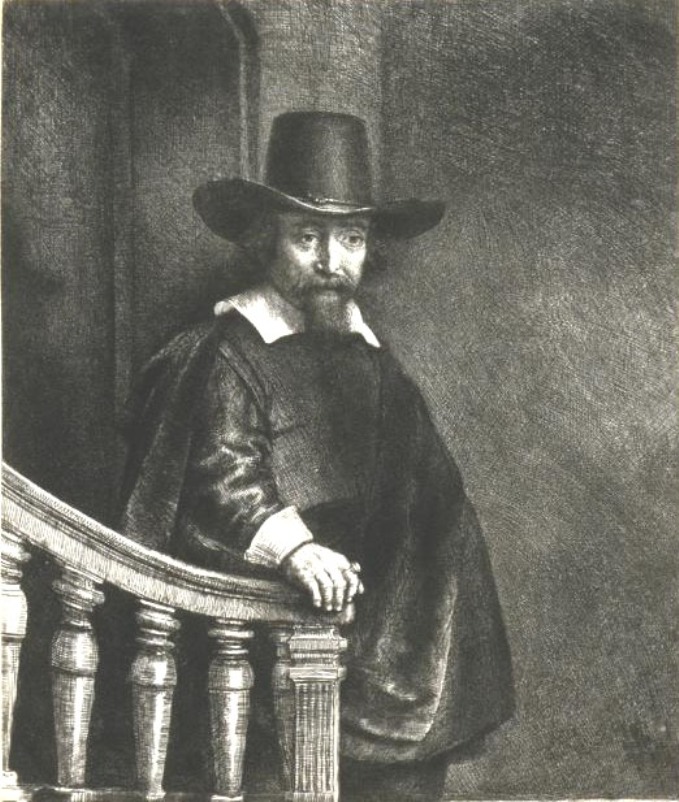
Rembrandt’s 1647 portrait of the physician and scholar Ephraim Bonus—often nicknamed “The Jew with the Banister”—is one of the finest demonstrations of how an etching can hold the psychological depth of a painted masterpiece. The sitter appears half-length at the turn of a staircase, one hand resting on a carved balustrade, the other gathered in the folds of a heavy mantle. A broad-brimmed hat shades his calm, penetrating gaze. Behind him, a modest doorway and a field of cross-hatched tone open a chamber of quiet. The plate is a study in how architecture, light, and gesture can be organized to present not simply a likeness, but a vocation and a way of moving through the world.
The Stair and the Stage of Character
The banister is not a prop. It is a stage that Rembrandt uses to place Ephraim Bonus mid-motion, as if we have caught him pausing on his way up or down. The rhythm of turned balusters, meticulously bitten into the copper, sets a measured tempo that echoes the discipline of a physician’s practice. The rounded rail curving toward the viewer becomes a visual conduit that leads the eye to the sitter’s poised hand—fingers relaxed, knuckles articulated with a few decisive hatchings. Because the hand is foregrounded and true, everything else is believed: the measured breath in the chest, the weight of the cape, the intelligence in the eyes.
Architectural Framing and the Ethics of Place
Rembrandt often builds a moral architecture around his sitters. Here, the stair and adjacent door carve a niche that belongs to neither private study nor public street. It is a threshold—appropriate for a doctor and man of letters whose life crosses boundaries of community and thought. The door’s shadowed recess catches a softer pattern of cross-hatching that suggests breathable air beyond. The stair’s solid timber declares a life anchored in craft and habit. Between these two, Ephraim Bonus stands with unforced authority, a neighbor whose knowledge is practical and whose presence steadies the passage from one space to another.
Chiaroscuro Carved from Line
The sheet’s glamour lies in Rembrandt’s command of light through line alone. Dense networks of parallel strokes veil the background, their direction pivoting subtly around the figure to produce a pocket of atmosphere. The hat’s underside is thick with strokes that leave a narrow rim of unbitten paper as a glow around the head. The face is modeled with a delicate economy: short, curved lines for the cheeks, a deepened pool for the eye sockets, sparse highlights reserved for the bridge of the nose and the forehead’s high plane. The coat and mantle are drawn with broader, more open hatchings that breathe; their darkness is never opaque. This orchestration lets the eye experience form as volume and air rather than as black-and-white diagram.
Costume, Identity, and the Refusal of Stereotype
Ephraim Bonus wears the sober attire of a seventeenth-century Amsterdam professional—dark cloak, crisp collar, brimmed hat. Nothing exoticizes the sitter; nothing leans into type. Rembrandt’s decision is cultural as much as visual. Amsterdam’s Sephardic community flourished in medicine, commerce, and letters; Rembrandt, who lived and worked among Jewish neighbors, pictures Bonus as a citizen first, a learned doctor whose dignity comes from service and discipline. The wide hat casts shade that gathers the mind; the broad collar reflects light that animates the face. Costume is not display; it is instrument.
The Hand as a Second Portrait
Hands in Rembrandt’s portraits speak with the eloquence of faces. Bonus’s right hand rests on the rail with a patient weight that only a close observer of anatomy could assert. The cuff’s bright rectangle, articulated with a few etched angles, throws the knuckles into relief. The gesture is neither theatrical nor idle; it is the quiet claim of a professional pausing to address a question. The left hand sinks into the cloak, holding knowledge and privacy together. In this pairing—one hand forthcoming, one hand reserved—Rembrandt invents a psychological symmetry that feels instantly true.
The Face of a Listener
Look at the eyes beneath the hat’s shadow: they do not seek to dominate; they receive. The eyebrows lift by a fraction; the lids lower just enough to imply concentration rather than fatigue. The beard is a scatter of slightly varied strokes, more notation than description, quickened by a few pinpoint lights. The mouth is closed but softened, a line ready for counsel rather than judgment. Taken together, the features produce a portrait of attention. Rembrandt shows a physician in the act of listening—one of the highest arts in medicine and in friendship.
The Banister’s Carving and the Pleasure of Craft
The balustrade is rendered with loving exactitude. Each turned post is unique; highlights ride along their edges like breath on glass; the rail’s top plane picks up a continuous band of light that slows the eye and calibrates the depth of field. Rembrandt’s relish in these details is not mere virtuosity. It honors the world of making: the carpenter’s lathe, the joiner’s care, the way a hand finds security in a well-shaped rail. The sitter shares this world of craft. A good doctor, like a good artisan, is precise, patient, and faithful to material truth.
A Portrait That Moves Through Time
Many of Rembrandt’s etched portraits feel cinematic in their timing; this one is a frame that implies before and after. Because Bonus stands at a stair’s bend, he must have ascended or descended just prior; because his hand relaxes on the rail rather than grips it, he expects to move again. The print captures the tempo of a day between duties, a moment that belongs to both work and neighborly exchange. The viewer, placed at the landing, becomes a participant in this pause—recipient of a glance and a sentence half-begun.
Technique, Plate Tone, and the Breath of Paper
Impressions of the plate vary in plate tone, the veil of ink left on the surface at printing. In toned impressions, the background gathers velvet depth and the figure glows as if emerging from lamplight; in clean wipes, the drawing sings with graphic clarity and the banister’s highlights sharpen. Both conditions enhance the portrait’s human climate. The slight grain of the paper shows through the open hatchings like atmospheric dust, making the room’s air palpable. This is one reason Rembrandt’s etchings feel alive: the medium’s materiality becomes part of the sitter’s presence.
Dialogue with the Painted Portrait of Ephraim Bueno
Rembrandt painted a half-length portrait of Ephraim Bueno around the same time. Together, the painting and this etching create a two-part study of identity. The painting brings the viewer close—hat, collar, and a warmly lit hand—offering the intimacy of conversation. The etching introduces architecture and movement, presenting the doctor as a citizen in the built world, stepping between spaces. The pairing suggests Rembrandt’s fascination with vocation as rhythm: the pulse between interior thought and public action. Seen side by side, the two works enrich each other’s truth.
The Social History Inside the Frame
Ephraim Bonus belonged to Amsterdam’s Sephardic community, composed largely of families who had left the Iberian Peninsula and reestablished their lives in the Dutch Republic. Their contributions to medicine, printing, and international trade were profound. By placing Bonus at a banister and door, Rembrandt makes a quiet civic claim: here is a learned neighbor moving confidently through a city that makes room for his work. The portrait resists the easy categories of its time and ours. It is neither an ethnographic study nor a vehicle for moral allegory. It is a likeness that lets a complex life be legible without reduction.
The Psychology of Light and Edge
Edges in the print are tuned like the plucked strings of a lute. Where Rembrandt wants softness—a cheek rounding into shadow, the felt rim of the hat—lines loosen and spread. Where he wants authority—the banister’s profile, the cut of the collar—lines align and harden. Light accrues at these edges, organizing perception with the precision of a clinician. We feel how close the hand is, how the hat shelters space, how the cloak wraps the torso’s mass. This is not only drawing; it is thinking made visible, a diagnostic way of seeing that the sitter himself would recognize.
The Viewer’s Role and the Ethics of Meeting
We meet Ephraim Bonus at human distance. The stair allows us to stand a step lower, a vantage that flatters without servility and that encourages conversation rather than scrutiny. The sitter’s body turns slightly into the room; our own stance, imagined by the print, turns slightly toward him. This reciprocal geometry creates an ethics of viewing. We are welcomed into the space with the same calm courtesy the sitter offers. The print becomes a rehearsal for good encounters—measured, attentive, and generous.
The Etching as a Study in Restraint
Rembrandt does not cram the plate with anecdote. He chooses a narrow palette of tones, a handful of textures, and a precise set of forms. This restraint concentrates meaning. The viewer is not distracted by enviable possessions or by grand heraldry. The only grandeur here is the grandeur of attention. The climax of the print is not an emblem but a gaze, an open hand, a well-drawn curve of rail—the things that constitute, in any century, the signature of a decent life.
Influence and Afterlife
Collectors prized this portrait early, in part because it compresses so many of Rembrandt’s strengths into a single plate: the living face, the articulate hand, the performing architecture, and the atmosphere woven from cross-hatched light. Later artists studied it for the same reasons. Portraitists learned how to make a sitter breathe without props; etchers learned how to build light without wash; viewers learned how to read character from gesture rather than from costume alone. The image endures because it portrays not only a person but a way of seeing that still feels sane.
Why the Image Still Feels New
What keeps the portrait modern is its candor. It refuses stereotype but does not ignore identity; it acknowledges status but does not genuflect to it; it honorably records age and fatigue without making them the subject. In a time saturated with performed images, the plate models an alternative: a likeness that respects privacy and invites conversation. The hand on the banister remains the perfect emblem of this ethos—steady, open, and ready to move.
Conclusion: A Pause at the Turn of a Stair
“Ephraim Bonus (The Jew with the Banister)” is finally a portrait of a pause. A physician, scholar, and neighbor rests a moment at the turn of a stair. Light, patiently woven from etched lines, gathers on his face and hand; architecture lends him a firm yet permeable frame; the viewer is granted a place on the landing to receive his regard. Nothing is overexplained, and everything necessary is present. In its quiet authority the print is an education in how to meet another person well—with attention, with room for breath, and with an honest, steady light.
