Image source: wikiart.org
Introduction to Rembrandt’s “Winter Landscape” (1646)
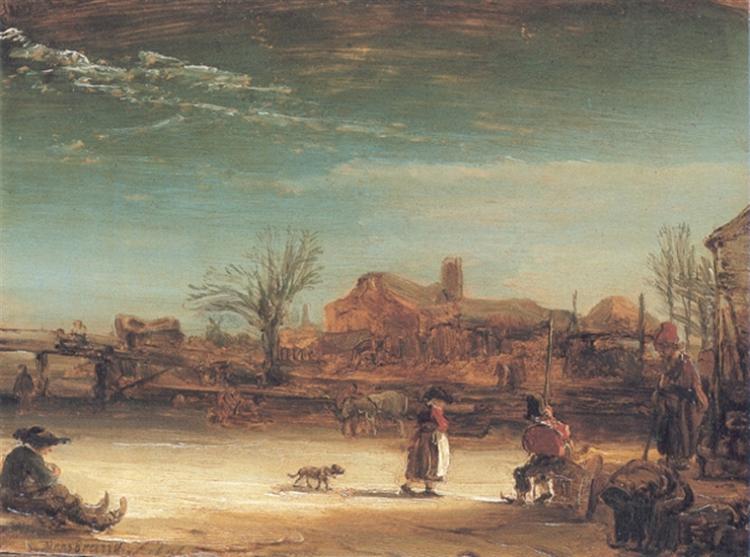
Rembrandt’s “Winter Landscape” from 1646 is a quietly dazzling meditation on light, breath, and the social life of cold weather. Instead of dramatizing a blizzard or a spectacular sunset, he condenses winter into a broad, pale expanse of ice, a luminous sky shifting from blue-green to pearl, and a low horizon where barns, leafless trees, and bundled figures knit a village into being. The painting does not simply record a season; it shows how a community moves through that season—how people cluster, pause, and resume their errands when a canal freezes and the world slows down. With economical brushwork and an eye for small truths, Rembrandt offers a winter that is not hostile but inhabitable, even companionable.
A Sky That Writes the Weather
The painting’s first sensation is the sky, a generously proportioned vault that occupies more than half the canvas. Its color reads as winter’s inhale: cool turquoise leaning into smoky gray, then warming imperceptibly toward the horizon where the light catches the brick-red roofs. Feathered streams of cloud slide across the upper left like frost etched on glass. Rembrandt’s handling is loose yet precise; the sky feels moved by breeze rather than painted by recipe. This large, breathing field sets the mood for everything beneath it. Because the sky is open and deep, the village can be small and humane without shrinking into insignificance. Atmosphere gives dignity to the ordinary.
The Low Horizon and the Human Scale
Rembrandt pulls the horizon low so that the village sits exactly where the eye rests after roaming the sky. Chimneys, barns, and bare trees form a gentle silhouette—no dramatic towers or theatrical ruins, just the modest architecture of work. This decision is not merely compositional. It asserts that the people here matter, that their scale is the measure of the world. The low horizon also lets light stream in, a horizontal glow that lifts the ice into a pale mirror and warms the reddened buildings, keeping the scene from the monochrome that often flattens winter landscapes.
Ice as Stage, Mirror, and Road
Across the foreground stretches an expanse of ice tinted with spare strokes of cream and ochre. Rembrandt paints it neither like glass nor like polished silver; it is a skin over water, slightly scuffed by traffic, reflective enough to collect the faintest sky tones. The ice is also a stage for human choreography. A woman steps forward with careful weight; a child tails a small dog; seated figures rest on bundled goods; a man with a staff idles at the right margin; a worker crosses the middle distance beside a horse. The ice converts the canal into a temporary road, a civic commons where travel, trade, and play converge. Rather than stage spectacular skating feats, Rembrandt prefers the ordinary—footprints, pauses, and conversations—because these gestures anchor the scene in believable habit.
Figures That Keep the Cold Honest
The people are small, yet their postures and clothing are exact. Hats pull low; shoulders hunch; hands tuck into muffs or sleeves. One seated figure leans forward to warm a pipe or share a story; another tends a basket. These figures do not pose; they simply live. Even the little dog tells weather with its body—a brisk trot, nose near ice, a tail angled against the chill. By painting such particulars, Rembrandt avoids pastoral fantasy. The cold is real but not punitive; people adapt and continue.
A Village Drawn with the Memory of Heat
At the horizon, the built world glows with the browns and reddened oranges of brick, thatch, and timber. Rembrandt’s color carries a subtle logic: warm hues concentrate where people huddle—houses, barns, and the bridge—and cool hues rule where exposure widens—sky and ice. The effect is psychological as much as optical. Warmth belongs to community; coolness belongs to distance. The eye, like a cold traveler, gravitates toward the village glow, then returns to the open air refreshed.
Rembrandt’s Winter Palette and the Art of Restraint
Where many Dutch winter scenes of the period sparkle with high-contrast whites and crisp blues, Rembrandt moderates the register. He prefers parchment lights, tea-brown shadows, and a range of blue-greens modulated into mist. This restraint keeps the painting humane. The light settles on faces and dogs and baskets rather than exploding into spectacle. The sparing whites, when they appear, count: a crisp edge of snow along the ice, the glint on a puddle, the nicked highlight on a hat. Because the palette whispers, the subtleties of gesture and atmosphere speak clearly.
Brushwork That Breathes
The painting’s surfaces reveal how much life Rembrandt packed into a small scale. Skies are laid in with sweep and wipe, as if a cloth moved thin paint across the panel to mimic cloud. Buildings are touched with thicker, warmer pigment that breaks just enough to suggest brick and timber. Figures are abbreviated—tilted strokes for hats, triangular scumbles for coats, a bright touch for a face turned to light. The dog is a dash and a flick. Everywhere the brush breathes, describing not static objects but moments in use: a bench that has been sat on, a bag that has been handled, a scarf that has been pulled tighter. This living surface ensures that the painting never freezes even as it depicts winter.
The Bridge as Connector of Worlds
At the left middle distance, a low bridge brings the town into conversation with its outskirts. It is not a grand arch; it is a working hinge. Without it, the ice would feel severed from the human world; with it, the frozen canal reads as a road that simply changes material with the season. Figures move across the bridge with the same deliberateness as those on the ice, confirming that cold weather redirects, rather than halts, commerce. The bridge’s dark band is also a compositional anchor, a polite horizon within the horizon that steadies the broad sweep of sky and ice.
Trees Like Ribs of the Season
The leafless trees punctuate the horizon with expressive lines, their branches splayed like ribs, their trunks leaning slightly into wind remembered rather than shown. Rembrandt uses them economically to break the horizontal and to cue depth: a tree’s scale diminishes across the scene, its silhouette softening in distance. The trees’ bareness is not bleakness. It is a frame for winter light. Against their tracery, the sky’s color changes become legible, like breath seen when it meets cold air.
Social Weather: Clusters, Pauses, and Paths
Rembrandt organizes the people not as a parade but as constellations. Two seated figures form a camp near the right; a woman and child hold the center; a solitary figure at left sits with boots turned outward; workers in the distance dot the bridge and bank. These clusters suggest conversations and errands, beginnings and endings, all moderated by weather’s pace. Winter compresses social space; bodies draw nearer, voices lower, and time elongates. The painting is a portrait of such social weather, where the landscape is not backdrop but participant in human timing.
The Poetics of Distance
Look long enough and the painting begins to speak in distances. Near forms are crisp enough to touch—ice scored by traffic, a dog’s back, a woven basket—while middle forms soften: buildings blend, edges blur, a horse becomes tone with a leg. Far forms compress into the idea of a village, more memory than description. This graduated clarity calibrates the viewer’s attention the way cold calibrates the body: sharp senses at the surface, slower, broader perception in the distance. Rembrandt’s distances are therefore not merely optical; they are emotive, teaching the eye to inhabit the space the way a walker inhabits a winter day.
A Landscape Without Moral Allegory
Seventeenth-century winter scenes sometimes smuggle moral tales—slipping skaters as vanitas, tavern revelry as warning. Rembrandt resists. There is no sermon hidden on the ice. The painting honors usefulness and rest in equal measure: a man leaning on his staff is as dignified as a figure leading a horse; children playing are as true as adults conducting errands. By excluding overt allegory, Rembrandt allows a gentler ethic to emerge: community survives by accommodating different paces and purposes, especially when the season levels distinctions and everyone must share the same cold light.
Echoes and Departures from Dutch Winter Traditions
Compared with the crystalline vistas of Hendrick Avercamp and his followers, this “Winter Landscape” is softer, earthier, and more atmospheric. Rembrandt shares their love of ice as civic stage but departs in mood and method. Where Avercamp arranges dozens of skaters in bright daylight, Rembrandt slims the cast and lowers the chroma, letting weather and work settle the tone. He remains deeply Rembrandt even outdoors: light is moral, attention is humane, and paint is a record of feeling as much as of sight.
The Dog as the Painting’s Metronome
The small dog in the center is easy to miss and impossible to forget. Its trot sets the tempo of the scene—brisk but not urgent. Because dogs attend to the world with unfiltered interest, the creature licenses our own. We follow its path across the ice and then widen our gaze to the woman and child, to the seated figures, to the bridge, to the sky. The dog is a moving comma in the painting’s sentence, keeping breath steady and eyes awake.
Time of Day and the Temperature of Light
The sky’s cool upper register and the warm flipping of roofs suggest late afternoon or a winter morning after frost. The light rides low, elongating shadows just enough to model forms without dramatizing them. The temperature feels around freezing: ice sound and pale, air bright but brittle, smoke implied rather than seen. Rembrandt is too discreet to paint breath as visible vapor, yet the viewer senses it anyway. Time here is specific and universal: any winter day when errands continue and the sky seems a touch bigger than in summer.
The Frame of Edges
Rembrandt uses edges as lightly as one lays a scarf. At the far right, a vertical band of architecture enters the scene like a neighbor lingering at the doorframe. At the far left, a seated figure anchors the field, hat brim echoing the curve of distant clouds. These lateral elements give the painting a conversational frame, as if the viewer had stepped into a space already occupied and was welcome to linger. This edge play is crucial for intimacy; it converts landscape into encounter.
Why the Painting Still Feels Contemporary
Modern viewers find the scene contemporary because it respects the intelligence of weather and of people. It does not sensationalize winter; it translates it. It does not require exotic mountains or heroic storms; it discovers grandeur in an open sky and a careful step on ice. It is a picture about sustainability before the word existed: how a community adapts to a season without fighting it, using bridges and benches, baskets and boots, light and neighborliness.
A Painterly Essay on Belonging
At its heart, “Winter Landscape” is an essay on belonging. The village belongs to the season and the season belongs to the village. People belong to one another as they share light, ice, errands, and pauses. Even the dog belongs to the choreography, trotting as if knitting paths together. Rembrandt paints this belonging not as sentiment but as arrangement—of color, line, figures, and space—so that the viewer can feel, without instruction, the rightness of the world he describes.
Conclusion: The Warmth of a Cold Day
Rembrandt’s winter is honest and kind. A vast, articulate sky governs; a pale plane of ice hosts the day’s traffic; a low, warm village waits at the horizon; people disperse and gather in patterns as gentle as breath. No figure dominates, no gesture shouts, and yet the painting holds attention the way a clear day holds the eye—steadily, persuasively, with quiet joy. It is winter understood not as hardship alone but as season—a time that asks for care, grants beauty, and gives communities the pleasure of moving together through the cold.
