Image source: wikiart.org
Introduction to Rembrandt’s “The Monk in the Cornfield” (1646)
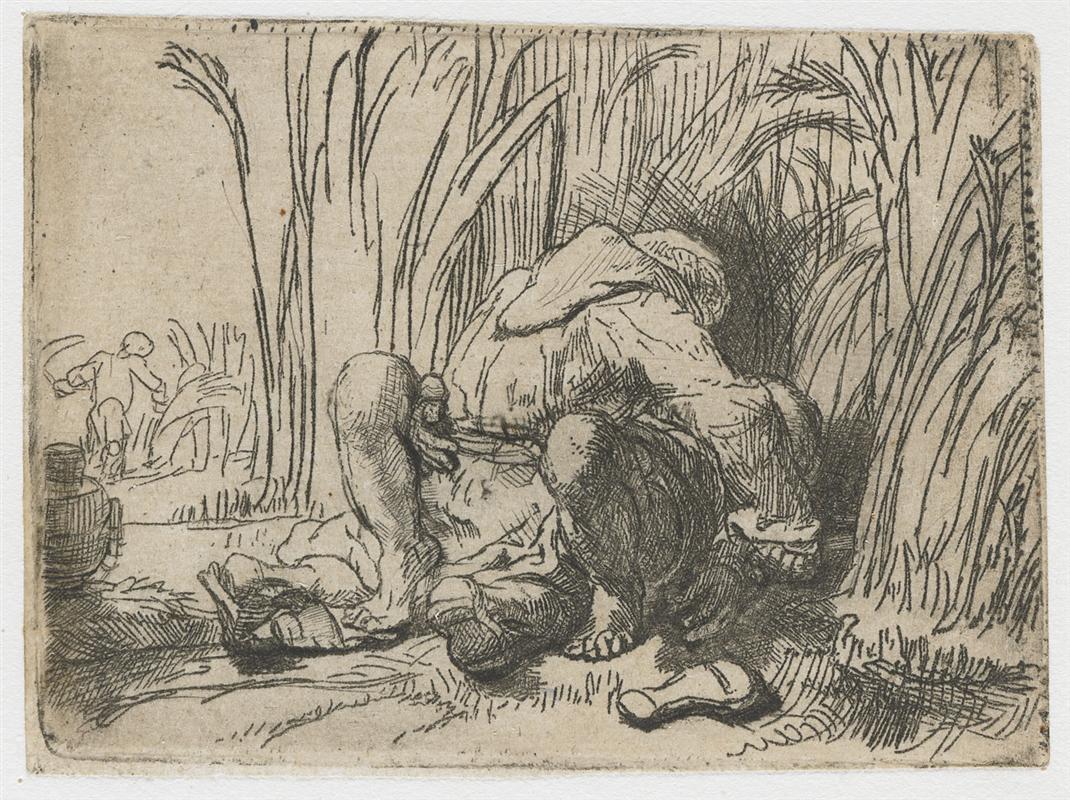
Rembrandt’s small etching often titled “The Monk in the Cornfield” is a miracle of compression. On a sheet scarcely larger than a postcard, the artist stages a rustic corner of field and alder, tucks a drowsing friar into the shade, and lets a second figure reap grain in the sunlit distance. The scene is humble and almost comic at first glance: a heavy-robed monk has sunk to the ground, ankles crossed, back propped against a mound, chin to chest, hat fallen aside. Yet the longer one looks, the more the print discloses an intricate meditation on labor and rest, appetite and discipline, the public field and the private body. With a clutch of hatchings and a few passages of velvety tone, Rembrandt builds a moral landscape that never sermonizes and a genre scene that never trivializes. It is one of those works where the artist’s sympathy for ordinary life and his command of line meet at perfect pitch.
A Composition That Hides Its Sophistication
The design is disarmingly casual. Tall grasses and corn stalks stand like loose curtains at left and right, framing a pocket of shade into which the friar has settled. Behind him a dark mass of foliage creates a rich wedge of tone that throws his robe forward. In the left background, a narrow opening reveals a worker with sickle raised, tiny against the vertical stalks. A barrel stands near this aperture, a simple cylinder that rounds the space and marks the edge of the monk’s camp. The ground at the friar’s feet is a small theater of things: a discarded shoe, a bag or wallet, perhaps the brim of a hat. The composition reads as found and unplanned, but it rests on stable geometry. The friar’s body is a low triangle; the wedge of foliage behind him opposes that triangle; the negative space at left is a rectangle that balances the weight of shade. If one draws a line from the reaper’s lifted sickle to the monk’s closed eyes, another from the barrel to the abandoned shoe, the diagonals cross in the monk’s torso, the center where appetite, breath, and sleep arrive.
The Monk as a Body That Tells the Truth
Rembrandt’s friar is a study in unguarded posture. The robe bulges where it must yield to sitting; the belt slackens; the shoulder folds sag as gravity pulls cloth and flesh downward. The left leg stretches out and rotates so the sole shows; the right leg tucks, knee raised, heel dug into the soil for purchase. The hands settle in a soft clasp; the head tips so far forward that the neck disappears. The draw of sleep is overwhelming and ordinary, and the artist records it without rebuke. In the seventeenth century, artists frequently used friars as emblems of sloth or gluttony, a stock device for satire. Rembrandt does not deny the comic element—the fallen shoe is almost a stage prop—but he declines caricature. The monk’s body feels heavy because bodies are heavy when they are tired; the shade seems cool because the cross-hatching there is dense and directional; the field beyond looks hot because the paper is left almost bare.
Work and Rest as a Two-Part Invention
What makes the print sing is the counterpoint between the sleeping friar and the distant reaper. The reaper is all angle—arm cocked, blade raised, legs stepping—while the monk is all curve. One figure catches light; the other absorbs it. One shrinks to a silhouette; the other swells with texture. Rembrandt thereby proposes a two-part invention on a rural theme: labor and rest are neighbors in the same field. Because he places the worker in a small, windowlike opening, the viewer experiences him not as a rival narrative but as time passing elsewhere. The monk’s nap exists inside the day’s larger rhythm. The picture’s humor comes from the closeness of contrast; its tenderness comes from the refusal to press the contrast into accusation.
Etching as a Language of Grass, Cloth, and Sleep
Technically the sheet is a marvel. Rembrandt varies his etched lines with exquisite sensitivity to material. Tall grasses are described with long, elastic strokes that taper like blades; the dense hedge behind the friar is built from cross-hatched meshes that bend against one another like interlocking leaves; the robe is modeled with short, soft strokes that gather where folds catch and relax where cloth stretches; the ground bears a few broad, dragged lines that suggest rough soil and flattened straw. Plate tone—the residual film of ink left on the plate—hangs over some impressions like a warm haze, deepening the shade and making the air feel humid. In clearer impressions, the lines assert themselves with graphic crispness, and the comedy sharpens. Both states persuade. The first reads like a nap taken in July heat; the second like a quick nap stolen in spring.
A Tiny Still Life of Things That Earn Their Keep
Rembrandt never wastes a detail. The barrel at left is not a symbol of tavern excess; it is a usable object anchoring the edge of a clearing. The bag at the monk’s hip and the small pouch at his belt corroborate a life lived outdoors, walking, collecting, pausing. The shoe thrown off at the foreground does double work: it deepens the humor and proves the nap’s duration. Few people remove shoes for a momentary doze. The scattered objects make the scene feel unposed; they are the debris of a life continuing within the nap.
The Field as a Theater of Moral Weather
Because the artist supplies almost no sky, weather is inferred from tone and texture. The left opening where the reaper stands is as bright as the sheet will allow; blades there are thin, as if backlit. The friar’s grotto of grass is dense and cool; one can almost feel the damp of soil and the smell of crushed stalks. This environmental contrast turns moral by implication. Work happens in glare, where visibility is maximum; surrender to sleep happens in shadow, where the body forgets the watching world. Yet the shadow is not sinister. Rembrandt’s black is soft, like shade made by leaves. The print honors both climates without forcing a choice.
A Rural Subject With Urban Intelligence
Rembrandt’s Amsterdam audience knew markets and canals more than fields and hedgerows, yet the Dutch Republic’s self-image was deeply tied to agrarian labor—the seasonal cutting and shipping of grain that fed cities and trade. By presenting a monk asleep in a cornfield while a reaper works, the artist touches a cultural chord. He records the rustic with accuracy and lets the urban moral tug gently at the edges. The scene is not propaganda for industriousness, but it makes a city viewer feel the pace of labor that supports comfort, and it lets that viewer smile at a human whose vows have not exempted him from drowsiness.
Humor Without Cruelty
Rembrandt liked jokes that respected their subjects. The friar’s body sprawls, but it is not lewd; the stockinged foot shows, but it is not exhibited; the hat and shoe mark mild disorder, not shame. The reaper’s tiny figure, arm lifted, is comical by scale but dignified by purpose. Even the line that suggests the monk’s chin sinking into chest is gentle. The humor arises from timing and juxtaposition, not from ridicule. One can imagine the monk waking, smiling at his own lapse, and moving on. That generosity of imagination is part of the sheet’s charm and a key to its lasting freshness.
A Study in Rhythms of Line
Look closely at the long stalks. Some rise perfectly vertical, others arc, and still others fork like quick notations from a calligrapher’s brush. Rembrandt conducts them like a chorus, alternately spacing and clustering to produce visual rhythm. This rhythm supports the narrative: the lullabies of grass around the sleeper and the metronome beat of stalks around the worker. The artist’s experience as a painter of drapery, foliage, and hair informs every stroke; the cornfield is treated as a vast garment drawn over the earth, pulled tight here, loosened there, creased where the monk leans.
The Body’s Physics and the Persuasion of Weight
The nap convinces because the physics convince. The monk’s left knee projects toward us and then drops; the weight of the right thigh presses the robe into sag; the heel of the tucked leg bites shadow into soil; the spine roundness pushes the scapulae outward; the head’s weight collapses the neck; the belly softens where the belt no longer constricts. These are the small truths one recognizes from the honesty of one’s own body. Rembrandt’s figuring of them is unshowy and exact, and because they are right, the sheet’s entire atmosphere seems true.
The Distant Harvester as a Scale for Compassion
Placing the worker so far away accomplishes two things. It keeps the scene from becoming narrative scolding; the reaper is simply there, as the day is there. It also enlarges the friar by contrast, bringing him near so we can inspect his humanness. Many depictions of monks in art flatten them into types. By making the worker tiny and the sleeper intimate, Rembrandt flips the usual order. A specific person receives our attention, and the public rhythm of labor takes its proper place as context, not judge.
Echoes within Rembrandt’s 1646 Suite
The year 1646 yielded a cluster of sheets in which Rembrandt explored unguarded moments—lovers in a curtained bed, a beggar woman leaning on a stick, male models resting, biblical travelers at a city gate. “The Monk in the Cornfield” belongs to this humanist mode. Rather than illustrating a doctrine, these prints watch people at thresholds of privacy: sleep, hunger, weariness, desire, hesitation. The small scale suits the subject, demanding that the viewer come close and adopt the same tact the artist extends to his models.
The Plate as a Pocket of Time
Etchings like this were printed in multiple states, and impressions vary in wiping and wear. Some hold a haze of ink that turns the grotto into velvet; others are bright, the lines crisp, the jokes sharper. Each impression is a slightly different afternoon. That variability is not incidental; it aligns with the scene’s temporality. A nap is the most perishable of events, and the plate acknowledges that by refusing to fix the atmosphere once and for all. The print remains alive because it is never exactly the same.
A Parable Without a Caption
If one wished, one could read the sheet as a parable of vigilance and neglect, as a mild satire of clerical softness, or as a reminder that vows cannot defeat the body’s needs. Rembrandt gives room for all such readings but compels none of them. His true allegiance is to observation and to the ethics of seeing. He gives us a man who has fallen asleep in a place where others work, and he surrounds that fact with the kindness of shade and the rigor of line. The rest is entrusted to the viewer’s conscience and humor.
The Viewer’s Position and Responsibility
We stand on the ground with the friar, close enough to touch his shoulder and wake him, far enough to watch without intruding. We also command the view to the left where the reaper continues. This double vantage makes us participants. We could be a fellow traveler who pauses and decides whether to let the man sleep. We could be the reaper’s companion glancing back. Rembrandt invites this kind of role play by giving us both intimacy and overview. Looking becomes a small rehearsal for judgment and mercy.
Contemporary Resonance and the Tender Eye
Modern audiences, accustomed to images that sensationalize laziness or idealize productivity, can find in Rembrandt’s print a relief. It respects bodily need without celebrating vice, honors work without despising rest, and restores humor without cruelty. In an age of constant output, the monk’s brief surrender to shade feels honest and perhaps enviable. The print reminds us that fields need reaping and people need naps, and that a humane society makes room for both.
Conclusion: A Shade of Kindness at the Edge of a Field
“The Monk in the Cornfield” is at once joke, study, and gentle homily. A friar sleeps where grain sways; a reaper lifts his arm in the sun. Between them stands Rembrandt’s understanding that art can dignify ordinary lapses and ordinary labor with equal grace. The etched lines bend like grass, thicken like hedges, soften like cloth, and rest like a tired man. Nothing here is grand; everything is precise. It is the kind of small masterpiece only a great artist can trust: a corner of field, a patch of shadow, a body that tells the truth about itself, and a viewer close enough to see.
