Image source: wikiart.org
Introduction to Rembrandt’s “The Man of Gibeah” (1646)
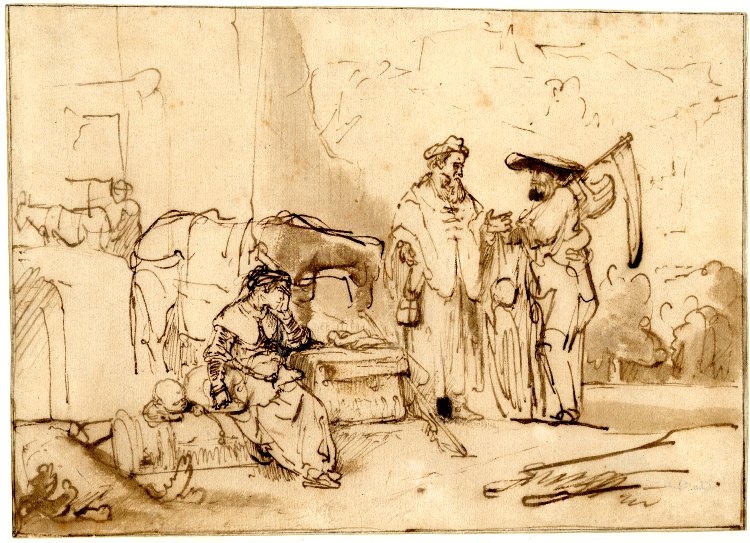
Rembrandt’s “The Man of Gibeah” is a taut, small-scale drawing that distills a harrowing Old Testament episode into a scene of uneasy hospitality. Executed in pen with brown wash in 1646, it stages a moment from Judges 19: a Levite and his concubine have reached the Benjamite town of Gibeah; strangers pass them by until an old man finally offers shelter. Rembrandt chooses the hinge of the narrative—the instant when welcome hesitates at the threshold, before the night turns catastrophic. With just a few vigorous lines and diluted wash, he conjures a market edge, a packed donkey, a travel chest, a host who argues with a wide-hatted traveler, and a woman who slumps in exhaustion. Everything necessary is here, and almost nothing extra. The drawing’s power lies in how its economy of means becomes an economy of moral attention.
The Scriptural Source and the Chosen Moment
The story in Judges is among the Bible’s darkest. A traveling Levite, his concubine, and a servant seek lodging in Gibeah. No one receives them until an old man from the countryside insists they stay in his house. That night townsmen surround the home demanding the traveler be handed over; the ensuing violence leads to the woman’s death and a civil war. Most artists, when they touch this episode at all, choose the siege at the door or the aftermath. Rembrandt, with typical moral tact, backs up to the prelude—the negotiation of shelter in a public square. By withholding the violence, he focuses the viewer on the civic failure that makes violence thinkable: a town that leaves strangers to fend for themselves unless a single righteous person intervenes.
A Composition Built on Triads and Thresholds
The drawing organizes its figures into a clear triangle of attention. At the left sits the woman, collapsed on a low block before a piled chest and sleeping pack animal; at the center stands the elder of Gibeah, his robe falling in simple verticals; at the right the traveler, hat brim wide, gestures with the awkwardness of one who must ask. The three points form a stage where lines of responsibility cross. The woman’s lowered head draws the eye down, the elder’s upright figure pulls it up, and the traveler’s raised hand extends the action outward into the street. Behind them, faint lines suggest buildings and distant folk, but Rembrandt keeps them ghostlike. Architecture and crowd are not agents here; duty and hesitation are.
Gesture as Moral Grammar
Rembrandt tells the story through hands. The host’s left hand opens, palm down, in a calming argument; his right thumbs the strap of a small jug or lantern that hangs from his girdle, the instrument of bringing strangers home. The traveler’s hand rises in a half-plea, half-explanation, echoing the shape of a question mark. The woman’s hand droops between knee and chest, fingers slack, the anatomy of spent strength. These three distinct gestures describe a triangle of generosity, need, and depletion. Even the donkey contributes a gesture: its head hangs over the chest in a curve of patient animal fatigue, a visual rhyme with the woman’s pose.
The Woman as Center of Gravity Though Not of Action
Although she does not speak in the drawn moment, the concubine centers the moral field. Rembrandt seats her slightly forward, so that the viewer meets her first on entering from the left. Her cowl and garment are drawn with thicker strokes that catch the wash, making her volume more solid than the airy figures to the right. The artist resists caricature or pitying theatrics; he merely records the posture of a long day. A small jug sits near her foot; the strap of her bag slides across her lap. Every sign says the same thing: she needs the room, the meal, the rest she has not yet been offered. In a narrative often told from the men’s perspective, Rembrandt’s staging gives the woman the visual weight of consequence.
The Old Man of Gibeah and the Ethics of Welcome
The central figure bears the middle burden: he must decide. Cloaked and bearded, he looks toward the traveler with active concern, not suspicion. Rembrandt draws the face with quick, searching lines but makes the body speak most clearly. The elder stands slightly open to the traveler and slightly turned toward the woman, like a door not fully shut. This in-between posture captures the essence of hospitality: a readiness to shift one’s stance to accommodate another. The small dark circle at his feet (perhaps a shadowed knot in the ground or a drain) serves as a compositional anchor, holding him where conscience plants him.
The Traveler and the Implicit Servant
At the right, the traveler’s costume is a study in road-worn practicality: wide hat, staff, sacks, and the flaglike cloth slung across his shoulder. His body leans toward speech, but his feet are planted—a man who has walked far and will not walk farther tonight if he can help it. Rembrandt omits the servant mentioned in the biblical text or folds him into the faint background figure emerging through an arch at far left. The omission is deliberate. By keeping the group small, the artist intensifies the exchange between obligated host and vulnerable strangers.
Wash and White Space as Theatrical Air
The warm brown wash that pools behind the figures creates a shallow theater of dusk. It falls darker behind the standing men and lightens around the seated woman, giving her relief without false spotlight. In the upper half of the sheet, Rembrandt leaves ample blank paper where few lines scratch in hints of clouds or stucco. That white expanse is not empty; it is the civic air into which any passerby might step and either ignore or assist. The drawing’s morality is written in this atmosphere: public space is either a vacuum where suffering evaporates or a stage where welcome is performed.
Luggage, Tether, and the Evidence of Travel
Rembrandt lavishes attention on the objects that verify the travelers’ claims. The travel chest is stout and practical; straps and ropes bind its bulging lid; the donkey’s blanket folds over the edge in convincing droops. The tether line traces a graceful curve to the left as if recently looped around a peg. These concrete details prevent the scene from dissolving into allegory. The travelers are not “types”; they are people with a known weight of baggage and a borrowed animal in need of fodder and rest.
The Square That Fails and the House That Will Save
At the far left, beyond a low wall and arch, a tiny figure reclines or slumps in his own space, oblivious to the drama. This miniature citizen stands in for the town that will not take responsibility. In contrast, the middle ground near the host and traveler is clean of interior lines, a negative space into which a path home can be drawn. Rembrandt thus constructs an ethics of architecture: public squares can abandon, houses can rescue, and the line between them is the breadth of a man’s decision.
The Drawing’s Pace and the Breath of Rembrandt’s Hand
The pen moves at two speeds. In figures and objects, lines are brisk, calligraphic, confident; in the sky and far buildings, they slacken into quick indications. The alternation produces a rhythm that matches the scene’s tempo: urgent at the point of speech, unhurried in the world that fails to notice. Occasional pentimenti—adjusted folds, corrected outlines—reveal the artist’s thinking, the way he nudges a hand or shifts a hat brim to tighten dialogue. The wash, laid after the main lines, sinks into the paper like memory, strengthening the larger masses without drowning the nimble drawing.
Hospitality, Violence, and the Logic of Prevention
Because the viewer knows where the biblical story goes, the drawing’s modesty reads as prophetic. A bed offered now might avert a riot later; a meal shared this hour might prevent a death by dawn. Rembrandt’s choice to show negotiation, not assault, reframes the subject as a civic lesson: the most crucial moral acts occur quietly, in the hour before catastrophe, around chests and donkeys and benches. The old man’s open palm becomes a countermove against the clenched fists that will soon appear. The drawing asks whether communities can be built from such palms.
Echoes with Other Rembrandt Threshold Scenes
“The Man of Gibeah” belongs with Rembrandt’s many threshold drawings—prodigals at doors, travelers at inns, beggars at stoops, mothers and children in entryways. In these works, architecture is social instrument: doors symbolize choice, thresholds enforce etiquette, interiors become judgments about character. Compared to the broader genre scenes of his peers, Rembrandt’s threshold sheets are narrow and ethical. They are not busy markets or merry companies; they are moral barometers measuring the weather between those who need and those who can help.
Costume and Cultural Translation
Rembrandt dresses his figures in a hybrid costume that allows biblical time to live in Dutch drawing. Long robes and headcloths coexist with the traveler’s broad brim and knapsack. The mixture is intentional: it imports the ancient story into the recognizable world of seventeenth-century viewers without pedantry. By refusing antiquarian fuss, Rembrandt makes empathy easier. A Dutch viewer could imagine this negotiation at a city gate, and so the lesson lands closer to home.
Donkey, Jug, and the Poetics of Use
The animal’s patient profile, the jug’s weight on the host’s girdle, the low chest’s scuffed edges—these signs of use elevate the scene’s truthfulness. Rembrandt’s things are never symbolic props first; they are working objects that then inherit meaning. The donkey is not “humility”; it is transport that confirms the mileage on the travelers’ feet. The jug is not “charity”; it is a container that will fill and pour. This ethic of usefulness keeps the drawing from sermonizing while allowing it to teach.
Light as a Moral Weather
Even without dramatic chiaroscuro, the sheet has a moral climate. Wash cools the left and warms the middle, so that the host’s body is wrapped in the softest atmosphere. The rightmost figure stands partly against unwashed paper, a brighter field that reads as exposure. The woman sits in a pocket of gentle mid-tone, a calm that she has not yet felt in her body. Light here is not spectacle; it is a forecast of how care might redistribute brightness among those who need it.
The Viewer’s Vantage and the Responsibility of Witness
We stand at ground level, a step or two from the woman, close enough to hear the men’s first words. The vantage makes us potential participants. We might lift the rear of the chest, take the donkey’s rope, or simply nod in affirmation as the host insists. Rembrandt uses this proximity to turn spectatorship into ethical rehearsal. Looking is not neutral; it leans toward help or toward indifference. The drawing asks which way we lean.
Relation to Rembrandt’s 1646 Experiments in Narrative Drawing
The year 1646 finds Rembrandt exploring quick narrative sheets where pen-line speed and wash breadth carry complex emotions. Alongside domestic holy families and scenes of Abraham’s hospitality, “The Man of Gibeah” extends a theme: how private kindness counters public failure. Instead of building large compositions with many actors, he discovers how much drama a trio can hold and how negative space can act like silence in which conscience speaks.
The Afterlife of a Small Sheet
The drawing’s scale encourages intimate viewing. One must come close, the way one must approach to overhear a conversation. That physical nearness sharpens the story’s relevance; the viewer becomes a fourth figure on the square. Over centuries, this intimacy has preserved the sheet’s freshness. It still feels like a note made from life, though it records a text written millennia earlier. That paradox—immediate and ancient—gives the work its staying power.
Contemporary Resonance: The Ethics of Welcome Today
Modern cities echo Gibeah’s dilemma daily. Travelers arrive—migrants, refugees, the displaced, the poor—and public squares test our hospitality. Rembrandt’s drawing argues that the moral pivot remains small and human: an individual’s open hand, the practical intelligence of making room, the refusal to let anonymity absolve responsibility. In a time when borders and doorways dominate debate, the sheet’s tenderness suggests that prevention is the deepest justice: care now rather than vengeance later.
Conclusion: A Quiet Plea on a Public Square
“The Man of Gibeah” is quiet, swift, and exact. With a few strokes and a veil of wash, Rembrandt builds a square, a chest, a donkey, a tired woman, and two men at the cusp of a decision. The drama is not spectacle but conscience. By choosing the moment before catastrophe, the artist honors the saving power of ordinary hospitality. The old man’s open palm is the drawing’s final word—a small gesture that, if multiplied, would rewrite the night that follows. In a world that loves climaxes, Rembrandt invests meaning in prevention. He invites us to imitate the host of Gibeah long before the door is pounded.
