Image source: wikiart.org
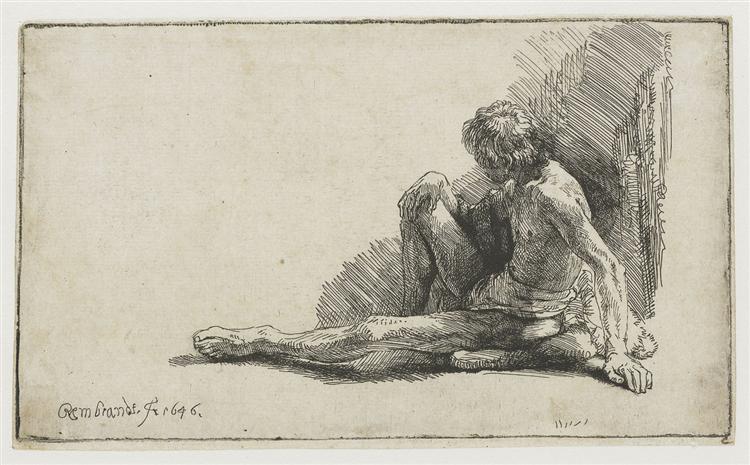
Introduction to Rembrandt’s “Nude Man Seated on the Ground with One Leg Extended” (1646)
Rembrandt’s “Nude Man Seated on the Ground with One Leg Extended” is a spare, electrifying etching from 1646 that turns a modest sheet of paper into a stage where the human body thinks. A young male model sits on a rough surface, back pressed to a wall, left leg stretched long into the foreground, right knee drawn up, right hand braced behind him for balance. The figure turns away from us so that the face remains largely in profile and shadow, while the ribcage, abdomen, and long leg collect the light of etched highlights. Around him, space is almost blank—only a wedge of diagonal hatching suggests the corner and the weight of air. The economy is deliberate. Because there is almost nothing else to see, the viewer must dwell on posture, pressure, and breath, the very grammar by which a body carries thought.
A Composition Built from Diagonals and Rest
The print’s design is as strict as it is humane. The figure’s extended leg establishes the dominant diagonal from the lower left to the middle distance, a vector of length and fatigue. The drawn-up right knee and bent left elbow supply two counter-diagonals that lock the pose into a stable triangle, while the bracing right arm forms a third support—an oblique pillar set against the wall. Rembrandt echoes these angles with the slanting hatchings that darken the corner; line direction performs the role of architecture. The eye enters at the signature, climbs the shin, detours across the knee, follows the hip into the compressed torso, and finally rests on the turned head where hair and shadow thicken. The whole composition breathes like a sigh: energy gathered, released, and gathered again.
The Studio as Laboratory of Truth
Rembrandt’s figure studies from the mid-1640s reject the smoothed, ideal bodies of academic tradition in favor of living anatomy. The model here is wiry, asymmetrical, articulate in joints and tendons. Muscles do not preen; they answer the physics of the pose. The right side ribs rise under the stretched skin; the abdomen creases where the pelvis rotates; the thigh’s long extensor visibly tenses along the extended leg. Such particulars are not anatomical displays; they are observations of a person negotiating gravity and time. The studio becomes a laboratory of truth, and the etching needle, biting copper, becomes the instrument capable of registering minute adjustments of posture that a broader, painterly medium might blur.
Chiaroscuro with a Needle
Although an etching offers no paint to brush and smudge, Rembrandt conjures chiaroscuro through line density and direction. In this sheet, the brightest planes—the shin, the top of the kneecap, the ridge of the abdomen, and the near shoulder—are defined by the absence of line or by fine, widely spaced strokes. Darkness gathers in cross-hatched pockets behind the model, under the thigh, and along the far flank. The wall’s shadowed wedge amplifies the body’s relief, the way a sculptor uses a niche to bring out form. Because the light is built, not painted, the eye reads it as entirely earned; every highlight is an infarction of paper left unbitten, every shadow a decision to thicken the weave of marks. The effect is intimate, tactile, and utterly convincing.
Gesture that Thinks Before It Speaks
Rembrandt often fixes human action at the hinge between impulse and completion. Here the raised right knee and the turned head imply transition rather than stasis. The model looks past the shoulder as if following a sound or a thought; the hand on the ground is ready to push; the extended left leg, heavy and relaxed, argues for rest. The contradiction animates the sheet: half the body wants to rise, half to remain. That duality reads psychologically. The figure is neither heroic nor abject; he is human, caught between the will to move and the need to breathe. This is why the print feels modern. It captures not a pose but a state of mind conducted through muscle and bone.
The Ethics of Looking at a Nude
Rembrandt’s male nudes have the candor of medical truth without the coldness of a specimen. The turned-away head protects the sitter’s subjectivity and converts the viewer’s gaze from possession to study. We apprehend weight, stretch, balance, and the pulse of breath, not a theatrically presented identity. The short cloth at the waist registers modesty without prudery and anchors the composition with a pale, irregular shape that interrupts the expanse of the pelvis. As in his female nudes, Rembrandt’s ethic is clear: the body is a person’s instrument, not an emblem. The image invites a learning gaze rather than an acquisitive one.
Paper Space as Air and Silence
The empty field surrounding the figure is not neglect; it is air. Rembrandt chooses to leave the majority of the sheet untouched, allowing the slight texture of the paper to function as atmosphere. The quiet amplifies soundless details: the scrape of skin against wood, the grit under a heel, the scuff at a wall. The plate tone in certain impressions drifts over this emptiness like dust in light, deepening the sensation of an afternoon studio where windows sit high and the model rests between sets. Silence in the composition becomes a moral courtesy, a refusal to crowd the figure with irrelevant furniture. In that space the viewer can think.
Anatomy of Weight and Contact
Nowhere does the artist’s keenness show more than in the depiction of pressure. The right hand presses into the ground with a palm that spreads under load, a slight bulge at the heel of the hand articulating weight transfer. The left elbow rides the raised knee and compresses the skin around the joint. The extended leg flattens at the ankle where it meets the floor. Even the small cushion under the buttock yields realistically. These local truths produce the global persuasion of the sheet. Because touch and counterforce are right, we trust everything—the anatomy, the psychology, and the light.
A Dialogue with Antique and Academic Ideals
Rembrandt knew antique sculpture and the academic canon that prized symmetrical, idealized bodies in contrapposto. In this etching he speaks with that tradition and demurs. There is contrapposto, but it is generated by necessity rather than pose; the twist of the torso follows from bracing, not display. Proportions are normal, not heroic. Hair is unbarbered, the body is not oiled, and the skin shows its natural mottling through the cross-hatch. By respectfully refusing the mask of ideal beauty, Rembrandt redirects the viewer’s admiration from type to person. The result is not anti-classical but post-classical: the human takes precedence over the emblem.
The Signature as a Spatial Cue
Rembrandt tucks his signature and the date into the lower left corner, precisely where the extended leg begins. The inscription is not a vanity stamp; it is a compositional anchor. Its crisp horizontal and vertical strokes rhyme with the border and stabilize the restless diagonals of limb and shadow. Psychologically, the signature places the artist in the scene, a reminder that this is a meeting between two people—the observing hand and the model’s patient body—rather than a disembodied abstraction.
The Model’s Head and the Refusal of Drama
The head turns toward the wall, hair falling forward, features barely detailed. Rembrandt resists the temptation to dramatize expression; the mind’s weather reads through neck tendons and shoulder carriage instead. This restraint concentrates dignity. Because the face is not a mask performing for us, the viewer must infer feeling from the larger orchestra of the body. That inversion makes the study active to read. Every return to the print yields new cues—a slight tilt in the jawline, a tension at the trapezius—that change the mood subtly.
The Etching Needle as Recorder of Breath
Look closely at the chest and abdomen and you’ll see how Rembrandt uses short, angled strokes to suggest the shallow breathing of a resting body. Lines converge under the lower ribs, spread across the obliques, and then taper toward the navel. These minute choices produce a sensation that painters often chase with glazes: the skin moving over the engine of lungs. The medium’s limitations become its strength. Because line has to carry both structure and softness, each decision counts, and the viewer feels the draughtsman’s care with unusual immediacy.
A Study That Becomes a Poem
On the face of it, this is a studio exercise—a model taking a break. Yet the print refuses to remain merely academic. The stripped setting, the turned head, the eloquence of angles, and the severe light combine into a small poem about fatigue, attention, and readiness. The body lies long as a thought; the wall’s shadow is the mind’s corner; the supporting hand is resolve; the extended foot is the future, still resting but pointed outward. Rembrandt habitually discovers such metaphors in ordinary posture, and here they arise without a single symbol or caption.
Relation to Rembrandt’s Other Mid-1640s Figure Sheets
This etching belongs to a cluster of studies in which Rembrandt drew male models seated, standing, or reclining in unidealized attitudes. In some, he duplicates the same figure twice on one plate to compare poses; in others, he places a study within a domestic vignette. “Nude Man Seated on the Ground with One Leg Extended” is among the most distilled of the group. The absence of background anecdote focuses attention on the expressive potential of a single arrangement. Across the set, Rembrandt’s interests are constant: how line can model weight, how shadows can be woven from hatching, how a body resting can still narrate.
The Viewer’s Position and the Ethics of Proximity
We are placed low to the ground, almost shoulder-height with the extended knee, so that the body’s length feels present rather than remote. The proximity is intimate but not invasive because the subject faces away. This balance—nearness without trespass—governs the sheet’s tone. It is the visual equivalent of a respectful studio silence: the artist looks closely, the sitter inhabits the pose, and the viewer shares the dignity of that exchange.
Time Inside the Image
Rembrandt often includes a small cue that locks a moment in time. Here, it is the slackness of the left foot and the relaxed splaying of toes, a detail that immediately signals pause rather than preparation. That single fact commands the tempo of the whole picture. We are not witnessing a leap or a fall; we are witnessing the minute after exertion or the minute before standing—a meditative interval that art, at its best, preserves.
The Print’s Modern Resonance
Contemporary viewers recognize in this sheet a way of seeing the body that resists both sensationalism and abstraction. In a culture swamped with perfected images, its wiry truth feels cleansing. The drawing acknowledges effort, resting, and the unresolved mix of strength and doubt that inhabits any human frame. Artists still study it for its structural clarity; physicians admire its keen sense of functional anatomy; poets admire its stillness; ordinary viewers feel, simply, that this is how bodies are when no one asks them to perform.
Technique, Plate Tone, and the Look of Breathable Light
Different impressions of the etching vary in plate tone—the residual film of ink left on the plate when it is wiped. When tone remains along the wall, the shadow zone becomes velvet and atmospheric; when the plate is wiped clean, the sheet glows with a starker, northern clarity. Both states suit the subject. Tone makes the corner feel cooler, deepening the relief of the body; a clean wipe sharpens the graphic music of line. In each, the print’s light reads as breathable rather than theatrical, the sort one recognizes from a window high in a studio wall.
Conclusion: A Human Interval Etched in Copper
“Nude Man Seated on the Ground with One Leg Extended” is a study in how little is needed to say much. A body, a wall, a floor, and a few thousand thoughtful lines suffice to tell the truth about weight, fatigue, and attention. Rembrandt’s genius lies in the way the print refuses to choose between anatomy and psychology, between description and metaphor. The etched marks that build shin, thigh, and shoulder also build a state of mind, and the white space that surrounds the figure becomes the silence in which that mind can be heard. More than three centuries later, the sheet still asks us to look with patience, to honor the ordinary heroism of rest, and to recognize, in a young man leaning against a wall, the durable dignity of being human.