Image source: wikiart.org
Introduction to Rembrandt’s “Woman in Bed” (1645)
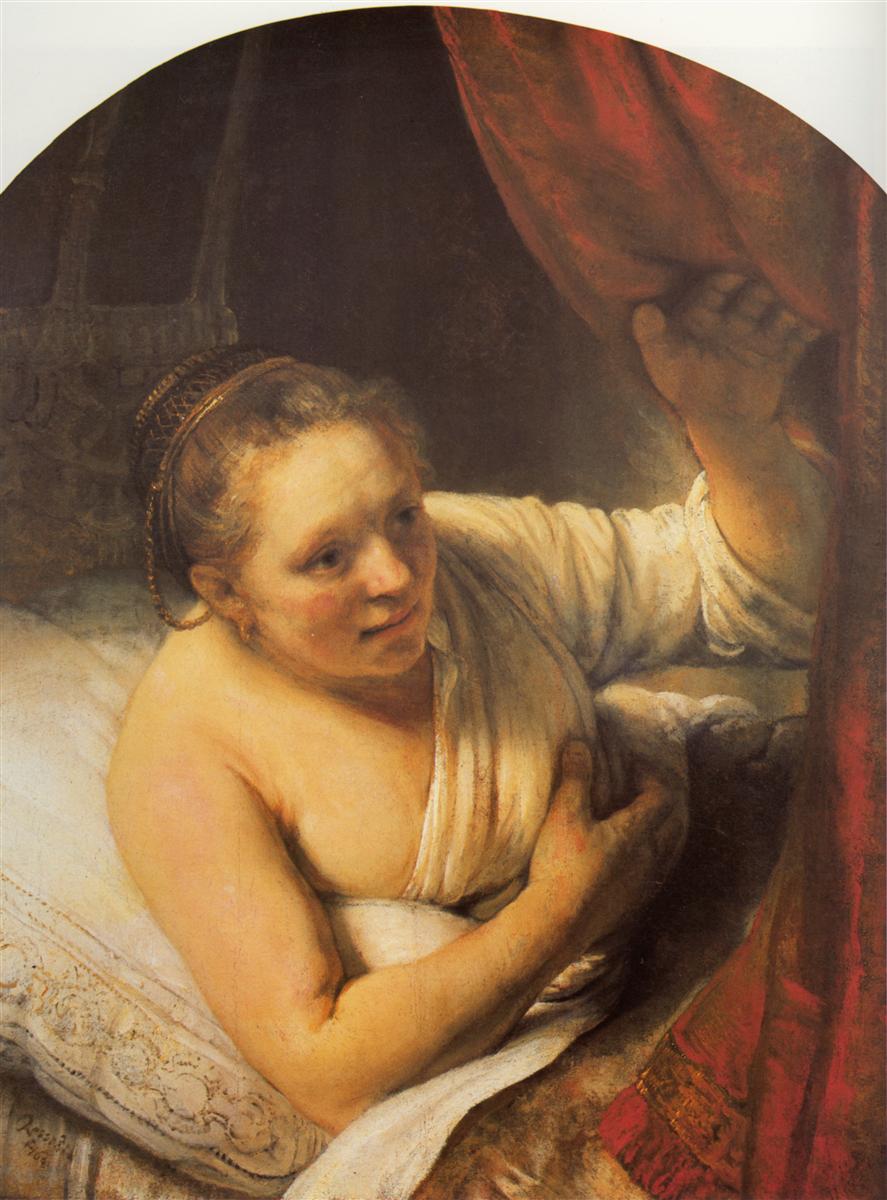
Rembrandt’s “Woman in Bed” is among the most intimate works of his middle years, a painting that exchanges spectacle for nearness. The figure is caught mid-gesture, half-rising from pillows while drawing aside a heavy red curtain. Her body turns toward the opening she makes; her gaze settles softly on someone just beyond the frame. There is no stage set, no narrative furniture beyond bedding and textile; the scene unfolds in a wedge of lamplight and air. With a limited range of colors and a ravishing orchestration of textures—skin, linen, velvet—Rembrandt turns a private moment into a sustained meditation on presence, touch, and the ethics of looking.
A Composition Built Around an Opening
The composition curves like a shallow arch, echoing the arched top of the panel. The woman’s arm, the line of her shoulder, and the pulled curtain establish a powerful diagonal from lower left to upper right. That diagonal is not a mere design trick; it is the hinge of the moment. The figure is not posed; she is doing something—parting fabric to greet light, to invite speech, to acknowledge an arrival. The bed, pushed close to the picture plane, compresses space so that the viewer seems to stand at arm’s length. The intimacy is architectural: a room reduced to a threshold between inside and out, sleeping and waking, private and shared.
Chiaroscuro as an Instrument of Tenderness
Rembrandt floods the face, shoulder, and forearm with a warm, breathable light while letting the background melt into browns and deep reds. This chiaroscuro is never theatrical. It behaves like light filtered through drapery and bed hangings: diffuse, caressing, humane. Shadows along the clavicle, in the open sleeve, and under the chin are soft as breath. The skin reads not as polished marble but as living tissue with temperature and weight. Light here is a moral force; it grants the viewer the right to see only what is offered, keeping the rest—pillow depths, far side of the bed, the space behind the curtain—unexplored and therefore respected.
Gesture, Breath, and the Timing of the Scene
The painting captures a very particular second. The left hand gathers the curtain’s edge, fingers flexing just enough to hold the fold. The right hand, drawn inward, acknowledges the state of undress without panic or pretense. Shoulders lift slightly, as if the body had just shifted upward from reclining to listening. Rembrandt is a master of hinges in time—the instant before an action resolves. Because the image suspends the movement, the viewer’s eye finishes it, imagining the curtain fully drawn or released, the torso settling back or continuing forward. That involvement of the viewer’s body in the scene’s rhythm is the source of its psychological immediacy.
Fabric as Theater and Proof
Textile drives the picture’s drama. The red curtain, thick and fringed, is a wall the hand can move. Its saturated color intensifies the surrounding half-tones and frames the pale skin. The linen sheets and embroidered pillow establish the opposite pole of sensation: cool, porous, absorbent. Between those poles—the sumptuous and the domestic—the figure’s body becomes the neutral ground where light proves itself. Rembrandt’s brushwork changes character accordingly: long, supple pulls in the curtain, small fused strokes on the pillow lace, broken scumbles where cloth crushes under weight. The world is made tangible by how paint behaves.
The Oval Top and the Privacy of the View
The arched format is not incidental. It removes the corners of the rectangle, concentrating attention on the curve of head and arm and the round of the shoulder. The arch also suggests a niche or canopy, an architectural embrace consistent with bed hangings. In such a frame, the figure appears sheltered rather than exposed. The shape tells the viewer how to look: not as a passerby in a public gallery but as a welcomed guest. The painting’s intimacy is formal before it is thematic.
Warm Palette and Skin That Breathes
Rembrandt restricts the palette to honeyed ochres, warm umbers, velvety crimsons, and the chalky whites of linen. Within that restraint, the flesh glows with astonishing variety—pink at the knuckles, cooler along the underside of the arm, faintly bluish in half-shadows where veins lie near the surface. These modulations are not cosmetic effects; they communicate the living circulation of blood and the weight of warmth against cloth. The painter’s knowledge of how color travels through skin is inseparable from the image’s emotional truth.
The Face: Alertness Without Pose
The face is rendered with a tact rare even for Rembrandt. The eyes are awake but not dramatic; the mouth rests between speech and a smile; the brow is smooth with the concentration of one who has just noticed someone she knows. There is no coyness, no contrived glamour. The beauty here is relational—arising because the figure is already in conversation with the unseen other who has approached. The portrait is psychological rather than decorative: a state of mind rather than an arrangement of features.
The Body as Locus of Human Dignity
The partial undress in the painting refuses the categories of titillation and prudery alike. The woman’s right hand acknowledges her body without anxiety, as if to say that intimacy and dignity are compatible. Rembrandt’s empathy lies in this refusal to turn flesh into a commodity. The shoulder is frankly modeled, the breast suggested rather than displayed, the skin given weight and temperature rather than gloss. In his art, bodies are not excuses for virtuoso anatomy but places where light and feeling meet.
The Curtain as Narrative Device
Pulled aside, the curtain converts the bed into a stage, but it also reads as a narrative device. It implies an outside: a doorway, a visitor, the approach of day. In many of Rembrandt’s domestic interiors, curtains serve as instruments of revealing and concealing, and the hand on the fabric is a declaration of agency. This figure orchestrates her exposure; she controls the aperture. The painting’s ethics flow from that control. We see because she has chosen to see us.
Distance, Scale, and the Viewer’s Role
Rembrandt places the viewer close—so close that the cushion’s embroidery can be read, so close that the arm feels within reach. Yet the cropping and the curtain enforce a respectful distance. The picture teaches how to look at another person: be near enough to notice textures and temperature, yet remain outside the red boundary where privacy begins. That paradox—intimacy without trespass—accounts for the painting’s contemporary resonance.
Identity, Type, and Rembrandt’s Humanism
The woman’s identity has been variously speculated in the literature, but the painting itself resists reduction to biography. It offers a type rather than a name: a person at the border of sleep and waking, of privacy and welcome. Rembrandt’s humanism shines in this choice. He prefers archetypes grounded in observation over allegories caught in costume. The work invites anyone to recognize this moment—an encounter at a bedside—without importing a fixed myth or a moralizing code.
Brushwork That Thinks
The surface of “Woman in Bed” is a record of decisions. In flesh passages, small strokes cohere into soft transitions, as if the brush were breathing with the model’s skin. In the curtain, loaded pigment sits higher on the weave, catching light to simulate nap and fringe. In the pillow, the brush sometimes skates nearly dry, leaving a granular trail that reads as lace. Such variety is not merely a pleasure for connoisseurs; it is how the painting reasons. Texture tells us where to look, what to touch with the mind’s hand, when to sense softness or weight.
The Psychology of Nearness
Rembrandt’s portraits often imagine the viewer as a participant in a relationship; here that dynamic is overt. The direction of the gaze, the opening curtain, and the slight forward lean all posit an addressee. The painting thus becomes a mirror for whoever stands before it. Each viewer takes the place of the person entering; each viewer receives the same moderated welcome. This shared structure of approach and response gives the image inexhaustible freshness: it re-enacts first seeing every time it is seen.
Domestic Luxury and the Ethics of Comfort
While the setting is intimate, it is not austere. The red textile is good cloth, the pillow embroidered, the hair bound with careful coils. Comfort is not condemned; it is humanized. The bed is a site of rest and conversation, not a throne. By granting small luxuries their place, Rembrandt sidesteps piety’s suspicion of pleasure. Here, the moral temperature is set by mutual regard, not by self-denial. The painting proposes that beauty belongs in daily life where love and speech occur.
A Conversation with Dutch Interior Traditions
Seventeenth-century Dutch painting teems with domestic scenes—letter readers at windows, women pouring milk, figures framed by half-drawn curtains. “Woman in Bed” converses with that tradition while stripping it to essentials. There is no window, no tiled floor, no instructive emblem. Instead, Rembrandt isolates the interpersonal core. He adapts the culture’s taste for interiors to a single, breathing relationship and lets the rest of the room fall away.
The Oval as Timekeeper
The arched top can also be read as a clock. It presses the figure into a present tense—now—by limiting visual escape routes. The picture has the temporal vividness of a first glance, a moment that will change in the next second when the hand releases or pulls the curtain further. The format’s closure intensifies that sense of passing time, making the image feel like a cup that briefly holds what otherwise would spill.
Sensation and Memory
Few paintings evoke touch as convincingly. The warmth of the arm, the cool of the sheet, the dense nap of the curtain—these are sensations that the body remembers even when the eye has moved on. Rembrandt’s gift is to activate those memories without resorting to spectacle. The painting lives not in the retinas only but in the skin and the breath, which is why it continues to feel intimate across centuries and cultures.
The Ethics of Showing and Withholding
Perhaps the most modern aspect of “Woman in Bed” is its understanding of consent as an aesthetic principle. The figure decides what to reveal; the painter respects her decision by modeling only what the light touches and letting shadow keep the rest. The viewer’s role is to accept the given and refrain from forcing the curtain wider with imagination. In this pact among model, artist, and audience lies the painting’s calm.
Conclusion: A Threshold Made of Light and Cloth
“Woman in Bed” endures because it turns a modest act into a poem about encounter. A woman wakes and opens a curtain; light finds her; paint records the meeting. Everything essential is here—gesture, breath, texture, regard—and nothing extraneous. The painting asks for the viewer’s best attention and rewards it with a humane vision: intimacy grounded in respect, beauty born of nearness, and the knowledge that the most consequential thresholds in life are made not of stone but of light and cloth.
