Image source: wikiart.org
Introduction to Rembrandt’s “Boazcast” (1645)
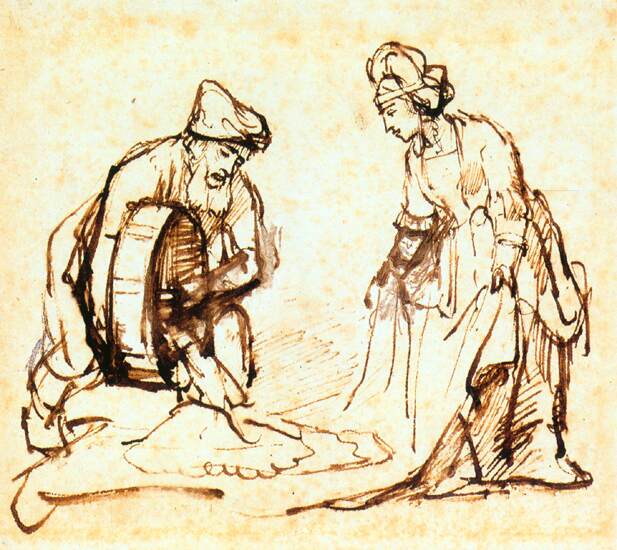
Rembrandt’s small sheet often titled “Boazcast” distills a moment from the Book of Ruth into a handful of urgent lines. Two figures in “oriental” dress face one another across a low heap of grain. At left, an older man bends, tipping a round measure; at right, a young woman gathers her robe to receive the gift. The drawing, executed with brisk pen strokes and touched with brown wash, reads like an eyewitness note—swift, tender, and exact about gesture. What it captures is not spectacle but the quiet economy of charity: grain passing from hand to fabric, from field-owner to foreign gleaner, from abundance to need. In 1645 Rembrandt was deeply engaged with biblical subjects and with the expressive power of ink; this sheet shows both obsessions working together with disarming simplicity.
The Scriptural Moment and Its Human Stakes
The Book of Ruth recounts how Ruth, a Moabite widow, comes to Bethlehem with her mother-in-law Naomi and gleans in the fields of the wealthy Boaz. Moved by her loyalty and vulnerability, Boaz instructs his workers to let her glean freely and later measures grain for her to carry home. “Boazcast” appears to record precisely that exchange of measure—a practical enactment of hesed, the Hebrew word for steadfast kindness. The drama is pastoral and domestic rather than epic. No angels arrive, no crowds gather. What matters is the ethics of provision expressed through workaday implements. Rembrandt chooses this hinge of the narrative because it is where intention becomes gesture, where the story’s theology is carried by a sack, a measure, and a pair of hands.
Composition as a Dialogue of Triangles
The composition is an intimate duet arranged across the page. Boaz occupies the left with a triangular crouch: head bent, torso leaned forward, one knee up, the drum-like measure angled toward the center. Ruth stands at the right in a counter-triangle: body tall and slightly inclined, arms extending down as she gathers the hem of her garment to make a makeshift container. Between them a low mound of grain forms a third, earthbound triangle—the result and rationale of their meeting. The page asks the eye to shuttle repeatedly along this triangular conversation: tool to fabric, giver to receiver, supply to need. Because the drawing is small and the marks are quick, that shuttling happens at the speed of breath, which is why the scene feels alive.
Line, Wash, and the Speed of Seeing
Rembrandt’s pen line here moves with the agility of thought. Contours of turban and sleeve snap into place with a single stroke; hatching deepens in the interior of the measure and under Ruth’s robe; brown wash pools at elbows and in the shadow of the vessel to anchor the figures to the ground. The alternation of dry line and wet wash is not decoration; it is optical tactics. Line names a form; wash gives it weight and temperature; the unworked paper supplies air and light. One can read the order in which the drawing was made—Boaz’s crouch first, then the round of the measure, then Ruth’s receiving fold, and finally the accents of wash—because the urgency of the hand is preserved. That urgency matches the charity being depicted: quick, practical, without fanfare.
Gesture as Moral Language
Rembrandt’s art often relies on hands to speak. In “Boazcast” each figure’s hands articulate character. Boaz steadies the measure with a laborer’s grip, fingers splayed to control the pour; the angle of his wrist tells us he will not spill wastefully, yet he is generous in quantity. Ruth’s hands pull her garment outward in a cradle that can hold more than the first heap. Her posture conveys readiness and humility without servility. The whole exchange is a choreography of hands—a grammar of gift, reception, and trust. Viewers who know the story feel the future in these hands: Ruth’s security for the day, Naomi’s relief at home, and, beyond them, the lineage that will run through Boaz and Ruth to David.
“Oriental” Costume and the Poetics of Distance
Rembrandt had a cupboard of exotic garments in his studio and frequently clothed biblical figures in turbaned, Near Eastern dress to give them an aura of antiquity and dignity. Here the turbans, layered robes, and sash turns provide visual interest and cultural distance without becoming costume pageantry. The folds are drawn for their structural logic, not for ornament; each line helps the body read. The result is a useful ambiguity: these could be Boaz and Ruth in ancient Bethlehem or neighbors in Amsterdam’s multicultural streets seen through a biblical lens. That doubleness lets viewers translate the ethic of the scene into their own time.
The Heap of Grain as Fulcrum
The small mound of grain between the figures is the fulcrum on which the sheet’s meaning balances. Rembrandt does not render individual kernels; he records the softness of a pile with a few ovals and scalloped lines. Its lowness keeps the exchange within reach and scale; its formlessness signals that the gift is not yet fixed—it will grow as the measure pours. Because the heap is unheroic, the drawing resists turning charity into spectacle. Provision in this world is granular and daily, a matter of enough rather than excess.
Space, Ground, and the Breath of Paper
There is no detailed background. A few contour lines suggest ground plane; the rest is unmarked paper. This choice has two effects. It brings the figures forward, letting them breathe in ample white air; and it universalizes the scene by refusing specific architecture. The lack of setting is not a lack of craft; it is an ethic. The story needs no stage beyond the ground underfoot and the blankness that stands for open day. Rembrandt trusts the viewer’s imagination to supply climate and context—a field, a threshing floor, a corner of a barn—because the heart of the matter lies in the meeting of persons.
Economy of Means, Completeness of Meaning
The sheet is a demonstration of how little is required to make meaning complete. Where another artist might surround Ruth with gleaners or Boaz with stewards, Rembrandt reduces cast and props to essentials: two bodies, one measure, one garment, one heap. Because nothing distracts, everything signifies. The eye completes what the hand implies, and the satisfaction of recognition—“I know this story; I see this gesture”—deepens the viewer’s involvement. The drawing thereby becomes a participatory parable about sufficiency.
Theological Substance in a Workaday Act
The Book of Ruth is cherished for presenting covenantal love through mundane acts—walking back with a mother-in-law, gleaning in a field, measuring barley. “Boazcast” preserves that theology. There is no radiance or halo, no calligraphic annunciation. Grace arrives in the form of a man who has the authority to be generous and a woman who has the courage to receive. In Rembrandt’s Protestant Amsterdam, this message resonated with domestic piety: godliness enacted in workplaces and kitchens rather than on altars. The sheet visualizes that creed with empathy and tact.
Gender, Power, and Reciprocity
Although Boaz’s posture implies power—he controls the measure—the drawing subtly insists on reciprocity. Ruth’s upright stance and poised arms refuse the posture of mere begging; she collaborates in the transfer, making a container from what she has. Boaz, meanwhile, is not enthroned but crouched, bringing himself to her level. Their heads tilt toward each other in a triangle of attention that reads as mutual regard. The sheet therefore avoids both sentimental helplessness and patronizing largesse. It proposes an ethic of aid that dignifies both giver and receiver.
Time, Motion, and the Unfixed Present
Frozen images can still move if the eye senses an unfinished action. “Boazcast” captures the pour in midstream; the grain has just begun to mound; Ruth’s garment is still being arranged. This suspension keeps viewers inside the present tense—before the heap is tied and heaved, before the day’s heat presses down, before Naomi’s gratitude. Rembrandt often chooses such hinges because they invite the imagination to complete the scene and because they dramatize the moral stakes: will the measure be ample? will the garment hold? will the exchange proceed without shame? The drawing answers gently—yes—while leaving the action open enough to remain true.
Kinship with Rembrandt’s Broader Drawing Practice
The sheet belongs to the cluster of quick biblical studies Rembrandt made in the 1640s, where he tested narrative clarity with minimal means. A similar economy animates his studies of the Prodigal Son, Abraham and Isaac, and Joseph’s dreams. Across them all, the artist reduces apparatus so that gesture and face carry the weight. The overlapping pen lines and brown wash, the reliance on negative space, and the confident shorthand for drapery connect “Boazcast” to this broader practice. It is a laboratory note vivid enough to stand alone as a finished work.
The Viewer’s Role and the Ethics of Looking
The vantage grants viewers the privilege of standing close, slightly above the heap, as if participating in the exchange. But the drawing also disciplines us: we are near enough to see but not to intervene, invited to witness with sympathy instead of judgment. The ethical lesson of the sheet thus extends to the act of viewing. To look well is to let generosity unfold without turning it into spectacle, to honor the privacy of the poor, and to recognize abundance as a responsibility rather than a trophy.
The Resonance of Daily Bread
For Rembrandt’s contemporaries, grain was life, and the textures of its economy—harvest, storage, milling, baking—were part of the year’s rhythm. “Boazcast” therefore speaks to a visceral sense of daily bread. We can feel the slight drag of the measure’s rim against the heap, the rustle of cloth as Ruth gathers it, the gritty weight that will soon pull at her arms. The drawing’s material specificity is what gives it devotional force. Gratitude arises not from an icon’s radiance but from the recognition of bread as gift.
The Sheet’s Afterlife in the Imagination
Small drawings have a way of expanding inside memory. “Boazcast” lingers because it compresses so much—scripture, ethics, social observation—into a moment that a viewer can carry. The next time one sees a server pour grain or a parent measure rice, the image returns. That portability is a function of Rembrandt’s choices: minimal staging, maximum empathy, and a pace aligned with the ordinary gestures of a day.
Modern Relevance and the Politics of Provision
For contemporary readers, the drawing’s relevance is immediate. In a world anxious about scarcity and inequity, “Boazcast” models generosity that is concrete, reciprocal, and unadvertised. It suggests that the drama of provision happens at ground level and that dignity is maintained when gift and reception are both active. Rembrandt offers not a policy but a posture: bend with what you have; receive with what you carry; let enough become grace.
Materiality, Paper, and the Beauty of Imperfection
The sheet’s warm paper, scattered with small foxing marks, contributes to its appeal. The modest support and the visible aging suit a subject about endurance and humility. Imperfections—blotted turns of line, small pools where the wash darkened—remind us that beauty in Rembrandt is allied to truth rather than polish. The drawing’s honesty about its making parallels the story’s honesty about need and generosity.
Conclusion: A Measure of Mercy
“Boazcast” is a quiet masterpiece of narrative empathy. With a few strokes and washes, Rembrandt turns biblical kindness into a choreography of hands and cloth, measure and mound. Nothing is overexplained, yet everything essential is present: the weight of grain, the tilt of the measure, the respect in posture, the reciprocity of giving and receiving. The sheet teaches without preaching that mercy is made of ordinary gestures, that abundance becomes itself when it moves, and that the most trustworthy art is the kind that honors small acts with exact attention.
