Image source: wikiart.org
Introduction to Rembrandt’s “Men in Oriental Dress and Two Studies of a Beggar in Half Figure” (1645)
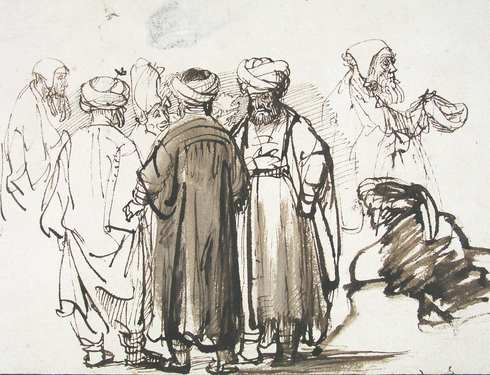
Rembrandt’s sheet “Men in Oriental Dress and Two Studies of a Beggar in Half Figure” gathers a small crowd of figures into a lively exchange of line, wash, and imagination. Produced in 1645, the drawing shows several turbaned men clustered in conversation while, at the right margin, a hooded beggar is studied twice, once upright and once stooped. What looks at first like a casual studio note is, on sustained viewing, a compact treatise on human variety, social theater, and the alchemy by which inked strokes summon character. The sheet exemplifies Rembrandt’s middle-period habit of treating drawings as thinking surfaces—places where curiosity about the world becomes form.
Amsterdam, Trade, and the Lure of Exotic Costume
Seventeenth-century Amsterdam, dense with merchants and travelers, offered a daily pageant of clothing, languages, and beliefs. “Oriental” dress—especially Turkish, Persian, and Levantine garments—circulated through the city as diplomatic gifts, theatrical props, and fashionable curiosities. Rembrandt collected such costumes for his studio, using them to invent “tronies,” or character studies that were not portraits but exercises in physiognomy, posture, and light. The men in turbans and robes here are not ethnographic documents; they are artistic resources activated by memory and costume. The sheet participates in a Dutch fascination with the foreign while filtering it through Rembrandt’s humanist lens, where the interest in difference serves the larger aim of rendering presence.
A Ring of Conversation and the Choreography of Backs
Compositionally, the center of gravity is a compact ring of men facing inward. Remarkably, Rembrandt places two or three figures with their backs turned, coats falling in dark planes that anchor the composition. This is a daring choice: backs usually block narrative. Here they create it. The blocked faces force the viewer to read body language—tilted heads, bent elbows, the pitch and fall of robes—to infer an exchange. The circle suggests discussion rather than spectacle, and the void preserved inside the ring of bodies becomes the invisible subject of their talk.
Ink, Pen, and Wash as Expressive Vocabulary
The sheet’s language is the elastic alternation of crisp pen lines and soft brown wash. Contours of turbans and sleeves are set down with quick, decisive strokes; the shadows of folds and the weight of hanging garments are deepened with wash brushed in with a few confident sweeps. The different media are not simply layered; they argue with each other, producing a vibration between the drawn and the painted. The result is a choreography of edges—some sharp as speech, others soft as breath—that animates the scene without pedantry.
Drapery as Structure
In Rembrandt’s hands, drapery does more than decorate; it builds figure. The weight and fall of the robes give mass to torsos, measure the twist of hips, and articulate the pressure of feet on ground that is barely indicated. The long verticals of coats counter the round swaddling of turbans, producing a rhythm of straight and curved that holds the group together. Drapery also locates social station: the voluminous garments and sashes signal authority or ritual status, even as the drawing refuses to reduce identity to costume alone.
Turbans, Sashes, and the Theater of the Foreign
Turbans are treated as sculptural forms—volutes of cloth whose wraps and tails allow Rembrandt to display spatial intelligence in a few turns of the pen. Sashes cross torsos and knot at the waist, introducing diagonals that break the vertical dominance of the robes. These accessories create a theater of the foreign in which the “Oriental” is a texture of forms as much as a category. The costumes are luminous not in color but in the way line and wash suggest weight, sheen, and multiplicity. Rembrandt’s delight in how cloth sits on bone and muscle transcends curiosity about distant lands, offering, instead, knowledge of how bodies carry identity through dress.
The Two Studies of a Beggar as Moral Counterpoint
At the right, Rembrandt studies a hooded beggar twice: a half-figure upright, his gesture perhaps extended toward the group, and, lower right, a figure crouched, the back arched into a human comma. These studies are not incidental. They constitute a counter-theme to the central conversation. The rich drapery of the “Oriental” men is answered by the rough shapelessness of poverty; the closed circle of the group is answered by the solitary curve of the beggar. Without didacticism, the sheet sets status against need, costume against exposure, public talk against private survival. Rembrandt returns often to this juxtaposition, not to scold but to measure society’s range within one visual field.
Gesture as Speech
Because faces are often turned away or abbreviated, gesture must carry expression. A hand cups a beard as if weighing an argument; a shoulder lowers in concession; a forearm lifts in the small theater of persuasion. Even the crouching beggar, drawn with a few looping strokes, speaks through the bend of back and the crest of hood. Rembrandt writes with bodies, and the result is a conversation readable even in silence. The drawing enacts what it depicts: a fluent exchange.
Economy of Line and the Ethics of Suggestion
Many outlines are left open, hems dissolve into air, and some heads are indicated by two or three marks. This incompletion is not a failure of attention but a moral choice about depiction. By refusing to close every form, Rembrandt lets the viewer’s imagination perform a share of the work—an act of cooperation that dignifies seeing. Suggestion becomes a kind of courtesy. It also keeps the sheet alive, as if the figures might shift or speak before the ink dries.
Spatial Weaving Without Setting
No architecture or ground plane anchors the group, yet space is palpable. Overlapping contours, alternating darks and lights, and subtle foreshortening knit a shallow stage on which the figures stand. The back-turned central figure, darker than his neighbors, pushes forward; the lighter standing man behind him recedes; the beggar slips to the margin like a footnote. This weaving achieves depth without environment, proving that social space—how bodies occupy with respect to each other—can suffice to conjure place.
Drawing as Workshop and Performance
Sheets like this one likely arose in Rembrandt’s studio, where models in costume or students rehearsing poses gave the master opportunities to improvise. But the drawing is no mere exercise; it is a performance of seeing. The briskness of mark, the confident use of reserve paper, and the calligraphic arcs of wash all express a mind that delights in the speed of perception. Rembrandt draws as a musician might play scales that become music mid-practice.
The Cosmopolitan Studio and the Invention of Types
The “Oriental” men here participate in Rembrandt’s creation of types used across paintings and prints: scholars, patriarchs, prophets, and noble foreigners. Costumed studies allowed him to calibrate the dignity and strangeness that later charged biblical episodes with plausibility. The figures embody the double nature of types: general enough to be reusable, specific enough to convince. The sheet is thus a seedbed for future narratives.
Compassion as Method
Rembrandt’s empathy for the beggar is not sentimental. The lines are as exacting as those lavished on the richly dressed men. The crouched figure’s weight is believable; the hood falls with a logic of gravity. Compassion, here, is a way of drawing—a commitment to give each subject enough attention to exist convincingly. This ethic distinguishes Rembrandt’s handling of social difference from mere exoticism. Everyone is invited to appear fully.
Light Without Tone
While no extensive shading constructs chiaroscuro, light happens by implication. The white of the paper serves as air and illumination; darker washes gather where cloth overlaps or where a back blocks light. This economy lets the sheet breathe. The viewer senses a generalized daylight and, more importantly, senses the priority of line over mass. The eye travels swiftly, following the itinerary of the pen, and reconstructs volume along the way.
Circulation of Attention and the Viewer’s Role
The composition channels the viewer’s gaze in a loop around the central cluster, then out to the beggar studies and back. This circulation allows an ethical oscillation as well: we look at power and at need, at conversation and at survival, at costume and at bare life. The sheet instructs our eyes to be agile and inclusive. It is a choreography of looking that mirrors the variety of the city Rembrandt inhabited.
Relation to Contemporary Curiosity About the “East”
Dutch collectors treasured prints and drawings of “Orientals,” sometimes for erudition, often for novelty. Rembrandt absorbs that curiosity and complicates it. He delights in turbans and sashes as forms, yet refuses to render their wearers as mannequins. The men’s postures are psychologically legible; the group dynamic feels local rather than staged. The drawing therefore offers a countermodel to simplistic exotica: the foreign appears, but it is folded into the everyday drama of talk, gesture, and proximity.
Studies on a Single Sheet as Proof of Process
The coexistence of the central group with marginal studies reveals the sheet’s status as a working surface. Rembrandt notates variants of the beggar, perhaps exploring how a request might be posed—hand extended, body bowed. He tests the social geometry of a group—who turns, who listens, who leads. This transparency of process is part of the sheet’s modern appeal. We witness art thinking in real time, unhindered by the formality of finished tableau.
Comparison with Other Costume Studies
When compared with Rembrandt’s more polished “oriental” portraits or his elaborate biblical scenes, this sheet is freer, rougher, and more polyphonic. Some drawings isolate a single figure in luxuriant dress; here, multiplicity matters. The conversation, not the costume, is the protagonist. The beggar’s inclusion also differentiates the sheet from purely picturesque studies, tilting it toward social observation. It belongs to the family of Rembrandt works where urban anthropology and studio experiment meet.
The Calligraphic Pleasure of Ink
Beyond representation, the sheet offers sheer calligraphic delight. Turban wraps loop like written flourishes; hems taper like cursive tails; the wash pools at the bottom of coats with the ease of a period at a sentence’s end. Such pleasures are not decorative excess. They communicate speed, confidence, and a bodily pleasure in making that transfers to the viewer. To look is to retrace the hand’s dance.
A Theatre Without a Script
The scene delivers the impression of a narrative without binding itself to one. Are the men bargaining, debating, or recounting news? Does the beggar address them, or is he adjacent to their circle, unseen? Rembrandt leaves the story open, and that openness is the drawing’s generosity. Each viewer supplies a different script, and the sheet holds them all. Openness also mirrors the larger social truth that cities teem with simultaneous dramas, some central, some peripheral, all real.
The Modernity of Presence
The drawing feels startlingly modern because it trusts brevity and believes that partial views can be truer than staged completeness. It honors the fragmentary nature of perception—how we observe backs, overhear snippets, and glimpse need at the edges of our errands. The sheet’s ethics and aesthetics converge on a single value: presence. Rembrandt insists that to be present to others, even briefly and imperfectly, is to see them.
Conclusion: Variety, Mercy, and the Intelligence of Line
“Men in Oriental Dress and Two Studies of a Beggar in Half Figure” distills Rembrandt’s intelligence about people into a mesh of pen and wash. The central group demonstrates how clothing and posture create social theater; the beggar studies widen the moral frame; the calligraphic ease of the marks reveals a pleasure in perception as such. The sheet is not a travelogue, not a sermon, not a costume plate, yet it contains elements of all three. Most of all, it is a celebration of drawing as an instrument of attention—quick, merciful, and awake to the multiple worlds that coexist on a single street.
