Image source: wikiart.org
Introduction
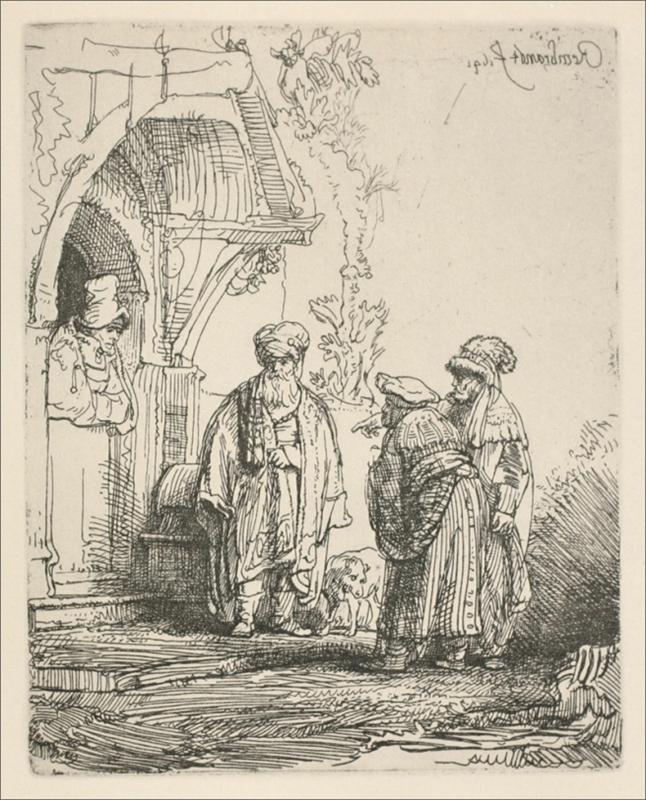
Rembrandt’s “Jacob with Laban” (1644) is a compact drama engraved in lines: a meeting of three men under a rustic porch, a small dog nosing the ground, a woman half-hidden in shadow, and a strip of landscape that opens beyond the figures. The subject is biblical, the mise-en-scène is quietly theatrical, and the drawing is alive with the speed and intelligence of the needle. Rather than stage the most dramatic episodes in Jacob’s long negotiation with his uncle and father-in-law Laban, Rembrandt chooses a moment of conversation—precisely the kind of hinge on which the entire story turns. Wages, flocks, and family allegiances are at stake, yet the etching favors gesture over spectacle, tact over confrontation. In a handful of strokes, the artist renders a complex world of kinship politics and mercantile bargaining, illuminated by the ethical questions that run through Genesis.
The Biblical Narrative and Rembrandt’s Choice of Moment
Genesis tells how Jacob, fleeing his brother Esau, takes refuge with Laban in Haran. He agrees to work for seven years to marry Rachel but is deceived into marrying Leah; he works another seven years for Rachel; still later he bargains his wages in terms of speckled and spotted livestock, cleverly increasing his portion until Laban grows resentful; finally the two men part under a pact sealed with a heap of stones. Painful family entanglements, labor, deception, and blessing interlace the story.
Rembrandt’s etching distills this saga to an exchange at the threshold of a house or tent. The elder, draped in voluminous robes and a turban, stands to the left of center, composed and slightly withdrawn, possibly Laban. Opposite him, two men in travel coats and fur-capped hats—Jacob and a companion—approach with a mixture of respect and insistence. The scene could correspond to one of several meetings in Genesis: the opening negotiation for Rachel’s hand, a discussion about wages and flocks, or even the tense reconciliation after Jacob’s secret departure. Rembrandt keeps the identification flexible, trusting gesture to carry the moral content: this is a talk about terms between kin whose trust has been complicated by need.
Composition and the Architecture of Negotiation
The composition is a lesson in how lines can stage a conversation. The porch at left creates a vertical frame—posts, a carved capital, a shallow arch—that shelters Laban and the seated woman in the shadowed niche. The three figures form a shallow triangle across the lower half of the plate. Jacob bends slightly forward, hands clasped; Laban stands erect, hand gliding toward his robe in a restrained reply; the third figure leans in, supporting Jacob’s position. A diagonal of ground—hatched with quick, parallel strokes—pulls the viewer into the scene, while the open space at right allows the eye to rest, as if leaving room for the future that words will shape.
By keeping the center relatively open and reserving dense cross-hatching for the foreground and porch, Rembrandt engineers a stage where bodies read clearly and gestures have maximum legibility. The little dog near Laban’s feet occupies the shallow gap between parties, a witty mediator nosing neutral territory.
Orientalizing Costume and the Theater of Otherness
Rembrandt and his Amsterdam audience loved the “oriental” costume repertory—turbans, furred mantles, patterned girdles—borrowed from Near Eastern textiles that circulated through the Dutch mercantile world. Here Laban’s turban and layered robe assert patriarchal gravity, while Jacob and his companion wear a hybrid northern dress trimmed with fur. The visual code is clear without being pedantic: the elder is rooted in a different household economy and a different generation; the younger men are travelers from elsewhere who must negotiate for place and future. Exotic costume thus becomes practical dramaturgy, not mere ornament.
Gesture, Posture, and the Rhetoric of Kinship
Rembrandt’s genius for hands and tilt of spine carries the narrative. Jacob’s slight bow acknowledges filial obligation; his hands, joined and thrust forward, suggest petition, argument, and honesty at once. Laban’s hand, barely shown, gathers his cloak—a gesture that reads as caution and reserve. The nearby companion’s body leans into the space with supportive urgency, head tipped toward Laban as if promising good faith or confirming details.
Such nuanced body language evokes the entire moral texture of Genesis 29–31: labor exchanged for love, trickery offset by divine favor, the uneasy arithmetic of trust within families. The etched line, vibrating with small changes of pressure, engraves emotion directly into posture.
The Woman at the Door and the Social Frame
At the left, a woman stands within the shadow of the arched doorway, her head covered, arms folded. She might be Rachel, Leah, or a servant; Rembrandt keeps her identity open, but her presence is crucial. She is a human reminder that domestic lives, not just contracts, hang in the balance. Framed by architecture and half-veiled in darkness, she embodies the household that Jacob would enter or depart, the community that will be reshaped by the outcome of the talk.
The Dog as Atmospheric Counterpoint
The small dog, casually sniffing, operates as a charming counterweight to the solemnity of the scene. In Dutch prints the dog often signals fidelity or simply the everyday. Here it relaxes the rhetoric, anchoring the negotiation in ordinary life. The animal’s placement between the men suggests the homely ground the parties share—grazing, tents, tasks—despite all intrigue.
Space, Light, and the Economy of Lines
Rembrandt organizes space through sparing light and a broad economy of marks. The porch and figures are drawn with decisive outlines; the garden and far bank are suggested with quick, looping strokes. He uses dense horizontal hatching underfoot to create a floor of shadow that both supports and stage-lights the actors. The right half of the plate is left largely unworked—paper-white air that feels like possibility. In an etching where ink is thought, emptiness is eloquence.
The sky is almost blank, but a few cursive lines above the roof break its stillness and stimulate the eye. The effect is like a held breath: the environment is quiet so that words can be heard.
Etching, Drypoint, and the Hand in the Copper
This print shows Rembrandt’s hybrid approach to intaglio. Most of the drawing is etched—needle drawn through a wax ground, then bitten by acid—but certain accents, especially in the darker costume folds and fur trims, likely carry drypoint burr. The burr adds soft, velvety shadows that print more richly and wear down with impressions, giving early pulls extra warmth. The plate seems to have been printed fairly clean (little residual plate tone), enhancing the clarity of line and the airy reserve to the right. The signature at the upper right prints in reverse—a quick reminder that we are looking at the result of a mirrored process where every stroke has an opposite.
Architectural Invention and the Worldly Porch
The porch is an invention that fuses rural architecture with a memory of Italianate ornament gleaned from prints. A shallow barrel vault shades the doorway; a stout post carries a small entablature; carved brackets peek from under the roof. This scaffolding dignifies the meeting without monumentalizing it. It also frames Laban as master of the threshold: a patriarch who controls entry and exit, marriage and wage, hospitality and farewell.
The Path and the Landscape Beyond
In the lower right, the ground breaks open and turns into a path that seems to lead away from the house into a small dell. A few light strokes sketch a hedge and a suggestion of water. This is not a full landscape; it is a preposition—toward, away, beyond. In a story defined by comings and goings, such spatial cues become moral punctuation. Jacob’s future lies somewhere along that path, whether returning to Canaan or herding mixed flocks on Laban’s pastures.
Dutch Mercantile Eyes on a Patriarchal Bargain
Seventeenth-century Dutch viewers read Genesis with the eyes of merchants and contract-makers. In a republic whose prosperity turned on shrewd bargains, the saga of Jacob and Laban—wages negotiated, property divided, oaths sworn—was more than piety; it was recognizable business. Rembrandt translates the patriarchal world into a theater of everyday diplomacy that his audience would have felt in their bodies: the angle of a bow, the testing phrase, the moment when a hand half-withdraws from its purse.
Theology Without Emblem
Although the print contains no explicit divine signs, its moral weather is theological. The open light to the right suggests providence unclaimed yet available. The woman in the doorway hints at the human cost of duplicity and delay. The dog’s ordinary contentment contrasts with the fretful calculations of men. Rembrandt refuses allegorical apparatus; he trusts the viewer to feel the scriptural gravity in honest posture and quiet air.
The Signature, Edition, and the Performance of Printing
Rembrandt’s signature sits high at the right, as if written into the sky. Its presence declares authorship with a flourish yet doesn’t disrupt the scene. Because intaglio prints are performances—inked and wiped by hand—impressions of “Jacob with Laban” can differ in lightness and line strength. Slight shifts in wiping can deepen shadows underfoot or leave a faint veil of plate tone in the right-hand air, changing the mood from crisp daylight to late afternoon. Rembrandt welcomed such variability; it allowed the print to breathe like a living negotiation rather than a fixed decree.
Comparisons Within Rembrandt’s “Oriental Figure” Sheets
This etching belongs to a small constellation of prints from the early 1640s often called “oriental figures,” where Rembrandt explores Biblical or Near Eastern costume in small ensemble scenes—three men in conversation, a patriarch and a servant, Jacob and Laban. Across the group, he varies the mix of finish and sketch. “Jacob with Laban” leans toward the finished in the three main figures and toward suggestive shorthand in architecture and ground. The approach underscores his aim: to make the men read first as characters in a moral play, with place and décor acting as chorus.
Reading the Three Figures Individually
Laban, centered and upright, is a study in controlled authority. His robe hangs in broad, weighty folds; his beard flows but does not flare; the turban caps his presence as a sign of station. Jacob’s companion—perhaps a shepherd or mediator—wears a tasseled cap and heavy coat that bunches at the waist. His stance widens slightly as he leans forward, an embodied argument. Jacob himself is the most complex: hat brim shadowing half the face, body angled in deference, hands clasped in a grip that can be read as prayer to his relative, plea for fairness, or oath of faithful service. Each figure is a grammar of posture.
The Emotional Temperature
The print’s temperature is mild but tense—the heat of an important talk kept polite. No one gestures wildly; no weapon or tool intrudes; yet the etched air hums like the silence in a room where accounts are being reckoned. Rembrandt communicates that temperature through restraint: no busy cross-hatching in the sky, no heavy shadows swallowing faces. The world seems to pause so that speech can take effect.
Time Suspended Between Past and Future
Rembrandt loves the seconds before decisions: Judas before he flees, a prodigal son just entering the doorway, or here, kinsmen with words poised. In “Jacob with Laban,” time is held like a breath. Behind the porch lies a record of years—Jacob’s service, Leah’s substitution, Rachel’s waiting. Before the path lies an unknown journey—the speckled flocks, flight by night, and the covenant on the hillside. The etched present sits precisely between those histories, making the print a meditation on human agency under the long arc of providence.
Why the Etching Endures
The sheet endures because it gives weight to the ordinary tools of peace: bodies squared to listen, hands that ask and answer, a porch where hospitality can be either offered or withheld. It is also a primer on the expressive strength of etched line—how a few pressured strokes can build architecture, character, and air. For modern viewers, the image reads like a still from a dialogue-driven film: minimal set, exquisite acting, maximal stakes. The story of Jacob and Laban has always been about more than livestock. It is about the dignity and danger of making terms with those we love. Rembrandt understood that, and he wrote it into copper with a restraint that invites repeated, grateful looking.
