Image source: wikiart.org
Introduction
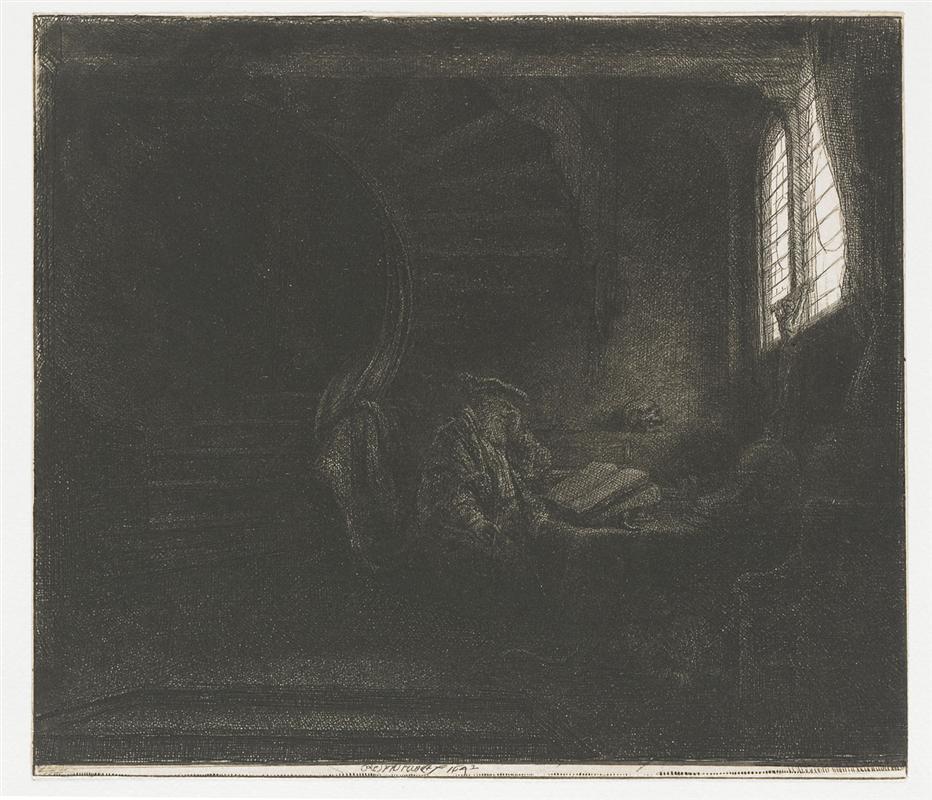
Rembrandt’s “St. Jerome in a Dark Chamber” (1642) is one of the most atmospheric images in the artist’s long meditation on study, sanctity, and solitude. The scene is barely visible at first—an interior almost swallowed by shadow, from which a few essentials emerge with patient looking: a scholar bowed over an open folio, a window set high at the right that spills a narrow wedge of daylight, a modest table, the soft contour of a bed or settle, and the suggestion of a lion’s head lost in dusk. In this etching, deepened with drypoint and rich plate tone, Rembrandt converts darkness into a subject in its own right. The saint is not shown beating his breast in the desert or translating scripture before a crowd; he is simply at work, keeping company with his book and with the slow intelligence of light.
St. Jerome and Rembrandt’s Choice of Iconography
St. Jerome is among the most frequently pictured saints in European art, typically recognizable by four attributes: a lion (tamed after Jerome removed a thorn from its paw), a skull (memento mori), a cardinal’s hat (an anachronistic tribute to his status as a Doctor of the Church), and a Bible or writing desk. Rembrandt keeps the symbols spare. He sets the cardinal’s hat aside and rarely flaunts the skull; what matters is Jerome as reader and translator—the human face of scholarship. In the “Dark Chamber,” the saint appears not as an ecclesiastical celebrity but as an elderly man in a working room, hunched over a task with tenderness. The lion, half dissolved into shadow, serves less as emblem than as fellow occupant of the quiet, proof that life shares the space with study.
A Theater of Shadow and the Ethics of Light
The print is named for its darkness, and rightly so. Rembrandt allows a dense, velvety plate tone to cover much of the copper, so that the image behaves like a room after dusk. This darkness is not mere absence; it feels textured, inhabited, a kind of breathable fabric in which thinking can take place. The brightest passage is the window at the right, its leaded panes rendered as pale parallelograms. From there light crosses the chamber, dwindling as it travels, and comes to rest on the open book and on Jerome’s forehead and hand. Nothing else claims it. The candlestick on the table remains unlit, a reminder that natural light is sufficient to consecrate the labor at hand. Rembrandt’s light is never casual; here it is moral weather. It attends attention.
Composition and the Architecture of Stillness
The room is built from a few clear shapes. The window’s rectangle secures the top right, a large circular form (perhaps a chair back, curtain hoop, or the arch of a bed canopy) anchors the left, and an oblique band of table and figure rests along the lower middle. This asymmetry generates a slow, diagonal drift from the illuminated window down to the figure, then into the deeper cave of the left-hand space. Rembrandt avoids busy furniture or theatrical decoration. The saint’s world is modest: a bed or bench, a table, a book, a candle, and enough air to let thought move. The composition thus aligns with the subject—the architecture of stillness fits a vocation that values quiet over display.
The Material Language of Etching, Drypoint, and Plate Tone
Technically the print is a masterclass in how intaglio processes can collaborate. Etched lines sketch the geometry of the room—the muntins of the window, the edges of table and folio, the little burst of highlights where the book’s pages kink. Drypoint burr deepens strategic contours—the hem of Jerome’s coat, the shadowed arc behind him—so that darkness has a soft, furry edge. Most decisive is Rembrandt’s use of plate tone. By leaving a film of ink on the plate during printing, he casts the entire chamber in a deep, even dusk. Where the printer wiped more vigorously—the window, the book, the bright tissue on the saint’s brow—paper-white breaks through like illumination. Because plate tone is variable, impressions of this print can feel different from one another: some like midnight, others like late afternoon. Rembrandt embraced that variability as part of the work’s expressive range.
Jerome as Worker Rather Than Icon
What holds the eye after it adjusts to darkness is Jerome’s posture. He bends from the waist, chin tipped toward the page, one hand supporting the cheek or temple, the other steadying the book. The pose is not dramatic; it is ergonomically true. Anyone who has read for hours recognizes the logic of the body here—how weight distributes, how shoulders gather, how the hand shelters concentration. Rembrandt spares us the heroic nude of Renaissance desert Jeromes; he offers a warmly clothed elder at a task. That decision is theological as well as aesthetic: grace inhabits work, and sanctity looks like attention sustained over time.
The Book as Lamp and Landscape
The open codex on the table is a second light source—not literally luminous, but bright with paper that catches the window’s beam. Rembrandt draws the pages with a few elastic lines and a single, telling highlight at the fore edge. The book is a landscape—valleys of text, ridges of paper—where the saint travels daily. By letting the book receive the scene’s brightest value after the window, the artist makes a visual argument: revelation is mediated; the world’s light arrives, the text reflects it, and the human mind receives it. The triangle—window, book, face—acts like a circuit through which understanding flows.
The Unlit Candle and the Memory of Nights
A slender candlestick stands on the table, its flame absent. The object is more than still-life filler; it is a time signature. The candle remembers the night. It means that this task has hours beyond daylight, that the saint’s fidelity is not limited by sunset. Its unlit state keeps attention on the daylight economy (natural illumination, human reception) and underscores an ethic of sufficiency. The little gleam on the candlestick’s stem hints at latent fire, at stored brightness ready to be called on when the window goes dark.
The Lion in the Gloom
A faint lion’s head—they eye, muzzle, or mane resolved in just a few strokes—rests near the center-right shadow. Rembrandt refuses to spotlight it; he lets the animal share the darkness with the saint. This is no circus partner. It is a calm, breathing presence, a roommate in contemplation. The lion’s subordination to the room’s overall dusk does two things: it keeps symbol from overwhelming study, and it threads animal life into the harmony of a cell dedicated to words. Jerome’s legend of compassion (the thorn removed) resonates quietly in the compositional kindness with which Rembrandt houses the beast.
Sound, Air, and the Sensorium of Study
Though the image is nearly silent, it carries suggestions of sound: the faint squeak of chair wood as Jerome shifts, the rustle of a leaf turned, distant street noise softened by thick walls, the barely audible scratch of a pen set down. The air itself is visible, grained by the plate tone’s velour. That air is the real medium of the scene; light occupies it, breath thickens it, history sleeps in it. Rembrandt is a painter of air as much as of faces. In this small room the atmosphere has weight, and thought must move through it like a swimmer.
Chiaroscuro and the Theology of Study
The print’s chiaroscuro is less theatrical than metaphysical. Dark is not evil; it is the necessary partner of light, the ground against which illumination shows its true color. The saint’s head is neither flooded nor lost; it is toned to a middle value, the place where human obedience lives. The brightest blank (the window) stands for gratuity—the world’s given brightness; the next brightest (the book) stands for mediation—wisdom handed down; the warm middle (the saint) stands for reception—the attentive heart. Without a single symbol beyond book and lion, the print offers a theology of study articulated entirely in tones.
Comparison with Rembrandt’s Other Jerome Images
Rembrandt returned to Jerome across decades: as a penitent in wilderness, as a scholar in his cell, as a man visited by angels of thought. Compared with his more open, sketchy studies, “St. Jerome in a Dark Chamber” is a meditation on saturation and hush. Compared with the dramatic “St. Jerome reading in an Italianate landscape,” this image withdraws spectacle to the edge and deepens the inwardness. Across the series, Rembrandt honors a double identity—Jerome the desert ascetic and Jerome the library worker. In the “Dark Chamber,” the second identity dominates, but the first is present in the austerity of the room and the discipline of the body.
The Human Scale of Sanctity
One reason this print continues to persuade is its scale. The chamber is not cathedral grand; it is an ordinary room made beautiful by use. The saint’s clothes are not rhetorical; they are practical, layered against cold. Sanctity here inhabits human scale, which allows the viewer to imagine entering the room, sitting in the spare chair, and beginning to read. Rembrandt democratizes holiness by respecting the textures of daily labor—paper, wood, wool, skin—more than pageantry.
The Viewer’s Vantage and Invitation
Rembrandt places us slightly below and to the left of the saint, as though we have stepped quietly into the doorway and paused. The window’s glare does not blind us; we share Jerome’s distance from it. Our eye follows his: down from light to book to hand. The space welcomes rather than confronts. We are not gawkers at sanctity; we are potential imitators, reminded that attention is within reach. The print’s ethics of looking is gentle: it invites presence without intrusion.
Time Suspended Between Afternoon and Night
What hour is it? The wedge of daylight could be late afternoon, angle low and tender; the unlit candle waits its turn. Rembrandt leaves the hour ambiguous, and the ambiguity is generative. We feel a day’s passage in the room: the saint has been here a long time; he will remain after the light fails. The print holds the moment when the work’s rhythm is perfectly tuned—no glare, no rush, just the measured pace of line to line. Time is not background; it is the medium of study.
The Face as Landscape of Habit
The detail of Jerome’s face is minimal yet exact. A small highlight nets the brow ridge; nose and cheek sink into soft penumbra; the mouth disappears into beard; the eye, half caught by light, bends to the page. This restraint is poignant. Rembrandt does not pursue expression; he paints habit—the expressionless look of someone absorbed. Habit is the moral of the print: holiness as repeated choice, not as rare ecstasy.
Lessons for Seeing and for Living
The image teaches a way of looking. Give your eyes time to acclimate; allow the dark to reveal its gradations; follow the path light takes rather than demanding a spotlight. It also offers a way of living. Build a room where the essentials are close at hand; let a simple beam of light be enough; keep company with a text worth rereading; accept a quiet companion animal that shares your attention; rest your hands on pages made warm by use. None of these lessons is ornate. All of them are hard to maintain. Rembrandt honors them by making them beautiful.
Afterlives and Influence
Later artists—especially printmakers—learned from this plate how to make darkness eloquent. The mixture of etched structure, drypoint softness, and luxuriant plate tone becomes a model for nineteenth-century nocturnes and for photographers who expose interiors so that windows flare while figures smolder. But influence is secondary to the print’s immediate hospitality. It does not require art-historical preparation to be felt; it requires the same thing Jerome’s book does: attention returned, day after day.
Conclusion
“St. Jerome in a Dark Chamber” distills Rembrandt’s belief that the life of the mind is a sacred calling best staged without fanfare. He gives us a saint as worker, a room as instrument, and light as honest partner. Darkness is not enemy but friend, the backdrop against which the smallest illuminations become radiant. The book reflects the window; the face receives the book; the whole room relaxes into a hush that feels like prayer. Looking at the print, one senses a benediction not in the form of spectacle but in the sustained presence of a human being paying attention. That is the sanctity Rembrandt trusts, and it remains persuasive: a candle ready, a window bright, a page open, and a mind at work.
