Image source: wikiart.org
Introduction
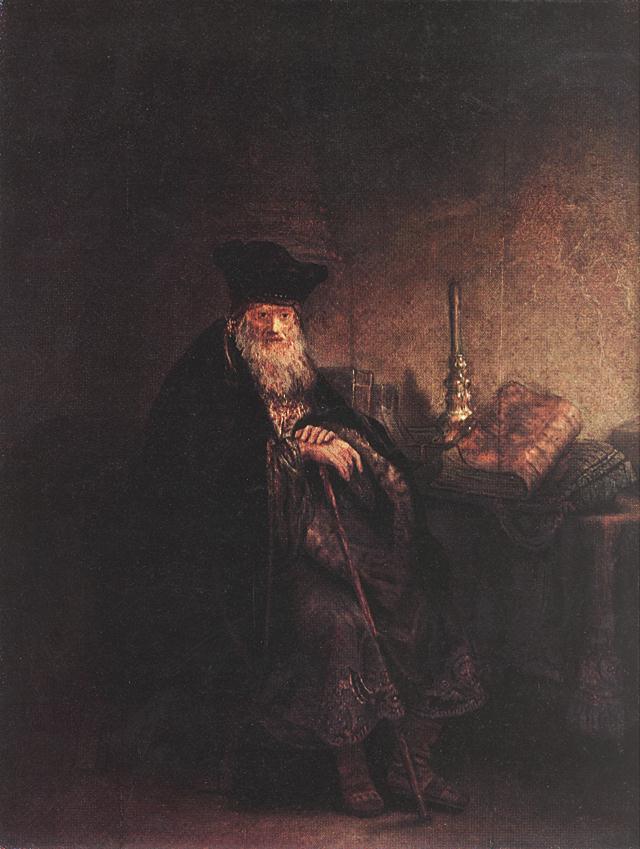
Rembrandt’s “Old Rabbi” (1642) is a meditation on time, learning, and spiritual gravity. The painting shows an elderly scholar seated in a dim interior, wrapped in dark robes, his hands folded across a staff, a small pool of light catching beard, brow, and the edge of a table piled with heavy books and a tall candlestick. The room is simple, almost bare; the drama is the man’s presence. Instead of theatrical gesture, Rembrandt builds the image from the slow materials of age—creased skin, worn cloth, gleaming wood, and the heavy, thoughtful air of a study where a life has been spent reading. The result is one of the artist’s most humane portraits of spiritual authority, not as power or prestige but as a way of seeing the world that has been learned sentence by sentence and prayer by prayer.
A Portrait of Learning as Vocation
The sitter’s identity is less important than his vocation. Rembrandt paints him as a rabbi—an interpreter of sacred law and tradition—through the eloquence of context: the dark cap and mantle that read as clerical; the staff that doubles as support and symbol of guidance; the thick folios that signal a lifetime among texts; and the candlestick, not lit, which stands as a memory of evenings bent over pages. He gives us a scholar whose dignity resides not in costume but in attention. The face is not theatrical; it is attentive, inward, and kind. In the seventeenth-century Dutch Republic, where Amsterdam’s Jewish community flourished, Rembrandt found in such figures the moral weight he prized: intelligence braided to humility.
Composition and the Theater of Quiet
The composition is a study in asymmetry that feels inevitable. The rabbi sits low and left, a dark triangular mass whose apex is the hat and whose base spreads into the shadowed hem of the robe. Opposite, on the table at right, a counterweight of light rises: candlestick, stacked books, and a folded cloth. The back wall receives a warm, drifting glow that wraps the head and hands with intimacy. Nothing interrupts the eye’s slow circuit from face to staff to books and back again. Diagonal vectors—hat to candle, staff to table edge—quietly knit the halves of the painting, but the prevailing sensation is rest. This is not a moment that demands decision; it is a life gathered in pause.
Light as Moral Weather
Rembrandt’s light falls like an ethical judgment that is also a caress. The brightest points are not jewels, gilding, or trophies, but the scholar’s forehead, the ridge of his hands, the frayed edges of cloth, and the worn corners of books. Illumination attends the traces of use. The candle is unlit, yet its brass stem glints as if it remembers flame, and its long shadow becomes a time signature on the plaster. The room’s darkness is not menacing; it is medicinal, a soft medium in which the mind can work. Light in Rembrandt is almost always a character; here it is the quiet companion of age.
Costume, Textures, and the Tactility of Thought
Rembrandt’s love of surface gives the painting a haptic truth. The cap is felted and soft against the skull; the mantle is heavy, with a border of stitched or woven pattern that catches the last glimmers along its folds; the beard is a thicket of silvery strokes that alternate between wiry and cloudlike. The staff is polished where the hand has worn it smooth. The books are leathered lumps, their bindings cracked, pages slightly wavy from years of use. These textures are not inventory; they are the material record of attention. The painting says: wisdom leaves a patina.
Hands, Staff, and the Grammar of Age
The hands articulate the painting’s language of age. One encloses the other across the head of the staff, fingers gently overlapping, a grip that is firm without tension. Veins rise; knuckles gleam; nails are clean but unboastful. The staff slopes toward the floor in a calm diagonal that steadies the figure and grounds the composition. This grammar of palm, knuckle, and wood is as expressive as a face: age has not withered strength, it has taught how to measure it. The staff functions symbolically, too—part shepherd’s crook, part pilgrim’s rod, part student’s pointer laid aside for a moment of rest.
Face and the Ethics of Attention
Rembrandt’s face is alive with micro-decisions: the thin highlight at the ridge of the nose, the luminous edge of the lower eyelid, the ambers pooling at the inner corner of the eye, the beard’s soft parting where breath warms it. The mouth hides slightly within the beard, so the primary speech is ocular. The eyes look not outward into spectacle but slightly down and across, as if the sitter keeps a thread of thought connected to the closed book at his elbow. Spiritual authority here is not thunder; it is patience. The viewer feels invited, not examined.
Books and Candle: Instruments of a Life
On the table thick volumes lie stacked at various angles, their spines and straps worn to softness. The topmost volume is partly covered with a textile whose edge is picked out with tiny lights, a practical habit that reads like reverence. The candlestick’s placement just beyond the books suggests recent use and expected return; learning in this life is a daily practice that survives night. Rembrandt avoids overt symbols—no bold Hebrew letters, no insistent inscriptions—because he trusts ordinary objects to carry the theme: a life lived with texts eventually shines through fingers and gaze.
Palette and Tonal Design
The painting inhabits a restrained palette of umbers, warm blacks, softened reds, and honeyed highlights. Against this field the brass of the candlestick, the creamy map of the face, and a few embers in the books and robe act as color’s quiet fireworks. The tonal design is masterful. Dark masses stabilize the lower left and right; a middle band of brown, textured with thin glazes, stretches across the center; and the head and hands lift into higher value like stones brought into sunlight. This modulation keeps the picture breathing: even the deepest darks feel aerated, never choking.
Space, Scale, and the Feeling of Being There
The room is shallow but convincing. The wall’s mottled surface recedes just enough to keep the sitter from flattening against it; the floor dissolves into dusk; the table thrusts gently into our space. The figure’s scale in relation to the room produces humility. He does not dominate the architecture; he belongs to it. The quiet distance between viewer and sitter—neither remote nor intrusive—matches the painting’s emotional pitch. We are visitors who have stepped inside a circle of study and are received without fuss.
Technique: Glaze, Impasto, and the Breath of Paint
Rembrandt’s surfaces testify to work done in layers. Thin, translucent glazes build the wall and robe, allowing under tones to glow through like old varnish on wood. Across them he lays passages of thicker paint: the highlights along the candlestick, the burrs at the beard’s edge, the crisp touch on a knuckle. The brush changes speeds—the robe is slow and weighted; the beard quick and dancing; the books dense and knotted; the face a blend of both. These technical modulations supply the viewer with an embodied sense of looking: the eye slows where the hand slowed; it quickens where the hand quickened.
Time and the Poetics of Stillness
The painting conveys time not through clocks or windows but through stillness that has a history. The angle of the staff and the settled weight of the robe suggest someone who has been sitting for a while, not a model who just took a pose. The candle is burnt down but not spent; the books are closed mid-thought; dust must be settling even as we look. This poetics of stillness suits the subject: study is not an event but a duration, a long obedience in the same direction.
Rembrandt and the Jewish Community
Amsterdam’s Jewish community provided Rembrandt with sitters, patrons, and friends. The painting reflects a relationship based on observation and respect rather than exoticism. He does not treat the rabbi as “other” but as a fellow citizen whose vocation commands admiration. The costume reads as authentic without being ethnographic; the face is individualized, not typecast. The result is a portrait that registers difference in the service of shared human dignity.
The Drama of Dark and Light as Spiritual Allegory
Rembrandt never needs overt allegory to make spiritual points. Here, darkness and light do the work. The rabbi’s dark mantle anchors him in the human lot of limitation; the light that touches face and hands suggests revelation arriving not from the sitter but to him. The extinguished or unlit candle, polished to reflect unseen light, implies that illumination is not self-generated; it is borrowed and reflected. The books, catching and giving light, reinforce a theology of mediation: wisdom comes to us through words carried across time.
Comparisons within Rembrandt’s Oeuvre
Compared with his more theatrical depictions of scholars and philosophers—figures dazzled by shafts of sun or framed by elaborate architecture—“Old Rabbi” is intimate and low-key. It stands nearer to the late portraits in which brushwork and empathy merge, but it carries the tonal warmth and finish of the early 1640s. Its closest kin are Rembrandt’s serial portraits of aging men and women whose faces he treated like landscapes, dignifying wrinkles as rivers and eyes as wells. In those works, as here, the subject is not fame but character.
The Viewer’s Ethical Response
The painting invites a response that mirrors the sitter’s posture: pause, attention, gratitude. Standing before it, we feel the pressure to be quiet. Our eyes adapt to the dusk, then discover the slow fireworks of detail; we start to hear the room’s silence. Rembrandt’s gift is to guide the viewer into a temporality appropriate to reverence. In that slower time, the image’s kindness becomes visible. The old man is not displayed; he is accompanied.
The Staff as Thread through the Picture
The staff is more than a prop. It draws a diagonal that ties together the head, hands, and feet; it offers a through-line for the viewer’s gaze; it places the sitter within the long human story of walking, wandering, and being supported. In religious tradition, a staff may mark authority or pilgrimage; here it reconciles both. The rabbi is both guide and traveler, one who has shepherded others and one who has himself been led.
The Candle’s Silent Theology
Why is the candle not burning? Because the painting’s light does not come from it. Flame would have imposed a narrative of obvious source; Rembrandt chooses mystery. The candle stands as a memory of nights spent reading and as a promise that study will resume. It also allows the polished brass to perform a visual parable: objects that have absorbed light radiate it back. The sitter’s face participates in the same economy—bright not because he shines, but because he reflects.
What the Painting Teaches about Authority
Rembrandt’s rabbi holds no scepter, wears no badge, and sits without retinue. Authority here is the authority of age graciously borne and knowledge quietly kept. The painting argues against noisy versions of power. It suggests that trustworthy leadership looks like this: hands that have turned pages more than they have clenched fists, eyes that have read others as carefully as books, a body that knows how to rest as well as to act.
Legacy and Modern Resonance
Modern viewers find the image disarmingly contemporary. In an era of overstimulation, the painting models attention. At a time when expertise is contested, it honors study as a public good. And in a culture that often shies from aging, it renders old age luminous. Rembrandt crafted an image that belongs to a particular community and yet speaks across boundaries because it locates value not in the emblem but in the person.
Conclusion
“Old Rabbi” is one of Rembrandt’s deep quiets—a painting in which the loudest thing is a mind at rest after long searching. Every formal decision serves that mood: the low key of the palette, the concentration of light on face and hands, the tactility of the books and staff, the dignified asymmetry of sitter and table, the unlit candle polished by many nights. In place of spectacle we get the patience of looking, and in that patience we perceive the grandeur of an ordinary room where a life of reading has become a form of light. The picture endures because it honors a truth that does not age: wisdom is visible, and it looks like this.
