Image source: wikiart.org
Introduction
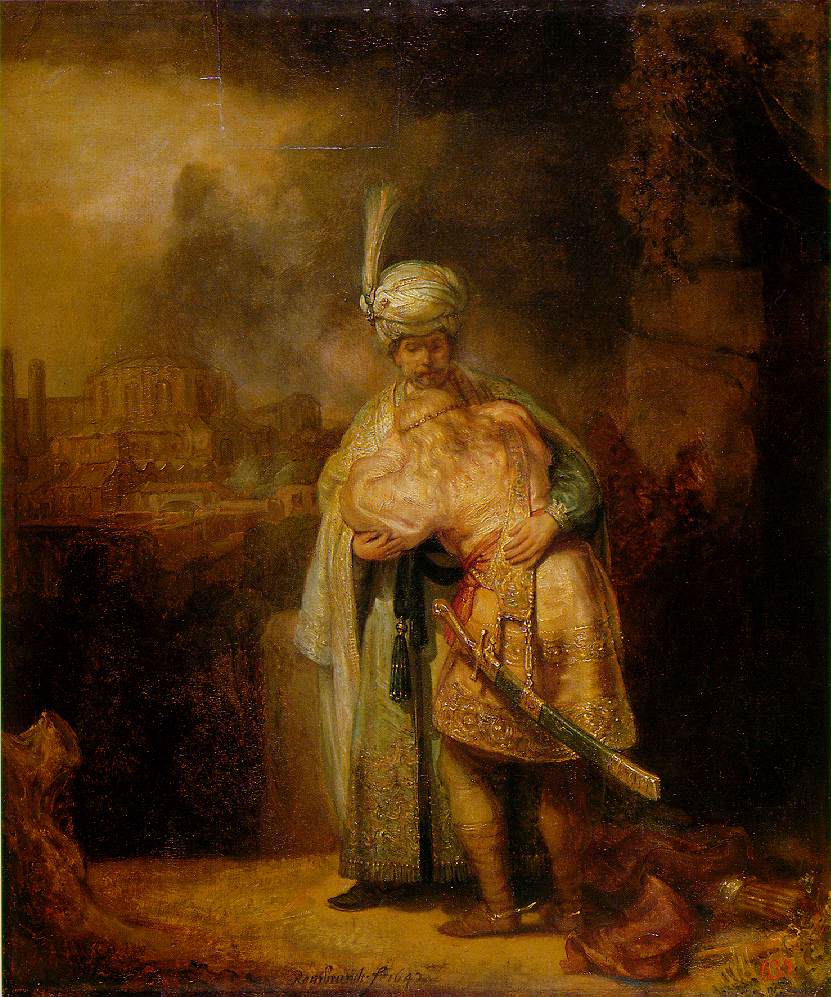
Rembrandt’s “David and Jonathan” (1642) distills one of the Old Testament’s most moving friendships into a scene of concentrated tenderness. The future king David and Prince Jonathan, son of Saul, embrace in a rocky clearing with a city spreading dimly behind them. Rather than stage political intrigue or battlefield heroics, Rembrandt selects the moment of parting described in 1 Samuel, when Jonathan warns David of Saul’s murderous intent and the two men weep together before David departs. The painting’s emotional center is unmistakable: two figures locked in a quiet, protective embrace, their richly worked garments and weapons momentarily rendered irrelevant by the intimacy of grief and loyalty. Around them a moody sky and shadowed landscape suspend time, turning the moment into a solemn witness of fidelity under threat.
Subject and Narrative Moment
Biblical sources tell how Jonathan, recognizing David’s anointing and virtue, loves him “as his own soul.” When Saul’s jealousy turns murderous, Jonathan devises a signal to warn David away. After the signal, they meet once more to renew their covenant, weeping together before parting. Rembrandt isolates this exchange from the larger plot and reduces the cast to essentials. David, dressed as a warrior in gilded tunic and sword, leans into Jonathan’s arms and buries his face in his friend’s shoulder. Jonathan, wearing a pale, elaborately patterned robe and turban, receives him with a steadiness that reads as both consolation and promise. The scene draws power from its stillness: the political future hinges on a private farewell, and Rembrandt ensures we feel that hinge turning.
Composition and the Embrace as Architecture
The embrace is designed like an arch. Jonathan stands firm, almost axial, a pillar draped in pale fabric. David curves into him at a slight diagonal, his body forming the arch’s inner sweep. Their combined shape creates a single luminous mass against the darker city and trees, producing a compositional “niche” that holds the emotion without leakage. The swords, straps, and tassels echo this rhythm with smaller arcs and verticals, knitting the pair into a unified structure. A draped cloak lies at the lower right as a soft, grounding triangle; it keeps the figures from floating and suggests the hurried, unguarded nature of the reunion. The empty space to the left opens to the distant city and swollen sky, a breathing room that intensifies the closeness of the figures by contrast.
Light and Chiaroscuro as Moral Emphasis
Light falls most generously on David’s bare neck and hair and on the upper planes of Jonathan’s robe and turban. This focus allows the viewer to read the embrace with clarity, then wander outward into half-tones where details soften. Rembrandt restrains high contrast elsewhere so that the emotional core glows rather than shouts. The background architecture—domes, walls, parapets—sits in a brownish, atmospheric haze, an urban memory rather than a place we can enter. The sky carries a multiphonic gray, mottled by thicker, storm-dark clouds near the figures and lighter vapors above the horizon. Light here is not theatrical spotlight; it is empathy. It rests where the story’s weight lies and withdraws from what would distract.
Color and Material Splendor
Rembrandt sets the scene in a restrained but sumptuous palette: honeyed golds, olive greens, dull rubies, and deep umbers. Jonathan’s robe has passages of mint and pale celadon patterned with gold; his turban is cream with a faint green cast and an airy feather. David’s tunic reads as warm gold with reddish undertones, its embossed ornament catching highlights. The sword’s scabbard, richly colored, slices diagonally across the lower half, a reminder of the career David must resume alone. These colors do double duty. They deliver courtly magnificence suitable to a prince and a champion while also keeping the touch human. The paint is worked so that brocade and metal scintillate rather than glitter, sharing the scene’s emotional gravity.
Costume and Historical Imagination
Rembrandt dresses the figures in “Oriental” costume that would have read as ancient Near Eastern to his Dutch contemporaries. Turban, long robe, lavish embroidery, and a broad sash contrast with David’s shorter, martial dress and strapped sword. This costume choice opens a repertoire of textures—silk, velvet, leather, gilt metal—that Rembrandt relishes painting, but it also clarifies the relationship. Jonathan, the prince of the house of Saul, appears as a court figure, stable and ceremonial; David appears as the active warrior-poet, ready to leave. Costume becomes psychology: the one who remains and shields is wrapped, the one who must journey is belted and armed.
Gesture, Hands, and the Story of Touch
Hands carry the narrative. David’s arms clench around Jonathan’s waist, his right hand clasping tight, his shoulders lifted in sorrow. Jonathan’s right hand rests broad and gentle on David’s back, fingers splayed in reassurance rather than restraint; his left hand draws the friend close at the shoulder. Rembrandt’s treatment of flesh is highly tactile—the way fingers compress fabric, the way a palm shapes to a spine—so that we can almost feel the pressure of comfort. The faces are partially obscured by proximity, a daring decision that privileges the language of touch. We do see Jonathan’s downward glance, tender and intent, and the mass of David’s hair and cheek crushed into silk. The painting’s truth lives in this physical eloquence.
Space, Setting, and the Language of Departure
Rembrandt composes the setting as a place of thresholds. To the right, a steep bank and overhanging foliage enclose the pair, as if nature itself provided privacy for their covenant. To the left, the vista opens toward a city with domes and walls—Jerusalem imagined through seventeenth-century eyes. The parted sky above the city suggests weather passing; the dark band near the figures works like a curtain drawn back for the farewell. The ground beneath them is warm and bare, a small clearing in which steps and footprints would be legible if the paint allowed. Everything whispers departure, from the road-like diagonal of light at their feet to the sword’s angle pointing outward.
Theology of Friendship and Covenant
Biblical language describes David and Jonathan swearing loyalty “in the name of the Lord” and renewing their covenant despite the king’s hostility. Rembrandt’s painting honors that theological underpinning without overt symbols. The solemnity of the embrace, the gravity of light, and the absence of court spectators turn the moment into a vowkeeping before God. Jonathan’s turban and feather, however courtly, do not turn the scene into a parade; they crown a character whose soul recognizes David’s destiny and chooses love over dynastic advantage. The painting therefore meditates on covenantal friendship as a form of righteousness—an act in which political stakes are subordinated to fidelity and truth.
Emotion without Sentimentality
One of Rembrandt’s distinctive gifts is to reveal strong feeling without sweetening it. “David and Jonathan” is tender, but never decorative. Grief here carries responsibility: both men know the cost of their choice. The weight of David’s head, the forward stoop of his upper body, the careful hold of Jonathan’s arms all suggest emotion under control rather than collapse. Tears are implied, not recorded. The painting respects the men’s privacy even as it invites the viewer into the circle. This emotional tact keeps the scene from becoming anecdote; it reads as a human truth large enough to carry theology.
Texture, Paint Handling, and Surface Life
Up close, the surface is a geography of painterly decisions. Jonathan’s robe has passages of thick, patterned paint that sit high on the canvas and catch light like woven gold. David’s tunic is built from smaller, more closely knit strokes that mimic the density of embroidered cloth. The sword’s hilt and scabbard gleam with a mix of glazing and scumbled highlights. Skin is soft and low-sheen, allowing light to pool rather than sparkle. Rembrandt varies thickness and transparency ceaselessly, keeping air around the figures alive. The rocky bank and tree bark at the edges are handled rougher, with dragged, broken marks that set off the smoothness of silk and skin. This alternation between rough and smooth concentrates the eye where emotion lives.
Silence, Sound, and the Viewer’s Distance
The painting is quiet. If it has sound, it is the soft friction of fabric, a muffled exhale, perhaps a distant rumble of the city under a brooding sky. Rembrandt positions the viewer just in front of the pair, close enough to feel the heat of the embrace but not so close as to intrude. The sword and the hanging tassels cross the foreground like a low screen that asks for respectful distance. We do not eavesdrop; we attend. That sense of reverent viewing is central to the work’s power.
Iconography of the Sword and Feather
Two visual accents operate as counter-emblems. David’s sword, bright and oblique, states the road ahead—years of wilderness flight, battle, and kingship. It cuts across the lower field like a diagonal promise. Jonathan’s feather, upright and airy, declares princely honor raised for something other than self; it is showy in material but modest in meaning, a single note of ceremony hovering over the embrace. Together, these accents articulate the difference between public role and inner allegiance. Rembrandt lets the emblems speak softly so they do not pull focus from touch and face.
The City as Memory and Foreshadowing
The distant architecture reads as a composite of ancient Jerusalem and the Ottoman-inflected silhouettes familiar to Rembrandt’s audience. It is not topography; it is memory and prophecy. From that city David will one day rule; toward it he will return bearing both victory and grief. In this painting, however, the city lies under a suffused haze as if history were momentarily suspended while a private covenant is renewed. The glowing tone of the buildings, warmer than the sky, hints at hope even as storm-toned clouds press down.
Comparisons within Rembrandt’s Oeuvre
Rembrandt repeatedly stages intimate revelation amid darkness—“The Return of the Prodigal Son,” “The Jewish Bride,” and numerous small paintings and etchings where hands speak as loudly as faces. “David and Jonathan” belongs to this family. The emotional dynamic resembles “The Jewish Bride” in its compressive tenderness, while the sheen of textiles and quiet royalty anticipates later portraits of civic and biblical nobility. Yet this work is unique in the clarity of its embrace. The heads align so closely that individuals become a single form of loyalty, an effect achieved again only rarely in the artist’s career.
Psychological Reading of the Figures
Jonathan’s expression—eyes lowered, mouth slightly softened—has the composure of someone who has made a choice and will bear its consequences. He is the giver of space and protection, the friend who steps back so the other can live. David’s inward collapse into Jonathan’s shoulder is not weakness but permission to be comforted before action resumes. Rembrandt refuses to stylize youth and heroism; both men appear adult, weighted by experience. The painting therefore becomes a study in mature friendship, where affection has endured complexity and now speaks in economy.
Time, Parting, and the Threshold of Action
Every formal decision points toward parting. The road-like bands of light at their feet, the sword’s directional thrust, the open left background, and the tightening darkness along the right bank combine to press the narrative forward. Yet the embrace stretches time for a moment into stillness. This tension—movement outward held in a pocket of pause—charges the painting with dramatic electricity. The viewer senses that when the arms loosen, history will surge again.
Why the Painting Endures
“David and Jonathan” endures because it honors friendship as a moral and theological good. Rather than staging triumph, it stages fidelity at a point of maximum risk. The paint’s warmth, the careful choreography of bodies, and the economy of color turn a biblical story into a human truth: love that chooses the other’s future even at personal cost. In Rembrandt’s hands, that truth is not abstract. It is two people, here and now, under a dark sky, holding fast.
