Image source: wikiart.org
Introduction
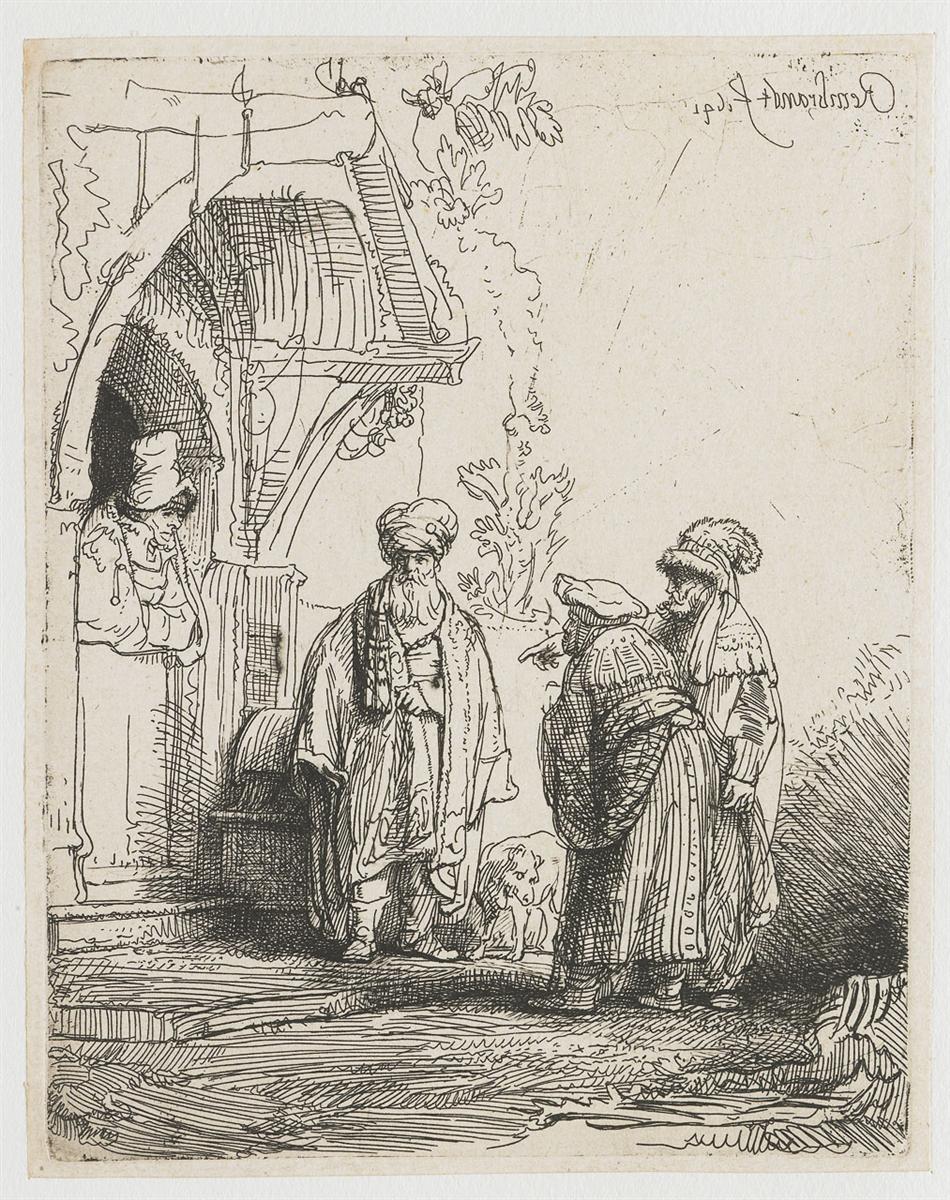
Rembrandt’s “Three Oriental Figures (Jacob and Laban)” from 1641 is a compact masterclass in how an artist can compress an entire chapter of human negotiation into a few square inches of copper. The image is an etching whose spare, economical lines nevertheless open into a world of narrative possibility. Three men in sumptuous Eastern dress confer beneath a small canopy or doorway, their bodies arranged in a triangle of tension and deference. A dog nestles by the central figure’s feet. Behind them, a woman peers from the threshold, and a tangle of foliage fills the sky’s margin. Although the composition is intimate, the story it implies is expansive: a family dispute, a bargain struck under pressure, the tug of pride and kinship and law. Often identified as Jacob and Laban with an attendant, the print takes a familiar biblical relationship and renders it not as a grand spectacle but as a close, lived conversation where character is revealed by posture, clothing, and the weight of a line.
Subject and Narrative Context
The Book of Genesis tells of Jacob’s years with his uncle and father-in-law Laban, a relationship braided with mutual advantage, trickery, and blessing. Jacob flees to Laban after deceiving his brother Esau; he works for Laban to marry Rachel, is given Leah first, stays longer to earn Rachel as well, and later bargains for speckled and spotted livestock as his wages. The biblical episodes are full of contract-like moments where kinship must pass through the sieve of terms. Rembrandt seizes that tone. The print does not specify precisely which incident we see, but the mood of haggling softened by blood ties pervades the scene. The central figure, richly robed and bearded, is commonly identified as Laban, a household head on his own threshold. The man bending forward in a respectful but assertive posture is read as Jacob, the younger party negotiating his place and portion. A third man, upright and fur-capped, could be a witness, a servant, or a son. The woman in the doorway, half hidden, reminds us that domestic consequences will echo from whatever these men decide.
Composition and the Architecture of Conversation
The composition is a clinic in narrative geometry. The doorway and canopy on the left carve out a shallow stage, their arching forms described by energetic hatchings that deepen into a pocket of shadow. The three main figures stand just beyond this pocket, lit by the open air and set against a blank expanse of paper that reads as sky. The effect is to push the conversation into relief, the way a spotlight isolates actors. Their bodies form an asymmetrical triangle: Laban at the left, tall and columnar; Jacob at the center-right, bent forward in a curve of supplication mixed with urgency; the attendant at far right, upright and observant, anchoring the group with vertical calm. The figures’ heads create a descending diagonal from left to right, which pulls the eye along the direction of speech and reply. The dog at Laban’s feet is not simply an accessory; its rounded form is a counterweight to the arch’s mass, and its animal presence grounds the human debate in ordinary life.
The Expressive Power of Line
Although the print appears deceptively light, Rembrandt’s line is charged with intention. He uses longer, more insistent hatchings to carve the deep pocket of shadow under the canopy, an area that almost reads as a separate interior world. The stones around the doorway receive short, chiseled strokes; the foliage bursts into airy loops and zigzags; the ground at the men’s feet is webbed with horizontal strokes that thicken near the threshold and thin out toward the right. On the figures themselves, contour lines swell and taper with exquisite sensitivity, describing the weight of layered cloth without overburdening the forms. Where he wants silk, he lets a smooth contour glide; where he wants fur, he shakes the line into quick burrs. The vitality of the drawing arises from how these marks remain alive to touch and temperature. One feels the cool of stone under the arch, the softness of a mantle trimmed with fur, the rough nap of the attendant’s sleeve.
Light, Shadow, and Moral Emphasis
Even with minimal ink, the print plays a sophisticated game of illumination. The darkest area is the interior nook behind Laban, where a woman stands half veiled by shade. That darkness establishes the threshold as both a physical and a moral boundary: behind it lie domestic obligations, dowries, and the hidden dynamics of household management. The figures step into the light to negotiate terms that must be seen and heard. Laban’s upper body is lightly shaded but not engulfed; Jacob’s bowed back catches a wash of paper-white that gives his gesture clarity; the attendant’s fur cap, cross-hatched more densely, keeps the composition from drifting into weightlessness. Light, in other words, is not only visibility but argument. It identifies the act of negotiation as the thing that matters now, and it gives each participant a distinct tonal register—Laban in measured half-light, Jacob bright in appeal, the attendant baring his shadowed judgment.
Costume, Identity, and the Seventeenth-Century Eye
Rembrandt dresses his figures in “Oriental” garments that seventeenth-century viewers would have associated with the biblical world and with Amsterdam’s cosmopolitan trade routes. Turbans, long robes, sashes, and fur-lined coats signal status and difference while giving the etcher delightful opportunities for textural invention. These costumes are not simply exotic window dressing. They serve narrative and psychology. Laban’s robe falls in large planes, stabilizing him as the household pillar; Jacob’s layered clothing, with its gathered seams and belt, seems more practical and mobile, fitting the role of a shepherd and traveler; the attendant’s fur speaks to authority and wintered experience. Rembrandt’s accuracy here is less ethnographic than expressive: the “Oriental” style allows hierarchy and dignity to appear through cloth. It also harmonizes the biblical past with a contemporary sense of worldly trade and encounter that Dutch viewers would have recognized as part of their own civic identity.
Gesture and the Drama of Posture
Look at Jacob’s body: he bends sharply at the waist, one hand raised, the other held close. The bend is respectful, but the raised hand and forward step push the bend toward assertiveness. Jacob is not groveling; he is urging, pleading his case with facts and promises. Laban’s posture is different. He stands broad and composed, shoulders set, chin slightly down. One can imagine the slow nods of an elder who knows the stakes and will not be rushed. The attendant’s hands are quiet; his presence suggests witness, accountability, or kin standing by to affirm the outcome. The woman in the threshold watches, a visual reminder that agreements among men reshape the domestic order. Each posture is a sentence in the argument: Jacob’s urgency, Laban’s authority, the attendant’s reserve, the woman’s attentive caution. None of these are caricatures; they are anatomies of responsibility.
Space and the Threshold as Theme
The print’s space is shallow but eloquent. The architecture creates a corner—a threshold that protects and exposes at once. Negotiations happen at thresholds because thresholds are where private and public meet. Behind Laban lies his house, his daughters, his store of goods; before him lies the world of work, fields, flocks, and travel. Jacob approaches from that outer world seeking terms that will allow him to cross the line in fairness. The canopy’s undergirding beams and cords, described in a few brisk lines, stress the man-made character of the boundary. This is a place constructed to shelter the act of speaking and listening. The ground slopes slightly and is scribbled with horizontal hatchings, which slow the viewer’s eye and suggest the measured pace of negotiation. Even the sparse foliage matters: it fills the upper right with organic forms that answer the geometry of the doorway, as if nature listens in on the contract.
The Dog as Emblem and Companion
Rembrandt often uses dogs as subtle emotional barometers in crowded scenes. Here the small dog at Laban’s feet does several jobs at once. It aligns the elder with household guardianship, fidelity, and domestic authority. It also softens the scene’s gravity with the everyday companionship of an animal decidedly uninterested in terms and conditions. The dog looks downward, a quiet echo of Jacob’s bowed posture, casting a sympathy across the composition. In a print where pride and duty are in dialogue, the dog signifies loyalty as something that precedes bargaining and confirms it after. Once one notices the animal, the whole tone of the image feels warmer, more human.
Signature, Plate, and the Intelligence of Making
Rembrandt inscribes his name in reverse at the upper right, as he typically drew the signature on the plate so it would print correctly. In some impressions of related prints from this period, one finds varieties of plate wear and small changes that reveal his working method: he would lightly bite the plate to map the composition, then return to deepen shadows or enrich textures, sometimes adding drypoint to thicken a contour or emphasize fur or hair. In “Three Oriental Figures,” the line remains largely etched rather than burr-heavy, which keeps the image open and airy. That openness suits the theme, as if too much darkness or velvety burr would make the scene heavy with foregone conclusions. Instead, Rembrandt lets the copper hold a conversation as nimble as the one it depicts.
Relation to Other Works on Jacob and Family Negotiations
Rembrandt returned to the Jacob cycle across media. In paintings and drawings he explored Jacob wrestling the angel, meeting Esau, blessing his sons, dreaming of the ladder, and conversing with Laban. The thread connecting these subjects is transition under pressure: identity worked out in crossings, bargains, night struggles, reconciliations at the edge of violence. Compared to the stormy energy of the wrestling scene or the large-scale pathos of Jacob blessing his sons, “Three Oriental Figures” is hushed, concentrating on the moral algebra of speech. It resembles his small etched “Presentation” and “Christ Preaching” in the way it assembles figures around words spoken in the open air. In all of these, Rembrandt treats speech as action and gives the spectator the privilege of overhearing.
Psychology Without Portraiture
None of these men is a portrait in the modern sense; yet each reads as a realized individual. Rembrandt accomplishes this by refusing to generalize the face. Laban’s eyes turn down and inward, and the droop of his mustache communicates inward consideration. Jacob’s brow tilts as if he has rehearsed his case and now places it on the table again. The attendant’s gaze angles toward Jacob, like a witness testing consistency. These are not theatrical masks but working faces that carry weight through years. The woman’s face is lightly struck but keen in outline; one senses alertness and worry as she stands half in shadow. Rembrandt’s point is not only that people negotiate; it is that the quality of their faces matters when they do.
Ethics, Kinship, and the Texture of Time
The biblical story of Jacob and Laban stages the tension between contract and kinship. Wages, flocks, and years become the arithmetic of loyalty. Rembrandt’s image takes that tension seriously. The threshold and canopy are the architecture of agreement; the dog symbolizes pre-contract loyalty; the woman in the doorway represents how the private sphere must live with public terms; the bending and standing bodies enact the roles assigned by age and desire. The print also understands time. These men are not strangers striking a bargain; they are relatives counting shared seasons. The lines in the etching, with their cross-currents and overlaps, carry the sensation of time layered into routine—steps worn into thresholds, garments creased by use, a dog accustomed to this spot. The scene feels like one instance in a long series of talks, the one we happen to be allowed to witness.
Theology by Implication
Rembrandt rarely illustrates doctrine directly; instead he lets the Bible’s moral weather permeate everyday light. “Three Oriental Figures” is a theologically charged scene precisely because nothing miraculous occurs. Providence appears in the fact that speech is possible, that human beings can appeal, reconsider, and bind themselves with words. The print refuses the melodrama of punishment or reward and concentrates instead on the ordinary holiness of fair dealing. Jacob’s bow acknowledges an order larger than himself; Laban’s measured stance answers to a responsibility larger than personal irritation or greed. The viewer senses that truth, if honored here, will echo through flocks and children and journeys—through the future itself.
The Amsterdam Context and the Allure of the “Oriental”
Seventeenth-century Amsterdam was an entrepôt where goods, people, and ideas from the Ottoman Empire, Persia, North Africa, and beyond were familiar presences. Artists like Rembrandt found in “Oriental” dress both visual pleasure and a way to signal biblical antiquity without slavish historicism. The choice also allowed him to place stories of kinship and contract in a cosmopolitan frame that echoed his city’s mercantile ethics. Viewers of the time would have recognized the mix of reverence and pragmatism—the sense that holiness might walk through a marketplace and speak in the language of agreements. In this light, the print becomes a mirror of Amsterdam’s own conscience: trade tempered by law, ambition tempered by kinship, strangers and relatives meeting under the same awning of obligation.
Scale, Intimacy, and the Viewer’s Role
The print’s modest size asks the viewer to come close. That closeness is not incidental. It replicates the physical act of drawing near to overhear a conversation. One leans in, as one might lean toward two elders settling a matter. The small scale also invites repeat viewing. On first glance, one reads the triangle of bodies and the threshold drama; on second glance, the dog and the woman emerge as moral witnesses; on third, the subtleties of line begin to glow—the soft tremor of a fur edge, the quick whisk of foliage, the calculated spacing of blank paper that lets the figures breathe. This layered discovery echoes the layered process of negotiation itself, where first positions give way to finer clarifications.
Comparisons with “The Triumph of Mordechai”
Seen alongside Rembrandt’s contemporaneous “The Triumph of Mordechai,” the present print demonstrates the artist’s range. Both works treat public recognition and social order, but the modes differ. The Mordechai etching explodes into civic spectacle, with crowds in tiers and light blazing across a pageant. “Three Oriental Figures” doses the same concern with scale and restraint. The honor at stake here is not the king’s award but the fairness of a wage, the justice of a household’s arrangements. The shift from procession to conversation is a shift from fate unfolding to responsibility negotiated. Together, the prints show how Rembrandt could stage moral life at the level of the city and at the threshold of a home.
The Woman in the Doorway
It is easy to overlook the woman in the arch’s shadow, yet her presence changes the scene’s meaning. She stands within, arms drawn close, watching. If the figures indeed represent Jacob and Laban, she may be Leah or Rachel or another household member. She embodies the silent stakeholders who bear the consequences of male agreements. Her placement in shadow is not a diminishment; it is a factual note about the era’s gendered spaces, and it is an artistic device that makes the threshold pulse with significance. The arch cups her like a niche, and the heavy hatching gives her the density of interior life. She turns the men’s words into an echo of domestic reality, ensuring that the negotiation never drifts into abstraction.
Movement, Pause, and the Breath of Dialogue
Despite its stillness, the print contains breath. Jacob’s forward lean suggests speech mid-flow; Laban’s downturned gaze suggests measuring the proposal; the attendant’s quiet stance implies that he will speak next. The dog’s posture reads as a pause rather than a freeze, and the foliage seems to twitch in a summer breeze. Rembrandt orchestrates these micro-movements so that the viewer experiences the scene as a held moment between sentences. That sensation—of a pause electrically charged with possible outcomes—is one of the hallmarks of his narrative art. He trusts the viewer to let the next line of dialogue unfold in the mind.
Why This Small Print Endures
“Three Oriental Figures (Jacob and Laban)” endures because it respects the complexity of ordinary justice. It does not flatter Jacob as a pure hero, nor does it demonize Laban; it shows two men with history seeking terms under a canopy that is both shelter and scrutiny. The etching’s beauty is inseparable from its moral tact. Every line has a job to do, every blank carries air, every gesture reveals a conscience at work. One can return to it repeatedly and find not a fixed lesson but a renewed invitation to listen, weigh, and speak fairly. In an age enamored of spectacle, the print’s quiet confidence feels radical. It whispers that much of the world is decided in small, careful conversations at thresholds where families meet the future.
