Image source: wikiart.org
Introduction
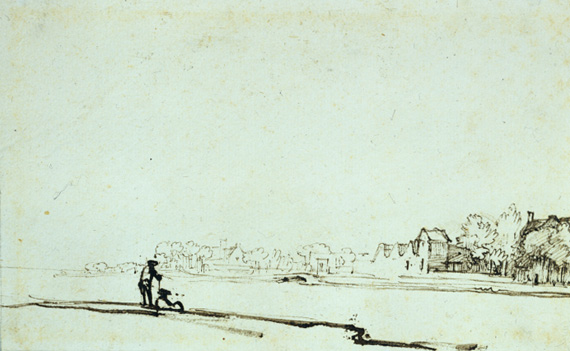
Rembrandt’s “View of Amstel River in Amsterdam” from 1641 is a masterclass in economy and atmosphere. Executed with minimal means, the drawing captures an expansive river panorama in which the smallest marks carry the weight of sky, water, shoreline, and human presence. A solitary figure with a dog stands on a darkened bank in the left foreground; a slim band of architecture and trees rides the distant horizon; the Amstel occupies the luminous field between. The composition is striking for what it withholds as much as for what it shows. Vast, untouched paper becomes sky and air, while a few decisive strokes anchor the scene to a specific place and time. In this analysis, we explore how Rembrandt transforms near-emptiness into abundance, how he uses line and tone to stage spatial drama, and how the sheet crystallizes the artist’s mature landscape vision at the dawn of the 1640s.
Historical Context
By 1641 Rembrandt van Rijn was an established painter and printmaker living in Amsterdam, the booming capital of the Dutch Republic. The city’s fortunes were tied to water: the Amstel River fed the harbor and threaded a network of canals that shaped daily life and commerce. Artists of the period often celebrated the practical beauty of this engineered environment. Rembrandt’s landscapes, however, rarely settle for topographic report. Even when rooted in recognizable sites, they are filtered through sensation—weather, light, and the feel of distance on the eye. The “View of Amstel River in Amsterdam” belongs to the body of on-the-spot drawings in which he tested ways to make space breathe with the fewest possible marks. The sheet’s date places it near other landscape experiments, including etchings that probe the balance between dense hatching and open paper. Together they show an artist confident enough to let emptiness carry meaning.
Composition and Spatial Architecture
The composition pivots on a daring asymmetry. A thin, earthy ribbon of shoreline runs horizontally across the lower quarter of the sheet, turning gently toward the foreground at the left where Rembrandt deepens the tone into a dark wedge. That wedge supports the silhouetted figure and his dog, the only forms that break the upper field of light. Beyond the bank, a pale sweep of water spans the page to a distant strip of settlement and foliage drawn with small, nibby strokes. The upper two-thirds of the sheet are left almost untouched, an atmospheric vault of sky that presses against the thin horizon line. This balance—dark, compact mass at the left; faint, long murmurs at the horizon; a boundless sky—creates a sensation of the eye adjusting to vastness. The viewer stands with the lone figure, looking across water and light to a city that sits, quiet and low, on the far side.
The Role of the Foreground Figure
Rembrandt’s decision to place a single figure with a dog at the left edge is not incidental; it is structural and psychological. The human silhouette establishes scale, tethering the sublime space to a relatable vantage point. The figure’s stance implies a pause—perhaps a walker who has turned to watch the river—and in that act of looking the viewer finds a surrogate. The dog’s compact shape adds a note of domesticity and companionship, softening the heroic sweep. Their shadows and the darkened bank create a visual hinge: from here the gaze unfurls into the open bright field. Without this anchor, the drawing might drift into abstraction; with it, the scene feels inhabited and the distance measurable.
Line, Ink, and the Intelligence of Omission
The technical brilliance of the drawing lies in its line discipline. Rembrandt uses a limited repertoire—short verticals for tree masses, quick horizontal skims for water, a handful of charged contours for the bank. The economy is radical. There is no attempt to model forms with cross-hatching or to agitate the sky with decorative clouds. Instead, the artist cultivates a hierarchy of marks: the darkest, most saturated lines define the nearest ground; mid-tones articulate the distant shore; hairline touches hint at roofs, gables, and foliage in the far distance. Between these levels lies a gulf of reserved paper that reads as brilliant daylight. What is omitted—a detailed surface for the water, specific reflections, the milling activity of boats—is what allows the sheet to glow. The silence of the untouched paper becomes an active element, a field of light that cannot be achieved by adding more ink.
Light and Atmosphere
The most striking sensation is lightness: a high, clear day in which visibility extends without haze. Rembrandt achieves this luminosity by resisting the temptation to fill space. The river is not a mirror but a sheet of light. The sky is not described with forms; it is allowed to be emptiness, which paradoxically makes it more present. The sparse, staccato marks on the horizon flicker like sunlit leaves and rooftops. The left-bank wedge is the only area of concentrated darkness, and by contrast it makes the rest of the landscape feel irradiated. The drawing converts the page itself into light, so that what we experience is less representation than the paper’s own brilliance harnessed to depict open air.
Perspective and the Experience of Distance
Distance in this sheet is created by scale compression and mark attenuation. The figure and his dog are essentially silhouettes, dense and legible. The horizon buildings, by contrast, are lightly indicated accents, almost a code. The river manages the space between with virtually no descriptive labor; its breadth is felt rather than measured. This method respects how human eyes actually scan a bright panorama: we register the foreground with clarity, the middle with generalities, and the rest as a map of signals. Rembrandt’s orchestration of these zones produces a serene but powerful recession, the kind of space that seems to keep opening as one looks.
The River as Artery and Stage
The Amstel is both a subject and a stage. As subject, it is the city’s liquid backbone, carrying goods and people, reflecting light, and breathing weather across the plain. As stage, it holds the vast middle ground where any narrative might occur—boats crossing, birds skimming, wind troubling the surface. Rembrandt deliberately leaves this stage empty, which loads it with potential energy. The viewer senses motion without specifics, as if the river’s current, tide, or breeze whispers through the untouched paper. The decision to depict the water as a field rather than as a catalog of ripples elevates the scene from anecdote to phenomenon.
Urban Edge and Dutch Identity
On the horizon rests Amsterdam, not monumental but intimate—roofs, chimneys, and a rank of trees. The low silhouette speaks to the Dutch preference during the Golden Age for balance between human construction and the flat, reclaimed land. There is dignity in restraint; the city does not dominate nature but participates in it. Rembrandt’s band of architecture registers as a gentle signature of culture against the larger page of creation. This is a civic image without heraldry: the recognizable order of a prosperous town quietly integrated with river and sky.
Rhythm, Silence, and the Poetics of Space
The drawing’s rhythm flows from left to right. The heavy note on the left begins like a downbeat; the long, pale measure of river carries an even tempo; the delicate trills of the far trees and houses resolve the phrase. Silence—visual and metaphorical—fills the great midsection of the sheet. That silence is not emptiness but rest. It allows the mind to project breezes, sunlight, and distance, and it enacts the contemplative mood often found in Rembrandt’s landscapes. The sheet’s poetry resides in this interplay between sparse marks and the viewer’s imagination, a collaboration that gives the view a living hush.
Comparison with Rembrandt’s Other River Views
When set beside Rembrandt’s denser etched landscapes with bridges, mills, or storm-laden skies, this drawing feels almost ascetic. Elsewhere he constructs space with mossy cross-hatching or rolling banks of cloud; here he wagers on the eloquence of nearly bare paper. Yet the same instincts govern both: a search for the exact amount of information that will let the viewer experience weather and depth. The left-bank silhouette recalls the anchoring mounds and foreground trees that ground many Rembrandt landscapes, while the delicate horizon echoes his habit of letting cities appear as fragile lacework in the distance. The difference is one of degree. This sheet is the distilled version, the quietest voice still carrying to the far end of the room.
Mood, Narrative, and the Everyday Sublime
The presence of the walker and his dog suggests a narrative of daily passage: a morning stroll along the river path, a pause to look. Nothing dramatic happens, and that is the point. Rembrandt elevates the ordinary act of looking into a subject worthy of record. The everyday sublime—the sensation of largeness and calm available in common places—becomes the drawing’s emotional core. The figure becomes a stand-in for any viewer who has stopped before a bright reach of water and felt the world open.
Material Qualities and Speed of Execution
The drawing likely came together quickly, perhaps in a single sitting outdoors or reconstructed later from on-site notes. The line is confident but not fussy; the pen lifts and lands with the assurance of someone who trusts the interval between marks. The few wash-like shadows on the bank suggest a damp brush or diluted ink applied to deepen the tonal anchor. The paper carries small freckles and the slightest tooth, which the pen exploits to break lines into living textures. That speed and responsiveness give the scene freshness—the sense of a moment caught rather than manufactured.
The Ethics of Looking
Rembrandt’s minimalism here has an ethical dimension: it models a way of looking that is patient, undemanding, and respectful of space. Instead of colonizing the sheet with descriptive noise, he listens to the landscape and lets it speak through spareness. The result is a democratic view in which the human presence is acknowledged but not domineering. The river, air, and city share the page in proportion to their roles. In an age of engineering triumphs and maritime reach, this humility reads as wisdom.
Reception and Legacy
Though a modest-sized drawing, “View of Amstel River in Amsterdam” anticipates later landscape traditions that value atmosphere and emptiness, from the 18th-century here-and-now studies of English watercolorists to the 19th-century plein-air sketches of the Barbizon painters and beyond. Its language of sparse marks translating vast luminance also prefigures modern minimal landscape photography, which relies on the tension between a small built element and enormous sky. Within Rembrandt’s oeuvre, it stands as a touchstone for how the artist thought about place: not as a spectacle to be framed, but as a spacious field for perception and memory.
Practical Geography and Poetic Abstraction
One can, if inclined, read the horizon for specific spires or gables of Amsterdam’s outskirts. Yet the sheet resists narrowing into a mere topographic document. It hovers between particular and universal, between the record of a riverbank and an abstract arrangement of dark shape, pale plane, and delicate fringe. This duality—geography infused with poetry—is the hallmark of Rembrandt’s greatest landscapes. The more one seeks to pin down exact buildings, the more the drawing returns to feeling: the light on water, the pause of a walker, the breathing space between city and sky.
The Viewer’s Path and Duration
The drawing is designed for slow looking. The eye enters at the dark left, steps onto the bank with the figure, then glides across the water’s luminous breadth. It lingers at the delicate horizon, counting the rhythm of trees and roofs, before drifting up into the high, unmarked sky. That sky keeps the gaze from escaping; it is generous but not porous. The viewer’s attention returns, like a tide, to the anchored shore. This cyclical movement gives the small sheet surprising duration; one can look for a long time without exhausting it.
Emotional Resolution
The final effect of the drawing is calm. There is no impending storm, no heroic ruin, no allegorical signal. Instead, there is openness and balance, the quiet confidence of a city resting on its river under a capacious sky. The walker’s pause becomes the viewer’s. The dog’s patient posture becomes ours. The world is not stopped but gently slowed so that its ordinary radiance has time to register. Few drawings use so little to say so much about the experience of living in a place.
Conclusion
“View of Amstel River in Amsterdam” is a hymn to space and restraint. With a handful of strokes, Rembrandt crystallizes the relationship between shore, water, city, and sky; he anchors the scene with a single human silhouette and leaves the rest to light. The drawing’s greatness resides in its trust—trust in the viewer’s imagination, in the paper’s capacity to signify air, in the river’s power to suggest motion without description, and in the city’s ability to sit modestly at the edge of vastness. It is a vision of Amsterdam from the vantage of everyday life, yet it achieves a timeless lyricism that continues to refresh the eye. Standing beside that lone figure and his dog, we learn how to look outward with simplicity and inward with depth.
