Image source: wikiart.org
Introduction
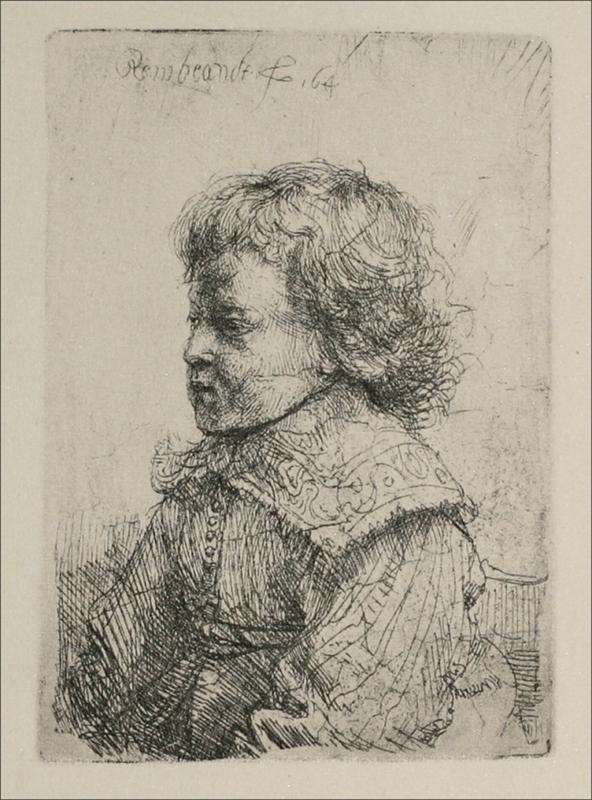
Rembrandt’s “Portrait of a Boy” (1641) is a small etching that distills the artist’s gift for psychological observation into a few square inches of copper. The child appears in profile, his soft, rounded face turned toward the left, a cascade of unruly hair catching the light around the crown and nape. He wears an ornate collar that flares like a shell and a patterned doublet whose seams and folds are described with vibrating lines. The boy’s lips are gently pressed, the nose slightly upturned, the gaze focused beyond the frame—an expression at once self-possessed and tentative. Though the print’s format is modest, its impact is large: Rembrandt makes a persuasive case that the inner life of a child can be rendered with the same gravity usually reserved for statesmen or saints.
The Power of Profile
Choosing profile is a decision with consequences. A frontal or three-quarter view invites a direct exchange; a profile, by contrast, establishes a space of contemplation. Rembrandt leverages that distance to honor childhood’s absorptive attention. The head’s contour is set with concise strokes that move confidently from brow to nose, from upper lip to rounded chin, then back toward the ear and the spiraling hair. The crisp edge of the face against the lighter paper articulates form without heaviness. Because the eye cannot meet ours, we become observers rather than interlocutors, reading the curve of cheek and the set of mouth as if they were sentences. The profile also connects the boy to the antique tradition of medallions and cameos, discreetly ennobling his presence while leaving him recognizable as a living child.
Light, Line, and the Tactility of Youth
Rembrandt’s etched line never sits inert; it breathes. He modulates cross-hatching to suggest the bloom of youthful skin, the down at the temple, the shadow that gathers under the lower lip. Thicker strokes sweep across the collar and sleeve, while finer networks follow the roundness of cheeks and the softened plane of the forehead. The result is a tactile contrast between the resilience of fabric and the delicate elasticity of flesh. Sparks of uninked paper are left for light to catch in the eye socket and along the upper contour of the cheek. These breaks are not omissions; they are deliberate reserves that create a humid atmosphere around the face, as if air itself were luminous.
A Child’s Gaze and the Ethics of Portraying Innocence
The boy’s gaze is notable for what it refuses—no performance, no forced cheerfulness, no adult affect. Many seventeenth-century portraits of children dress them in miniature versions of adult fashion and demeanor. Rembrandt accepts the costume but refuses the pretense. By allowing the boy’s mouth to remain slightly compressed and the gaze to drift just off focus, he captures a moment of interiority. The child is thinking, not posing. That fidelity to experience is ethical as well as aesthetic. It resists the temptation to turn a young sitter into a symbol of familial pride and instead recognizes a person in the process of becoming.
Costume, Pattern, and Social Identity
The ornate collar and the patterned doublet locate the child within Amsterdam’s prosperous milieu. Rembrandt does not linger on every stitch, but he suggests enough detail to convey expense and taste. The fluted edge of the collar, the embroidered bands, and the vertical seams are briskly articulated with directional lines that obey the logic of cloth. The clothing acts as a frame for the face, a stage for light rather than a spectacle in its own right. In this way Rembrandt balances the demands of representation—parents commissioning a likeness that reflects status—with his own commitment to psychological truth.
Composition and the Quiet Drama of Edges
Space in the print is shallow but not cramped. Behind the head, Rembrandt builds a low wall of hatching that thickens toward the right margin, allowing the profile to read in relief like a coin lifted from a velvet case. The bust-length format stops just below the chest, where the boy’s arm bends inward. This diagonal gesture, barely indicated, creates a sense of latent movement: perhaps the hand toys with a button or clasps the edge of the bench. The background’s networks of lines never compete with the head; instead, they nudge the eye back to the delicate rim of cheek and hair where drawing becomes pure attention.
Etching Technique and the Fluidity of Rembrandt’s Hand
“Portrait of a Boy” showcases the flexibility of etching, a medium Rembrandt used with painterly freedom. The needle moves at multiple speeds: swift and sketchlike in the hair, deliberate and weight-bearing along the jaw, almost whispering as it shades the temple. Drypoint burr may be sensed in a few plush lines, lending softness to the collar’s edge. Plate tone—the thin film of ink left on the copper—seems to linger around the head, intensifying the glow of the paper on the forehead and collar tips. These material decisions are not technical flourishes; they are expressive instruments tuned to the sitter’s age and temperament.
The Psychology of Scale
The print’s small size demands proximity. One must lean in, narrowing the world to the child’s profile and the murmuring architecture of lines that invent it. That act of closing the distance is pedagogical: the viewer adopts the artist’s discipline, discovering form through patience. The resulting intimacy is gentle rather than intrusive. It respects the sitter’s space while inviting empathy—an ideal mode for viewing a child’s portrait.
Childhood in the Dutch Golden Age
Seventeenth-century Dutch art produced a variety of images of children: family groups, allegories of the five senses, scenes of play, and stiffly posed likenesses. Rembrandt’s approach is set apart by his attention to character over costume. This 1641 etching arrives at a moment when his studio was busy with commissions and when his experiments with oval formats, night lighting, and richly hatched atmospheres were in full bloom. Despite that intensity, he found time for a modest portrait that reads like a study from life. The boy could be a patron’s child, a studio visitor, or even a relative, but his precise identity is less important than Rembrandt’s insistence that childhood merits the same seriousness as any adult subject.
Hair, Breath, and the Movement of Line
One of the print’s quiet miracles is the hair. Rather than drawing each strand, Rembrandt builds wind-soft curls from arcs and loops that catch light unpredictably. The hair spills slightly over the collar, emphasizing the body’s softness against the order of clothing. These airy lines animate the stillness of the profile and become a visual equivalent for breath—restless, living, resistant to confinement. In a medium often associated with graphic clarity, this lyrical looseness feels like a painter’s caress translated into metal.
Hands Unseen, Presence Felt
The boy’s hands are not visible, yet their implied position affects the whole. The inward bend at the elbow hints that one hand may rest in the opposite palm or tuck beneath the collar’s edge—gestures typical of children asked to sit still. By not showing the hands, Rembrandt concentrates expressive energy in the head and shoulders, but the suggestion of movement prevents stiffness. The portrait becomes a record of time rather than a frozen mask.
From Study to Keepsake
This etching occupies a threshold between private study and public keepsake. Its spontaneity suggests Rembrandt working directly before the model, yet the signature and date embedded in the upper field imply a finished object meant to circulate. For the owner, the print would have offered a portable token of the child’s likeness. For us, it offers access to Rembrandt’s working intelligence, the way he calibrates every mark to maximize character while minimizing fuss.
The Grammar of Childhood
Rembrandt avoids the clichés that often attend images of children—cherubic smiles, overflowing props, sentimental gestures. Instead he builds a grammar of childhood from subtle signs: the fullness beneath the eye, the slight forward push of the upper lip, the hair’s refusal to lie down, the shoulders’ diminutive slope under a costume a bit too grand. Each cue is small, but together they speak fluently. The child appears neither angelic nor unruly, simply alert to a world in which adults ask him to sit still while life pulls his attention elsewhere.
The Background as Moral Atmosphere
Look closely at the field behind the boy and you see not emptiness but intention. In some areas the hatching is almost a net, in others a soft mist. The right side is more worked than the left, causing the head to advance from shadow like a thought becoming clear. This atmospheric design creates a moral climate for the portrait: the world is complex and textured, but the child remains legible within it. Rembrandt’s backgrounds often perform this duty, offering not settings but states of mind.
The Dialogue Between Ornament and Simplification
The etched pattern on the collar is specific enough to read as embroidery yet abstract enough to keep the eye from getting lost. Rembrandt neither flaunts detail nor abolishes it. His strategy is to simplify toward the essential. Where the collar overlaps the shoulder, marks thicken to express weight; where it turns toward the light, lines thin and open. The eye experiences pattern as sensation rather than inventory, enabling the portrait to honor craftsmanship without becoming a catalogue.
Comparison with Other Youthful Studies
Rembrandt etched and drew many heads—old men with furrowed brows, women in white caps, youths in caps. Compared with those, “Portrait of a Boy” is distinguished by its refusal of drama. There is no theatrical costume, no exotic turban, no role-playing. The boy sits as himself. That restraint allows the print to live alongside more elaborate works as a counterpoint, a reminder that the artist’s greatest subject is always the unadorned human face.
Time, Memory, and the Poetics of the Small
Childhood is as much a temporal category as a physical one. The etching captures the fragile interval between babyhood and adolescence, when features begin to sharpen but softness persists. Rembrandt’s lines participate in that theme: some are tentative, testing; others assertive, already sure. The print reads like memory forming—edges clarifying even as they blur. Holding an impression in the hand, one feels how scale supports memory’s intimacy. It is an object that could have been kept in a portfolio, revisited as the sitter grew older, a touchstone for the parent or collector who valued not merely appearance but a specific mood in time.
Craft, Humility, and the Artist’s Empathy
At its core, this print testifies to Rembrandt’s empathy. He attends to the child without projecting his own agendas. The etched web becomes a net of care that neither constricts nor abandons. Even the signature, placed unobtrusively at the top, avoids cutting across the head or collar. Everything serves the dignity of the sitter. Such humility is part of the artist’s greatness: he knows when to dazzle and when to step back, when to summon virtuosity and when to let one clean contour carry a world.
Legacy and Continuing Relevance
“Portrait of a Boy” continues to attract viewers because it feels contemporary in its respect for children as complex subjects. It speaks to educators and parents who recognize the seriousness of youthful attention. For artists, it remains a masterclass in how few lines are needed to suggest life when those lines are placed with conviction. Museums and print rooms treasure impressions not only for their rarity but for their ability to draw modern viewers into a quiet conversation with a real child living in seventeenth-century Amsterdam.
Conclusion
In “Portrait of a Boy” Rembrandt uses the smallest of means to achieve the largest of ends. Profile, line, and light cohere into a presence that is both particular and emblematic. The ornate collar and costume establish context, but personality carries the image. The boy appears alert yet withdrawn, a person on the cusp of the world. The etching’s craft—its gradations of hatch, its breathing plate tone, its generous reserves of paper—becomes inseparable from its ethics: to look carefully, to honor interior life, and to let childhood be as dignified as any adult subject. In a culture of grand canvases and public gestures, this tiny print whispers, and its whisper is unforgettable.
