Image source: wikiart.org
Introduction
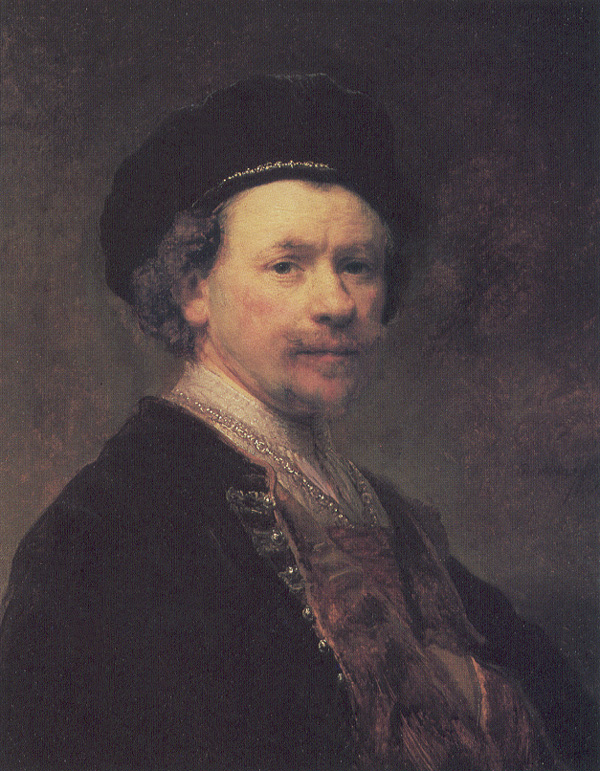
Rembrandt’s “Self-portrait” of 1640 is a poised declaration of artistic identity at a pivotal moment in the painter’s life. Painted shortly after his marriage to Saskia and amid a wave of critical and commercial success in Amsterdam, the work captures a thirty-something Rembrandt looking outward with composed assurance. The head turns gently toward the light, the lips are set in a subtle half smile, and the eyes hold the viewer with a quiet steadiness. The attire is rich without ostentation: a softly bereted cap, a dark mantle fastened with a decorative clasp, and a warm, reddish tabard whose plush surface invites the light. Behind him the field is atmospheric and uncluttered, allowing face, handsomely modeled collar, and upper torso to dominate. What emerges is not an improvised likeness but a carefully staged thesis about authorship, craft, and reputation—an image in which Rembrandt calibrates light and texture to announce who he is and what painting can do.
A Moment of Self-Fashioning
The year 1640 finds Rembrandt consolidating his position as Amsterdam’s leading portraitist and history painter. He had already produced ambitious canvases and dazzling etchings; commissions flourished among burghers, merchants, and civic groups. In this self-portrait he chooses to appear neither in the casual garb of the studio nor in the emphatic costume of a biblical role. Instead he presents himself in dress that feels chosen for the picture: garments whose materials—velvet, fur, metalwork, embroidered trim—let him demonstrate sensitive handling of surfaces while remaining plausible for a prosperous artist. He is not playing a character; he is playing himself as a master.
Composition and the Geometry of Calm
Rembrandt situates the torso at a slight three-quarter angle while the head turns more fully toward the viewer. This counter-twist produces a rhythm that keeps the picture alive without theatricality. The dark cap forms a stable crown, echoed by the darker mantle that frames the lower right. The warm tabard creates a vertical triangle of color, concentrating attention near the clasp and then ascending to the face. The background is a gently modulated field whose darker passages at the upper right and lower left cup the figure like an armchair. The composition’s structure reads as confidence: the artist gives himself room, occupying space with ease.
Light as the Author of Character
As in his greatest portraits, light in this picture acts like a second narrator. It enters from the upper left and walks across the features: a glow on the forehead, a measured highlight along the bridge of the nose, softness over the cheeks, a quick spark on the lower lip, and a last touch at the tip of the chin. The cap remains mostly in shadow to prevent the region above the brow from dominating. On the clothing, the light moves differently, mapping texture rather than anatomy—sheen on the silver chain and clasp, suede-like bloom on the mantle, deeper absorption within the folds of the tabard. Because Rembrandt allows flesh to receive light more gently than metal or fabric, the eye returns again and again to the face where intelligence and mood reside.
Brushwork from Whisper to Pronouncement
The painting’s surface reveals a flexible vocabulary of touch. The face is constructed with layered, semi-opaque passages that knit into one another so smoothly that the flesh seems to breathe. In the hair Rembrandt switches to broken strokes, letting warm underpaint flicker through darker curls. The soft brim of the cap is handled with velvety restraint, while the clasp and chain receive firmer, calligraphic touches that catch highlights in single gestures. The tabard’s warm field is built with broader, more sweeping movements, some glazed to a satin luster, others scumbled to suggest wear. This play of strokes is not an exhibition of virtuosity for its own sake; it is a way of aligning hand and material so that each substance—skin, metal, cloth—speaks in its own dialect.
Costume as a Workshop of Effects
Rembrandt’s clothing in self-portraits is never mere costume; it is an instrument. The beret’s dense black allows the head’s flesh to shine without competition. The clasp punctuates the diagonal edge of the mantle and marks a hinge where light turns. The reddish tabard, placed centrally, functions as a reflector that pushes warm light back into the face. Each material invites a different solution: crisp highlights for metal, sinking glow for velvet, granular strokes for fur. By staging this suite of textures around his features, Rembrandt demonstrates that painting can be a form of truth-telling not only about people but about the world’s touchable realities.
The Psychology of the Gaze
The eyes are not sharply theatrical; they are watchful and engaged. There is a minor asymmetry between the two sockets—one slightly more open than the other—producing the effect of a thinking person rather than a mask. The mouth, relaxed but closed, avoids bravado. Viewers often read this expression as a blend of self-assurance and reflective restraint. Unlike later self-portraits that emphasize vulnerability or age, this 1640 image inhabits the long middle register where authority and curiosity coexist. The painter recognizes the viewer, but he also measures them, as if weighing whether the conversation will prove interesting.
Dialogue with the Old Masters
This self-portrait converses with Titian and Raphael, whose portraits Rembrandt studied through prints and examples circulating in Amsterdam. The calm turn of the head, the dark cap, and the softly luminous background recall Venetian precedent; the warm, sculptural modeling of features echoes High Renaissance ideals of presence. Yet Rembrandt’s difference is plain. Venetian flesh often aspires to idealized coolness; his retains the life of blood and breath. High Renaissance harmony can feel aloof; his sympathy pulls the viewer closer. He borrows the old masters’ poise and returns it with Dutch immediacy.
Color World and Tonal Harmony
The palette is limited but sophisticated: earth reds and siennas for the tabard; bone or lamp black tempered with umbers for cap and mantle; lead white warmed with ochre and faint lake for flesh; cool gray half-tones for shadow transitions; and tiny notes of silver in chain and clasp. Because chroma is restrained, temperature shifts do the expressive work. A warm cheek meets a cool temple; a slightly bluish shadow under the eye deepens the socket without hardening the gaze; a toasted highlight in the lower lip animates the mouth. The overall effect is neither brown nor monochrome; it is a living harmony in which warmth and coolness modulate like quiet music.
The Background as Breathing Space
Rembrandt resists the temptation to fill the ground with props or architectural niches. Instead he uses a mottled, atmospheric backdrop that deepens toward the edges. This negative space performs several tasks. It prevents distraction, allowing the head to float forward. It creates soft spatial recession so the figure seems to inhabit air rather than sit upon a flat ground. And it contributes to mood: the darkening at upper right balances the cap’s silhouette; the warmer lower left bathes the tabard subtly. The background is not empty; it is the breath in which the portrait lives.
The Artist as Craftsman and Citizen
Dutch portraits often functioned as public statements of role and status. While Rembrandt does not flaunt civic insignia, he places himself within that tradition of self-possession. The sturdy posture, sober but fine clothing, and composed expression assert professional dignity. He is not an artisan hidden behind commissioned work; he is the author and guarantor of it. The picture thus becomes both a personal likeness and a calling card—evidence that its maker has mastered not just technique but the social mode of portraiture.
Comparison with Other Self-Portraits Around 1640
Placed beside “Self-portrait at the Age of 34,” also from 1640, this painting feels slightly more intimate and less theatrical. The companion work quotes Raphael’s Castiglione in pose and dress and airs a deliberate Renaissance elegance. The present image is closer to everyday life while retaining gravitas. Later self-portraits from the 1650s and 1660s turn inward, showing the costs of time; earlier ones from Leiden sport youthful bravado and exotic costume. The 1640 portrait sits at the fulcrum: the self fashioned as professional, confident, and alert, still early in the arc but already aware of art history’s conversation.
Drawing, Underpainting, and the Logic of Build
Technical reconstructions suggest that Rembrandt often began such portraits with a drawn placement of features in thin brown paint, establishing the great planes of light and shadow before modeling particulars. He would then work flesh to a high key early, surrounding it with darker costume and background, allowing wet-into-wet transitions to soften edges. Final accents—the tiny bright on the eye, the sharper highlight on the clasp, the coolest gray in the cap’s brim—would arrive last. One can feel that logic here: the face breathes from within because its construction was prioritized; the clothing and field wrap around it in cooperative support.
Edge Control and the Atmosphere of Presence
Edges in this portrait are pruned and modulated with exquisite tact. The contour of the cap against the background is soft enough to avoid cut-out, yet it tightens at the forehead to anchor the silhouette. The cheek’s lit edge feathers into air so the skin appears round; the mantle’s nearer shoulder retains a slightly crisper outline to keep the torso from dissolving. These decisions make the difference between a likeness that sits on the canvas and one that seems to inhabit the space in front of it.
The Ethics of Self-Representation
Rembrandt is neither flattering nor punitive toward himself. He acknowledges the soft fullness of the cheeks, the irregularity of the mustache, the slight asymmetry of the eyes. But he also casts himself in generous light and dignified attire. This balanced ethic—truthful but humane—became the signature of his mature portraiture. In representing himself this way, he models the contract he offers patrons: not a rhetorical mask, not a forensic record, but a living presence attended by light.
Reception and the Work’s Afterlife
Self-portraits traveled in workshop copies, prints, and later photographic reproductions, shaping Rembrandt’s durable public image. Collectors prized them as windows onto process and persona; fellow artists studied them for lessons in color, lighting, and character. Over centuries, this 1640 example has often been cited as a standard of middle-period poise, the moment before turbulence and loss enter the late works. Its calm, however, is not complacent. It feels like composure earned through work, a readiness for the next ambitious commission.
The Viewer’s Experience
Standing before the painting, the viewer senses both intimacy and ceremony. The scale allows the face to meet ours at nearly life size, creating the feeling of a real encounter. Yet the stillness of pose and orchestration of light keep the meeting formal enough to feel intentional, like an introduction. Rembrandt’s art thrives on this tension: we feel welcomed into a private space even as we recognize the public theater of portraiture. The painting achieves an equilibrium that many modern portraits still seek.
Lessons for Painters and Photographers
This self-portrait is a compact school for image-makers. Use restrained palettes to prioritize value and temperature. Let light narrate and costume support rather than compete. Build faces with layered transitions rather than outlines. Reserve the highest highlights for small accents so the eye knows where to rest. Avoid busy backgrounds; give the subject air. Calibrate expression to sit between drama and indifference. These precepts, embodied rather than preached, explain why the painting remains a touchstone across media.
Why the Image Still Feels Contemporary
Despite its age, the portrait reads with striking immediacy. The close crop, the neutral environment, the balance of candidness and construction—these are strategies familiar to modern portrait photography. The viewer encounters a person, not a symbol. The small imperfections that Rembrandt allows become tokens of authenticity, while the luxurious but subdued clothing signals professionalism rather than vanity. In this sense the picture anticipates a contemporary ideal of self-representation: present yourself accurately, stage the light thoughtfully, and let character outshine costume.
Conclusion
Rembrandt’s 1640 “Self-portrait” crystallizes an artist at a moment of confident self-definition. Composition, light, brushwork, and costume conspire to present a presence both immediate and considered. The portrait is not just a likeness but a manifesto of method: a belief that attention to light and texture reveals character more reliably than rhetoric ever could. In the calm between youthful bravura and later introspection, Rembrandt offers a living model of artistic authority—one that continues to instruct viewers, painters, and photographers in how to let a face, under honest light, become the center of a world.
