Image source: wikiart.org
Introduction
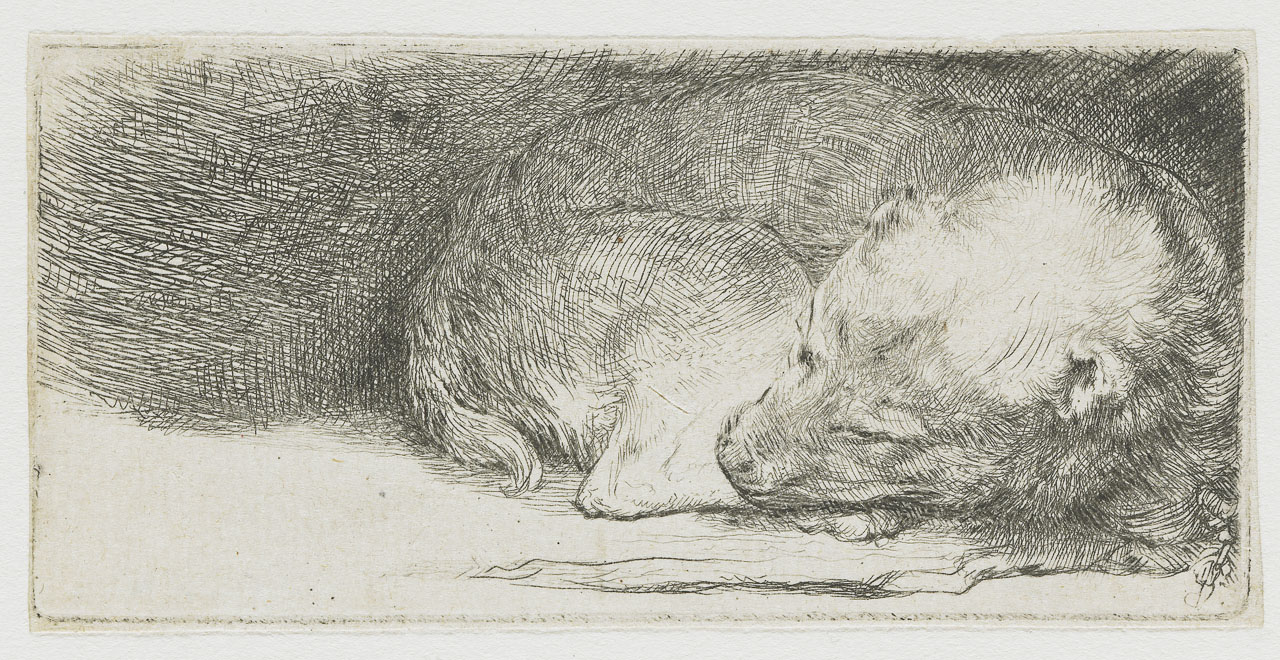
Rembrandt’s “Sleeping Puppy” (1640) is among the most disarmingly tender works in his entire printmaking career. Measuring only a few inches across, the etching renders a drowsing dog curled into a crescent of fur and breath. There is no background scene, no furniture, no human figure to contextualize the moment. The world contracts to the shape of sleep. A network of hatched and cross-hatched lines builds the pup’s body; a reserve of untouched paper becomes the pillow of light beneath its muzzle and paws. In a century crowded with grand narratives and allegories, this slight plate is radical for its quiet. It is a portrait of rest, made with the same seriousness Rembrandt brought to saints and sovereigns, and it proves how profoundly he could invest feeling in the simplest subject.
What We See When We First Look
The animal lies on its side, head tucked forward so that the nose nearly touches the forepaws. The tail has looped around to complete the circular contour; the back rises in a soft ridge before descending into the shaded cradle along the floor. The ear closest to us rests in a small fold, while the far ear sinks into dark. The pup’s face is barely detailed—just the delicate bevel of the brow and a few tremulous marks for whisker and nose—yet it conveys perfect relaxation. Behind the dog, a dense scrim of cross-hatching wraps the figure in a cocoon of shadow, allowing the animal’s lighter body to emerge lucidly. The light source seems to come from the left, where Rembrandt allows more of the paper to remain unworked, letting the white ground glow like a soft cloth.
Etching as the Perfect Medium for Fur and Air
Etching suits this subject with uncommon grace. Unlike engraving, which forces the hand to push through metal with an even, formal line, etching allows the artist to draw freely into a wax ground and then to bite the plate with acid. The line responds to speed and pressure much like pen and ink on paper. Rembrandt exploits this freedom to suggest the nuances of fur: flicked strokes for the wiry hairs along the back, shorter stippling around the muzzle, and fine broken lines around the paws where softness gives way to bone. He thickens and thins lines to model volume without resorting to outline; the dog’s flank “breathes” because the hatch-wrap follows the curvature of the ribcage. By varying the density of cross-hatching in the background, he controls the pressure of shadow without deadening it, keeping the surrounding air alive.
Light, Shadow, and the Modelling of Sleep
The plate is a delicate study in light’s gentleness. Illumination grazes the top of the head, slips down the bridge of the nose, and loses itself in the tangle of paws. The back is darker, as if the animal lies near a wall. Rembrandt understands that sleep is a state of lowered contrast, so he avoids theatrical chiaroscuro. There is no harsh boundary between brightness and dark; instead a slow gradient passes across the animal’s body, allowing the viewer to sense the warmth inside the form. The brightest area is not the forehead but the oval of paper just beneath the muzzle and paw, a small courtyard of quiet in which the dog settles. That empty light gives the composition its breathing room.
Composition: The Circle That Holds a Life
The design is elegantly circular. The pup’s spine arcs from the head around the torso to the haunch; the tail curves back to nearly touch the forepaws. This unbroken loop locks the figure into a protected shape, like an unclosed letter O. Rembrandt nestles that circle against a diagonal band of shadow that runs from the upper left to the lower right. The diagonal and the circle counterbalance each other, creating a stable yet dynamic arrangement. The long, narrow format of the plate intensifies the sense of enclosure. The dog occupies most of the horizontal space, but Rembrandt leaves slim margins at either side so that the eye can feel the hush around the sleeper.
Scale and Intimacy
One reason the etching feels so intimate is its small scale. The image invites the viewer to lean in, as one would approach a sleeping pet so as not to wake it. The closeness reduces social distance; there is no grand viewing platform here, just the edge of a floor or cushion. Rembrandt often used small plates for the most private subjects—domestic scenes, self-portraits, beggars—and this puppy belongs to that family of closeness. The plate’s modesty amplifies tenderness; its near-life size makes the depicted sleep believable as an event we could almost touch.
Anatomy Observed with Love, Not Pedantry
Rembrandt knew animals. In other prints and drawings he studies lions, elephants, oxen, and horses with the same mixture of accuracy and affection. Here he resists the temptation to define every element. The eye is closed; the nostril and whiskers barely indicated; the legs are minimized to soft bends. What matters is the distribution of weight and the logic of relaxation. The shoulder sinks; the belly yields to the floor; the paw that anchors the head flattens under pressure. The tail’s loop is not decorative; it is the instinctive reach of warmth toward warmth. Such details persuade without pedantry and demonstrate the artist’s grasp of how living bodies occupy rest.
The Pup’s Breed and the Meaning of Specificity
Viewers often ask what kind of dog this is. The compact body, short coat, and rounded skull hint at a small mastiff-type or a mongrel common in Dutch households, perhaps a watchdog for the studio or a client’s home. Rembrandt tends to avoid aristocratic breeds favoured for status display; his animals feel like companions or working creatures. The lack of breed precision is not a weakness; it is a declaration of attention to an individual. This is a particular dog in a particular moment, not an emblem of pedigree. That specificity—rooted in observation rather than taxonomy—makes the etching feel modern.
Background as Shelter
The dense cross-hatching behind the dog is more than a tonal backdrop. It functions as shelter. The angled strokes knit into a woven roof of shadow that “tucks” the animal into the corner. There is likely a wall just off the picture plane; we sense its proximity by the way the dark halts abruptly at the animal’s outline, as if light were slipping in along the floor but not penetrating the upper recess. The shallow space intensifies the closeness and stillness of the nap. Rembrandt turns negative space into protective architecture.
The Sound and Feel of Silence
Because etchings do not carry color, they depend on rhythm to suggest sensation. The rhythms here are slow and regular, like breathing. The lines around the muzzle are short and parallel; the background is a steady tide of cross-strokes; even the paw’s contour is drawn without flourish. Our bodies read those rhythms as calm. We imagine the faint rasp of the pup’s breath, the warmth of fur, and the comforting weight of a sleeping animal near the ankle. In an oeuvre full of biblical dramas and civic portraits, this small print contributes something rare: audio silence and tactile ease.
The Psychology of Looking at Sleeping Creatures
Humans experience a particular tenderness toward sleeping animals and children. Vulnerability lowers our defenses; we become custodians rather than judges. Rembrandt builds that psychology into the plate by refusing any sign of threat or alertness. No eye looks back; no ear swivels. The image demands nothing of us except quiet attention. It thereby becomes a subtle study of empathy. We do not admire the dog as we might a lively hunting scene; we keep it company. The etching’s success lies in how convincingly it turns viewers into guardians of a moment.
Connections to Rembrandt’s Domestic World
Rembrandt lived with wives, children, apprentices, and a menagerie of studio props and pets. Household life surfaces repeatedly in his work: Saskia asleep, Hendrickje at a window, a child learning to walk, a mother tending a fire. “Sleeping Puppy” joins this domestic canon. It likely records an animal known to the artist rather than an invented model. The affection we sense is not sentimental but observational—the kind of affection that grows from sharing a room with another life. The print also reflects the Dutch Republic’s culture of home, where interiors and family scenes occupied a central place in painting and printmaking.
Technique: From Plate to Paper
The beauty of the image also depends on the printing. Rembrandt often printed his plates himself or supervised their pulling closely, exploiting plate tone—an intentionally thin film of ink left on the plate—to veil highlights and deepen shadows. In strong impressions, the background cross-hatching prints with rich, velvety depth, while the dog’s body holds a faint atmospheric glow from residual tone. The burr along some lines, created by acid’s bite or by drypoint scratches, traps ink and yields softness appropriate to fur. These technical decisions animate the sleep; they make the air around the dog palpable.
Comparing Animal Studies Across the Career
When set beside Rembrandt’s lions harmed by captivity or elephants seen on parade, this puppy shows another side of the artist’s engagement with animals: not spectacle, not exotic curiosity, but companionship. Even his etchings of beggars and vagrants share with the puppy a recognition of vulnerability and dignity. In all these works the artist refuses cartoon or ridicule; he draws what he sees with gravity and intimacy. The puppy, then, is not an outlier but a kernel of Rembrandt’s ethics.
The Minimalist Poetry of Line
Although the plate is made of myriad lines, the overall effect is minimal. There are no extraneous objects, no furniture textures, no scattered crumbs to narrate a setting. The economy trusts the viewer’s imagination to supply context. That restraint gives the etching poetic force. Like a haiku that evokes a season with a single image, the print evokes an entire household noon with the curl of a sleeping dog.
Time and the Snapshot of Stillness
Prints fix an instant, but Rembrandt often suggests before and after. The slightly raised paw under the muzzle implies the dog settled recently; the tail’s tip not quite touching the forepaws hints that the circle may tighten again. We sense the time just before sleep when the animal turned once or twice and the time soon to come when a sound from the studio will wake it. The etching therefore holds movement in abeyance. It is stillness with a memory of motion.
The Viewer’s Path Through the Image
Our way of looking mirrors the animal’s curled shape. We begin at the bright forehead, follow the line down the nose to the paws, loop around the belly and tail into the darker haunch, then climb the furred back to the crown of the head again. This circular route repeats with each glance, reinforcing the sense of self-contained rest. Rembrandt’s hatching guides this path; the direction of strokes subtly steers the eye along the form, as if our vision were petting the dog.
Meaning Without Allegory
Dogs often symbolize loyalty or domestic virtue in early modern art, but Rembrandt resists overt allegory here. The subject means what it is: a puppy asleep. Nonetheless, the print carries implications. By devoting careful craft to a small, ordinary creature, Rembrandt honors the value of the everyday. He proposes that attention itself confers significance. The work becomes a lesson in how to look at the world—quietly, kindly, and with patience for small miracles.
Why This Image Endures
Four centuries later, “Sleeping Puppy” continues to move viewers precisely because it is so ungrand. Its humility reads as sincerity; its detail reads as love. The print fits easily into modern sensibilities that prize intimate observation, yet it also exhibits the timeless rigor of superb draftsmanship. Pet owners recognize their own animals in its turn of tail and heavy nap; artists recognize the bravery of restraint; printmakers admire the orchestration of line and plate tone. The image proves that greatness in art requires not grand subjects but grand attention.
Conclusion
“Sleeping Puppy” may be small, but it contains a world: the warmth of shared rooms, the ethics of careful looking, the poetry of rest, and the mastery of a hand that could make metal breathe. Rembrandt turns etching into a cradle for vulnerability and offers viewers the rare privilege of unhurried company with a creature at peace. In the simple curve of a sleeping body, he finds a complete composition. In the measured pressure of lines, he finds fur, air, and silence. And in the choice to record a domestic pause rather than a public drama, he reveals the breadth of his compassion. The plate is at once an homage to the comfort animals bring and a demonstration of how art can transform attention into tenderness.
