Image source: wikiart.org
Introduction
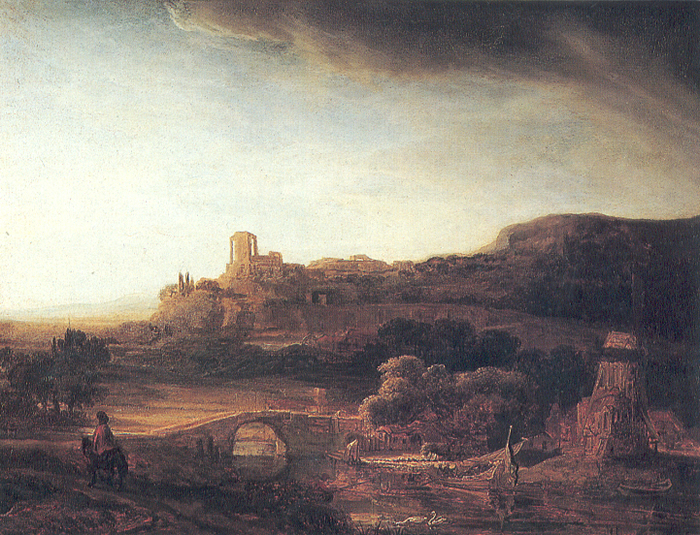
Rembrandt’s “River Landscape with a Windmill” (1640) opens like a deep breath of weather. A pale sky spreads across the top half of the panel, its cool light slowly gathering into a darker mass of cloud that drifts from the right. Below, the land unfurls in terraces of brown-green tone: a ridge crowned with a distant ruin, a belt of trees, the gleam of a stone bridge, a shallow bank where boats idle, and at the far right a wooden windmill standing like a quiet sentinel above the water. Figures are few and small—a rider in the foreground, boatmen handling their craft, a couple of workers along the bank—yet their scale secures the landscape’s magnitude. The painting is not merely a view; it is a weather-mood translated into place, a Dutch poem of light and distance where industry and nature coexist.
A Landscape of Atmosphere
Rembrandt understands that a landscape is first an arrangement of air. The sky occupies more than half the composition and sets the painting’s emotional temperature. Near the horizon the light is cool and chalky, flaring toward whiteness; higher up, the blue is thinned by moisture; at the right, a darker, smoky cloud mass arcs inward, establishing a visual canopy that directs the eye toward the illuminated center. This meteorological drama is subtle rather than stormy. The effect is of a day turning—late afternoon slipping toward evening, or a bright morning pulled under a passing cloud. By loading the sky with such calibrated variation, Rembrandt gives the land beneath a changing pulse.
Horizontal Depth and the Staged Distance
The composition is organized in horizontal bands that recede like theater flats: the foreground ridge with the rider; the midground water and bridge; the tree belt and windmill; the distant plateau with its ruins; and the sky. Rembrandt differentiates these planes by value and texture rather than by hard contours. Foreground grasses are handled with tighter strokes; middle-distance trees are softened into plush masses; distant architecture dissolves into warm, powdery shapes; the sky becomes an airy field of blended paint. Each register yields to the next without abrupt transitions, creating the sensation of slow, unforced depth. Our eyes travel as if along a river of vision.
The Windmill as Moral Axis
The windmill at right is a quiet fulcrum for the scene. Its slanted roof and laddered sails rake the sky with diagonals that counter the broad horizontals of land and water. Painted with warm, reserved browns, the mill rises from its masonry base like a wooden watchtower. In the Dutch Republic, windmills were emblems of ingenuity—machines that drained polders, ground grain, and safeguarded livelihoods. By placing the mill near the river and beneath large sky, Rembrandt integrates human industry into the natural order. The mill becomes less a hero than a citizen, faithful and unostentatious, participating in the weather and the work of the day.
A Bridge Between Worlds
At the center left, a low stone bridge arcs over the reflective water. Its single arch catches a pocket of light, doubling itself in the river’s mirror and quietly anchoring the entire composition. Bridges in Rembrandt’s landscapes often serve as thresholds—linking near and far, labor and leisure, earth and sky. Here, the bridge also performs a pictorial function: it provides a crisp, manmade geometry amid the softer masses of trees and hills, preventing the scene from dissolving into pure tone. The bridge’s shadow, thrown against the bright water under the arch, adds a dark counterpoint that deepens the river’s luminosity.
Human Scale and the Poetics of Smallness
Rembrandt’s figures are diminutive but necessary. The rider in the foreground, seen from behind, invites the viewer into the picture on a human path; he becomes our proxy as he advances toward the light. Boatmen along the bank bend to their tasks; tiny silhouettes on the bridge mark passage; a pair of workers near the mill stand as caretakers of place. These are not anecdotal staffage; they are the landscape’s pulse points. Their presence calibrates scale and infuses the panorama with lived time—footsteps, the creak of timbers, the scrape of a keel against mud. The grandeur of the setting grows in proportion to their smallness.
Color World: Browns, Greens, and River Light
The palette is a restrained hymn to earth and water. Warm browns and olive greens dominate the land; grays tinted with blue and violet structure the sky; the river gathers pale greens and silvers from the light. Within this narrow range, Rembrandt generates richness by modulation. A warmer brown warms the hillside under the ruin; cooler greens darken the tree canopy; amber glints lick the thatch of the windmill; pearly tones spill across the water near the bridge. This chromatic restraint gives the painting its calm credibility. Everything feels toned by the same air.
Brushwork and the Intelligence of Surface
Up close, the painting reveals a versatile hand. The sky is laid with fused, almost transparent layers that feather into one another; across the clouds, Rembrandt drags the brush in long, soft swathes that echo wind movement. The trees are built from clustered touches that mimic foliage without pedantic leaf-counting; the river’s surface switches from horizontal striations in shadow to smoother, reflective planes in light; the mill and ruins receive more articulated strokes that suggest wood grain and stone without stiffening the scene. The brushwork’s variety is never showy; it simply lets each surface behave as itself.
Composition as Journey
The picture rewards a deliberate path. We begin at the lower left with the rider poised on the bank. From there the track turns toward the bridge, moves across to the bright void under the arch, and exits into the floodplain where boatmen cluster. Our route then rises through the belt of trees to the windmill and runs along the gentle ridge toward the distant ruin. Finally, the eye sails into the sky where the heavy cloud arc curves the journey back toward the land. This choreography gives the painting narrative structure without imposing a story: we travel through work and water to settlement and history, then to weather and back again.
Memory, Ruin, and the Distant Hill
The ruined structure crowning the far hill carries a note of time’s attrition. It is not a dramatic Gothic ruin but a simplified block, perhaps a monastery or tower, softened by distance into myth. Its presence recalls histories beyond daily labor—the long persistence of settlements, the rise and fall of institutions. Rembrandt rarely overplays such symbols; he lets light do the work of meaning. The ruin rests in a pocket of brightness, as if memory itself were lit by the clearing sky. The contrast between the mill’s practical vigor and the ruin’s quiet surrender creates a dialogue between present work and past grandeur.
Water as Mirror and Road
The river in the foreground is both mirror and road. It reflects the bridge and bank, doubling forms and softening edges, while also carrying boats and supplying the mill’s business. Rembrandt paints the water with tactful restraint: no jewel-like highlights, just a believable sheen where the sky opens and a dark, almost metallic tone where trees cast shadow. Small ripples catch along the near bank; a shallow inlet and a bit of shore vegetation establish depth and texture. The river reads as a patient, enabling presence—the kind of water that has shaped Dutch life for centuries.
Light as Narrative Weather
There is a drama in the way light moves across the picture. The left half is brighter, the right half darker, with the windmill sitting on the seam between climate zones. This split suggests a weather front: clear air advancing, clouds receding, or the reverse. The effect gives the painting temporal tension—a sense that the day is in motion. Rembrandt thereby converts a static view into a narrative of minutes and hours. The landscape is not posed; it is breathing.
The Rider and the Viewer
The small figure on horseback introduces a note of anticipation. Cloaked and headed into the scene, he stands at the threshold between shadow and light. We may imagine his destination across the bridge or beside the boats, but in any case he motivates the picture’s forward vector. Compositionally, he provides a dark counter-shape against the illuminated river plain, enhancing the depth. Psychologically, he gives us a role: the traveler who looks up at the weather, notes the mill’s arms, judges the path to the bridge, and continues. The painting becomes not just a spectacle but a place to enter.
Dutch Landscape and Rembrandt’s Difference
Seventeenth-century Dutch art minted a strong tradition of topographical and panoramic landscapes—low horizons, precise architecture, meticulous light. Rembrandt rarely pursued strict topography. His landscapes, whether painted or etched, tend toward poetic construction: quasi-Italianate hills joined to Dutch waterways, invented ruins placed for rhythm and meaning, and weather treated as a protagonist. “River Landscape with a Windmill” belongs to that lyrical strain. It values atmosphere over map, mood over survey. Yet it remains unmistakably Dutch in its affection for waterworks, mills, and the quiet heroism of managed land.
Industry Without Spectacle
One of the painting’s virtues is its refusal of bombast. The mill is not over-detailed; the boats are not gleaming; the bridge does not grandstand. Industry is present as habit, not as pageant. The workers along the bank are engaged, not performing. Rembrandt’s tone matches the ethos of a republic that prized useful labor and municipal cooperation. Even the ruin, that magnet for romantic showmanship, is subdued. The landscape’s dignity arises from the way everything attends to its work under a shared light.
The Architecture of Silence
The painting is full of silence—the hush between breezes, the soft clop of a horse on damp ground, the creak of timbers, the distant rush of water. Rembrandt achieves this through extended planes of tone and long, unbroken contours. The sky’s large, quiet fields calm the eye; the river’s surface lies smooth; the trees form muffled volumes. This architecture of silence invites prolonged looking. Viewers feel their own breath align with the painting’s pace.
Material Poetics: Oil as Weather
Oil paint is the perfect instrument for such a scene. Its translucency allows the layering of air; its plastic body catches the subtle serrations of a windmill’s timber; its capacity for glazing permits the river to hold depth within gloss. Rembrandt uses these properties to make not a glossy showpiece but a living environment. Thin scumbles soften the sky; richer passages thicken the earth; a slightly tackier stroke on the water edges gives a recent-wet sensation. Material technique and subject conspire to create palpable climate.
A Landscape as Moral Thought
Beyond its visual pleasures, the painting proposes a gentle ethic. Human craft belongs within nature’s processes; memory and present labor can share a horizon; travel and dwelling are part of the same order; and light keeps everything in conversation. The composition’s balance—mill at right, bridge near center, ruin left of center, rider in the near left—embodies fairness rather than dominance. It is a landscape built from the convictions of a civic culture: distributed attention, restraint, perseverance.
Why the Painting Endures
“River Landscape with a Windmill” endures because it captures a sensation we still recognize: walking or riding into a patch of weather where light shifts, industry hums, and distance opens. Its restraint keeps it fresh; its rhythm of bands and diagonals keeps it legible; its tonal poetry keeps it moving. The windmill’s quiet silhouette has become an emblem of Dutch persistence, and Rembrandt positions it within a world that, for all its changes, still speaks to us: open sky, working water, remembered stone, and the small human figure proceeding into light.
Conclusion
In this 1640 landscape Rembrandt practices a humane grandeur. He gives us sky broad enough to hold changes of mood, land layered with history and work, water that reflects and carries, and a mill that turns weather into sustenance. Nothing shouts; everything participates. The painting invites not a quick glance but an unhurried passage—from rider to bridge to boats to mill to ruin to cloud and back again—until the eye recognizes the scene as a version of its own inward climate. It is a landscape to dwell in, a place where light, labor, and memory align under a single, generous sky.
