Image source: wikiart.org
Introduction
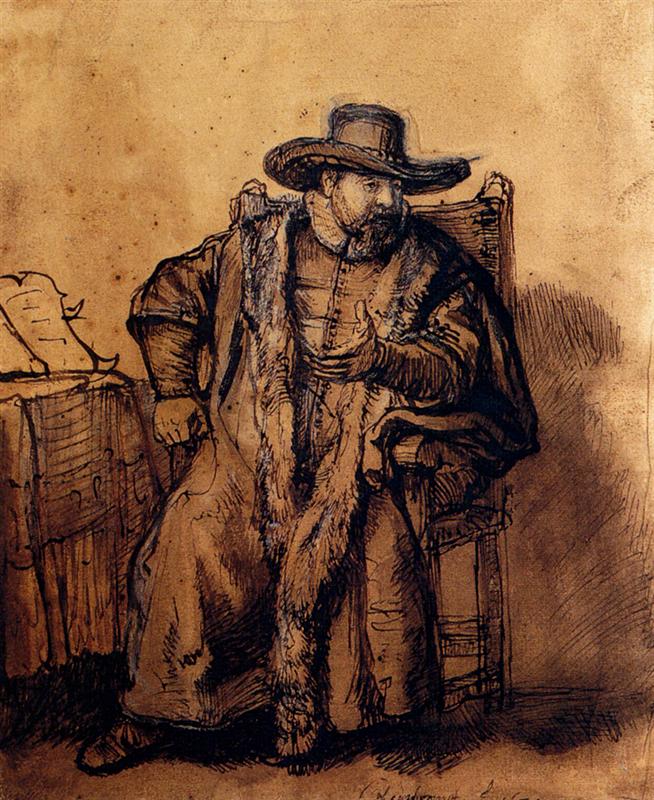
Rembrandt’s “Portrait of Cornelis Claesz” (1640) is a drawing that reads like a conversation. Executed in a warm array of brown washes and decisive pen lines, the sitter appears half-turned in a sturdy chair, one gloved hand gathering the fur-lined front of his coat while his face angles toward something or someone beyond the sheet. A broad-brimmed hat caps the composition; a table with papers intrudes from the left; the ground is stated with a few slanting strokes that anchor the legs and cast a shallow shadow. Nothing here relies on polished finish. Instead, the portrait depends on rhythm, touch, and the quick intelligence of line. The result is a likeness that carries the temperature of a real meeting: a prosperous Amsterdam burgher caught at the exact moment thought turns into speech.
A Type and a Person
Cornelis Claesz represents a recognizable Dutch type—the well-off citizen of the Republic who moves confidently between countinghouse and council chamber. Rembrandt makes the type personal. The face is broad but alert, the beard clipped, the eyes narrowed in assessment. The posture is alive: torso twisting slightly at the waist, shoulders uneven, the left arm pushed outward as if making space on the chair for his heavy garment. The sitter is not locked in place for posterity; he is poised to answer a question. This behavioral truth gives the drawing a contemporary freshness even as it records a seventeenth-century life.
Composition and the Arc of the Body
The portrait’s structure is a choreography of curves and counter-curves. The brim of the hat sweeps horizontally, echoed by the flat of the table; below, the vertical drop of fur down the coat’s center forms a strong line that divides the figure while guiding the eye toward the hands. The sitter’s turn generates a dynamic S-curve—from the tilt of the hat to the angled hips, then down through the outward-thrust left foot. Rembrandt sets this supple arc against the rectilinear chair and table so that stability and movement coexist. The drawing’s energy comes from that balance: the civic solidity of furniture and costume meets the unpredictable music of a living body.
Medium as Voice
The sheet is a masterclass in the expressive range of pen and wash on toned paper. Rembrandt uses iron-gall ink for the drawing’s skeleton—hat brim, contour of the sleeve, stiff edges of the collar—and then floods the forms with warm brown washes to articulate volume and cast shadow. The paper’s middle tone becomes the default light, so that highlights are achieved not with white paint but by carefully leaving passages untouched. Where fur rims the coat, the pen frays into soft, feathery strokes; where linen meets beard, the line tightens and shortens. The instruments do not merely describe surfaces; they imitate them. The medium speaks as clearly as the sitter does.
The Hat as Engine of Character
The wide hat does more than crown the head; it shapes the psychology of the portrait. Its low, level brim casts a measured shadow that focuses the eyes beneath, granting the gaze a guarded intensity. The ellipse of the brim also stabilizes the composition, establishing a horizontal counterweight to the diagonal slant of the torso. Socially, the hat marks rank—a respectable burgher, not an artisan—but Rembrandt avoids theatrical flourish. The hat’s authority is quiet, the authority of someone accustomed to being heard when he chooses to speak.
Fur, Cloth, and the Weight of Presence
One reason the drawing feels so physical is the way Rembrandt renders the coat. The fur trim waterfalls down the center, a cascade of little hooked strokes over wash that suggest both nap and thickness. The body of the garment falls in broad, simplified planes whose edges sharpen at elbows and knees. This alternation—feathered texture against smooth mass—makes the coat read as heavy, expensive, and warm. It also thickens the sitter’s silhouette, turning him into a presence that occupies space rather than a diagram that merely outlines it.
Hands as Rhetoric
Rembrandt gives the sitter two different hands and, with them, two different messages. The right hand pulls the fur closed, an inward gesture of self-possession and protection; the left hand, laid near the chair arm, opens slightly, ready to punctuate a point. In Rembrandt’s world, hands are verbs. Together they conjugate the sentence of civic identity: hold what is yours, and speak your mind. The artist renders joints and tendons with an economy that feels anatomical without pedantry. The viewer senses the pressure of glove on palm and the slight tension in the knuckles as fabric is gathered.
The Table and the Unseen Ledger
At the picture’s left edge, a table juts into the frame bearing a few sheets and the suggestion of a ledger or brief. This fragmentary still life plugs the sitter into the larger circuits of writing, accounting, and judgment that governed Amsterdam’s mercantile society. The papers curl with a quick flick of the pen; their presence is understated yet decisive. The portrait becomes a scene: Cornelis Claesz has been reading, someone has spoken, and he turns to reply. Rather than isolate the sitter in timeless emptiness, Rembrandt gives him a task midstream.
Light, Wash, and Theatrical Restraint
The wash pools most deeply behind the shoulders and along the chair’s back, creating a simple wedge of shadow that throws the head and coat forward. It thins across the face so that the features sit in a sober half-light—neither flattered brilliance nor melodramatic darkness. A few controlled puddles at floor level anchor the feet, while a translucent veil at left suggests ambient air around the table. The effect is quietly theatrical: light stages the conversation but never steals the scene.
The Chair as Civic Architecture
The wicker-backed chair is more than furniture; it is civic architecture at domestic scale. Its verticals and horizontals, drawn with deliberate stiffness, assert order and governance. The sitter leans into that architecture rather than floating free of it, implying a life aligned with structures—guilds, courts, boards—rather than with bohemian whim. Rembrandt’s line slows down around the chair, respecting its carpentry and allowing it to carry symbolic weight without a single overt emblem.
Face and Gaze: Calculation Without Cynicism
Rembrandt refuses caricature. The face is built from short, cross-hatched units that thicken at the cheeks and quietly describe the nostril, eyelid, and line of the mouth. The gaze is side-long, assessing but not hostile, like a person deciding whether a proposition is sound. The mouth’s slight compression hints at humor held in check. It is the psychology of negotiation captured with an economy of means. This degree of nuance is why the drawing feels less like a “type” and more like a meeting with a specific intelligence.
Comparison with Rembrandt’s Etched “Cornelis Claesz”
In the etched portrait of the same sitter, Rembrandt seats Claesz at a table engulfed by folios and tools, presenting him as a professional mind at work. This drawn version strips the setting down and sharpens the bodily rhetoric. The etching emphasizes instruments—books, pistol, quill—whereas the drawing emphasizes posture and turn. Seen together, the two works form a diptych of identity: role and temperament, public desk and private bearing. The drawing’s immediacy, its visible decisions and lively corrections, allows viewers to feel nearer the man within the office.
The Paper’s Warmth and the Patina of Time
The sheet’s toned ground is not a neutral support; it is a collaborator. Its warm brown sets the key for the entire image, turning the white of the paper left unwashed into mellow light rather than cold glare. Over time, that tone has deepened, which only intensifies the drawing’s sense of intimate interior. The soft abrasions at edges, the faint blooms where wash dried a shade darker, and the granular tooth that catches pen all contribute to the impression of a living artifact—an object that has itself entered history while remembering a person.
The Ethics of Economy
One of the portrait’s pleasures is its discipline. No superfluous ornament crowds the scene; no flamboyant flourish distracts from the sitter’s presence. The coat’s planes are simplified; the hat’s shadow is stated once and left; the chair is crisply functional. That economy is ethical as well as aesthetic. It resonates with the Dutch ideal of measured prosperity: show what you have without boasting, and let workmanship speak. In this way, the drawing’s style echoes the values it portrays.
A Pause Filled with Sound
Though silent, the sheet suggests the texture of a room. You can almost hear boots drag on floorboards, the wicker of the chair creak, a paper rustle on the table, and the soft raking of fur as a gloved hand pulls it close. Rembrandt conjures these sounds by calibrating line density and wash depth, producing zones that the mind translates into sensory memory. Such synesthetic fidelity is part of his secret: pictures that behave like lived moments rather than like diagrams.
From Contour to Character
Technically, the portrait moves from clear contour at the hat and coat hem to broken, suggestive line at the fur and seat. This shift is not merely descriptive; it is psychological. The most fixed parts of a civic self—status signaled by hat and garment—are crisply drawn; the more mutable, conversational parts—the fur that responds to touch, the seat that yields—are rendered with looseness. Rembrandt thus uses drawing strategies to map the permeability between persona and person.
The Viewer’s Position and the Pact of Looking
Rembrandt places us slightly below eye level and just to the sitter’s left. We occupy the space of the person who has just spoken or offered a document across the table. The portrait therefore assumes a pact: we are participants, not distant spectators. That pact explains the drawing’s magnetism. The sitter’s half-turn answers us; his hand secures his coat not against cold but in preparation to respond. The drawing’s energy comes from this triangulation of artist, sitter, and implied viewer.
Why the Portrait Endures
The image persists because it grants dignity to a kind of life often abbreviated under labels—merchant, regent, burgher—and because it does so with the lightest of means. It shows intelligence carried in posture, civility in clothing well used, and authority that is more listening than commanding. As modern viewers, we recognize this social grammar: the desk just outside the frame, the papers to be signed, the pause before a verdict. The drawing remains legible because people still live this scene in conference rooms and offices every day.
Conclusion
“Portrait of Cornelis Claesz” is a small, resonant theatre of attention. With pen and wash Rembrandt constructs a room, furnishes it, and invites a citizen to inhabit it—hat wide, coat warm, gaze weighing, hands ready. The economy of marks creates the amplitude of character; the warm ground sustains a climate of conversation; the minimal props place the portrait inside a world of reading and decision. In capturing the instant when thought leans into speech, Rembrandt honors the civic intelligence that shaped his city and, in doing so, fashions a likeness that still looks back at us with living judgment.
