Image source: wikiart.org
Introduction
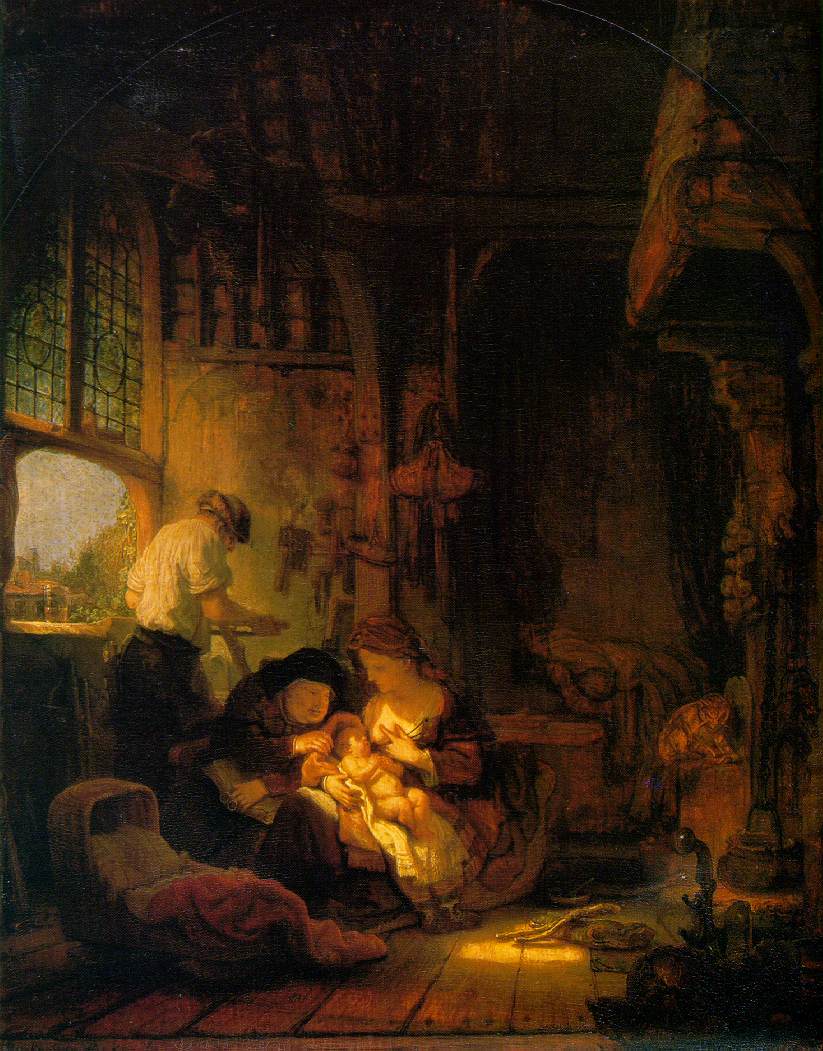
Rembrandt’s “Holy Family” (1640) transforms one of Christianity’s most venerated subjects into a scene of intimate, domestic tenderness. Set inside a humble, timbered interior flooded with warm, directional light, the painting shows Mary cradling the Christ Child while an older woman—traditionally read as Saint Anne or a midwife—leans forward to touch the infant’s cheek. Joseph, working by a window at left, is half-absorbed in his task, the daylight behind him dissolving into a golden haze. A cradle rests in the foreground; a small brazier, tools, a stool, and a tangle of household objects occupy the right-hand shadows. The sacred event is not staged as a public miracle but as a family moment lived among ordinary things. With calibrated chiaroscuro and an orchestration of textures—linen, wood, plaster, and skin—Rembrandt anchors theology in the reality of a home.
A Domestic Nativity
Unlike altarpiece Nativities or Adorations of the Shepherds, this “Holy Family” is quiet. There is no celestial choir, no architectural splendor, no gathering of dignitaries. Mary sits low on a bench, the child reclining along her lap, his body described with creamy, tangible flesh. Anne bends close with the curiosity and confidence of one who has known many babies. Joseph, sleeves rolled, stands at his makeshift work surface, a carpenter engaged in the rhythm of labor. The scene is not narrative spectacle; it is uninterrupted life. Rembrandt’s audacity lies in allowing the divine to reside in the daily, presenting sanctity as a pattern of care rather than a flash of wonder.
Composition and the Stage of Light
The composition is built like a chamber play. A strong diagonal of illumination falls from the left, kissing the child’s body, flaring along the hem of Mary’s dress, and pooling on the wooden floorboards. This slanted beam becomes the painting’s stage. The figures cluster inside the light like actors at center stage, while the right side recedes into sober shadow punctuated by small glints. The arched top of the panel and the ribbed, timbered ceiling create a canopy that rotates gently over the group, echoing the curve of the cradle. The window and the mantle act as vertical bookends that keep the eye from drifting outward. Within this architecture of beams and shadow pockets, the family seems both sheltered and revealed, at once private and offered to view.
Chiaroscuro as Narrative
Rembrandt’s light is never merely atmospheric; it is interpretive. Here, illumination meets bodies with palpable intention. The brightest passage—the baby’s torso and face—announces incarnation in a language of flesh, not blaze. Mary’s profile, caught in half-light, suggests a mother’s focused attentiveness. Anne’s features, softened by age, emerge from dusk like memory itself. Joseph’s back catches a faint silvery rim that separates his silhouette from the sunlit window, letting labor exist as a quiet counterpoint to adoration. Even the floor participates: a small ellipse of light before the group reads as warm hearth-glow and as a visual seal binding the figures together.
Architecture and the Reality of Place
The room is constructed with carpenterly sympathy. Thick posts, scalloped braces, and a heavy mantel tell of weight carried and heat contained. Plaster clings unevenly to the wall, a map of years. The leaded panes of the casement window hold dull reflections; the sill is cluttered with vessels and working stuff. The space is not rustic pastiche but a believable Dutch interior, relocated in imagination to the biblical past. Rembrandt’s fidelity to structure makes the theological claim more persuasive: holiness can occupy real rooms; revelation can ripen among beams and nails.
The Figures: Mary, the Child, Anne, and Joseph
Mary is the compositional heart, rendered with a gravity that never slides into solemnity. Her hands cup the child with experienced gentleness; her dress, dark but luminous, anchors the chromatic scheme. The Christ Child is fully human here—squirming, pudgy, a little dazzled by light. Anne’s forward lean and outstretched finger convey both maternal instruction and delighted surprise, as if teaching Mary some small trick of soothing while marveling at the infant’s alertness. Joseph’s partial turn, his concentration upon some simple task, acknowledges another vocation within the family: provision. He is not reduced to a symbolic staff-bearer; he is a working man whose labor sustains the quiet in which wonder grows.
Objects and the Theology of Use
Rembrandt scatters ordinary objects as if they had been set down moments before: a cradle with a rumpled blanket, a small brazier or kettle smoking faintly, a coil of rope or tools on the floor, garments thrown over a chest, a broom leaning out of shadow. None of these are decorative. Each contributes to a theology of use. The cradle promises rest after fuss; the brazier offers warmth; the tools remind us that this home is maintained by hands; the thrown garments witness to the interruptions that babies bring. In this array, sacred history shares a table with household needs, which is precisely the painter’s point.
Sound, Smell, and the Sensory World
Rembrandt’s handling invites a sense beyond sight. We can almost hear the floorboards creak under Anne’s weight, the soft wheeze of the brazier, the muffled clink of Joseph’s tools by the window. Light falls through dusty air, suggesting the smell of warm wood and wool. The baby’s skin looks warm to the touch. These sensory cues attend the theological claim that the Word became flesh; the senses are not enemies but witnesses.
Palette and the Harmonies of Brown and Gold
The palette centers on a deep, resonant brown keyed by golden lights. Ochres, umbers, and warm blacks shape the shadows; lead-tin yellows and creamy whites bloom in the highlights. Rembrandt’s mid-tones, mixed from earth pigments, give the painting its hearth warmth. Areas of coolness—a pale window sky, a grayish rim along Joseph’s sleeve—prevent monotony and keep the light feeling like daylight rather than theatrical amber. The chromatic harmony is domestic and durable, suited to a scene that celebrates endurance rather than event.
Brushwork and Material Intelligence
Looking close, one sees Rembrandt’s heterogeneous brushwork doing different jobs in different zones. The child’s flesh is built from soft, blended strokes that create buoyant volume; Mary’s sleeves are tightened by firmer, ribbon-like strokes that catch light; the plaster wall is dragged with a nearly dry brush so that its roughness shows; the brazier is pricked with small, bright touches to suggest metal. The paint surface itself becomes an index of materials in the room, binding depiction to substance in an almost tactile empathy.
The Window as a Spiritual Engine
The leaded window at left is a crucial device. It admits daylight that is temporally specific—morning or late afternoon—and morally suggestive. That same daylight, filtered by human craft into small squares, illuminates carpentry and cradle alike. The window’s geometry also governs the painting’s pacing: diagonals of light cross the floor and stop near the brazier, pulling the eye through domestic space rather than up to heaven. By routing illumination this way, Rembrandt insists that grace arrives through the apertures of ordinary life.
Narrative Time: A Pause Between Tasks
This is not the first hour after birth nor the public presentation at the temple. It is a pause halfway through a day. The cradle is ready, but the baby is awake. Anne’s gesture suggests a small comfort or game. Joseph keeps working because work is continuous. The painting captures a rhythm of family time: attention telescopes toward the infant, then dilates back to chores. This temporal realism makes the scene feel like something the viewer could join without ceremony.
The Iconography of Humility
Traditional symbols of the Virgin—blue robes, lilies, gilded halos—are absent. Instead, humility is shown through posture, dress, and environment. Mary’s clothing is dark and practical; her lap, not a throne, supports the child; the room’s imperfections are not scrubbed away. The result is not demotion but translation. The grandeur of this Holy Family lies in their unselfconscious belonging to each other and to their place. Rembrandt thereby reorients devotion from spectacle to recognition: to honor the family is to honor the daily work that keeps them whole.
Joseph’s Role Reconsidered
In many earlier images Joseph appears marginal—old, sleepy, or aloof. Here, though peripheral to the central light, he is purposefully alive. His strong forearms and focused posture render him the guardian of a protected sphere. The daylight behind him is the same that illuminates the child, suggesting that his labor participates in the same providence. Rembrandt dignifies craftsmanship as an instrument of divine care, a theme that would resonate in a mercantile, artisan-rich Amsterdam.
The Viewer’s Path Through the Picture
The eye enters at the bright oval of the child, travels up through Mary’s face to Anne’s hand, and then loops left toward Joseph and the window. From Joseph the gaze drops along the sill to the cradle, then returns by the small radiance on the floor to the group at center. This circuit is the painting’s heartbeat: wonder, work, rest, wonder again. Rembrandt’s orchestrated highlights—on the baby’s belly, Mary’s sleeve, the cradle’s rim, the puddle of light on the floor—act as stepping stones through a terrain of shadow.
Comparisons and Context
Rembrandt returned often to intimate biblical interiors—“The Holy Family with Angels,” “The Rest on the Flight into Egypt,” and smaller domestic scenes etched in the late 1630s and early 1640s. This 1640 painting sits among them as one of the most concentrated statements of his belief that the sacred chooses humble quarters. Compared to the theatrical brilliance of Caravaggio’s nocturnes or the ceremonial grandeur of Rubens, Rembrandt’s approach is reticent. He is less interested in the drama of sudden revelation than in the continuing revelation of care.
The Emotional Spectrum
Though quiet, the painting is not bland. It contains a full spectrum of feeling: the child’s blinking astonishment; Mary’s attentive absorption; Anne’s playful wisdom; Joseph’s contented industry. None of these emotions is exaggerated. Rembrandt understands that intensity in family life rarely comes as a shout; it arrives as concentration. By giving us a scene dense with attention rather than action, he invites the viewer’s attention to join it.
Reading the Shadows
The right-hand shadows are not empty. They contain stored garments, a plump cushion, the brazier, and perhaps hanging herbs. These are the resources of a household in motion: warmth, sleep, seasoning, repair. The half-visibility of these items suggests privacy preserved. The family allows us to witness a moment, but much remains theirs. Shadow protects dignity as surely as light reveals beauty.
Theological Resonance
This “Holy Family” performs theology without overt iconography. Incarnation is affirmed by the baby’s credible flesh; grace by the light that dignifies everything it touches; humility by the room’s ordinariness; providence by the echo between Joseph’s daylight and the child’s glow. Devotion here looks like attention, and worship like good work. In Rembrandt’s hands, the home becomes the first sanctuary, the parents the first ministers, the cradle the first altar.
Why the Painting Still Feels Contemporary
Modern viewers recognize themselves in this room: the scattered objects, the tired tenderness, the improvised workspace by the window. The painting resists sentimentality by honoring fatigue and clutter along with love. In a culture fascinated with spectacle, it proposes that meaning is made in rooms like this one, at hours like this, with people who have tasks to complete and babies to soothe. Its relevance endures because its truth does.
Conclusion
Rembrandt’s “Holy Family” is a hymn to domesticity as sacred vocation. Through disciplined light, believable space, and a chorus of textures, he renders divinity at human distance. Mary, Anne, and Joseph are not types but people whose care reveals God’s nearness more persuasively than pageantry would. The child dazzles not like a star but like warm skin in sun. The room is imperfect and loved. In this union of the ordinary and the holy lies the painting’s inexhaustible power: it calls the viewer to find revelation where life is actually lived—by a window, on a wooden floor, next to a cradle, in the kindness of hands.
