Image source: wikiart.org
Introduction
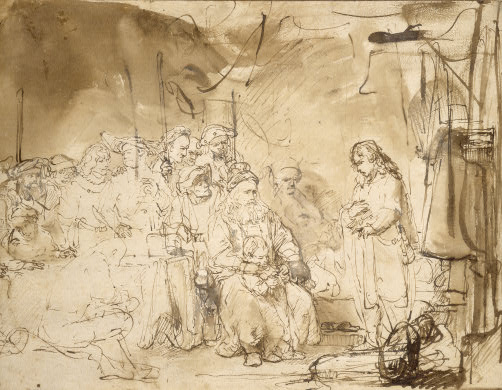
Rembrandt’s “Joseph Recounting His Dreams” (1640) is a pen-and-wash drama that captures the volatile moment when a teenager’s visionary confidence collides with the skepticism and envy of his older brothers. The sheet is alive with rapid lines and translucent, smoky washes. At right, Joseph stands holding his cloak, speaking with earnest intensity; at left, the semicircle of brothers crowds into a single organism of faces, hands, and bodies, a chorus of disbelief. Between them sits Jacob, the patriarch, occupying the fulcrum of judgment. The entire scene feels improvised on a stage of paper where light is made from untouched ground and shadow from diluted ink. In this drawing Rembrandt turns a biblical family quarrel into a meditation on power, youth, prophecy, and the politics of attention.
The Story and Rembrandt’s Moment of Choice
Genesis 37 records Joseph’s two dreams: sheaves in the field bowing to his sheaf and the sun, moon, and eleven stars making obeisance. When he recounts these visions to his brothers and father, their irritation hardens into resentment; the family’s fracture sets in motion the saga that will carry Joseph to Egypt. Artists have long favored the cloak-drenched crisis when the brothers sell him, but Rembrandt chooses the catalytic telling. The decision is crucial. By drawing the verbal scene rather than the violent one, he opens space for psychology and the choreography of listening. The danger is latent rather than explicit; the image hums with the potential energy of later betrayal.
Composition: A Crowd, a Judge, and a Seer
Rembrandt composes the sheet around a powerful asymmetry. The left half is dense with figures pressed together under a single canopy of wash; the right half holds Joseph almost alone, framed by hanging gear and a small area of clear ground. This imbalance does not weaken the drawing; it energizes it. The massed brothers behave like a weather front, their skepticism rolling across the paper, while Joseph stands like a slim column of light. Jacob, seated near the center, becomes the hinge. His beard and furrowed gaze anchor the chaos of emotions around him, and his hands—one gripping a staff, the other resting near his lap—announce a mind measuring what it hears. The three zones—crowd, judge, solitary teller—create a visual grammar that anyone in a household can recognize.
Gesture as Narrative
In Rembrandt’s Bible, hands and heads do the heavy lifting. Joseph’s posture is crisp and eager: torso slightly inclined, arms gathered around the mantle, gaze directed toward the seated patriarch. He is not arrogant; he is convinced. The brothers, by contrast, form a wave of reactions: one leans forward with aggressive curiosity, another pulls back in private scorn, another hides a smirk in his beard. Mouths half open, brows cocked, fingers counting or pointing—every unit in the group adds a note to the chord of disbelief. Jacob’s head tips just enough to signal thought rather than outrage. In these few lines Rembrandt locates the narrative in the human mechanics of hearing and speaking rather than in props or inscriptions.
Ink and Wash: The Breath of the Scene
The sheet’s atmosphere comes from the fluid partnership of reed-pen line and brown wash. Rembrandt sketches figures with calligraphic speed, letting the nib change width as it turns, and then floods selected areas with diluted tone. The upper left is a cloud of wash that fuses the brothers into a single mass; the right edge near Joseph is comparatively clear, as if the air around him were brighter. Wash pooled behind Jacob forms a soft nimbus that sets him apart without haloing him into piety. Shadows are not theatrical spotlights; they are the natural drift of indoor light across a packed room. The result is a drawing that breathes—lines inhale and exhale, and tone drifts like smoke.
Space and the Stage of Listening
Rembrandt creates depth without pedantry. The brothers tier back in shallow shelves; a few thin lines indicate poles, straps, or the inside of a tent; on the far right a hanging garment and a wheel-like object suggest the edges of a household or encampment. This dispersed setting is enough. The point is not the exact room but the behavior of people within it. By keeping the surroundings elastic, Rembrandt lets the figures define space through their attentions. Joseph’s voice seems to push a small clearing in front of him; the brothers’ murmurs thicken the air around their bench. We are placed at the corridor of conversation where meaning is made.
Character Through Economy
One of Rembrandt’s greatest skills is character with almost no detail. Joseph’s youth reads in the clean oval of his face and the certainty of his stance. Jacob’s age is a nest of parallel strokes in beard and brow. The brothers are individuated with the smallest of differences—a longer nose here, a heavier eyelid there—yet they cohere as a unit. This economy serves the story’s moral pattern: the dreamer separated by conviction, the siblings united by resistance, the father suspended between love and prudence. There is nothing schematic about these figures, but they carry the narrative archetypes that give the tale its bite.
Light as Judgment and Mercy
The distribution of light in the drawing implies judgment. Joseph stands in an area of relative clarity; his figure is described with comparatively crisp lines. The brothers pool in a character-building dusk, where wash veils and binds them. Jacob occupies a middle value—neither swallowed by shadow nor isolated in brilliance—befitting a man who must weigh and remember. This tonal ethics is gentle rather than accusatory. Rembrandt refuses to demonize; even in the murky corner every face is thinking. The drawing knows that envy can look rational from the inside and that youth can sound insufferable even when speaking truth.
The Cloak, the Poles, and the Unseen Future
Objects in the sheet do not shout symbols, yet they hum with premonition. Joseph clutches his garment at the very moment that garment’s colors will later inflame his brothers. The vertical poles behind Jacob could be staffs or tent rods, but they also read as bars in a cage, implying constraint to come. The wheel-like object at right might be a loom’s part or a cartwheel—either way, a sign of movement, spinning fate toward Egypt. These clues register subliminally, enriching the scene without freezing it into allegory.
Comparison with Other Treatments of Joseph
Renaissance and Baroque painters often dramatized Joseph’s sale, his encounter with Potiphar’s wife, or his triumph in Egypt. Rembrandt repeatedly returned to quieter thresholds: telling dreams, being cast into a pit, interpreting Pharaoh’s visions. He favored the moments where meaning is contested and where a face can hold competing loyalties. In this drawing he forgoes Egyptian architecture and courtly splendor for the colloquial theatre of a family room. The choice aligns with his broader project of domesticating the Old Testament, finding its gravity in human attention rather than in spectacle.
The Rhythm of the Crowd
The left-hand mass is not a blur; it is a musical rhythm. Heads create a rising and falling line; shoulders stack into chords; staffs and straps add syncopated verticals. Rembrandt conducts this choir so that no single brother dominates. The rhythm has urgency but not chaos; it carries the sound of simultaneous talk, muttered jokes, and the scrape of a stool. Against this, Joseph’s solo line is simple and steady. The drawing’s musicality is one reason it feels so present; viewers can almost hear it.
Jacob’s Mind at Work
Much of the scene’s poignancy rests on Jacob. He knows favoritism has consequences, yet he loves the dreamer. Rembrandt gives him a body that registers weight and thought. The staff, the bent neck, the slightly splayed feet—all convey the pause of someone taking counsel with himself. He does not hush the brothers; he does not embrace Joseph; he listens. Scripture says he “observed the saying,” and the drawing honors that verb. In a culture of quick judgments, this posture of observation feels radical.
The Ethics of Drawing and the Authority of the Line
Rembrandt’s medium itself becomes part of the message. Pen lines are commitments; each mark is a decision. In a story about speech and response, such decisiveness matters. The artist models how to attend: make a clear line, then let wash temper it; state a figure, then let neighboring figures complicate it. The authority of the drawing arises not from polish but from fidelity to thinking as it happens. This fidelity mirrors Jacob’s considered listening and critiques the brothers’ rush to resentment.
A Scene Without a Hero or Villain
The drawing offers empathy to all parties. Joseph is brave and perhaps naïve; the brothers are threatened and perhaps justified in weariness; Jacob is patient and perhaps complicit in a family imbalance he cannot undo. By refusing to score the scene in moral black and white, Rembrandt prepares the viewer for the long arc of the story in which suffering, wisdom, and reconciliation will reshape everyone. The sheet thus functions as a prologue: it introduces the themes—dream, envy, providence—without telling us what to think about them.
The Viewer’s Standing Place
Where do we stand? Rembrandt places us slightly to Joseph’s side, just within the cleared space before Jacob. We are close enough to feel the heat of the brothers’ crowd, yet not trapped within it. This location implicates us in the act of hearing. We face the same choice Jacob faces: to dismiss, to mock, or to keep the saying in mind. The drawing thereby becomes participatory; it asks us to practice an ethics of attention while we look.
Time, Memory, and the Brown Atmosphere
The warm, tea-colored wash suggests a room lit by oil and memory. The sheet feels like an old page from a family history, already browned by time, where figures are remembered more for their energies than for their features. That patina suits the story’s status as a recollection that will one day be retold by Joseph himself. The drawing, then, acts like a dream’s record: fluid at the edges, exact at the core.
Relation to Rembrandt’s Broader Practice
Around 1640 Rembrandt produced numerous drawings that test how much story can be told with minimal means. “Joseph Recounting His Dreams” stands among the finest. It demonstrates his faith that the human face is the true engine of narrative, that wash can shape moral space, and that the Old Testament’s power lies in its recognizably domestic crises. Taken with his paintings of the same decade, the sheet confirms that Rembrandt was forging a language where psychology and theology share the same breath.
Why the Image Endures
The drawing endures because it dramatizes a perennial human event: someone shares a vision for the future, and a community must decide whether to believe, to wait, or to crush it. Families, offices, and nations replay this scene daily. Rembrandt articulates it without bombast, in the spare means of pen and wash, so that it speaks across centuries. Viewers recognize themselves in every corner: the confident youth, the weary skeptic, the father who keeps a troubled peace.
Conclusion
“Joseph Recounting His Dreams” is a small theatre of listening where destiny first speaks in the plain room of a family. Rembrandt binds a crowd of brothers into a single murmuring mass, gives Jacob the gravity of measured attention, and sets Joseph in a zone of clarity that feels both vulnerable and illumined. The interplay of line and wash stages light as judgment and shadow as the comfort of groupthink. No blood is shed here, yet the future tilts. The drawing’s generosity toward all parties and its trust in the eloquence of gesture make it one of the most humane treatments of the Joseph cycle. In a few minutes of ink, Rembrandt shows how the world begins to change: a dream is told, many resist, one listens, and memory keeps the saying for what will come.
