Image source: wikiart.org
Introduction
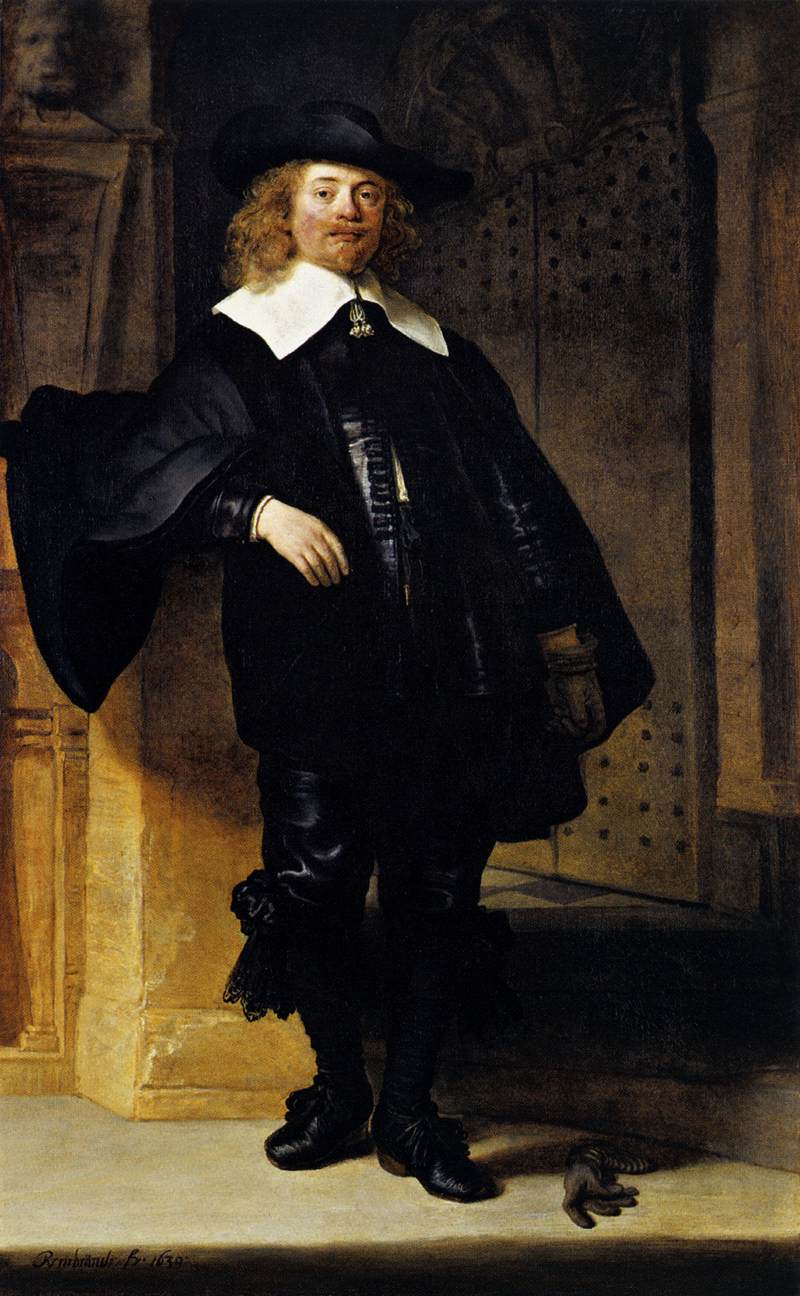
Rembrandt’s “Portrait of Andries de Graeff” (1639) is a tour-de-force of full-length portraiture at the height of Amsterdam’s Golden Age. The sitter—statesman, merchant aristocrat, and future burgomaster—stands at ease against a columned architectural backdrop, one hand resting on a stone pier, the other gloved and relaxed at his side. Dressed in sumptuous black satin with a crisp white collar and a broad-brimmed hat, he embodies the sober elegance of Dutch patrician taste. Yet the painting is far more than a record of costume. Rembrandt orchestrates light, pose, and setting to reveal a civic presence: a man confident in his role, measured in temperament, and completely at home in the world that power has built around him. In a moment where fashion and politics converged, this portrait declares both.
Andries de Graeff and the Culture of Dutch Power
Andries de Graeff belonged to a prominent Amsterdam regent family whose political influence stretched across the seventeenth century. The regents were not hereditary nobles but an urban elite—mayors, magistrates, directors of the East and West India Companies—who steered commerce and governance through networks of kinship and credit. Their public identity combined restraint with display, prosperity with utility. Rembrandt captures that balance. De Graeff’s attire is expensive but not ostentatious; his expression is alert rather than haughty. The painting thus participates in a larger civic image-making project: it visualizes the virtues the Dutch Republic prized in its leaders—competence, prudence, and a kind of secular gravitas.
Composition and the Authority of the Full-Length
Rembrandt adopts a full-length format more commonly associated with princely portraiture in Italy and Spain. The decision immediately elevates the sitter’s status. De Graeff occupies the entire vertical field, standing on a stone threshold with the open doorway and gridded nail-studded gate behind him. The viewer meets him at life size, a scale that produces the sensation of a real encounter rather than a studio likeness. The leftward column stabilizes the composition and gives the hand a ledge to rest upon, while the step below, bathed in light, projects into the viewer’s space and invites approach. The rhythmic geometry of column, doorway, step, and figure fuses architecture and body into a single, harmonious order.
The Poise of the Pose
De Graeff’s stance conveys mastery without aggression. His weight settles comfortably on the back leg, freeing the leading leg to bend slightly at the knee, a classic contrapposto adjusted for modern dress. The left arm bends at the elbow to rest on stone—an anchoring gesture that announces proprietorship of the space and calm control. The right hand, still gloved, hangs at ease, as if the work of ceremony is nearly finished. Even the set of the broad shoulders beneath the short cape reads as readiness rather than rigidity. Rembrandt is precise in the psychology of posture: every joint, fold, and balance corresponds to a temperament trained to govern.
Chiaroscuro and the Tact of Light
Light enters from the left and orchestrates the viewer’s attention. It rinses the stone pier in warm gold, brushes the feathered edge of the hat, breaks into glitter along the black satin, and rests on the pale planes of the face and collar. The face is modeled with Rembrandt’s signature subtlety—no harsh contrasts, just calibrated transitions that keep the features alive. By making the garment the darkest object in the painting, the artist ensures that glints on sleeve and hose feel like living movement rather than decorative sparkle. Shadow is equally eloquent: the recess beyond the gate recedes into a dignified dusk that suggests depth and governance extending beyond the sitter’s visible domain.
Black Satin as a Field of Painting
Black garments are notoriously difficult to paint; they demand the artist distinguish sheen, fold, and weight without recourse to bright color. Rembrandt embraces the challenge. De Graeff’s suit and mantle form a near-monochrome arena where subtle blues and browns mingle inside the “black,” catching light in crescents and seams. The satin hose reflect a cool shine at the shin, the doublet offers broader, slower glows, and the ribboned garters at the knee sink into velvet shadow touched with delicate highlights. This orchestration turns restraint into luxury and makes the fabric a metaphor for public virtue: controlled, disciplined, and capable of brilliance when illuminated.
The White Collar and the Language of Civic Virtue
The broad, starched collar is not only a fashion token; it is a moral sign. Its clean geometry and reflective brightness frame the face like a heraldic device for rectitude. Rembrandt paints the collar with a choir of whites—from chalky impasto on the edges to cooler, translucent notes nearer the neck—so that the form remains crisp yet integrated with the flesh tones. A small jeweled clasp or brooch punctuates the stern line and adds a note of cultivated taste. The collar’s breadth also widens the portrait’s psychological space: it functions almost like a horizontal capital atop the column of the body, a symbol of clarity capping strength.
Hands, Gloves, and the Politics of Touch
Two hands carry different messages. The ungloved left hand, resting on the pier, offers warmth of skin and a visible pulse of veins that humanize the man within the office. The right hand remains gloved, emblem of decorum and public ceremony. On the step, a second glove lies like a quiet prop—a suggestion that this session marks a threshold: gloves on and off as circumstances demand. Rembrandt models the gloves with spare highlights that read as soft leather; the gesture is not theatrical but telling, a reminder that power negotiates between the warmth of direct contact and the distance of protocol.
Face and Expression: Intellect with a Hint of Wit
The head is slightly cocked; the brow is open; the mouth carries the faintest suggestion of a smile, a controlled geniality that stops short of informality. This is a man who enjoys mastery but knows the value of moderation. Rembrandt resists flattery. The complexion shows the lived detail of pores and faint creases; the eyes do not glitter as in court portraiture but attend steadily, as if weighing the viewer. Hair, worn long and loose under the hat, frames the face with a golden corona that catches light, balancing the dark costume. The sitter’s intelligence feels active, ready for conversation or decision.
Architecture as Character
The architectural surround is not mere ornament. The sturdy pier, the flanking wall niche with a sculpted head, and the iron-studded door signal durability, tradition, and guarded privilege. Rembrandt’s paint makes these structures tactile: the stone carries small abrasions and patches of warmth from reflected light; the studs on the gate punctuate shadow with a pattern of control; the sculpted head in the niche suggests the presence of history—ancestors, lawgivers, or allegorical guardians. Architecture and sitter mirror one another: both solid, both articulated by light, both custodians of order.
The Stage of the Threshold
The portrait is set on a threshold—neither interior nor exterior—which allows Rembrandt to play with symbolic transitions. The checkerboard floor tiles in the doorway create depth and a matrix of civic rationality. The step at front pulls forward toward us, and the cast shadow of the hat brim and cape draws a gentle arc over that step, as if power extends outward to meet the citizen-viewer. De Graeff is not shown at a desk or in the bustle of office but at the poised moment between spaces, prepared to enter public duty or withdraw to private counsel. The threshold becomes an image of regency itself: the art of standing between competing spheres and negotiating them with balance.
Color World and Tonal Harmony
Though dominated by black and warm stone, the palette is rich. Honeyed ochres in the architecture, olive undertones in the gate, cool silvery notes in the satin’s reflections, and rose in the lips and cheeks harmonize under the controlling key of shadow. Rembrandt binds these tones with a warm ground that whispers through the surface, keeping the canvas unified. In this harmony, bright accents—the brooch at the collar, the small glints on the glove seams, the moist catchlights in the eyes—register with quiet authority rather than flashy interruption.
Comparison with Contemporary Portraiture
Portraits of Dutch regents often adopt rigid symmetry and polished surfaces designed to communicate a doctrine of sober governance. Rembrandt respects that aim but surpasses it with a uniquely tactile and psychological surface. Compared to the high sheen and cool finish of some contemporaries, his paint breathes; compared to flatter, hieratic poses, his figure leans and inhabits space. He borrows the elevated scale of court portraiture yet populates it with the lived textures of Amsterdam. The result is a hybrid: aristocratic in presence, bourgeois in ethics, and painterly in soul.
The Narrative of the Fallen Glove
The single glove lying on the step is a minor object with major resonance. It anchors the composition’s lower corner and creates a diagonal echo of the dangling right hand. Symbolically, it hints at readiness—the glove half removed as one enters negotiation or offers greeting. It is also a small theater of light: the leather’s folds catch illumination in a way that testifies to Rembrandt’s love of material truth. In a portrait dedicated to controlled authority, the glove adds a whisper of informality—a human trace amid the architecture of office.
The Hat and the Arc of Command
The broad felt hat is the sitter’s crown, establishing a dark horizontal that balances the column of the body and the pale wedge of the collar. Its brim casts a soft shadow that moderates the light on the face, lending the expression subtlety. The hat’s shape, echoed by the curve of cape and the semicircle of the doorway nails, supplies compositional rhythm. In social terms, it signals status while maintaining the understated code of Dutch patricians: distinction without flamboyance. Painted with dense, absorbent blacks, the hat allows Rembrandt to sculpt space around the head as if with a velvet mold.
Material Intelligence and the Brush at Work
Across the canvas, paint behaves like the substance it describes—stone dragged in warm opaque layers, satin laid with longer liquid strokes, flesh modeled through minute transitions, leather flicked into relief with quick highlights. Rembrandt’s touch communicates both mastery and presence: the viewer senses the painter’s hand deciding at every seam and shadow. This sensuous material intelligence lets the portrait register at multiple distances: from afar, a compelling figure in a balanced architecture; from near, a treasury of brush decisions that embody the same prudence and vigor the sitter projects.
The Viewer’s Path Through the Picture
Rembrandt guides the eye deliberately. We enter at the illuminated step and the small glove, rise along the dark column of the leg to the glowing wedge of collar, meet the face, travel across the brim to the left hand on the pier, and finally explore the deep space of the doorway before looping back to the figure’s center. The tour is both visual and psychological: it begins with the human trace, ascends to identity and judgment, touches office and stability, and returns to the person. The sustained loop keeps the portrait alive; there is no dead zone, only circulations of authority and response.
Historical Imagination and the Portrait’s Legacy
This portrait exemplifies the moment when Dutch portraiture could rival any court in Europe for scale and impact while maintaining the Republic’s ethic of restraint. It helped set the standard for how the urban elite wished to be seen: large but not loud, richly dressed yet morally neutral in color, engaged in space rather than trapped against a curtain. Later painters of state and business learned from it that power benefits from grace, that architecture can underscore character, and that a single well-placed glove can humanize a whole regime. For modern viewers, the painting remains a primer in how images naturalize authority and how an artist can complicate that effect with tactful humanity.
Why the Portrait Still Speaks
The painting endures because it offers more than biography. It shows how a person inhabits a role and how a role inhabits a body. The architecture frames but does not imprison; the costume declares but does not overwhelm; the face watches yet welcomes. In the glow along the satin and the tone of the stone, we feel a city’s ambitions; in the measured mouth and steady eyes, we meet a person. Rembrandt secures that balance so completely that the portrait continues to feel present—an encounter with a citizen who believed that governance was a form of bearing as much as a set of policies.
Conclusion
“Portrait of Andries de Graeff” is Rembrandt’s meditation on civic presence. With full-length scale, poised architecture, and virtuosic control of black, he renders a statesman who appears both composed and living, formal and approachable. Light confers authority without flattery; shadow protects dignity without obscuring truth. Every element—the column, the threshold, the glove, the satin, the starched collar—contributes to a coherent vision of restrained power. Four centuries on, the painting remains a benchmark for how portraiture can mate public stature to private humanity and how painting can make a life-size conversation out of cloth, stone, and light.
