Image source: wikiart.org
Introduction
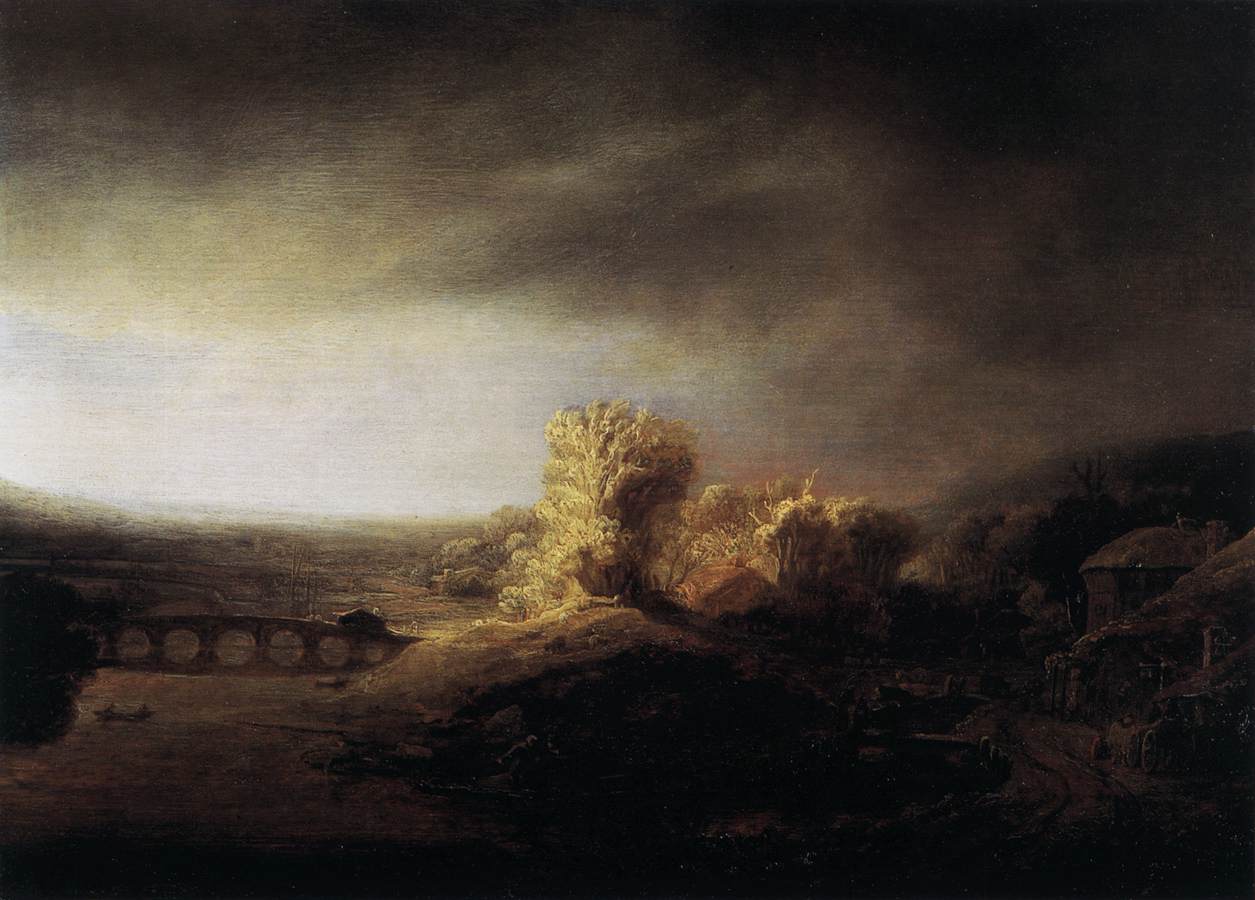
Rembrandt’s “Landscape with a Long Arched Bridge” (1639) is a drama of weather and distance. A wide, riverine valley spreads out beneath a low, storm-heavy sky; a stone bridge with multiple round arches crosses the water at the left; a cluster of trees and cottages gathers on a bank that catches a shaft of light; a winding road and scattered roofs sink into shadow at the right. The painting is not a topographical view but a poetic invention, a landscape conceived as an arena for light. At a glance it appears subdued, almost monochrome; the longer one looks, the more its harmonies of warm browns, mossy greens, and pearly grays begin to pulse. The picture’s true subject is the meeting of illumination and mass—how a burst of brightness can set a valley in motion and turn a bridge into a hinge between zones of calm and turbulence.
The Bridge as Organizing Device
The arched bridge functions like a bass line in a piece of music: steady, grounded, and binding the composition together. Its semi-circular openings make a rhythm of four or five beats across the water, gently echoing the round forms of the tree crowns on the bank beyond. The bridge’s horizontal run stabilizes the expanse of low sky and the rolling hills. By placing the bridge off to the left, Rembrandt avoids a static symmetry; the structure becomes a point of departure for the eye rather than a terminus. Viewers trace its length, cross into the central glow that ignites the trees, and then wander toward the dark road at right. The bridge is both architectural motif and metaphor, connecting light to shadow, foreground to distance, the human-built to the natural.
The Weather and the Sky
The painting’s sky occupies more than half the canvas and reads as an immense, moving ceiling. It is built up in thin veils of gray and brown, dragged and scumbled so that tones breathe through one another. Heavy cloud darkens the right half and top edge, while a pale clearing opens at left-center, where the river plain dissolves into silvery vapor. This contrast of sky tones is not decorative; it imposes a narrative of weather: a storm has passed or is about to pass, and a rent in the clouds releases light that skims the valley. Rembrandt converts meteorology into time—one can feel the moment chosen, a lull when sheep huddle near hedges, boats pause on slack water, and the day, bruised by rain, gathers itself again.
Light as Protagonist
Light arranges the entire scene. A beam, broken by cloud, falls on the central trees and the slope before them, turning their foliage into feathered gold. That light zigzags through the painting: from the bright bank it leaps to the left across the bridge’s parapet, then slips back into the far distance as a sheet of pale atmosphere, and finally returns in small sparks on rooftops and cart tracks at the right. Nothing is uniformly lit; even the illuminated grove contains pockets of dusk. This unevenness conveys reality but also theology of sorts: illumination is transient and selective, both gift and task. Rembrandt’s light never behaves like stage lighting; it behaves like a living element, a partner to matter rather than its master.
Perspective and the Long View
Rembrandt engineers a broad recession that carries the eye miles into space. The river plain at left opens like a fan, its banks flattening and fading as aerial perspective cools colors and softens edges. Beyond the bridge, the horizon is low, almost tidal, and the tiny structures that speckle it—distant dwellings, perhaps a church tower—register as brief accents rather than narrative information. This long view counters the density of the right foreground, where the road dips and rises around cottages and carts. The alternation between open distance and close texture keeps the painting alive; it offers the viewer two kinds of looking at once: roaming and dwelling.
The Poetics of Earth
In many Rembrandt landscapes, earth is not simply ground; it is a character with moods and memory. Here, the bank that catches the light swells like a shoulder, its surface described by low, scumbled highlights that suggest damp grass, exposed soil, and stones. The road at right is a darker ribbon whose ruts shine with residual wetness. The artist’s brush moves with geological sympathy—dragged to imitate erosion, stippled to suggest scrub, smudged to conjure moss. The earth absorbs the sky’s weather, reflecting it back in a spectrum of browns warmed by the sunbreak and cooled by shadow.
Architecture and Dwellings
The buildings are frank but reticent. The bridge is the star; the cottages are supporting actors who understand their roles. On the sunlit bank, roofs crouch low among trees as if seeking shelter after the storm. At the right edge, a circular tower-like structure anchors the darkness. These dwellings indicate human tenure without dragging the painting into anecdote. They keep the scale comprehensible: trees are big, banks are broad, yet human habitations persist. Rembrandt’s landscapes often suggest a social world without showing its bustle. One feels the navigation of ordinary life—work on the river, carts on the road, the warmth of hearths hinted at by small pale shapes that may be windows—without being asked to watch specific stories.
Boats, Water, and the Bridge’s Shadow
Under the bridge, the river is calm enough to reflect the arches as soft ellipses. A small boat at left barely wrinkles the surface; the water carries a somber, tea-colored tone beneath the clouded sky. Rembrandt loves water for its capacity to summarize conditions: the reflective sheet at left relays the openness of the clearing; the darker pool under the hill at right confesses the sulking shadow of the storm. Where many Dutch landscapists record water with a bright silver and crisp reflections, Rembrandt prefers a thicker, moodier medium—water that knows what the sky has been through.
Palette and Surface
The palette is restrained and resonant: burnt umber, raw umber, terre verte shifted into peat, warm yellow lakes leaned toward straw and lichen, grays made from black plus ochre and lead white. These colors build atmosphere rather than decorate. The paint handling is equally varied. Thin, almost transparent layers create the far distance; more opaque strokes articulate the central trees; dragged, dry-brush passages model the clouds’ fraying edges; tiny impasto touches catch light on a rooftop or a cartwheel. The surface reads like a map of decisions—swift here, patient there—yet the result is seamless, as if the landscape had organized the brush rather than the other way around.
Composition as a Play of Masses
The painting’s architecture is a conversation among large shapes. A dark block occupies the lower right quadrant; a luminous bank and tree-mass assert themselves at center-right; a long, low rectangle of pale distance stretches left; and above all, the sky’s heavy roof presses down. These shapes interlock with unusual grace. The bright mass is not central; it is slightly off-center, where it works like a keystone. The long pale distance to the left relieves the pressure of the sky and invites the eye outward, while the dark foreground at right returns the gaze inward to the winding road. This push-pull keeps the viewer from settling. The composition demands a lingering, wandering attention appropriate to a painting about weather and time.
Narrative Without People
Rembrandt sometimes sets small figures in his landscapes—travelers, riders, shepherds. Here, if figures exist at all, they are barely suggested: a person on the bridge, perhaps; a pair near a cottage. The absence is purposeful. By withholding explicit human drama, he allows topography and light to carry the mood. The story becomes a meteorological one: the hush after a storm, the exhale of a valley, the return of work. Viewers supply the human dimension from their own experience: crossings, journeys, shelter found at the hour when cloud breaks and a road glimmers.
The Bridge and the Dutch Imagination
Bridges in the Dutch Republic had practical and symbolic weight. They joined polder to polder, town to market, province to province. In art they often figure connectivity and control over water. Rembrandt’s bridge, solid and antique in character, reads as both monument and memory. It could be imagined Italy imported into a Dutch mood, or an ideal bridge built from recollection and desire. Its round arches imply Roman engineering, a gesture common in seventeenth-century visions of a golden past. The bridge’s durability, set against passing weather, offers a quiet consolation: human craft can endure even under louring skies.
Influence and Dialogue with Other Landscapes
The painting converses with the brown tonal landscapes of Hercules Segers and with the atmospheric horizons of Jan van Goyen, yet it is more theatrical than either. Rembrandt’s foreground darkness and spotlighted bank anticipate later Romantic drama while remaining rooted in Dutch sobriety. Compared to Claude Lorrain’s idyllic light, Rembrandt’s is weightier and more earthbound; compared to Ruisdael’s crisp topography, his distances are softer, less surveyed, more felt. The picture therefore occupies a bridge position in art history as well—linking native lowland realism with a psychological landscape that would flower later.
The Eye’s Route and the Experience of Time
A viewer’s eye enters at the bright bank, travels left along the bridge, pushes into the haze, then turns back, guided by the dark sky to the right-hand road, and finally loops again toward the central trees. That circuit repeats with small deviations, like walking a familiar path under changing skies. The painting thus builds time into looking. It invites revisits, each pass noticing a new ripple on water, a new accent on rock, a new softening in the sky. Landscape here is not an instant but a duration.
Sound and Atmosphere
Though silent, the picture evokes a soundscape: the dull thud of a cart on damp ruts; a distant, echoing call from the bridge; the faint rush of river under arches; the hush of leaves after rain, heavier and more fragrant than in dry weather. These suggestions arise from the image’s textures and from the way Rembrandt softens edges where moisture would thicken air. He makes atmosphere a substance. One can almost smell wet earth and timber warmed by a sudden shaft of light.
The Right-Hand Road and Human Passage
The road at right is a masterstroke—an S-curve that rises from shadow, bends behind a few low structures, and descends toward the valley floor. Even without visible travelers it implies human passage as surely as footprints in sand. That road gives the painting emotional direction. It is not an open invitation to escape; it is a path that returns. We travel out into the valley’s openness, then back into shelter. In that sequence lies a subtle philosophy of place: adventure and home are not enemies but partners.
The Painting in Rembrandt’s Career
Rembrandt is celebrated for portraits and biblical narratives, yet his landscapes, painted and etched, mark critical moments in his thinking about light. Around 1638–1640 he made several ambitious landscapes that experiment with wide skies, varied weather, and theatrical illumination. “Landscape with a Long Arched Bridge” belongs to this cluster. It shows him willing to give nature the stage while keeping human meanings active. The work foreshadows later, darker landscapes where light becomes rarer and more precious, and it complements his contemporaneous etchings in which country roads, travelers, and windmills are drawn with an immediacy that rivals the intimacy of his self-portraits.
Technique: From Ground to Glimmer
The surface likely builds from a warm ground that unifies the tonal range. Over this ground, thinly brushed passages establish large masses—the sky’s broad fields, the river’s plane, the first shapes of hill and bank. Subsequent layers add specificity: drier, lighter paint dragged across textured underlayers to create foliage; small touches of thicker light to mark roof lines and road edges; translucent glazes to deepen shadows without dulling them. The result is a skin of paint that alternately breathes and grips, like damp air that sometimes lets you see for miles and sometimes closes in around you.
Why the Painting Still Feels Contemporary
Contemporary viewers, accustomed to dramatic skies and vast, cinematic vistas, still find this painting compelling because it offers drama without spectacle. Its power comes from the credibility of its weather and the humility of its human traces. It is not a manifesto or a postcard; it is a place thinking aloud. The bridge’s solidity, the sky’s change, the road’s curve—these are universal structures of experience. The picture’s restraint also anticipates modern minimal palettes and the emphasis on atmosphere over detail seen in later artists from Constable to Whistler.
Conclusion
“Landscape with a Long Arched Bridge” is Rembrandt’s hymn to weathered earth and clearing sky. A river spans under quiet arches; a grove blazes briefly with light; a road bends toward shelter as cloud lowers again. The composition’s steady bridge and unsettled heavens, its alternation of distance and texture, and its harmonies of brown, green, and pearl create a landscape both specific and archetypal. It is not a catalogue of features but a meditation on how light finds the world after rain. Looking becomes a kind of walking, and walking becomes a way of remembering that even in somber weather a valley can receive a visitation of radiance. In that visitation, the bridge—human craft laid across moving water—keeps its promise, and the painting keeps its: to hold a moment of balance between storm and calm long enough for us to feel it.
