Image source: wikiart.org
Introduction: A Saintly Role for an Intimate Muse
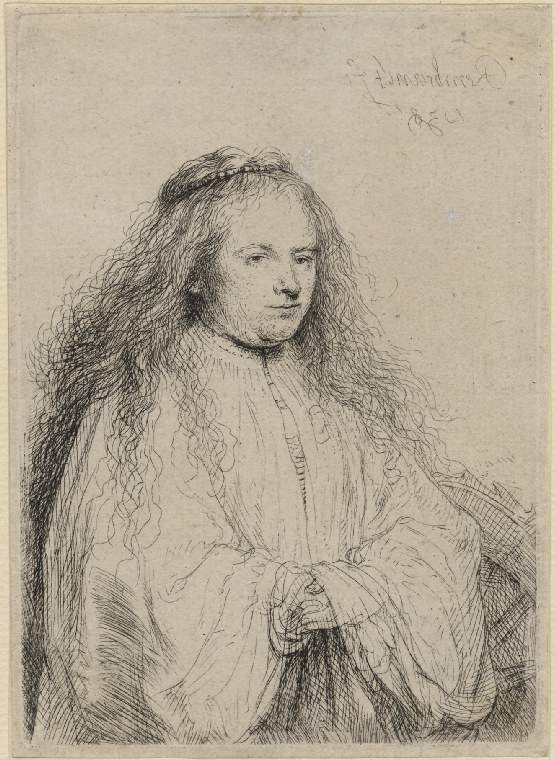
Rembrandt’s “Saskia as St. Catherine” presents a striking fusion of devotion and domesticity. The sitter is Saskia van Uylenburgh, the artist’s wife and most frequent model of the later 1630s, shown not as herself but inhabiting the persona of St. Catherine of Alexandria. Executed as an etching, the image is built almost entirely from hair-fine networks of lines: a river of curls, a voluminous robe, and a face that holds steady between youthful reserve and quiet intelligence. Rather than staging a grand miracle or a martyr’s climax, Rembrandt offers a contemplative moment—an inward, thinking Saint—while simultaneously offering a tender likeness of the woman he knew best.
The Choice of Saint Catherine and What It Signified
St. Catherine of Alexandria, legendary scholar and virgin martyr, was among the most compelling female saints in early modern Europe. Traditionally she is recognized by a spiked breaking wheel (the instrument of her attempted execution), a sword (the instrument of her eventual martyrdom), a crown or diadem speaking to royal birth, and sometimes a book symbolizing wisdom. Rembrandt departs from the full, emblematic program. In this print the explicit attributes are either pared away or implied as possibilities outside the frame. The result is a Catherine distilled to essence: not a theatrical emblem but an intellectual, almost private presence—someone who could plausibly have stepped out of a seventeenth-century Amsterdam interior.
This restraint alters the usual devotional grammar. Catherine’s real power—her learning, her eloquence, her capacity to argue—is brought forward by the sitter’s level gaze and the reservoir of thought suggested by the compressed mouth. Rembrandt chooses contemplation over spectacle, anchoring sanctity not in props but in attitude.
Saskia as Model and Collaborator
By 1638, Saskia was Rembrandt’s wife of several years, already appearing in drawings and paintings as shepherdess, goddess, biblical heroine, and companion. Depicting her as Catherine was not a neutral choice. The saint’s qualities—courage and intellect—form a high compliment, but the image is not flattery in the conventional sense. Saskia’s features are rendered with the frankness familiar from Rembrandt’s other likenesses of her: the slightly squared jaw, close-set eyes, and a mouth that seems readier to speak than to smile. He sees the person as much as the persona. The transformation into Catherine becomes a game of empathy rather than disguise: what kind of saint does Saskia already contain?
Composition: A Pyramid of Hair, Cloth, and Stillness
The figure is composed as a gentle pyramid. The small coronet or fillet gathers the crown of an extraordinary cascade of hair; that hair expands outward like a halo made of line and air; below it falls the monumental robe, its sleeves swelling into soft, bell-like volumes. The hands (lightly linked at the center) create a visual lock that steadies the whole form. The pyramid rests against a largely untouched field of paper. Nothing in the background interrupts the slow, breathing outline, so our attention never exits the figure’s orbit. The composition therefore reads as serenity. Stillness here is not emptiness but control.
Etching as Thought Made Visible
Rembrandt’s etching line is both reticent and decisive. Across the hair he uses nervous, springy strokes—tight coils that separate and recombine to suggest depth, sheen, and weight. The robe is mapped in longer, more relaxed lines that rise and fall like a tide, with small hatchings near the cuff to thicken shadow and prevent the garment from floating away. The face, the most economical zone, depends on the fewest marks: slight cross-lines at the eyes, a soft edge under the nose, a minute shadow at the upper lip. Because the face carries so little ink, the paper’s natural light does most of the work; Saskia’s skin appears luminous without any white heightening. The overall effect is an intelligence that has chosen what to clarify and what to leave suggestive.
Hair as Halo and Character Study
Few works in the period draw hair with such relish. The mane expands like a weather system around the head, at once ornamental and expressive. It functions as a secular halo—radiant, unruly, alive. Yet Rembrandt resists over-patterning; he interrupts the waves with strands that escape, small crossings that tangle, and pockets of blank paper that read as glints of light. In doing so he makes hair a narrative of character: energy contained but not tamed, a saint made vivid through a very human abundance.
Hands and the Language of Poise
The hands are linked lightly, not clasped in prayer, not deployed in rhetoric. This in-between gesture is the portrait’s moral center. It suggests attention without anxiety, confidence without display. The cuffs’ soft ruffles cup the wrists like clouds supporting bone. In Catholic art, Catherine’s hands often grasp the sword of martyrdom or rest upon the wheel; here the hands hold nothing except the moment. The absence is eloquent: faith and intelligence are being held in the mind, not demonstrated with stage properties.
Costume as Atmosphere Rather Than Pageantry
The garment reads as a saint’s robe and a contemporary woman’s voluminous house dress all at once. Rembrandt draws character through cloth, not fashion. The robe’s amplitude softens the body’s angles; its long verticals tether the composition; its minor folds around the wrists and bodice protect modesty without stiffness. This avoidance of hard edges or sparkly trim keeps sacred impersonation from sliding into masquerade. The sitter remains particularly herself while wearing the idea of Catherine.
Chiaroscuro: Light as Credibility
Because the etching relies on line to build form, value contrasts carry the psychological weight. Shadow thickens in the hair’s interior and beneath the sleeves, while the face stays in a middle tone, open and readable. The eye is guided to the least inked area—the visage—where the saint’s credibility must live. The print’s light is therefore ethical: illumination belongs to the part of the body that thinks. Rembrandt’s economy convinces us that the sanctity here is cerebral rather than theatrical.
A Face That Balances Role and Reality
Saskia’s face appears sober, perhaps even a touch skeptical. She is not ecstatic or transported; she is present. The slight tightening at the mouth and the direct, nearly frontal gaze are not typical of sugary devotional prints. Instead, we meet a Catherine whose genius is concentration. Rembrandt trusts the viewer to read intelligence as compelling spiritual evidence. In that sense the portrait echoes the textual Catherine—debater of emperors, confounder of philosophers—rather than the purely emblematic martyr.
The Signature and the Space of Authorship
A light, unintrusive signature occupies the upper right. Its placement keeps the upper field from becoming inert while avoiding any competition with the figure. In a print, the signature is more than vanity; it is an index of authorship in a medium of multiples. Its feathery presence rhymes with the feathery treatment of the hair, reinforcing the image’s atmosphere of deliberateness without heaviness.
Devotion and Domestic Life on the Same Page
What makes this sheet uniquely persuasive is its simultaneous commitment to the sacred and the everyday. Rembrandt, a supreme painter of domestic atmospheres, brings that tenderness into a saint’s portrait. The threshold between home and legend fades. The viewer senses how an ordinary room could nurture extraordinary thought. In a country where confessional identities coexisted uneasily and private devotion often retreated from public ritual, this quiet, interior saint feels exactly right.
Comparison With Other Saskia Images
Set beside Rembrandt’s more playful portrayals—Saskia as a flower-crowned reveler, or laughing beneath a feathered cap—this Catherine is a counterweight. Here the humor is muted, the romance turned into steadiness. Compared with the oil “Saskia as Flora,” where color and garlanded abundance dominate, this etching honors line and mind. The continuity across all these roles is the artist’s respect for Saskia’s interior life. Whether she appears as goddess, bride, or saint, the eyes always suggest that the sitter is more than the costume.
The Print Market and a Portable Spirituality
Etchings by Rembrandt were prized across Europe precisely because they could be owned, held, and revisited. A print of a saint—as opposed to a chapel altarpiece—makes devotion portable and intimate. “Saskia as St. Catherine” operates like a book of hours condensed to a single leaf. You don’t need a church to meet Catherine here; you need attention. The medium therefore matches the message: thinking faith that lives at home.
The Cultural Grammar of Female Sanctity Reconsidered
Baroque culture often painted holy women as visionaries flooded with light, eyes upturned, bodies dissolving into drapery. Rembrandt’s Catherine faces forward. She is neither overwhelmed by grace nor performing piety. She holds herself with quiet authority that reads as scholarly. This recalibration matters historically and emotionally. It claims a wide, dignified space for women’s intellect inside sacred imagination and inside Rembrandt’s own household.
Hair and the Question of Modesty
One might ask whether the torrent of unbound hair conflicts with a saint’s modesty. In Dutch portrait conventions loose hair could signal youth or informality; in sacred iconography, Catherine is sometimes crowned and composed, her hair managed. Rembrandt splits the difference. The hair is indeed abundant, but it is controlled by the small band at the crown and by the weight of the robe. The effect is not sensual display but spiritual amplitude, a cloud of presence. The visual rhetoric becomes: the mind is large; the spirit is at ease.
The Subtle Drama of the Mouth
Spend a moment with the mouth—neither smile nor frown, neither sealed nor open. The tiny shadow under the upper lip and the etched notch at the corner create a poised ambiguity that animates the whole portrait. It is the mouth of someone who has been speaking and will speak again, a rhetorician’s rest. Because Catherine is famous for speech, this tiny device quietly anchors identity. In the economy of etching, such micro-decisions carry surprising power.
The Hands as Anchor and Promise
While the face carries thought, the hands carry resolve. Lightly laced, they picture patience—the readiness to wait, read, argue when needed. The prints of Rembrandt’s saints often give the hands the last word: Peter’s rough fisherman’s grip, Paul’s writer’s fingers, Mary’s cradle or offering. Here, Catherine’s hands have the firmness of someone who will not be rushed. They make sanctity look sustainable.
The Role of Blankness
Large tracts of paper remain unmarked. That blankness is not hesitation; it is design. It functions as breath. The emptiness around Saskia keeps the drawing from collapsing into ornament and lets the eye rest between passages of intense line. In devotional terms, the white field is a small silence. Without that silence, the contemplative quality would be unthinkable.
How the Eye Should Travel
Enter the print at the hands, then rise along the central seam of the robe to the throat. Step out into the sea of hair, letting the curls carry you in loops back toward the tiny crown. From there, descend to the eyes—notice the minuscule highlights that make them wet—and consider how little ink is required to make them alive. Finally, move outward again into the robe’s soft borders where folds dissolve into the background. The image rewards this slow circuit; it feels designed to be circled like a rosary bead.
Why the Image Still Feels New
Modern viewers often seek authenticity, economy, and interiority—qualities this etching possesses in abundance. Without color and without elaborate props, it relies on line quality and psychological clarity. The sitter is not subsumed by the role; the role deepens the sitter. That doubleness feels refreshingly contemporary: identity as something we try on, test, and inhabit, rather than a costume that replaces us.
Closing Reflection: A Saint You Could Speak With
“Saskia as St. Catherine” is a soft assertion about holiness. Sanctity, Rembrandt suggests, looks like a thinking woman you could talk to. The print’s beauty resides less in spectacle than in trust: trust in line to carry light, in a robe to carry dignity, in hair to carry vitality, and in a familiar face to carry the name of a saint. Whether you approach the sheet as a piece of devotional imagery, as a portrait of a beloved spouse, or as a virtuoso exercise in etching, it answers with the same calm force—the virtue of attention.
