Image source: wikiart.org
The First Conversation: Rembrandt’s Adam and Eve as Human Drama
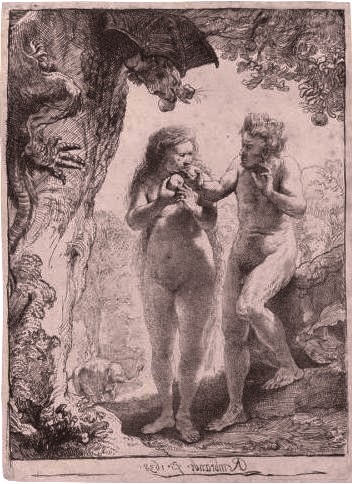
Rembrandt’s “Adam and Eve” condenses the Book of Genesis into a face-to-face moment that feels awkward, comic, and devastating all at once. The etching shows the couple standing beneath a cavernous tree as the serpent peers down from a crook in the trunk. Eve cradles the fatal fruit as if weighing its promise; Adam lifts both hands in anxious hesitation, his body pitched forward as though words have already slipped out that he wishes he could take back. Around them, the Garden is not a generic paradise but a living, earthy place with rough bark, lichen, undergrowth, and distant animals that continue their day. Rather than freezing the scene into allegory, Rembrandt frames it as a conversation between two fallible people who recognize themselves in each other’s uncertainty.
Choosing the Instant That Explains Everything
The artist selects the split second after persuasion and before bite, when decision is gravity rather than completed act. Eve’s fingers surround the fruit without entirely hiding it, and her head tilts inward in concentration. Adam, part counselor and part accomplice, compresses skepticism into gesture; his hands hover like parentheses around an argument. By refusing the spectacle of the bite or the thunderclap of divine judgment, Rembrandt makes the Fall intelligible as a human process: misgiving, curiosity, reassurance, and the fatal comfort of agreement. It is history made of seconds.
The Garden as Stage, Not Backdrop
The left side of the plate is occupied by a massive tree whose bark has the crusted ridges of age. Branches torque across a ragged aperture of light that opens toward a small horizon where animals roam. The right side folds into a darker thicket. This compositional architecture turns the clearing into a natural proscenium. The pair stand on a shallow stage of earth, the serpent hangs from a canopy, and the offstage world continues indifferent to the drama. Rembrandt understood that moral change happens within an ordinary ecology; the garden’s textures are not ornaments but witnesses.
The Serpent’s Physical Theater
Rather than a delicate snake twined around a twig, the serpent here is a stout, almost batlike creature whose human-ish head juts from a heavy torso. Its paws cling to the tree’s inner lip, and its face leans toward Eve with the conspiratorial tilt of a stage whisperer. This hybridized anatomy is less zoology than psychology. The serpent must be credible as a talker; it must possess enough presence to cast a conversational spell. Rembrandt supplies that by giving it weight and hinge, so that persuasion feels anchored rather than ethereal.
A Comedy of Posture That Turns Serious
There is humor in the way Adam raises his hands and in the awkward spacing between the figures. The etching observes bodies with the candor of a life study: Adam’s belly pushes forward as his back arches; Eve’s weight sits evenly on both feet, making her steady as a stump; shoulders are rounded, not heroic. Yet the comedy is loving, never cruel, and it heightens the tragedy. These are recognizably human bodies moving through a recognizably human exchange. The small silliness of gesture is exactly what temptation feels like before it is named.
Etching as Thinking in Lines
The plate is a masterclass in how etched lines can simulate breath, weight, and light. Rembrandt draws the trunk with broken, jagged strokes that abrade into rich midtones. The figures receive more continuous hatching, which softens into halftone over bellies, thighs, and shoulders. Very thin cross-lines create the moist darkness of mouths and the shine on the fruit’s surface. Punchy burin accents emphasize the edges of hands, noses, and the serpent’s face. The result is not merely descriptive but kinetic: line clusters accelerate where anxiety peaks and quiet where thought pauses.
Chiaroscuro That Teaches Where to Look
Light pools in the central clearance and fades toward the tree’s interior shadows. The couple’s bodies are modeled with luminous midtones; the serpent crouches in a higher contrast of dark against bright, which pulls the eye up to the source of suggestion and back down to its effect. The right side, where Adam stands, is darker than the left, pushing him toward the threshold of concealment. That tonal asymmetry implies the moral tilt of the scene without caricature. Visibility belongs to Eve and the offered fruit; uncertainty belongs to Adam and the shadows that gather behind him.
Faces That Are Not Masks
The two look at one another rather than at the serpent, and that mutual gaze makes the moment tender and terrible. Eve’s brows draw slightly together; her mouth is neither smile nor frown but the high-concentration line of someone handling a new tool. Adam’s nose wrinkles, his lips part, and his eyes widen in a look that mixes worry with desire. These are not masks of sin or innocence; they are working faces. Rembrandt understands that judgment enters the world not through villainy but through ordinary attention misdirected.
The Elephant in Eden and Other Creaturely Witnesses
In the distance behind the clearing a small elephant ambles through foliage—a quirky signature detail noted by viewers since the seventeenth century. Deer and other animals present in some impressions graze at the fringe. These creatures do not moralize; they scale the space and place the couple inside a wider creation. The presence of an elephant, a beast often associated with memory, invites an associative reading: creation will remember this day. Yet the touch remains playful, one more proof that Rembrandt’s Eden is a living landscape rather than a sterile emblem.
Gesture as Moral Language
Every body speaks. Eve’s elbows are tucked, hands centralized, chest closed—an inward gesture that protects both the fruit and her thought. Adam’s elbows are wide, palms outward, a public gesture signaling objection, surprise, and a plea for clarity. The serpent’s paws and head thrust down and in. Between those three vectors—Eve inward, Adam outward, serpent downward—the composition fixes a triangular field of intention. The triangle is compact enough to feel claustrophobic and open enough that a viewer can enter it imaginatively and feel the pull of each position.
The Theology of Delay
Because the bite has not happened, the etching becomes a meditation on delay. The space between fruit and mouth is the distance in which freedom lives. Rembrandt stretches that space with meticulous pacing: the fruit is slightly off center in Eve’s hands; her chin dips but does not arrive; Adam’s fingertips hover rather than touch. The viewer is invited to inhabit this delay, to experience how choices are time-events. The print’s moral force lies precisely in that patience.
Hair, Skin, and the Humane Body
Nudity in this scene is neither idealized nor punitive. Eve’s hair hangs in rough waves; Adam’s curls frizz and tangle. Flesh is rendered as a living surface, neither marble-smooth nor grotesque, crossed by subtle hatched shadows that indicate softness and temperature. The bodies look inhabited by breath. This humane treatment accomplishes two things at once: it refuses prurience and insists on embodied seriousness. These are the first bodies of art history that feel palpably warm.
The Edge of the World and the Shape of the Plate
Rembrandt uses the plate’s rectangular edges as compositional partners. The heavy canopy of foliage at the top left pushes diagonally toward the couple, tightening the spatial net. The dark cavern at left seizes the vertical border, making a threshold that one cannot cross without entering shade. The lower border catches the garden floor as if it were a shallow stage front. This choreography of edges turns the viewer into a participant; we find ourselves not merely looking at Eden but standing at its lip.
Sources and Subversions
Northern European artists had a long tradition of engraving Adam and Eve with classical poise—Dürer being the most influential precedent. Rembrandt knows that tradition and gently subverts it. He keeps the vertical pair in a wooded setting but replaces the statuesque contrapposto with colloquial stance. He exchanges symmetrical clarity for conversational messiness. He prefers character over type. The subversion is not parody; it is a recalibration toward humanity. Where Dürer offers idealized anatomy and emblematic animals, Rembrandt offers the lived psychology of a couple at a crossroads.
The Fruit as Scale, Light, and Thought
The fruit is not overwhelmingly large, but it is calibrated to be too big to disappear in a hand and too small to become a separate character. Its surface is described with tiny curved hatchings that catch white, making it the brightest solid object in the print. Its roundness echoes the curve of Eve’s belly and Adam’s cheek, insinuating itself as kin to the body. Because the fruit visually rhymes with the human, accepting it feels like accepting oneself; refusing it feels like refusing a part of one’s own appetite. Rembrandt loads that small sphere with meaning without letting it become symbol-heavy.
Silence as the Soundtrack
You can nearly hear the scene: the rustle of leaves over the cavern, a bird’s distant call, the soft gasp in Adam’s parted lips, the whisper of the serpent. Yet the etching is fundamentally quiet. The white of the paper works like a hush that wraps the central trio. That silence is an ethical atmosphere; in it, words matter. The fall into speech—“You will not surely die”—is what drives the action, and the print respects the weight of sentences by giving the scene acoustic space.
Why the Humor Matters
Viewers often note the print’s faint comedy—the serpent’s theatrical peering, Adam’s startled hands, the slightly gawky bodies. That humor is not disrespect but insight. Temptation often appears as a mixture of earnestness and silliness. We persuade ourselves with arguments that are both believable and faintly ridiculous. By allowing a smile at the edge of tragedy, Rembrandt deepens the sting. The Fall was not achieved by grand villainy but by two people being a little foolish together.
The Print as Portable Meditation
As an etching, the image could circulate widely and be handled by a viewer at close range. It functions less like a church altarpiece and more like a handheld mirror. The scale allows for inspection of tiny decisions—the bite of a line that shapes a knuckle, the flick of a drypoint burr that adds sparkle to an eye. In this intimacy the subject becomes less cosmic myth and more personal reflection. The portable print invites portable examination: what are the serpent’s voices in my own ear, what fruit am I weighing, how do my gestures persuade the people I love?
The Afterlife of the Moment
Because the etching stops before the act, it carries the future like a pressure system in the air. One can feel the plants already preparing to shrink, the animals to scatter, the horizon to darken, the ground to bruise feet. Yet none of that has happened. The Garden still gives itself freely. Rembrandt’s decision to keep the prelapsarian light alive in the clearing grants the viewer a space of hope, if only in imagination: would it be possible to step back, to speak another sentence, to drop the fruit? The print’s brilliance is that it makes this counterfactual feel briefly available.
How to Read the Plate With Your Eyes
Enter at the top left where the serpent bends out of foliage; follow the arc of its body to the bright ellipse of the fruit; trace Eve’s fingers, then the line of her arm to the soft hollow under her collarbone; cross to Adam’s raised hands, counting the light strikes on knuckles; descend to the dark ground and track the scattered plants toward the small animals in the distance; loop back along the tree’s rough bark to feel the weight of the world above the couple. A few circuits like this turn looking into a form of listening.
The Image’s Contemporary Freshness
Four centuries on, the etching still feels psychologically exact. It recognizes how often moral choice happens in ordinary talk, how bodies argue as much as words, how desire dresses itself as reason, and how love can be the medium of both truth and mistake. The print’s refusal of melodrama and its trust in tiny signals—eyebrows, fingertips, the angle of a wrist—give it a modern clarity that transcends style. It looks like people we know.
Closing Reflection
“Adam and Eve” is less a sermon than a study in attention. It invites the viewer to attend to faces, to hands, to the texture of trees and the delicate physics of persuasion. The catastrophe of the Fall is present, but Rembrandt captures the more intimate disaster of self-misunderstanding that precedes it. What makes the etching great is not that it illustrates a doctrine but that it illuminates a moment any person might recognize: standing with someone you love, holding an object you want, and listening to a voice that flatters what you already hope to believe.
