Image source: wikiart.org
A Sky That Thinks: Rembrandt’s Weather Made Visible
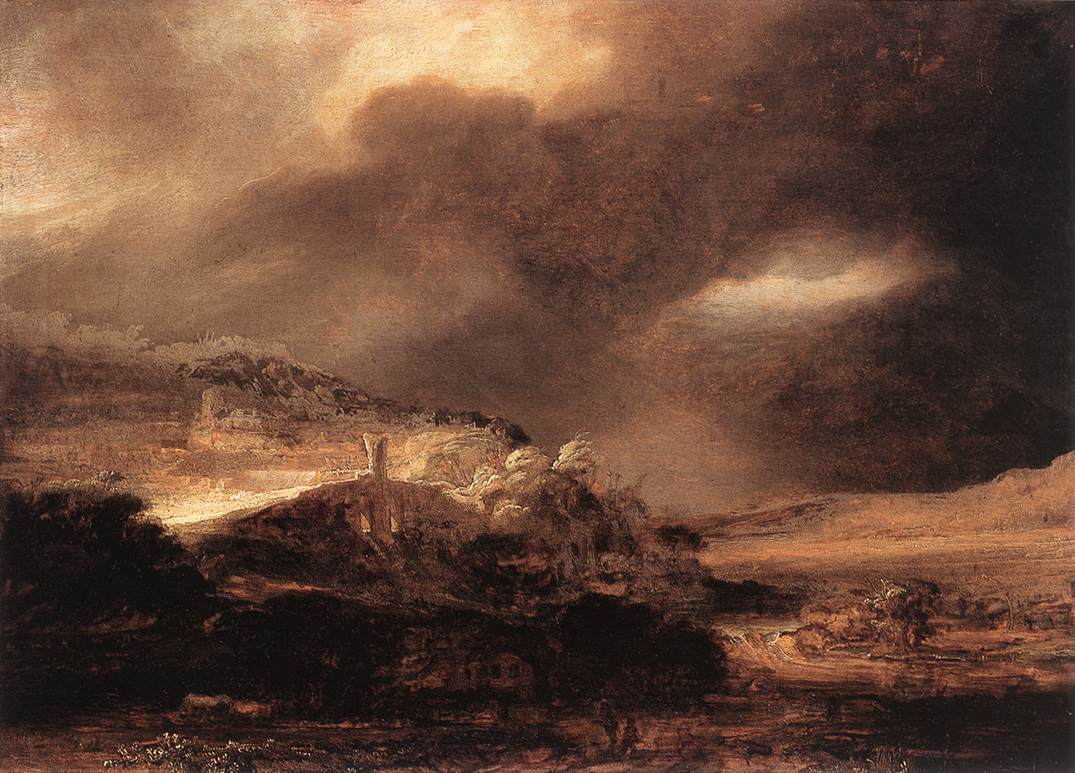
Rembrandt’s “Stormy Landscape” is a drama staged almost entirely in air. The earth lies low, tawny and dark, rolling away into river flats and distant hills. Above it piles a sky of bruised browns and slates, a heaving architecture of vapor whose cavities glow as if lit from within. The light is not gentle; it comes in sheets and seams, opening lanes through the cloud then sealing them again. In this world the land seems to brace while the heavens make up their mind. Few painters persuade us that weather has intention; here, the sky appears to think.
The Moment Before Impact
The painting fixes the minute when storm gathers but has not yet broken. In the left and middle distance a wedge of illumination races across ridge and ruin, bleaching walls, grazing foliage, and pulling a pale ribbon from a riverbed. To the right, a heavier mass of cloud lowers, swollen with rain. The contrast between the advancing brightness and the encroaching darkness is the canvas’s central tension. It is not a simple chiaroscuro; it is meteorology as narrative. We are placed on the threshold between a world still articulate with detail and a world about to be simplified by downpour.
A Composition Built from Diagonals and Shelters
Rembrandt organizes the vastness with two diagonals that meet near the glowing ridge. The land rises from the lower left, where trees knit into a single dark bank, and falls toward the right where lanes and streams draw us out to plains. Over that slope the clouds tilt on a counter-diagonal, their belly moving right to left, so that air and earth cross like sabers. Between those sweeps sits a cluster of stone and foliage—ruin, copse, and bluff—that acts as a hinge. This refuge is no accident: the painter gives us somewhere for the mind to stand while the sky considers violence.
Ruin as Timekeeper
At the crest of the bright ridge, a broken tower catches the storm-light. Its silhouette is small yet stanch; it persists while weather cycles. In Rembrandt’s landscapes ruins often measure time against the vaporous present. They carry history’s scar into the passing hour and remind us that storms are local episodes in a longer story. Here the ruin is neither picturesque ornament nor moralizing emblem. It is a stone fact that lets the painting weigh minutes against centuries without a word.
The River as Mirror and Narrative Line
Across the lower band of the canvas a river threads through shadow, then flashes white where the storm’s light tears the cloud. Water is the painting’s narrator. It reports the sky’s decisions in real time, flickering where a gap opens, dulling where darkness thickens. Follow its course and you discover the picture’s rhythm: bright, dim, bright, swallowed—like breath under running. The stream also supplies a route for the eye: from the obscure foreground through the illuminated middle distance into the weather’s mind.
Color as Weather, Not Ornament
The palette is austere: umbers, raw siennas, olive blacks, cool slates, a few chalky whites softened by warm glaze. Nothing is saturated; everything is adjusted by value. Because chroma is kept low, the smallest increment of light reads as revelation. The painting teaches our perception to find drama in nuance. When a tuft of tree takes a honeyed edge or a patch of grass turns a shade paler, we feel the atmosphere move. Color is not there to decorate the earth; it is there to persuade us that the wind is changing.
Brushwork That Breathes in Multiple Speeds
Rembrandt’s hand runs at different tempos across the surface. The sky is laid in broad, elastic swathes, then reopened with circular scumbles that carve out pockets of illumination. The ridge is knit from short, directional strokes that build rock and scrub; the dark fore-trees are dragged and stippled until they fuse into a living bank. Here and there the paint thins to a stain, allowing ground tone to glow like damp earth. This ensemble of speeds produces the sensation that the painting is ventilated, as if currents of air pass through the brushwork itself.
Scale and the Human Measure
If figures are present they are minute, dissolved into the brown-black of the foreground; if animals graze, they do so as specks. The choice is rhetorical. By diminishing human scale, Rembrandt elevates weather to protagonist. We are invited to read the world not as a backdrop for people but as a system with its own rules and moods. Yet the painting never becomes indifferent to us. The very smallness of possible figures—hints of roofs, whispers of paths—makes the viewer feel both humbled and at home. This is a world large enough to ignore us and generous enough to include us.
The Ethics of Light
In Rembrandt, light is never merely optical; it is moral weather. Here it seeks out roughness—the torn masonry, the shrubs that hunker on the ridge, the quick runnels that score the plain. The smooth, complacent surfaces lie in shadow. Illumination becomes attention paid to what endures and works: stone that has taken blows, vegetation that crouches and holds, water that keeps moving. The light’s preferences instruct the viewer in what has value.
A Landscape that Refuses Pretty
Dutch Golden Age painting abounds with tidy farms and sunlit harbors. “Stormy Landscape” declines the postcard and embraces the sublime. The brush is freer, the clouds weightier, the tonalities riskily close. Where many contemporaries paint weather as decoration, Rembrandt paints weather as condition—of labor, travel, time, and thought. This refusal to be “pretty” is not contrarian pose; it is fidelity to how the world often looks when you are far from festival and close to work.
The Physics of Distance
Atmospheric perspective—aerated blue in the far distance—yields here to a more radical approach. Rembrandt collapses distance by letting the sky’s darkness surge almost to the ground and by allowing the light to skitter unpredictably across planes. The effect is intimate. The storm is not a backdrop beyond the hills; it is above our heads. At the same time, the bright lanes slipping away toward the horizon keep openness alive. We sense proximity and escape simultaneously, a sophisticated illusion that mirrors how storms feel on the body: both enclosing and permeable.
Listening to the Painting
If you listen as you look, a soundscape comes clear. There is the blunt hush before rain, the low thudding of far thunder, wind spilling out of the cloud and running across grasses, water quickening in the channels, a bird’s abrupt change of direction. Rembrandt doesn’t paint any of this literally. He achieves it through spacing of luminous passages, the muffling density of shadow masses, and the way brushwork breaks and resumes like gusts catching breath. The ear learns from the eye.
The Foreground as Floor and Threshold
The lowest band of the image is burdened with dark. A heavy treeline and the black mirror of water make a sill that our gaze must cross. This floor is not dead space; it’s the threshold that establishes our point of view—sheltered, lower than the ridge, close to water. Standing in that shadow, we witness the storm light travel, and the scene gains the authority of a remembered walk. We are not above the drama like gods; we are under it like people.
Ruin, Weather, and Human Time
Because the ruin is struck by light, it takes on complex symbolism without losing concreteness. It is evidence of human aspiration and fragility. Weather moves around it, indifferent to history; yet the ruin also anchors the meteorology in a narrative of use and loss. The painting therefore braids two temporalities: the short hour of a passing storm and the long centuries that raise and dismantle walls. Rembrandt compresses them into one view so that we feel time layered rather than linear.
Theology Without Text
Many of Rembrandt’s landscapes keep biblical subjects at their margin—tiny figures of Tobias or the Good Samaritan tucked into miles of country. Here no named story intrudes, yet the canvas breathes a quiet theology. The world appears contingent and immense, perilous and provisioned. Light arrives unearned. Pathways exist where none seemed. Shelter holds for now. Without scripture or symbol, the painting resolves into gratitude startled by awe.
Kinship with “The Stone Bridge” and “Landscape with the Good Samaritan”
Seen alongside “The Stone Bridge,” this work shares a vocabulary: a storm-burdened sky, a glowing band of middle-distance, dark anchoring foregrounds. But “Stormy Landscape” strips the narrative to weather itself. Where “Landscape with the Good Samaritan” ties light to an act of mercy, here light is an event with no witness but us. The comparison clarifies Rembrandt’s range: he can make landscape serve story and he can let landscape be the story.
Method: Glaze, Scumble, and the Breath of Ground
Technical looking reveals layers. Thin, warm grounds shine through the sky’s mid-tones; wet-over-dry scumbles cloud the upper masses; thicker, loaded strokes articulate ridge and foliage; a few knife pulls expose lighter substrate at key flashes. The alternation of transparency and opacity mimics weather’s optics—how light seems to live inside cloud in one place and glaze its surface in another. The method is not showy; it is a quiet engineering of breath.
How to Walk the Painting With Your Eyes
Enter at the lower left where darkness pools. Step along the black treeline until you reach the bright breach on the ridge. Linger at the ruin, the trees ringed with light, the quick rundown of a path. Cross the canvas with the river’s flash; pause at the pale opening in the cloud to the right; feel how the brightness there does not reach the ground. Now lean back and sense the sky’s weight tilt toward you. Repeat this walk more slowly. Each circuit will widen the storm’s intelligence.
Why It Still Feels Contemporary
Our age understands weather as both mood and system—something we feel and something we study. Rembrandt’s storm anticipates that doubled consciousness. It is palpably emotional yet built from close observation of light dynamics, wind behavior, and the way land reflects the sky’s decisions. The painting has the modern honesty of refusing sentimental sunset and the modern humility of showing humans small. It reads like a field note from a witness who stayed outside until the first sheets of rain arrived.
Closing Reflection
“Stormy Landscape” is less a picture of a place than a report from inside weather. Rembrandt brings the viewer to the line where light breaks and fails, where distance opens and closes, where a ruin holds its ridge and the river tells the sky’s story. The canvas does not ask us to decode allegory; it asks us to stand still while a world changes above us, to feel the dignity of ground and the drama of air, and to carry that sensation back into our own hours when cloud gathers and the mind, like the sky, begins to think.