Image source: wikiart.org
A Body Drawn with Breath and Gravity
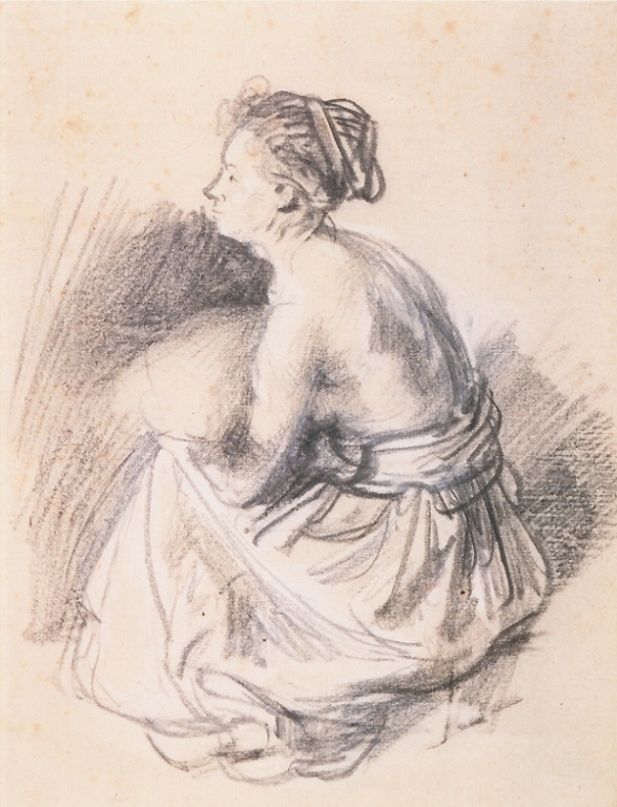
Rembrandt’s “A Seated Woman, Naked to the Waist” from 1637 is a small sheet with the emotional scale of a painting. The model sits in profile, torso turning slightly toward the light, arms folding in front of her as if to settle a shawl that pools around the hips. The head is lifted and turned, the hair gathered loosely, the mouth and nose indicated with sure, abbreviated marks. Around her, the paper remains largely open, a pale atmosphere that makes the figure feel newly present. Nothing about the drawing is theatrical. It is frank, immediate, and gentle, a record of looking that refuses both coyness and idealization.
Drawing as Sculpture in Air
The medium appears to be black chalk heightened with touches of wash, handled with a sculptor’s sense of mass. Rembrandt works the chalk from whisper to declaration. Across the shoulder blades, the strokes widen and soften so that the skin seems to take light the way clay takes a thumbprint. At the waist, the line tightens and darkens to anchor the turn of the torso. The drapery below is a field of pleats, but he avoids counting folds; instead he sets up broad, directional sweeps that catch shadow where cloth would naturally gather. The paper’s untouched expanses are as important as any mark. They give the figure oxygen and let the light appear to rise from within rather than being painted on top.
A Composition That Settles and Lifts
The pose is a coil. Hips rotate one way, rib cage the other, head and neck stretch ahead, and the whole mass sits in a C-shaped curve that keeps the body alive within stillness. The triangle of skirt on the ground provides a base, a deliberate geometry of stability. Above, the shoulder line slopes toward the turned head so that the viewer’s eye climbs the back, rests at the nape, and then arrives at the profile with a sense of earned attention. Rembrandt places a shadow wedge behind the head and back, not as a backdrop but as a resonance chamber that deepens the volume of the figure without enclosing it. The result is weight and levity in the same frame—gravity in the seated hips, lift in the alert head.
Light that Reads Skin, Not Symbol
Illumination enters from the left and slightly above, but the drawing never announces a source. Light here is descriptive, not allegorical. It touches the ridge of the scapula, grazes the slope of the shoulder, and slides across the upper arm before dissolving at the elbow. On the face, light is a single, decisive plane that makes the profile legible without carving it. Rembrandt refuses the vocabulary of polished marble; he prefers the warmth and irregularity of living skin. The slight bloom at the shoulder cap and the faded edge along the forearm are not effects; they are the way bodies appear when light is allowed to behave like weather rather than like theater.
The Ethics of the Non-Ideal
Rembrandt’s nudes are renowned for their humanity. They are not marble goddesses nor academic templates; they are people with weight, temperature, and time. This sheet honors that ethic. The back is not a diagram of muscles; it is a surface that has carried sleep, work, and the turn of daily gestures. The waist thickens and then narrows with believable irregularity. The shoulders are neither heroic nor flimsy; they are simply where the arms begin. Such choices are not a rejection of beauty. They are a redefinition of it as fidelity to observation and sympathy for what observation reveals.
Gesture as Interior Life
The model’s arms fold in a way that reads as practical and protective. The left arm tucks close, the right curls around as if grasping cloth. That small embrace is not a modesty trope; it is a believable rest position for someone sitting a long time, a way to hold the body without strain. The forward tilt of the head gives the profile an alertness that counters the resting arms. The face is not isolated as a mask; it is embedded in posture. What we read as psychology—the sense of calm absorption—emerges from anatomy faithfully described.
Hair and the Pleasure of the Quick Mark
The hair, caught up and tied, is drawn with shorthand pleasures. A few bold strokes state the band; smaller, lively lines suggest wisps that have slipped free. Rembrandt never overworks hair in drawings like this. He trusts our familiarity with its behavior. The economy keeps the head from feeling heavy and helps the profile’s clarity. The small queue of hair echoed by the tied sash below creates a visual rhyme that binds top and bottom halves of the figure.
Drapery as a Theater of Hands
If the upper torso is a poem of light on skin, the lower half is a theater of hands—the artist’s hands. Cloth wraps the hips, then cascades, then pools against the floor. Rembrandt moves between long, bowed strokes and short cross-strokes, changing speed to match the material. The sash gathers like a small belt of shadow, its darker tone compressing the waist and setting the abdomen’s plane. Where the skirt meets the ground, the chalk quiets into a dusty edge that makes weight sensible. The way fabric falls here is not decorative. It is part of the subject: a seated person whose body and garment cooperate to make rest.
The Studio as a Room of Air
The drawing’s setting is almost not a setting at all. A hatched triangle behind the model suggests a wall catching shadow; a soft, darker patch near the base reads as floor. This minimal architecture is just enough to keep the figure from floating. Rembrandt’s studio was full of props, yet he understood when to let space remain abstract. The sparseness here turns the sheet into a room of air where the figure’s breathing can be felt. Nothing distracts from the exchange between eye and body.
The Hand’s Pressure as Time
Look closely at the edges of the back and the drapery’s crest and you can follow the history of pressure applied to chalk. Heavier touches lay down rich tone; lighter ones skate over the paper’s tooth and leave a granular trace. These differences, legible even in reproduction, are the record of minutes passing. A painting can conceal its time; a drawing often shows it, and Rembrandt lets that evidence remain. We are looking not just at a model but at a session—an encounter between observer and subject captured through speed and slow care in succession.
A Dialogue with Other Seated Women
Across Rembrandt’s drawings of women—bathing, sleeping, nursing, dressing—runs a consistent attention to ordinary gesture ennobled by clarity. This sheet sits near drawings of women at a bath and of wives seated in domestic rooms, yet it maintains its difference through the turned profile and the strong diagonal of the back. Where other sheets emphasize enclosure—wraps pulled tight, heads bowed—this one emphasizes openness: the chest lifted, the head turned outward. The figure seems to listen rather than retreat, and that small distinction shifts the whole emotional pitch.
The Model, Identity, and the Refusal of Gossip
Speculation about who the model might be—wife, partner, studio regular—has trailed many Rembrandt studies. The drawing declines to join that gossip. It withholds identifying details to protect attention for the act of looking. Naming can sometimes blur seeing. Here the unknown status invites the viewer to read without biographical bias. The picture honors a person rather than a story about a person.
The Education of Seeing
A drawing like this instructs the eye in how to perceive weight and light. Begin by tracing the shoulder line, following the edge where light falls away to shadow; sweep along the spine’s curve to the knot of the sash; drop to the pooled drape and notice how lines run with gravity; climb back up through the soft modeling of the rib cage to the plane of the cheek. After one circuit you understand what the artist saw; after several, you begin to see more in the world beyond the paper. The sheet is a modest device for re-training perception toward patience and nuance.
Color Without Color
The monochrome of chalk and paper might seem limiting, but Rembrandt creates a sensation of color through value and temperature alone. The warm ground of the sheet stands in for the warmth of skin; the cooler grays of pressed chalk read as shadow chilled by distance from light; the highlights near the shoulder contain no pigment, yet they glow as if touched by sun. The illusion is born not of trickery but of balance. When values are judged precisely, the brain supplies chroma on its own.
Anatomy and Mercy
The modern viewer often worries whether the model is comfortable, whether exposure implies vulnerability. Rembrandt’s answer is in the handling. The back is not pried open for clinical display; it is presented with mercy. There are no exaggerations, no anatomical demonstrations for their own sake. The draughtsman’s knowledge never overrules the person. So the drawing avoids objectification by staying with the truthful scale of the moment: a woman resting, a draughtsman attending, a body carrying its ordinary history with dignity.
The Silence that Follows a Good Line
One of the most moving qualities of Rembrandt’s best drawings is their silence. After the first pleased shock at the beauty of the marks, a quiet arrives. That quiet comes from restraint. The artist does not correct the profile into symmetry; he does not scrape and polish away the grain of paper; he does not “finish” the hem into pattern. He stops when the figure begins to breathe. The open spaces of the sheet hold this decision like a pause in music. It is the silence of enough.
A Contemporary Feeling Across Centuries
Why does a drawing made in 1637 feel so present? The answer lies in its plainness and its honesty about process. Contemporary eyes accustomed to candid photography and sketch-like digital studies recognize in the chalk’s immediacy a mode of truth-telling. The subject itself—someone at rest, halfway dressed, thinking of nothing in particular—belongs to every time. Remove the date and the sheet belongs anywhere an artist and a sitter share a room and a trust.
How to Live With a Drawing Like This
If you meet the drawing in a museum or book, give it the sort of time it asks for: long enough to see three or four distinct things happen—realize how the rib cage turns, notice the similarity between hair tie and waist sash, register the rhythm of the drapery’s weights, return to the profile and feel its ease. The sheet repays such attention by adjusting your sense of scale. The world beyond it will look a touch more articulate afterward, as if light had learned better words.
Closing Reflection
“A Seated Woman, Naked to the Waist” carries in a handful of marks the best of Rembrandt’s humanism. It says that beauty lives in accuracy warmed by sympathy, that drawing can be both fast and profound, that modest subjects deserve the same concentration as epics. The figure sits, the air around her glows, and our attention steadies. That is all, and it is more than enough.