Image source: wikiart.org
Three Studies That Feel Like a Conversation
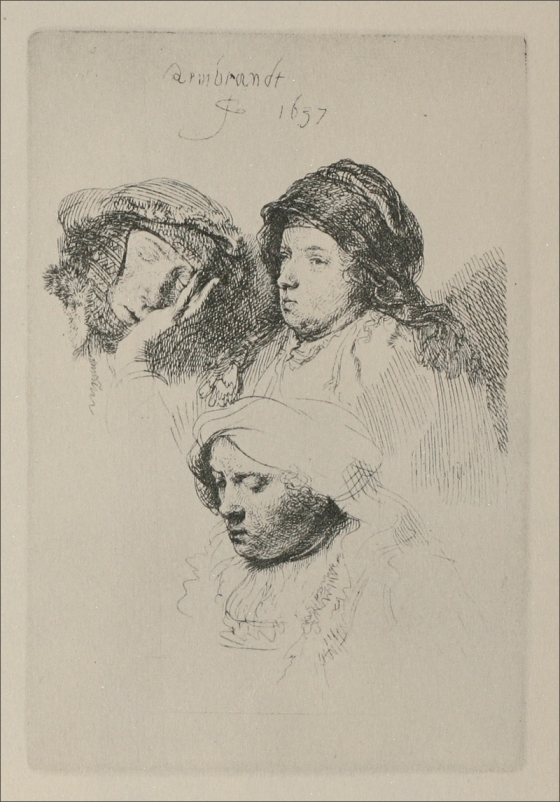
Rembrandt’s “Three female heads with one sleeping,” dated 1637, is a compact marvel of observation and printmaking. On a small sheet he arranges three bust-length heads—one dozing, one turned in lively profile, one bowed with eyes closed—so that they read as a single chord of human states. The upper left figure leans on her hand, lashes resting on the cheek, cap slipping forward; at upper right a second woman, more alert, faces left in three-quarter view, her lips pursed as if about to comment; at the bottom a third head tilts downward, features softened in reverie. Above the ensemble the artist’s signature and date hover like a whispered heading. There is no background narrative, no props beyond a few scalloped edges of headgear and fur. And yet the plate feels complete, a small studio world where fatigue, attention, and inwardness speak to one another.
Why an Etching of Heads Matters
Seventeenth-century Dutch artists used tronies—head studies not tied to a specific sitter—as laboratories for expression, light, and costume. Rembrandt turned the genre into a workshop of empathy. By placing three women at different thresholds of awareness, he explores how minute variations of eyelid, mouth, and weight can register mood with more authority than theatrical gesture. The plate compresses a lesson painters spend careers learning: that truth in faces is a matter of proportion and pressure rather than stereotype. The women are not allegories; they are people who have been looked at with patience.
Etching as Drawing in Metal
The technique is etching heightened by the suggestion of drypoint in select passages. Rembrandt draws through a wax ground on copper with the freedom of pen, then lets acid bite the exposed lines. The resulting network of lines holds ink and prints onto damp paper. What we see is the choreography of hand pressure: sharp incisive strokes for the contour of the awake profile, softer tremolos for the sleeping lids, quick hatches swelling into tone around the cheeks. Unlike engraving’s premeditated hardness, etching allows hesitations and corrections to remain legible. Those traces of decision are part of the work’s vitality.
The Architecture of the Page
Compositionally the plate is triangular. The eyes of the upper pair form a loose horizontal; the downward head closes the triangle’s base. This geometry stabilizes the improvisational feel of three separate studies. Rembrandt places the sleeping head at upper left partly because the left margin gives her a wall to lean against; the attentive central head faces her, setting up silent dialogue; the bowed head at bottom balances the mass and draws the viewer’s gaze back up. The empty spaces—especially at lower right—are not neglect; they function as breath between phrases, letting each head speak without crowding the others.
The Grammar of Line
Rembrandt varies his line like a voice changing register. Around the sleeping forehead and cheek, lines are short and parallel, suggesting weight settling into softness. For the alert profile, contour runs long, unbroken, and slightly thickened at the shadow side so the form feels decisive. The downward head is built from softer, more broken strokes, especially along the jaw and chin, where line yields to almost-dry grain, a whisper of tone that keeps the features from hardening. Cross-hatching behind the upper pair creates a modest halo of darkness that pulls them forward, while the lower head sits in a lighter field, reinforcing its inwardness.
Light Drawn from Paper
Etchings cannot glow with pigment; they glow by restraint. Rembrandt leaves paper bare in strategic planes—the bulge of a cheek, the tip of a nose, the upper eyelid’s rim—so the white of the sheet reads as light. He then tethers that light with hatched shadows that turn with the form rather than against it. The result is a believable daylight that arrives without a painted source. In reproductions the effect can look understated; in an impression the faces seem to breathe as the inked lines vibrate against untouched paper.
The Sleeping Head and the Truth of Weight
The dozing woman is among Rembrandt’s tenderest small inventions. Her cap presses into the brow; the temple rests into the open hand; the mouth slackens just enough to release speech. Nothing is caricatured. Sleep is indicated by weight, not by drool or slack jaw. The line that defines the eyelid thickens at the lash and thins at the inner corner, a nuance that persuades the eye that the skin actually lies over a sphere. Even the hatched pocket of shadow at the cheekbone reads as gravity gathering flesh. In a culture that loved moralizing contrasts between sloth and industry, this image refuses judgment. The woman is simply tired.
The Alert Profile as Counterpoint
To the right, the second head keeps watch. Her headgear sits lower on the forehead; hair tufts at the back; the mouth compresses into a small determination. The hatching behind her is densest, converting background into a velvet field against which the silhouette cuts cleanly. This is where Rembrandt displays his command of contour: a single line at the nose’s bridge breaks and resumes with exactly as much pause as the cartilage requires, and the results are lively without bravado. The profile does not merely “face left”; it feels like a person about to speak to the sleeper in a stage whisper.
The Downcast Head and the Privacy of Thought
The lowest figure neither sleeps nor looks; she thinks. The head tilts, the lids sink, the mouth loosens, and the weight of hair and cap draw the face downward—not from exhaustion but from inwardness. Rembrandt barely implies the far edge of the cheek and jaw; he lets a scallop of the turban carry the contour so the face can stay soft. Half the torso dissolves into sketch, the etcher’s equivalent of a painter’s evaporating brushwork. This openness dignifies the subject’s privacy. We grasp the mood without being invited to pry.
Costume as Rhythmic Device
The headpieces and fur-edged collars are not costume drama; they are rhythmic devices. Caps and folds generate arcs and scallops that echo one another across the sheet, binding the three heads as variations on a theme. At the same time, the textures offer Rembrandt line-vocabularies: stippled touches along a furry edge, ribbon-like runs for folded cloth, crisp slashes for a hem. The contrasts—soft fur against smooth cheek, crisp brim against piled hair—make the faces pop without needing heavy shadow.
Three Studies, One Time Signature
An invisible metronome runs through the plate. The sleeping head beats slow, the profile mid-tempo, the downward head adagio. Place your finger under each face and feel the rhythm: a long pause at the sleeper’s closed eye, a quicker bounce along the profile’s sharp nose and lips, a return to a slower pace in the lowered lids and mouth. This musicality is not fanciful; it’s how the eye experiences varied line lengths and densities. Rembrandt understands that variety alone is not enough; variety must be tuned into a felt cadence.
The Signature as Composition
“Rembrandt f 1637” sits above the heads like a quiet title. Its placement matters. It occupies the brightest field on the plate, balancing the darker mass of the central head’s background. The airy calligraphy of the signature also foils the dense hatch below, lightening the upper left quadrant so the composition doesn’t tip. As in many of his etched sheets, the signature is not a postscript; it is an element in the design.
States, Impressions, and Plate Tone
Rembrandt’s etchings often exist in multiple states—reworked versions of the plate printed at different moments—and the printers could leave “plate tone,” a thin film of ink on the surface that settled like atmosphere. In a plate like this, where the heads sit close to open paper, plate tone can change the mood. A cleaner wipe yields crisp daylight; a warmer veil deepens the hush around the sleeper and thinker. The best impressions thread a needle: enough tone to unify, not so much that whites turn dingy. Collectors loved such variability; it made each print feel like a fresh performance on the same instrument.
Women, Dignity, and Everyday Time
Rembrandt’s women rarely perform for allegory. They sit, stand, nurse, doze, pray, wait; they are mothers, vendors, models, acquaintances. These three heads continue that ethic. They do not sell a moral; they honor the dignity of ordinary time—resting, pondering, attending. In a market that rewarded picturesque beggars and coquettish beauties, Rembrandt chooses a gentler realism. It is tempting to read the trio as “stages of awareness,” but the plate resists symbol. It prefers temperament to thesis.
From Studio to Street and Back Again
Who were these women? Possibly studio regulars, perhaps a partner or relative posed in different attitudes, maybe a synthesis of features seen in markets and taverns. Rembrandt’s notebooks and drawings suggest that he moved freely between hired models, household sitters, and people caught on the fly. The power of the plate lies precisely in that mix. We do not need their names; we recognize their humanity because the marks bear the heat of seeing.
The Education of the Viewer’s Eye
The plate teaches how to look at faces. Start with the sleeping lashes and travel down the slope of the nose to the soft collapse of the mouth. Jump across to the bright rim of the alert cheek, let the contour snap along the lips and chin, then drift into the textured darkness behind. Drop into the lowered head, sense the gravity pulling cheek into collar, and watch line resolve into whisper. Doing this circuit a few times, you realize the sheet is a training ground: it invites you to practice reading minute differences in line as differences in state of mind. Few museum experiences are more pleasurable than learning to see on Rembrandt’s terms.
The Ethics of Incompletion
Half of the bottom figure’s clothing is barely indicated; parts of the upper figures’ torsos dissolve into suggestion. In lesser hands such incompletion would feel lazy. Here it feels ethical. The artist stops when adding would lie. The mind finishes what the eye proposes, and the result is livelier than any pedantic finish. This ethic of restraint is central to Rembrandt’s print language. He trusts the viewer; he trusts the subject; he trusts the line to carry just enough.
Why 1637 Matters
The late 1630s were extraordinarily productive. Rembrandt was consolidating his Amsterdam success, experimenting with biblical prints, portraits, landscapes, and quick studies from life. This plate sits among a group of 1637 etchings where he tries out heads of men and women in varied headgear and attitudes. It shows an artist secure enough to publish studies that keep the freshness of drawing. That decision helped reset expectations for what a print could be—not merely a reproductive medium but a direct, intimate expression.
Modernity in a Small Rectangle
Strip away the date and the print feels modern: close cropping, negative space used as air, narrative withheld, process visible. Photographers and contemporary draftspersons have borrowed these strategies for decades, often without realizing their debt. The fact that the image travels so well across time speaks to Rembrandt’s instinct to find the timeless in the ordinary: a head sleeping, a head thinking, a head listening.
How the Plate Holds Together
What keeps three separate studies from flying apart is tonal architecture. Rembrandt anchors the upper pair with a dark wedge of hatching that forms a kind of shallow niche; he leaves the lower field light so the downward head can float, a counter-weight to the mass above. The small triangle of white paper between the central and lower chins acts like connective tissue, and a few faint diagonal striations behind the central head quietly push back into space. The whole set of decisions confirms the impression: quick, yes; casual, never.
The Pleasure of Small Things
Spend time with the tiny details that don’t announce themselves. There’s a minute notch at the bridge of the central nose, a reminder that bone is not a straight rod. There’s a slight doubling of line at the sleeper’s cap where he may have shifted the needle and corrected. There’s a fleeting fleck on the lower lip of the bottom figure, a suggestion of moisture. These are not “easter eggs”; they’re instances of respect. They say: a face is not a diagram; it is an event.
Why the Print Endures
Because it offers a kind of companionship. You do not stand before it to be instructed or dazzled; you rest with it. The women are present without performing; the artist is present without boasting. You come away with the odd sensation that you’ve been in a quiet room with people you might know, at a time of day when talking would be a kindness but not a requirement. Few works carry so much presence with so little assertion.