Image source: wikiart.org
A Storm Gathering Over a Quiet Crossing
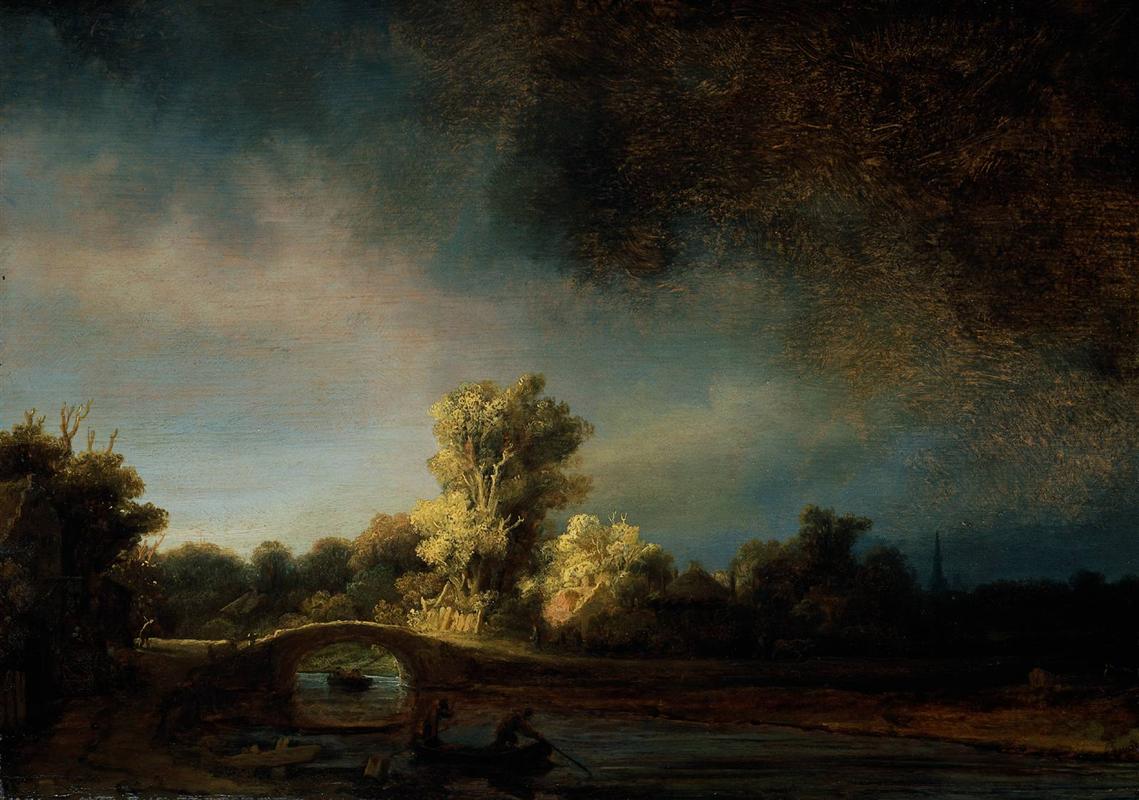
Rembrandt’s “The Stone Bridge” of 1637 is one of those landscapes that seem to inhale before they speak. A low arch spans a narrow river; small figures cross with the unhurried certainty of people who know the path by heart; a clump of trees rises like a living bastion at the far end; a solitary house nestles in their shelter. Over all of this, a sky churns. A massive, dark bank of cloud presses in from the right, leaving a luminous clearing around the trees and bridge, as if weather itself were framing the human world. The drama is not theatrical thunder and lightning; it is the moment just before the storm arrives—the hush when light grows thick, colors deepen, and sound seems to recede. Rembrandt catches that interval and makes it stand for more than weather. It becomes a meditation on passage, protection, and the fragile equilibrium between the ordinary and the overwhelming.
A Composition that Hangs on a Single Arc
The whole painting pivots on the modest arch of the bridge. It sits slightly left of center, low in the picture plane, allowing an enormous expanse of sky to dominate the upper field. That imbalance is intentional. By granting the heavens so much acreage, Rembrandt charges the small human structure with meaning: the bridge must hold against the weight of air and cloud. The arc itself is echoed throughout the scene. It is mirrored in the curved shoreline at the bottom, in the rounded crowns of trees, even in the sloping forms of the clouds that escort the eye toward the right. This orchestration knits the landscape into a single motion—the world rounds toward the crossing.
Light as Weather and Meaning
The most striking feature of the painting is its choreography of light. A cold, silvery illumination spreads across the mid-sky, then concentrates at the far bank, bathing the trees and the house in a halo that feels both meteorological and symbolic. It is as if a break in the cloud has opened just for this little village. The bridge’s crest is struck by the same light, while its underside drops into a dusky opening where a boat drifts. In Rembrandt’s hands, illumination is never mere description. It judges and it blesses. Here it blesses habitation—trees, path, roof—and it weighs the river and the approaching storm with gravity. The effect is a spiritualized naturalism: true to the Dutch weather yet tuned to a larger sense of providence.
The Bridge as Human Measure
A stone bridge is an economy of forces set in masonry. Rembrandt paints it as a simple, sturdy thing, old but confident in its span. People and animals move across it in miniature, their scale reminding us how small we are in the map of the landscape. And yet the bridge confers dignity. It is human intention made durable, a deliberate stitch across a divide. The low arch frames a patch of water and reeds on the far bank like a small lens. The passage beneath becomes a secondary world, a quieter current under the shared path above. Boats slide through that shadow as if choosing the slower, contemplative route while the walkers keep to habit. Both routes, Rembrandt implies, belong to a single livelihood.
A Sky That Thinks
The sky occupies almost two-thirds of the canvas and functions as more than backdrop. Its massive, dark right-hand mass crowds the picture, its surfaces brushed with circular, scumbled motions that give it a felt density. Toward the left and center, the air dilates into a pearly openness. This sky has psychology. It approaches, hesitates, and broods. Rembrandt’s brushwork makes the cloud not just a thing but a presence, like a thought passing over a mind. The relationship between sky and ground becomes a conversation: the land holds its familiar objects in place while the atmosphere tests their endurance.
Trees as Architecture
Rembrandt’s trees are not generalized green. They are bodies with posture and weight. The central grove stands like a citadel around the small house. He constructs the mass with layered touches—opaque leaves hit by light, darker interstices opening to shadow, trunks that step forward and recede. The primary tree, slightly right of the bridge, is posed like a figure: torso upright, limbs branching with credible rhythm. These trees do what buildings also do in Dutch landscape—they shelter, organize space, and declare a human center—but they remain living, porous to light and wind. Their crowns catch the last clarity before the storm curls over them.
The House as a Promise
The tiny house tucked among the trees glows with the pale pink of sunlit brick or tile. In a painting that otherwise restricts color to browns, greens, and chilled blues, that warmth reads as a promise. It does not dominate; it simply says that home exists here, and that the bridge does not lead to an abstract destination but to a threshold where lives unfold. Rembrandt avoids anecdote: no smoke puffs from the chimney, no figures wave from a door. The house is all implication, a focal punctuation mark in the sentence of the landscape.
Movement at Water Level
In the foreground, close to our own imagined feet, the river spreads into shallows. Two men kneel in a small boat, their dark silhouettes sketched against the glimmering water. Another craft hovers beneath the bridge’s arch. These figures are not focal in the way a narrative painter’s would be; they are part of the river’s grammar. They set a tempo for the scene, confirming that life persists regardless of the sky’s mood. The strokes that form the boaters are compact and sure, giving them the purposeful weight of labor rather than leisure.
The Palette of Earth and Weather
“The Stone Bridge” is built from a restrained palette that gives the painting its integrity. Earth colors—umbrous browns, moss greens, the warm notes of ochre—anchor the ground and trees. The sky pushes into blue-gray and leaden violets. The light across the trees has an almost enamel brightness, a pale, muted gold that refuses garishness. By resisting saturated color, Rembrandt preserves the scene’s credibility. The eye reads it as real weather and real soil. When a single small area warms—the house’s roof or the low bank under the bridge—the contrast feels deeply earned.
Brushwork that Shifts Gears
Stand close to the surface and the painting reveals multiple speeds of handling. The sky’s right-hand mass is worked with scumbled, circular strokes, the paint dragged and feathered so that it records gust and whirl. The left sky is smoother, thinly glazed, almost breathing. The foliage is dabbed and layered; the bridge is laid in with sturdier, descriptive touches; the water is pulled horizontally with a flat brush that creates ripples of paint as convincing as ripples of current. This orchestration of technique mirrors the orchestration of meaning: weather is restless, architecture is deliberate, plant life vibrates with small decisions, water slides.
Scale and the Intimacy of the Sublime
Rembrandt’s landscape is not monumental in the manner of later romantic canvases, but it courts a quiet sublime. The massive sky and the smallness of figures set up a scale contrast that suggests the implacability of nature without crushing human dignity. It is an intimacy of the sublime: we feel the pressure of weather not from a mountaintop or open sea but at a local bridge, the kind you cross to buy bread. That setting matters. It asserts that the profound occurs where people actually live.
Between Observation and Invention
There is no evidence that the bridge and grove represent a particular location, yet the image feels observed. Rembrandt saw real bridges and real clouds and real men in boats, then recomposed them into a scene with heightened coherence. He chooses a storm to bundle two truths: the Dutch sky’s mercurial theater and the painter’s penchant for moral chiaroscuro—light against dark, grace against risk. The painting’s credibility grows from that fusion. It is both a memory of weather and an argument about living under it.
A Landscape in a Portraitist’s Hand
Even when he paints land and sky, Rembrandt thinks like a portraitist. The bridge and trees receive the kind of attention he lavishes on faces—light placed to reveal structure, shadows used to thicken character. The dark bank of cloud encroaching from the right acts like a deep background in a bust-length portrait, pushing the subject forward. The landscape, in short, is treated as a sitter: watched, weighed, and given a psychology that we can read.
The Narrative You Complete
Rembrandt offers just enough human incident to spark a story and then declines to resolve it. Who are the men in the boat? Where are the figures on the bridge going? Will the storm break before they reach the house? The painting hands these questions to the viewer. By leaving them open, he keeps us in the suspended time that the sky already conjures—the interval in which decisions are made and meanings are inferred. It is a generous strategy. The painting does not dictate; it collaborates.
Sound and Temperature
Though paint is silent, “The Stone Bridge” is full of suggested sound: the muted plunk of an oar, the dull thud of a hoof on the planks of the bridge, the far rustle of leaves pulled by an incoming gust. You can almost feel temperature on your skin—the kind of chilly damp that comes before rain, balanced by the stored warmth of a wall that has held sunlight all afternoon. This synesthetic conviction grows from Rembrandt’s control of value and texture. The mind supplies sense impressions because the eye is so well fed.
The Moral of a Crossing
Bridges in art often carry metaphorical weight, and this one is no exception. It is a link between shores, yes, but also a hinge between weather systems, between work and home, between solitude on the water and company on the path. The bridge’s modest scale is the point. We do not live our lives on epic spans; we live them in manageable crossings repeated daily. Rembrandt dignifies that routine with the most serious tool he has—light. The arc glows in a world of deepening shadow, and the eye cannot help but read care into that emphasis.
The Dutch Eye for Land and Air
Seventeenth-century Dutch painters transformed landscape into a national mirror. Low horizons, broad skies, water as workplace—these motifs became a visual identity. Rembrandt stands slightly apart from contemporaries who specialized in topography or rural genre. He came to landscape with a dramatist’s instinct for moment and meaning. “The Stone Bridge” shares the national grammar—wet earth, navigable water, a church spire pricking the far distance—yet it subjects them to a more concentrated poetics. Where others catalog, he condenses.
The Distant Spire and the Horizon of Culture
Look to the far right and a thin spire pierces the dark horizon. It is a small stroke, easily missed, yet it matters. The steeple marks human culture persisting beyond the frame of the bridge community. It also introduces a vertical that counters the horizontal pull of river and cloud. In that single accent the local crosses with the civic, the present effort with the larger order of time. The painting locates us in a web of settlements without diluting the intimacy of the main cluster of trees and house.
A Lesson in Looking, Step by Step
Enter the painting at the lower edge where the river idles into shallows. Follow the boaters’ silhouettes as they work the water. Let your eye slide left to the under-arch where a second boat, half in shadow, heads toward light. Rise along the curve of the bridge, feel the rhythm of figures crossing, and then stand for a moment in the luminous space where path and grove meet. From that grove climb the trunk of the central tree, through the airy crowns, until you touch the cool clearing of the sky. Now allow yourself to drift right into the black, textured mass of cloud, its surface alive with circular brushwork, and sense the pressure that mass exerts on the scene you just traversed. Return to the house’s warm patch. That journey is the painting’s argument in miniature: passage through work and shelter under weather.
Technique and the Architecture of Paint
Rembrandt’s handling of oil is architectural. He lays underpainting to set the value map, then builds with glazes and impasto just where the eye needs a tactile cue. The gold edge of light on foliage is a slightly raised, warm brush; the bridge’s nearest parapet carries a fatter stroke to make the stone tactile; the water derives its sheen from thin paint dragged across darker underlayers. The sky’s dark right corner displays a rhythmic scrubbing that leaves circular internal eddies, evidence of the physical path of his arm. The technique never calls attention to itself at the expense of the scene, but it leaves a readable record for anyone who steps close.
Why the Painting Still Feels Present
Four centuries on, “The Stone Bridge” feels uncannily contemporary because it avoids pastiche and allegorical clutter. Its truth is observational and emotional rather than literary. Many modern viewers have experienced the same hour of weather—sun caught on trees while a storm shoulders in. The painting honors that common memory and gives it a tender grandeur. It suggests that the daily and the cosmic meet not in temples but on pathways and banks where people cross together.
Closing Reflection
“The Stone Bridge” is a small epic of ordinary life under a thinking sky. Rembrandt does not shout his meanings. He places light with care, he lets weather be weather, and he trusts a modest piece of architecture to carry the human story. In the sweep of the cloud and the glow on the trees, he gives us the scale of nature; in the boats, figures, house, and bridge, he gives us the scale of our own endurance. The painting holds those scales in balance, and in that balance we recognize the condition of our days: always crossing, always watched by the sky, always moving toward shelter.