Image source: wikiart.org
A Vigorous Head Caught in a Single Breath
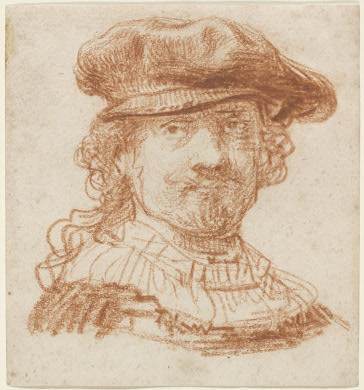
Rembrandt’s 1637 “Self-portrait” in red chalk captures a face that seems to have just turned toward us. The beret-like cap sits low, its soft crown bulging to the right; a cascade of curls breaks from beneath the brim; and a broad, square collar sets the head on a pedestal of fabric. The drawing is small, but it feels expansive because the artist’s line behaves like speech—quick, emphatic, and warm. No studio background is supplied and no symbolic accessories intrude. The paper is allowed to remain open, so the head appears to arise out of air, a presence made from pressure, speed, and restraint.
Red Chalk As A Language Of Warmth
The choice of red chalk matters. Its earth color suits the warmth of flesh and allows Rembrandt to move between whisper and proclamation without changing instruments. Pressed harder, the line glows dark and saturated, ideal for hat brim, mustache, and the shadow that rounds the cheek. Released, the chalk breaks into a granular softness that reads as skin and hair. The medium’s friable edge lets contours breathe. You can see the grain of the paper sip pigment along the slanted strokes of the collar, creating a lively drag that keeps the sheet from petrifying into diagram. Red chalk also encourages economy. Highlights are not added; they are spared. The face is modeled as much by what is left untouched as by what is drawn.
A Composition Built From Triangles And Arcs
The head, cap, and collar create a triangular scaffold that stabilizes the drawing. The cap’s low arc forms the composition’s top bar; the cheeks and beard sweep down to the collar’s squared platform. A series of counter-arcs prevents rigidity: the brim dips and lifts; the mouth curves within a soft shadow; the curls spring outward and then fall back toward the neck. These opposing motions animate an otherwise frontal pose. The rightward bulge of the cap draws the eye to the picture’s edge, then returns it along the collar’s bright plane to the face. Without a single background prop, Rembrandt keeps the gaze in fluent circulation.
A Face Constructed With Decisive Economy
Look closely at the features and the degree of finish across the sheet. The eyes are ovals quickly nested in shallow sockets, the upper lids heavier than the lower; a few short strokes suffice for brow and bags. The nose is a pair of planes that pivot along a firm bridge, stated with several darker hatches at the nostril and a swift indication of the wing. The mouth is written with a handful of strokes that compress and lift at the corners, forming a slight, knowing smile that is neither polite nor performed. Around these points of clarity, Rembrandt loosens his hand: the cheeks disperse into soft scribble, the mustache grows from elastic loops, and the lower beard is allowed to break into dry grain, leaving the viewer’s eye to complete what is only suggested.
Between Theatrical Mask And Private Glimpse
Rembrandt’s self-images of the 1630s often test expressions—surprise, haughtiness, laughter—like an actor before a mirror. This sheet occupies a middle ground. The beret and broad collar introduce a hint of studio costume, but the expression refuses melodrama. The gaze is direct without being confrontational; the mouth turns with restrained amusement. This is a man self-aware of his own image culture and simultaneously uninterested in mere display. The drawing’s candor makes it read as a private glimpse captured during a pause between more elaborate experiments.
The Cap As A Field For Touch
The cap is not an add-on; it is a theater for mark-making. Rembrandt builds the soft crown from long, gently arcing strokes that change pressure mid-line, creating a cushion of tone. The brim is a darker run that thickens where it casts the heaviest shadow on the forehead, then thins to a whisper at the temple. The cap’s pliant mass is the drawing’s largest shape, and by shaping it with such variety Rembrandt turns a simple hat into a test of how far a single stick of chalk can travel between breadth and edge.
Hair And The Pleasure Of Graphic Freedom
Curls are drawn with a joy that stops short of ornament. Short, looping strokes weave in and out of shadow, refusing to declare every ring. Instead, Rembrandt suggests directional movement—upward spring, outward flare, downward fall—allowing the viewer to experience hair as energy rather than inventory. Because the curls and cap brim touch the lightest and darkest notes on the sheet, they act as an acoustic frame around the face. The ear, barely indicated, recedes into this play, a modesty that keeps attention on the eyes and mouth.
Collar, Fabric, And The Architecture Of Presentation
The squared collar functions as a plinth for the head. Its bright upper plane, left mostly as paper with just enough hatch to turn its corners, throws light upward to the chin. Beneath it, a darker bib of strokes suggests a second layer of cloth that anchors the torso. This architectural handling of costume does not seek fashion detail; it aims to make the head legible. The collar’s lit expanse is a stage on which the face can perform without theatrical lighting.
Light That Rises From Paper
Instead of painting light, Rembrandt organizes it. The untouched paper becomes illumination where he declines to draw: the forehead’s center, the bridge of the nose, the top of the collar, the cheek’s forward plane. Shadows gather by accumulation of strokes rather than by wash, so the light feels internal to the sheet. It is a less dramatic, more truthful atmosphere than the spotlighting of his etched self-portraits. The effect is gentle and frontal, the luminous equivalent of a north window in the studio.
The Psychology Of The Gaze
The eyes meet ours with a directness that is neither self-promotion nor confession. There is confidence in the set of the brow and ambiguity in the small asymmetry of the eyelids. The mouth adds a note of wryness, as if the artist is assessing what the mirror gives him and is half-amused by the result. This psychology—alert, amused, unruffled—anchors the drawing’s tone. The sheet is a record of attention turned back on itself without anxiety, the look of competence resting within experimentation.
Speed, Correction, And The Trace Of Process
In places the chalk records hesitations. At the edge of the cap, a doubled line shows an early contour corrected by a firmer one; on the cheek, a light patch of hatching is overridden by a darker stroke that better states the shadow’s edge. Such palimpsests keep the drawing alive. They are the visible history of decisions, the evidence that the likeness is not a recipe but a found solution. If the earlier line softens the silhouette, Rembrandt leaves it; if it confuses the form, he clarifies with economy. Nothing is fussed into stillness.
Self-Representation In A Productive Year
The year 1637 finds Rembrandt flourishing in Amsterdam—busy with portraits, biblical etchings, and studies from life. This self-portrait in red chalk belongs to that industrious rhythm. It is not a stand-alone, gallery-ready work courting prestige; it is a studio instrument, light and portable, quick to deploy when a mirror and a quiet hour present themselves. The ease of the drawing matches a moment before later storms, when the pleasures of looking and the demands of the market were still in balance.
A Conversation With The Viewer
What makes the sheet feel current is its conversational stance. The sitter is close, cropped at the chest, as if leaning over a table we share. The blank background refuses to interpose narrative distance. The drawing seems to say: here I am, briefly, exactly as much as a few minutes of chalk can tell truthfully. That modesty invites trust. Standing before the sheet, you are not being sold a myth of the artist; you are being invited into an act of noticing.
The Line Between Type And Person
Because Rembrandt made many heads in costume—what Dutch artists called tronies—every self-portrait risks sliding toward type. This drawing resists that slide through the specificity of its features and the lived irregularity of its marks. The beret and collar could belong to a type; the mouth’s particular twist and the exact weight of the eyelids could belong only to this person, in this mood, at this instant. The tension between general costume and specific physiognomy is where the image’s energy sits.
Why The Image Feels Modern
Modern drawing prizes speed that can still tell the truth, economy that leaves space for the viewer, and evidence of process left visible on the surface. This sheet offers all three. The self-conscious staging of persona is secondary to the primary joy of mark-making. Even its small size contributes to contemporaneity: it demands intimate viewing, the kind of sustained attention that screens threaten to erode and that drawing, at its best, restores.
How To Look, Slowly
Start with the brim that pushes gently down on the forehead; notice how the pressure increases where the shadow is darkest. Follow the little ladder of strokes along the bridge of the nose to the tiny announcement of the nostrils. Move to the mouth and watch how three or four strokes become a living edge. Let your eye bounce through the curls to the ear’s ghost, then drop to the collar’s bright plane and the mesh of marks that hold it up. Retreat and feel the head resolve into a single, breathing mass. Repeat, and the drawing reveals a different inflection with each circuit, like a phrase reread for subtext.
The Ethics Of Restraint
Perhaps the deepest lesson of this sheet is the ethical one: knowing where to stop. Rembrandt refuses to grind the chalk into finish for its own sake. He leaves the background empty; he leaves parts of the collar unclosed; he leaves hair in lively shorthand. The restraint trusts the viewer and honors the moment. It recognizes that likeness is not a full inventory of edges but a living relation between marks and attention.
Closing Reflection
This “Self-portrait” proves how much intimacy can be forged from the simplest means. Red chalk, a few minutes’ concentration, a mirror, and a willingness to accept a truthful incompletion—out of these Rembrandt makes a head that still looks back at us with humor and poise. The drawing is both a study of the artist and a study of drawing itself: how line can become flesh, how paper can become light, how a face can be caught and released in the same gesture. It stands as a compact manifesto for a practice built on clarity, mercy, and the joy of seeing.