Image source: wikiart.org
A Quiet Blessing at the Heart of a Family
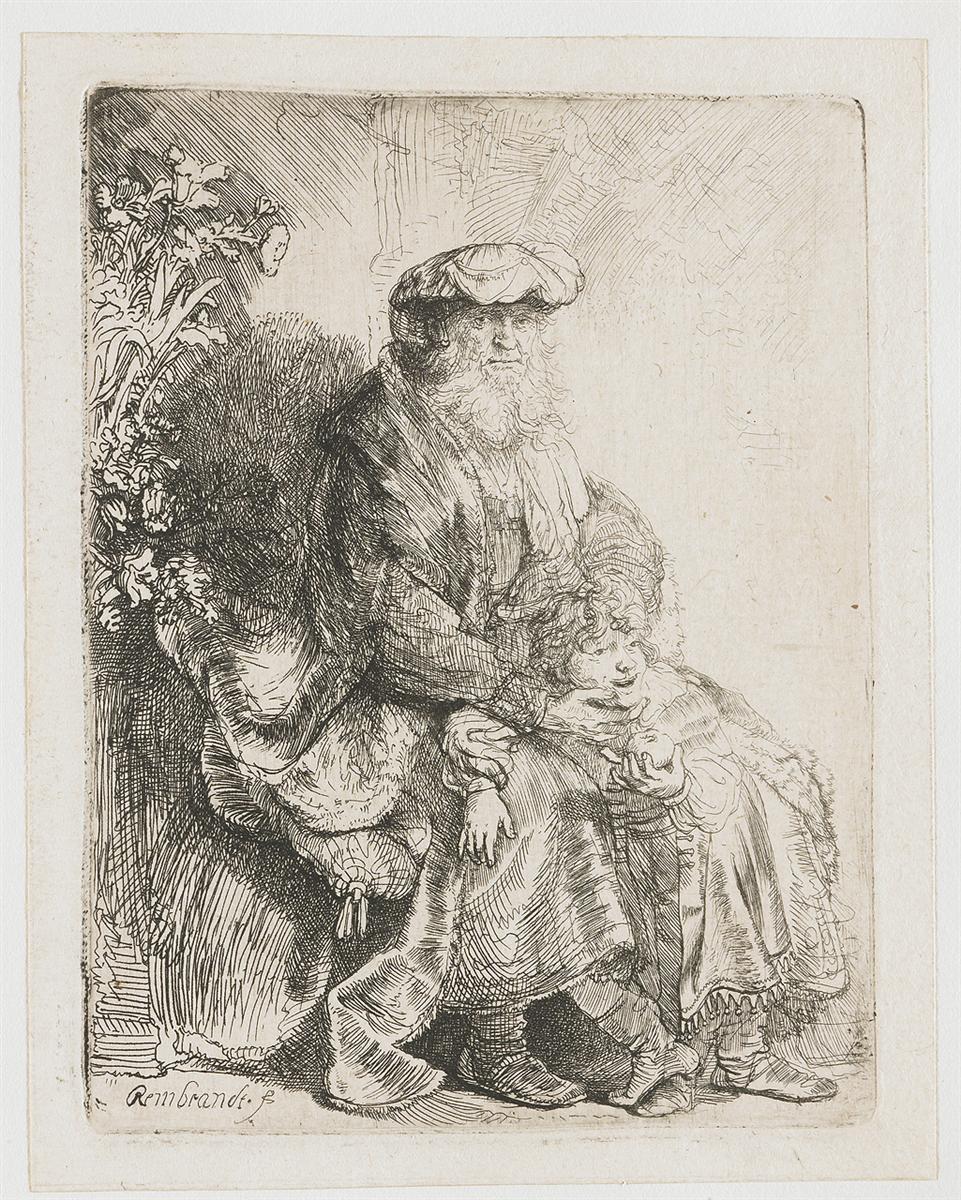
Rembrandt’s “Jacob Caressing Benjamin” from 1637 stages a moment of biblical tenderness with the scale and intimacy of a domestic scene. An elderly patriarch sits wide and heavy in his chair, beard flowing over his chest, turban resting on his brow. Leaning into him is a child wrapped in patterned cloth, face turned up and slightly outward while Jacob’s arm gathers him close. The left edge is crowded with foliage and a woven texture that suggests upholstery or a hanging; the right dissolves into the spare air of the room. Light settles over the pair like a hush. The image belongs to the larger narrative of Jacob’s late-life reunion with his sons, yet the etching refuses pageantry. It narrows the story to touch—hand at shoulder, cheek against robe—so that consolation becomes the subject.
The Biblical Moment and Its Human Scale
In Genesis, Jacob’s sons persuade him to allow the youngest, Benjamin, to accompany them to Egypt, where Joseph—unknown to them as the powerful official they face—will eventually reveal himself. Throughout this family drama, Benjamin is the beloved child of Jacob’s old age, reminder of Rachel and emblem of a promise nearly lost. Rembrandt selects not the revelation scene or a feast but a quiet interlude in which Jacob’s affection gathers like a shelter. The narrative’s stakes—famine, diplomacy, recognition—recede. What remains is the human scale of care: an old man who knows he must let go, and a boy who senses both privilege and peril.
Etching as a Language of Intimacy
The print’s medium—etching enlivened with a variety of hatchings and cross-hatchings—suits its subject. Etching allows the hand to move like drawing, sensitive to pressure and minute turns of form. Rembrandt employs striated fields of short lines to build tone that never feels mechanical. The darker weave behind Jacob activates the left half of the plate, pushing the figures forward. The faces are treated with the lightest touch, reserving more open paper so that expression emerges as breath rather than mask. The technique’s humility is crucial: the scene is not carved in marble; it is spoken in a warm whisper of line.
A Composition That Cradles
The largest shape on the plate is Jacob’s robe, a heavy, triangular mass that flows groundward and then back under the chair. It is both garment and architecture, the sheltering volume within which Benjamin rests. The child’s body forms a softer triangle that tucks into the elder’s. Between them, a river of light runs along the boy’s cheek and hand and across the old man’s forearm, binding the forms into a single figure of embrace. The diagonal of Benjamin’s legs, feet braced at different angles, introduces a liveliness that keeps the group from congealing into stillness. Space compresses leftward into foliage and fabric while opening to the right. That asymmetry grants the pair breathing room: we feel air around them rather than a stage crowded with props.
The Faces and the Ethic of Restraint
Rembrandt refuses theatrical pathos. Jacob’s eyes are heavy lids over darkened sockets; the mouth is soft, not clenched; the beard flows with unhurried strokes. Benjamin’s face, touched by a few careful lines, carries an alert quiet—the look of a child who knows he is loved and who also understands that the moment matters. There is no rhetorical grief, only inwardness. The etching’s power lies in that restraint. It trusts the viewer to supply feeling from the truth of gesture rather than from amplified features.
Gesture as Narrative
The story is told by hands. Jacob’s right hand, set firmly around Benjamin’s shoulder and neck, is protective without being possessive. The child’s hand rests on his father’s forearm, a reciprocal touch that confirms he is not a passive recipient but a participant in the embrace. Rembrandt often builds meaning from small articulations of fingers and wrists; here, the hands speak of recognition and permission. The gesture honors both attachment and the necessity of release.
Light That Reveals and Blesses
Illumination descends from above, slanting slightly left to right. It is strongest on Benjamin’s cheek and sleeves, then runs along the crest of Jacob’s robe and beard. Behind them, Rembrandt lets a corona of open paper glow like a pale halo—interpretable as literal light from a window or as the quiet aura that contact creates. The darker field at left and beneath the chair grounds the pair without turning the scene dour. Light here is not theatrical judgment; it is the gentle clarity that falls on those who sit near a window talking low in the afternoon.
Costumes That Carry History
Jacob wears the “Oriental” wardrobe—turban, heavy mantle, patterned fabrics—that Rembrandt employed to give biblical time a timeless attire. Benjamin’s robe is trimmed and layered, yet not ostentatious. The richness of clothing adds a ceremonial register to the intimacy: this is not any old grandfather and grandchild, but the bearer of a covenant and the son who will carry it forward. Fur, woven texture, and tassels are drawn with relish, yet always subordinated to the faces and hands. Detail asserts the gravity of the moment without drowning it.
Foliage as Frame and Counterpoint
At the left margin, a brimming cluster of leaves and flowers springs up next to the chair. This living border has several jobs. It anchors the composition with patterned darkness; it introduces a natural counterpoint to the heavy textiles; and it hints at a world beyond the domestic chamber. Its upward thrust balances the seated weight of Jacob. In Rembrandt’s prints, such vegetal margins often act like a chorus—silent but expressive—adding season and growth to scenes of human choice.
The Chair as Stage and Anchor
The chair is both furniture and platform. Its curved back receives the elder’s shoulders; its seat supports the dense fall of robe and the kick of the boy’s feet. Rembrandt describes the chair’s structure only where necessary, letting much of it dissolve into the web of crosshatching. This is typical of his approach to props: they exist to help bodies speak. The lower left corner, where a few crisp strokes mark a base or step, prevents the group from floating and reinforces the sense that the figures occupy real weight in space.
A Rhythm of Textures
The plate orchestrates a pleasing alternation: foliage, fur, satin, hair, bare skin, then fabric again. Each material receives a specific graphic vocabulary. Fur is splayed, errant strokes; silk is smooth hatching that curves; hair is short, looping lines; skin is minimum line supported by the light of the paper. This rhythm lends the small print a tactile richness that keeps the eye moving and renews attention with each pass. Textural differentiations also underscore the scene’s meaning—soft things meet, hard things recede.
The Child’s Body as Energy
Benjamin is not a decorative appendage. His posture carries narrative. Leaning inward, one knee cocked, feet active in different directions, he is kinetic even at rest. The slight twist in his torso and the tilt of the head convey the child’s alertness. Children in Rembrandt’s prints often function as dynamo and mirror; here the boy’s energy meets Jacob’s gravity to form a single, balanced figure of care.
The Psychology of Near-Profile
Rembrandt seats Jacob in a near-profile that preserves privacy. We see enough of the face to read mood but not enough to intrude. Benjamin’s face, by contrast, turns more toward us, though still protected by his father’s arm. This differential visibility mirrors the narrative: the elder, who has borne much, holds inward; the boy, who is the promise of the future, faces outward. The composition stages generational time in the architecture of heads.
Print Variability and Atmosphere
As with many of Rembrandt’s etchings, impressions of this plate can differ depending on plate tone and inking. With more plate tone left on, the background can thicken into a dusky atmosphere that makes the figures glow like embers; with a cleaner wipe, the scene breathes like cool morning light. This variability is not accidental. It is part of the medium’s life and deepens the image’s expressive range. In every state, the clarity of the embrace persists.
A Domestic Theology
The print is a small theology of touch. It suggests that blessing is not an abstract formula but an act that passes through bodies—hand to shoulder, cheek to sleeve. Jacob’s blessing of his sons in Genesis later becomes formal and prophetic; here it is physical and preparatory. Rembrandt understands scripture as a sequence of human moments in which grand covenants are carried by ordinary gestures. By focusing on this embrace, the print argues that spiritual significance is lodged in daily tenderness.
A Dialogue with Other Family Scenes
Rembrandt’s oeuvre is rich with images of parents and children, elders and infants, households at thresholds. “Abraham Dismissing Hagar,” made the same year, shows a parting; “The Return of the Prodigal Son,” painted decades later, shows a reunion. “Jacob Caressing Benjamin” sits between these poles. It is neither departure nor return but the maintenance of bond before the test. Its quiet is both respite and preparation, a pause that preserves courage for what comes next.
The Ethics of Looking
The print’s intimacy demands an ethic from the viewer. We stand close—close enough to see the curl of a tassel and the fold of a child’s shoe—yet we are asked to observe without prying. The openness at the right margin acts like a respectful distance, an area of air we should not cross. Rembrandt often teaches his viewers how to look by how he composes. Here he composes for compassion: approach, attend, do not intrude.
Time Made Visible
Time is present in the plate as layered duration. The old man’s beard and wrinkles tell of years; the child’s restless limbs promise years to come. The soft crossing of hatches across wall and chair is the time of the etching itself—the minutes and hours of the artist’s patient work. These times meet in the simple act of a caress. The print suggests that such acts are where human time is most fully lived.
Why the Image Feels Contemporary
Despite costume and biblical title, the scene reads with modern ease. In a world that often measures significance by spectacle, the print argues for the gravity of small acts—a grandfather and child in a chair, the weight of a hand, a window’s light. Viewers today recognize the truth of such moments as the substance of family life. The plainness of the setting, the exactness of the textiles, the dignity of age and youth together—these remain legible and moving across centuries.
A Lesson in Looking, Step by Step
Begin at the left edge, where flowers and foliage climb the border. Let your eye track the curve of the chair and the dark cushion that seems to remember the shape of bodies. Move to Jacob’s turban and the soft spill of his beard, noting how the lines loosen into downy edges where light strikes. Drop to the crossing of hands, then follow Benjamin’s sleeves, the sparkle of his patterned hem, and the opposing angles of his shoes. Drift into the bare space at right and feel the relief of it before returning to the center. Each circuit tightens your sense of the embrace’s truth.
Closing Reflection
“Jacob Caressing Benjamin” distills a complex biblical saga into a scene anyone might recognize: an elder’s blessing, a child’s trust, the light of a room. Rembrandt orchestrates everything—composition, texture, light, gesture—so that the etching breathes with humane intelligence. It neither preaches nor poses. Instead it invites us to witness the sacrament of care in ordinary touch. The print suggests that the bonds we form in quiet rooms are the architecture of our stories, the foundations on which departures and returns will later stand.
