Image source: wikiart.org
Introduction
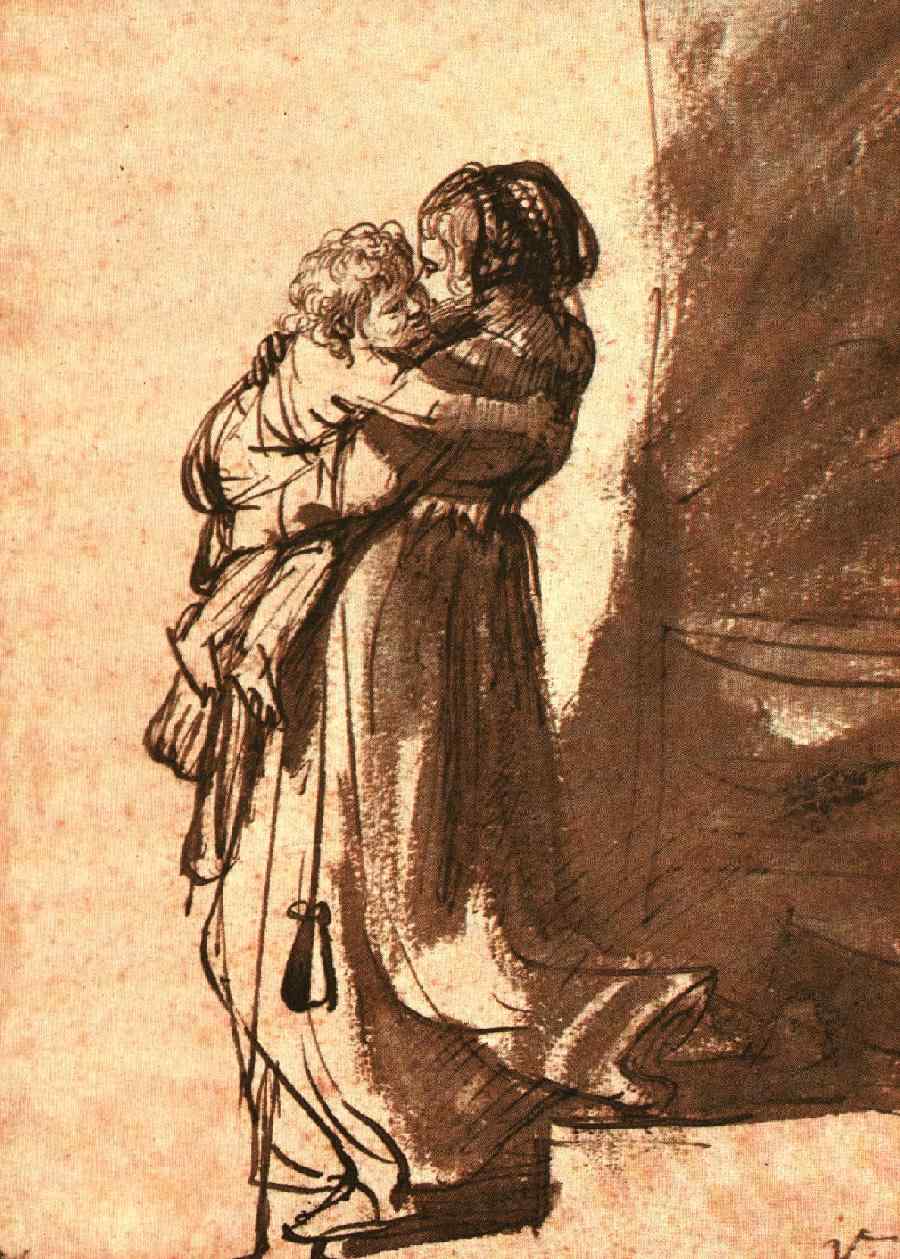
Rembrandt’s “Woman Carrying a Child Downstairs” (1636) is a small but astonishing sheet in which ink line and brown wash turn an everyday descent into a scene of gravity and tenderness. The woman presses a curly-haired child to her shoulder as she negotiates the final steps of a staircase. The setting is barely articulated: a dark vertical mass on the right hints at the stairwell, while the ground at their feet registers as a few assertive strokes. Yet in this modest constellation of marks Rembrandt captures motion, weight, breath, and the invisible force of care that binds the two figures together. The image is domestic and devotional at once, a study that reads like a finished poem.
The Subject And Its Human Core
At the center of the sheet is the transfer of weight from stair to floor, from the precarious to the secure. The woman bends slightly forward, her arms wrapping the child into the curve of her chest. The child’s face nestles into her neck and cheek, the mouth soft with relief. Nothing overtly dramatic happens, yet the drawing vibrates with feeling. The step downwards is a liminal moment—neither in the stairwell nor fully in the room—and Rembrandt uses that in-between state to illuminate the essence of caregiving: the adult’s responsibility to bear another’s weight until balance is recovered.
Economy Of Means And Abundance Of Meaning
The sheet is an education in how little is required to say a great deal. The contours of the woman’s robe are drawn with a confident reed pen, the line sometimes broken to imply light, sometimes thickened to suggest shadow. Over this scaffolding Rembrandt lays transparent washes that pool in the folds, creating volume with three tones at most. The child is even more sparingly described—tufts of curls, a few strokes for the shoulder, a shadow under the legs—yet the personality is unmistakable. The minimalism is not a lack but a discipline; by withholding detail, Rembrandt compels our eyes to complete the gesture, and in that act of completion we participate emotionally in the scene.
Chiaroscuro As Stagecraft
Although executed in drawing media, the image relies on the same play of light and shadow that powers Rembrandt’s paintings. A dark wash occupies the right third of the sheet, reading as the shadowed interior of the staircase and the wall beyond. Against this depth the figures gleam, their outlines catching an imagined light from the left. The contrast isolates them as if on a small stage. The effect is twofold. It clarifies the spatial situation—emergence from darkness into light—and it assigns meaning to that emergence. The descent becomes also a passage from risk to safety, from night to day, from anonymity to the intimate visibility of the home.
The Language Of Drapery
Rembrandt’s line is never more eloquent than in drapery. The woman’s garment falls in long, fluted rhythms that swell at the hip, cluster near the knees, and break into brisk, calligraphic tails around the hem. These folds do more than dress the body; they narrate it. The compression of cloth at the child’s back communicates the tightness of the embrace. The long diagonal fold that flows from the shoulder to the hem signals movement down and forward. Tiny hook-shaped accents at the elbow and wrist confirm a grip that is firm but careful. In Rembrandt’s hands drapery becomes body language.
A Composition Built On Curves And Counters
The composition is a dialogue between roundness and restraint. The woman and child fuse into an ovoid mass, a single protecting curve. That unity is pressed gently against the vertical edge of the stairwell’s shadow, a planar counterweight that prevents the figure from drifting and emphasizes the physical fact of the environment. The small ledge or final step underfoot, indicated by a couple of assertive strokes, acts like a fulcrum for the whole picture. Because the picture is so reduced, every line carries structural responsibility; remove one and the unity would loosen. This economy yields unusual clarity: we feel exactly how space, body, and motion interlock.
Movement Suspended And Released
Rembrandt arrests the descent at a precise instant—one foot likely still higher on the stair, the other feeling for the floor. The robe’s hem curls as if winded by motion, and the vertical push of the child’s back collides with the woman’s horizontal shoulder, producing the tight embrace that stabilizes them both. The figures are caught between a downward trajectory and a pause to secure the child. Viewers sense that the next beat will relax into a standing posture and perhaps a murmured word to soothe the child. That sense of imminent release creates emotional suspense more powerful than any theatrical gesture.
Intimacy Without Idealization
The mother—or nurse—has strong forearms and a practical garment. Her hair is gathered in a cap; there is no ornamental distraction. Rembrandt’s refusal to idealize grants dignity to the work of carrying, calming, and guiding. The child is not cherubic but real—heavy, perhaps cranky, seeking the reliable curve of the adult’s neck. This truthfulness anchors the drawing in lived experience, showing the artist’s attention to the domestic theater of seventeenth-century Amsterdam, where staircases were steep and children had to be navigated down them daily. By refusing to smooth away strain, Rembrandt exalts care as a form of strength.
The Staircase As Symbol
Though barely indicated, the stair is a loaded metaphor. Stairs signify transition, and in biblical and vernacular art alike they often imply moral ascent or descent. Here the movement is downward, but not in a pejorative sense. It is a descent into the ordinary world where duties are met. Rembrandt turns the stair into a sacramental threshold: to cross it is to accept the call of the everyday with love. The dark mass at the right is not a menace but a reminder that the path of care often emerges from shadow, from nights of broken sleep and rooms where worries collect.
Drawing As Thinking: The Study’s Purpose
The sheet likely functioned as a study from life or imagination, a place for Rembrandt to test the geometry of embrace and the silhouette of two bodies moving as one. Many of his paintings and etchings depend on the legibility of such silhouettes in larger crowds. By rehearsing a mother and child in this simplified environment, he perfects tools—overlapping contours, weighted folds, clipped highlights—that he will deploy in biblical scenes where compassion must read instantly. The drawing thus offers a window into the artist’s process: he discovers meaning through the hand’s direct negotiations with paper.
Psychological Depth In A Few Strokes
Look at the faces: the woman’s head tilts slightly, nose pressed near the child’s curls, mouth absent in shadow, eyes suggested by two short strokes. The child’s profile is merely a soft curve with a faint line for the eyelid. Yet we feel their minds. The woman concentrates on balancing and soothing; the child yields, attaching to the one secure thing in the world. The exchange is not just physical; it is a communication of trust. Rembrandt’s genius lies in how sparingly he renders the features while fully summoning the psychological weather they contain.
Light As Tender Pressure
The wash that rides along the woman’s back and the child’s shoulders is warm and buoyant, pushing the figures forward into the paper’s unpainted space. That light feels like a hand at the back, the world’s gentle pressure assisting a difficult task. Because the light is mottled and not perfectly smooth, it keeps a lived texture, the way daylight filtered through a stairwell window would flicker over stone and cloth. The atmosphere is therefore not theatrical but inhabitable; viewers remember similar light on their own staircases and are surprised to find their memories warmed by it.
The Ethics Embedded In Gesture
The drawing also articulates an ethics. To carry another is to accept asymmetry: one body takes strain so the other can rest. The woman’s posture broadcasts this asymmetry without complaint. Her torso leans forward, absorbing the child’s mass; the child’s limbs are tucked in, relying fully on her. Rembrandt records this contract without sentimentality. The beauty lies not in perfection or stillness but in distribution—the just sharing of strength in a moment of need. It is a vision of society in miniature, a proposal that care is the measure of grace.
Connections With Rembrandt’s Broader Oeuvre
Across the mid-1630s Rembrandt repeatedly explored parent-child bonds and threshold moments: “A Woman with a Child Frightened by a Dog,” “A Nurse and an Eating Child,” and “Abraham Caressing Isaac” share the same trust in the eloquence of small acts. In paintings such as “Tobias Cured With His Son,” this trust deepens into theology. The present drawing belongs to this constellation. It strips away narrative scaffolding to isolate the core gesture from which larger scenes grow. The intimacy here is the seed of later monumental tenderness.
Material Presence: Paper, Pen, And Wash
The sheet’s slight tooth catches the ink differently in firm and gliding strokes, making the line read as lived rather than mechanical. Where Rembrandt drags a nearly dry brush, the wash breaks into grain that suggests the nap of cloth and the roughness of plaster. He does not correct or fuss; he allows accidents to become evidence of touch. The paper’s warm tone partners with the brown wash to generate a humane palette of creams and umbers. Even at this scale, the materials carry a bodily sense—the moisture of wash, the scratch of nib—mirroring the physicality of carrying a child.
The Viewer’s Position And Vicarious Balance
We stand slightly to the left and below, as if waiting at the base of the stairs with our hands half-raised to help. That vantage is crucial. It inserts us into the moral space of the drawing, giving us a role as potential assistants or witnesses. The distance is intimate but respectful; we are close enough to feel the transfer of weight, far enough not to intrude. Rembrandt often composes from the point of view of a sympathetic onlooker, and the strategy works again here, implicating the viewer in the economy of care.
Time As Touch
Rembrandt’s drawings frequently register time not with clocks but with repeated strokes. In this sheet, faint retracings around the woman’s hands and the child’s shoulder indicate small adjustments—the way one might reposition a grip while stepping down. These micro-corrections create a sense of lived time inside a single image, approximating the rhythm of the descent. The viewer’s eye relives the seconds with the figures, and the drawing becomes not just an image but an experience.
Domesticity As Sacred Ground
By the 1630s Dutch artists had developed a finely tuned visual language for domestic life. Rembrandt shares that culture but inflects it with spiritual resonance. The staircase, the plain robe, the unadorned space—all belong to the world of households. Yet the gravity with which the figures are treated, and the light that greets them, dignify the ordinary as a place where meaning condenses. There is no need for emblematic props or inscriptions; the sacrament is in the embrace itself. The drawing suggests that the way we lift and hold one another is a measure of the divine in the world.
Why The Image Still Works
Part of the sheet’s enduring power is its modest scale. It feels like something you could keep folded in a pocket, a private icon for moments when care is tiring and patience thin. The image teaches without preaching: it shows that steadiness can be beautiful, that moving through thresholds with another’s weight in your arms is an art worth practicing. The open areas of paper invite us to place our own stairwell, our own room, around the figures. In doing so, we recognize ourselves in the scene and the scene in ourselves.
Conclusion
“Woman Carrying a Child Downstairs” demonstrates how Rembrandt turns a few ounces of ink and wash into a universe of empathy. The drawing’s economy amplifies its tenderness; its chiaroscuro clarifies both space and meaning; its lines translate physics into feeling. We do not simply see a woman and child; we feel the shift of balance, the warmth of closeness, the quiet relief of arriving safely at the bottom step. The image honors the unspectacular heroism of daily life and affirms that the smallest descents can contain the greatest care.