Image source: wikiart.org
Introduction
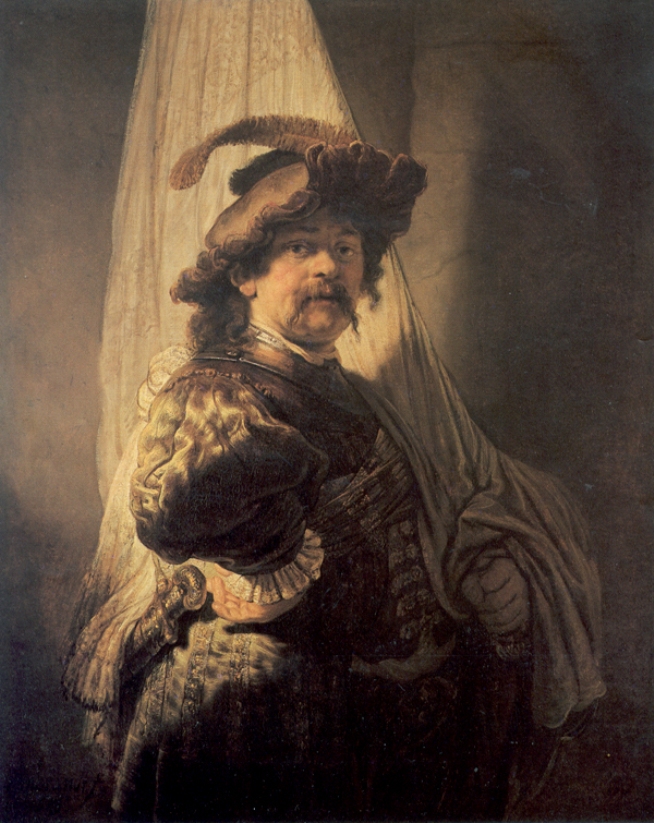
Rembrandt’s “The Standard Bearer” from 1636 seizes attention with the swagger of a man stepping from shadow into fame. Painted at the moment the young master had established himself in Amsterdam, the portrait dramatizes the martial pride and civic spectacle that animated Dutch society during the Eighty Years’ War’s afterglow. A militiaman thrusts his arm to his hip, turns toward us, and catches the light with a face equal parts bravado and curiosity. The satin brocade of his sleeve roils like surf; a great feathered hat crests over his brow; a white banner rises behind him like a luminous stage curtain. The painting is less a stiff record of uniform than a living theater of fabric, flesh, plume, and light—Rembrandt’s declaration that portraiture could carry the charge of history painting.
Historical Setting And Civic Identity
In seventeenth-century Holland the civic guard—the schutterij—was both an instrument of defense and a fraternity of status. Commissions for schutter pieces offered painters prestige and patrons visibility. The standard bearer occupied a prized role within that hierarchy: the keeper of the ensign that rallied the company and symbolized its honor. Rembrandt chooses not to paint a full group but to isolate the emblematic figure, thereby distilling the ethos of the militia into one man’s persona. The dating situates the work among Rembrandt’s early Amsterdam triumphs, when his handling of costume pieces, tronies, and historical subjects dazzled audiences hungry for pictures that joined virtuoso surfaces to psychological presence. “The Standard Bearer” stands precisely at that intersection.
A Stage Of Light
The composition is architected as an unveiling. A pale standard sweeps diagonally across the backdrop, its vertical fall interrupted by a gentle billow that reads like a theater drape. From the right creeps a wall of rich shadow. The figure emerges at the seam between these two fields, his face and sleeve catching a honeyed light that seems to glance off metal and lace before sinking into velvet darkness. Rembrandt arranges light not merely to describe but to narrate: illumination becomes action, as if a spotlight has just struck the protagonist stepping forward to salute the viewer. This orchestrated entry gives the painting its rhythmic confidence.
Costume As Character
Rembrandt revels in costume while refusing to let it smother the person inside it. The hat, with its flamboyant ruff of felt and streaming feather, magnifies the sitter’s head like a heraldic crest. The slashed sleeve, puffed and embroidered, is worked in passages of impasto and glazes that simulate the restless play of satin; the cuff’s lace is flicked into being with short, decisive strokes; the breastplate gleams quietly under the layered textiles, reminding us that this pageantry answers to real military memory. Ornament becomes biography. We learn that the bearer’s pride is inseparable from the garments he wears—garments that gesture to the entire civic company and to a republic that identified itself with disciplined display.
The Gesture Of Authority
The pose makes the painting. The sitter anchors his right fist at the hip and twists slightly so that the torso forms a subtle S-curve, a classical contrapposto translated into baroque swagger. The left hand, half-veiled by the hanging folds of the standard, bunches fabric near the banner’s staff—an action that is both practical and symbolic. To hold the flag is to grasp the image of communal honor; to clutch it with such directness is to own that honor publicly. The abdominal twist tightens the belt and compresses the patterned doublet, creating a kinetic tension between rigid armor and mobile cloth. Rembrandt composes these counterforces so that the eye keeps circling: face to sleeve, sleeve to hand, hand to banner, banner back to face.
Face, Flesh, And Psychological Charge
What keeps the bravura textiles from stealing the scene is the living intelligence of the face. Rembrandt sets the eyes slightly asymmetrical, with the right eye—our left—more directly engaged and catching a sharp reflection, while the other sinks a touch deeper under the brim. The mustache and small beard carry warm notes that answer the sleeve’s sheen; the cheeks blush with a diffuse warmth that softens what might otherwise be a strictly martial portrait. The expression reads as a blend of pride, readiness, and a hint of amused self-awareness, as if the sitter recognizes the theatricality of his own attire. It is precisely that tension—between role and person—that gives the portrait its modernity.
The Standard As Luminous Architecture
Unlike many portraits where a banner would be a mere prop, here it becomes an active architectural element. The pale fabric is laced with cool glazes and milky highlights to create a luminous field that both frames and reflects the figure. In places, Rembrandt’s brush thins the paint so the ground breathes through, making the cloth feel translucent; in others, he loads the surface, giving the sense of weight and weave. The banner’s scalloped lower edge and minute lacework at its seam echo the sitter’s ruff and cuff, creating a visual rhyme between public emblem and private adornment. The standard thus reads as the larger body of the militia echoing in miniature within the man.
Chiaroscuro And The Performance Of Depth
Rembrandt turns chiaroscuro into a performance. Notice how the right background recedes almost to black, allowing the hat’s rim to dissolve into the void and the shoulder to push forward with relief-like force. The left half of the panel, by contrast, is aerated by the pale standard. This yin-yang of dark and light does more than shape volumes; it enacts the sitter’s passage from backstage to stage. The gradations are gentle, avoiding melodramatic spotlighting. Instead, the light slides over surfaces, gathering at protrusions—nose, knuckles, cuff—and drifting into the hollows with a smoked softness that feels tactile. It is this atmospheric finesse that keeps the portrait grand while registering every tremor of complexion.
Materials And Painterly Execution
The surface is a compendium of Rembrandt’s early technical confidence. The satins are built from layered glazes over warm underpaints, then enlivened with scumbled lights that pick out creases and nap. The metallic elements of the baldrick and breastplate are dappled with tiny catches of thick paint; the feather is tracked with calligraphic arabesques that shift from crisp tip to vaporous fray. Along the cheek and nose, tiny touches of impasto give the sense of living skin, while the hat’s felt is handled with dry, dragging strokes that produce a matte contrast to the sleeve’s gleam. The painter’s hand is everywhere, but always in the service of the illusion that these materials exist before us under real light.
Iconography Of Rank And Virtue
The standard bearer’s accoutrements were legible to Rembrandt’s contemporaries. The sash or baldrick across the chest, the ornamented sword hilt near the waist, the decorative knots and buttons, and the scoop of lace at the wrist signaled not only rank within the guard but economic standing and taste. Though the militia’s wartime urgency had waned, the virtues it advertised—courage, vigilance, solidarity—remained civic ideals. By rendering these symbols with persuasive authority, Rembrandt aligns the sitter with those virtues while also suggesting the theatricality inherent in their display. The painting honors the role yet acknowledges the performance aspect of public identity.
Dialogue With The Artist’s Other Works
“The Standard Bearer” converses with Rembrandt’s tronies of soldiers and orientalized figures from the same decade, where he used exotic costume to experiment with light and character. It also anticipates the choreography of figures in “The Night Watch” (1642), another meditation on civic guard spectacle and the power of light to organize narrative. In both, Rembrandt transforms paraphernalia into portals: the viewer reads through fabric and armor into the moral temperature of the person. The standard bearer’s commanding gesture can even be seen as a solo rehearsal for the ensemble theatrics of the later masterpiece.
The Viewer’s Position And Impact
Rembrandt places us slightly below eye level, as if we stand on a pavement while the guard passes in review. The sitter turns into our space and claims it; his elbow projects, his belt’s clasp glints, and the feather arcs outward like a conductor’s baton. This calculated invasion collapses the distance between artwork and spectator. We do not merely observe a uniform; we are intercepted by a personality performing a role. That encounter activates the painting’s psychology: we feel the pressure to respond—admiration, skepticism, curiosity—and thus become part of the portrait’s theater.
Masculinity, Performance, And Self-Fashioning
Seventeenth-century Dutch masculinity often expressed itself through public service and mutual oversight within guilds and militias. The sitter embodies that ethos, but Rembrandt complicates it by staging the moment as self-fashioning. The flamboyant hat and languorous feather, the right hand planted in a pose of confident ease, the slight smile—all suggest a man aware that identity is crafted, not merely worn. Rembrandt refrains from caricature; his subject does not become a dandy. Instead, the picture acknowledges that civic virtue and personal vanity coexist, and that portraiture is the art of balancing the two without moralizing.
Color And Atmosphere
Although the painting may read at first as a play of golds and browns, its palette is finely tuned. Warm umbers and siennas structure the flesh and textile shadows; cooler gray-greens and bluish notes whisper through the satin and steel; soft creams shape the banner; embers of red flicker at the lips and knuckles. This chromatic restraint ensures that the drama of light, not chroma, carries emotion. The atmosphere, achieved through veils of glaze, is dense but breathable, a suspended dusk in which every surface glows from within rather than reflecting a harsh source.
The Banner’s Lace And The Painter’s Signature Touch
Rembrandt includes a delicate lace along the banner’s edge—a riff on the lace at the wrist and collar—that functions like a painter’s signature in motif. Lace, a product of craft and patience, mirrors Rembrandt’s own labor; it also speaks to the interdependence of civic prosperity and artisanal skill in Amsterdam. The lace’s pale intricacy pulls the eye upward and softens the compositional diagonal, preventing the banner from slicing the space too abruptly. Such small orchestrations reveal how carefully Rembrandt calibrates ornament to sustain pictorial harmony.
The Economics Of Splendor
Portraits of militia officers and standard bearers were as much about marketing as memory. They signaled the patron’s wealth and civic reliability to peers and business partners. Rembrandt leverages this economy of splendor to explore painting’s own value proposition. He gives the sitter magnificence, but he also gives viewers an argument for why paint matters: only brush and glaze can make satin shiver like living fabric, only pigment can coax flesh to breathe under a brim’s shadow. The work is a demonstration that artistic virtuosity is itself a civic resource, making visible the virtues the republic cherished.
The Tactility Of Presence
Stand close to the sleeve and you sense the weight of the cloth; the ridges of paint catch light like threads. Step back and that tactile event condenses into sheen. This oscillation between matter and illusion is Rembrandt’s signature gift. It’s the engine of empathy: the more convincingly the materials of a life are rendered, the more available that life becomes to our imagination. In “The Standard Bearer,” tactility is not a decorative extra; it is the mode by which pride, duty, and self-consciousness are made tangible.
Time Suspended
Rembrandt arrests a moment pregnant with movement. The bearer seems about to pivot, to signal, to lead a procession into view. The banner hardly flutters, as though breathing in before the music begins. That poised temporality saturates the painting with anticipation; it’s a portrait that points beyond itself to an event we sense but do not see. Such suspended time lends the sitter an aura of command: he is a hinge between stillness and action, ceremony and history.
Afterlives And Reception
Works like “The Standard Bearer” helped cement Rembrandt’s reputation as the painter who could make civic identity feel epic without sacrificing individual humanity. Collectors prized these portraits for their bravura surfaces; artists studied them for their lessons in light; historians read them for clues to the social grammar of the Dutch Republic. The painting’s afterlife includes its dialogue with Rembrandt’s later darker, rougher manner—here the surfaces remain relatively smooth and the light clear, capturing the fresh confidence of the 1630s.
How To Look Today
A fruitful way to read the painting is to track its diagonals. Begin at the lower left cuff, with its froth of lace and glint, then move upward through the swelling sleeve to the face. From there, let your eye ride the feather’s stroke to the banner’s crest, then sink along the pale fabric to the fist gripping cloth. Return across the belt’s ornaments to that first cuff. This circuit reveals how Rembrandt loops us through a choreography of textures and gestures, renewing our encounter with the person at every turn. Notice, too, how the face never loses its hold even when the sleeve’s bravado threatens to dominate; the human remains sovereign.
Conclusion
“The Standard Bearer” is a compact epic of identity. In one figure, Rembrandt gathers a city’s pride, a company’s honor, a craftsman’s joy, and a person’s self-awareness. He anchors the drama in light that makes cloth articulate and skin persuasive, then places the viewer within striking distance of a gaze that acknowledges the theater of it all. The painting insists that portraiture can do what history painting does—summon a world of values—and do so through the minute eloquence of lace, feather, metal, and flesh. That is why this militiaman, caught mid-turn in 1636, still steps toward us with undiminished authority.