Image source: wikiart.org
Introduction
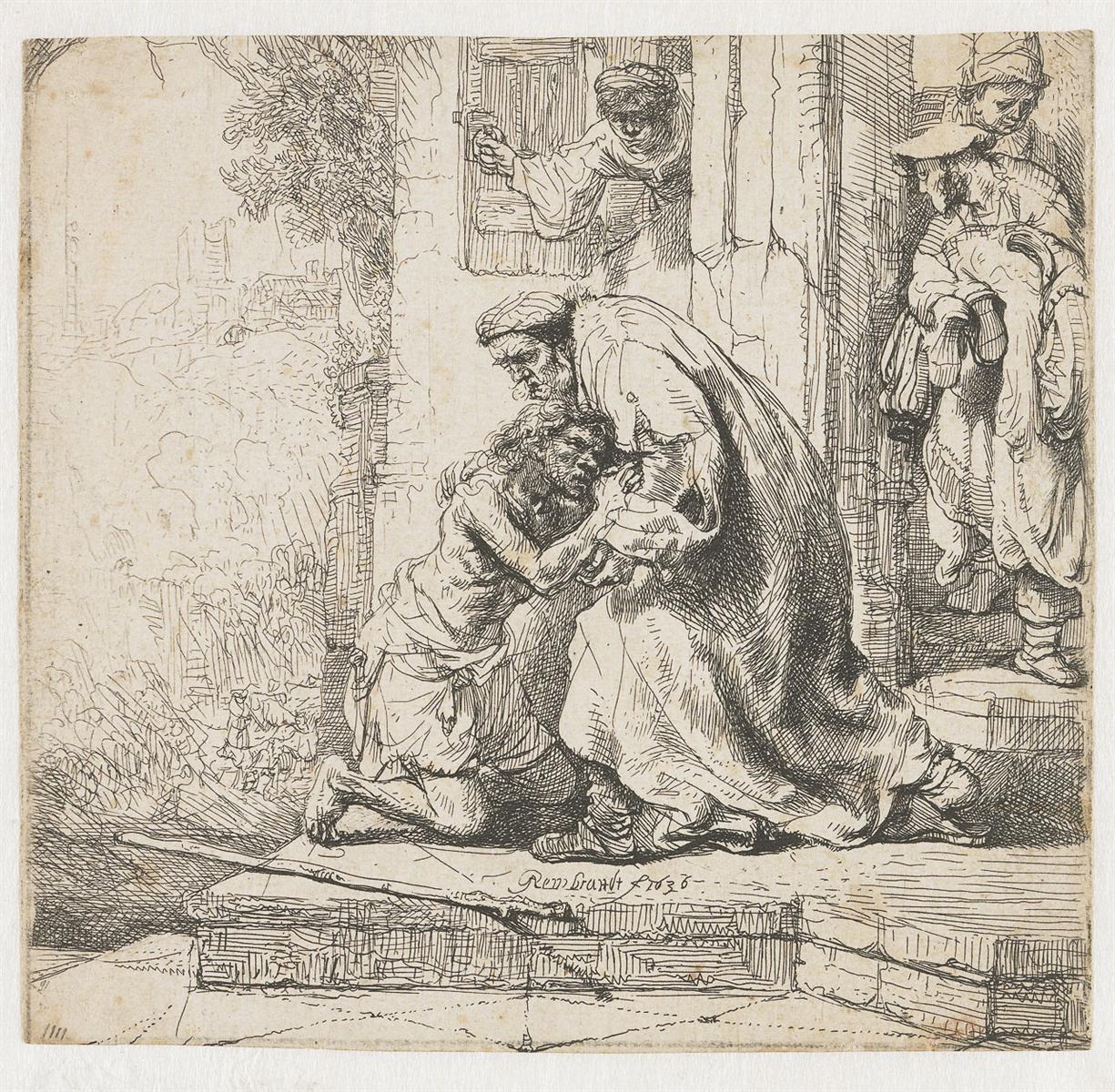
Rembrandt’s “The Return of the Prodigal Son” of 1636 condenses one of Scripture’s most moving parables into a scene of clasped bodies at a threshold. Executed as an etching, the work places the repentant son on his knees, the father bending to receive him, and the household looking on from doors and steps. With a handful of lines and a genius for staging, Rembrandt transforms a familiar story into a drama of touch, time, and light. The print is small in scale but monumental in feeling: architecture frames the encounter, the earth tilts forward like a stage, and the etched hatchings create an atmosphere dense enough to breathe. The son’s tangled hair and naked feet, the father’s enveloping cloak, the onlookers caught halfway between suspicion and surprise—every element works toward a single theme: mercy arriving in real time.
The Parable As A Human Encounter
The Gospel parable speaks of a younger son who squanders his inheritance and returns home prepared to be treated as a servant. Instead, his father runs to meet him, embraces him, and restores him to the family. Rembrandt chooses the instant when the son collapses into the father’s arms. He rejects symbolic props in favor of human bodies carrying moral meaning. The raggedness of the son’s clothes, the bony knees grinding into the steps, the father’s weight leaning forward so decisively that his feet brace for balance—these are not generalized gestures. They are observations of bodies in motion that make forgiveness visible as physical action.
The Architecture Of Grace: Threshold, Steps, And City
Compositionally, the picture is built around a threshold. A doorway and flight of steps create a shallow stage on the right; to the left, the world opens into a low townscape and hillside. The returning son has reached the juncture between those zones—the line between exile and home, death and life. Rembrandt insists on that liminal quality. The steps thrust toward us in a set of receding rectangles; the lowest one bears the artist’s signature like a date chiseled into stone. The architectural setting is not a neutral backdrop. It is a grammar of transition in which every horizontal and vertical quietly echoes the moral crossing underway.
The Father And Son: Geometry Of An Embrace
Place your eye on the knot of bodies at center right. The father’s back forms a protective arc; his cloak becomes a tent of acceptance that contains the son’s skeletal, inward curve. The son’s arms cling at the father’s waist and shoulder; the father’s hands press the boy’s back and head with different kinds of touch—one firm and stabilizing, the other tender and blessing. That duality captures the miracle of the moment: forgiveness is both legal restoration and emotional reunion. Even in the dryness of etched line, Rembrandt manages to vary pressure so that the father’s hands feel heavy with decision while the son’s fingers read as anxious and grasping. The faces meet in a compressed space; we read eyes, beard, and hair more by contour than by detail, as if the urgency of contact overwhelms the impulse to describe features.
The Elder Brother And The Witnesses
To the right, higher on the steps and half-turned away, stands a figure whose posture and distance match traditional readings of the elder brother. He appears reserved, even withholding, his body held together by layered garments and a stiffened silhouette. Above the central pair, another figure leans from the doorway with one hand on the latch and the other thrust outward—servant, bystander, or family member startled by the scene. These secondary roles are not decorative. They modulate our response. The etching invites us to choose a vantage point: to stand aloof like the elder brother, to peek from the shadows, or to kneel by the returning son. In this economy of postures the print becomes a moral mirror.
Line, Light, And The Weight Of Ink
Rembrandt’s control of etched line makes atmosphere out of metal. He builds shadows under the father’s cloak with tight crosshatching that thickens toward the core of the embrace, then loosens into airy strokes as the forms open to daylight. Around the left margin the lines are fewer, allowing the paper’s light to breathe and suggesting the openness of the countryside from which the son has come. The doorway’s deep recess and the elder brother’s garment are articulated with firm parallel strokes, lending them the rigidity that suits their psychological roles. Without resorting to theatrical contrast, Rembrandt composes a chiaroscuro of feeling: the densest ink gathers where mercy is enacted; the palest areas stretch where isolation lingers.
Raggedness And Richness: Textures As Moral Language
Texture is meaning here. The son’s hair is rendered in wiry, agitated curls, his clothing frays into threads, his calf muscles and knees are angular from hunger. By contrast, the father’s cloak hangs in generous folds, its fur collar etched with a soft burr that reads as warmth. Even the sandals differ: the father’s are intact and stable; the son’s feet are bare, tendons taut against stone. Rembrandt uses these tactile contrasts not to shame the penitent but to dramatize the distance grace travels to meet him. The rich meets the ragged, and the drawing of those surfaces becomes the scene’s central argument.
Stagecraft And Storytelling
The print’s staging is astonishingly efficient. The lowest step runs parallel to the paper’s edge, anchoring the viewer and establishing a plane we seem to share with the figures. The father leans from the security of the doorway toward the hazardous brink; the son has climbed from the lower left along a diagonal path implicit in the hillside and the fencing. A window opens above the father’s head, its shutter pushed outward by a figure who is literally “opening up” to witness. In the far right background a second onlooker, perhaps a servant carrying the son’s discarded clothes, descends toward the event. These moving parts create the sense that time extends both before and after the embrace: arrival is recent; restoration is beginning.
The City At Left And The Memory Of Exile
The left half of the plate is porous, filled with light and a sketchlike survey of walls, roofs, and distant towers. This city is not the “far country” of riotous living so much as the world at large, indifferent and expansive. The sparse lines allow the paper’s brightness to suggest the vastness in which the son wandered. A fence and tree trunk mark the boundary of the homestead, where density of line increases and human relations take on weight. Rembrandt withholds anecdotal detail—no pigs, no riot—to keep the focus on present transformation rather than past failure.
The Psychology Of Bodies
Rembrandt is a master of thinking with bodies. The father’s head dips in a classic gesture of pity; the son’s back curves like a question mark that has found its answer; the elder brother’s spine straightens in self-justification. Even the figure poking through the doorframe high above bends forward in the first movement of sympathy, while the descending servant pauses mid-step, undecided. These choreographies turn the parable’s interior states into legible silhouettes: compassion yields forward; pride holds back; repentance drops to the ground. Because the print is small and the lines are spare, the viewer supplies breath and temperature—an imaginative participation that makes the scene intimate rather than monumental.
The Father’s Face And The Art Of Restraint
Rembrandt does not fill the father’s face with theatrical emotion. He keeps the features economical—brow bent, nose and mouth indicated by a few strokes—so that the hands and body speak more loudly than expressions. This restraint guards the scene from sentimentality and aligns with the parable’s emphasis on action over words. The father’s love is not a speech; it is a movement outward. The son’s face, pressed to the cloak, is largely hidden; we read his desperation through grip, knees, and bare feet rather than through tears. The choice dignifies both figures and leaves space for the viewer’s own memory of being forgiven or forgiving.
The Etching As Shareable Devotion
Printmaking was the perfect medium for this subject in 1636 Amsterdam. An etching could be collected, gifted, pasted into albums, and revisited in the quiet of a study. The theme of mercy matched the devotional appetites of a Protestant republic where private piety and public charity intertwined. Rembrandt’s print therefore operated as more than a narrative; it was a pocket homily, a moral companion. Its portability allowed viewers to carry the threshold scene into their own thresholds—between business and home, grievance and reconciliation.
Gesture As Gospel
Look closely at the father’s right hand resting upon the son’s shorn head. The gesture resembles the traditional sign of blessing. Combined with the other hand, which braces the son’s back, it delivers a double message: you are received and you are steadied. The son’s hands answer with clutching rather than clasping—a posture of need rather than equality. Such specificity of hands recurs throughout Rembrandt’s work; here it functions as the distilled gospel of the picture. Words can be disputed; a touch like this can only be accepted or refused.
The Elder Brother As A Shadowed Warning
The elder brother’s distance is carefully calibrated. He is close enough to see and to be seen, far enough to avoid contamination by the prodigal’s dirt. His figure, crisply etched against the wall, helps define the architecture that both shelters and judges. The elder’s garments are layered, his hat brim stiff, his hands busy with folds rather than extended toward the returning sibling. Rembrandt refuses caricature; the elder is dignified. Yet the refusal to move becomes its own indictment. In a print about motion toward another, stillness reads as moral failure.
Movement Of Time: Before, During, After
Rembrandt suggests past and future without picturing them. The son’s torn garments and emaciation carry the “before.” The servant at right, perhaps carrying fresh clothes, and the figure at the window calling into the house hint at the “after”—the feast, the robe, the ring. The embrace is the fulcrum in which all temporal tenses balance. Etched line, with its capacity for both precision and vagueness, is uniquely suited to this narrative pivot. Where Rembrandt wants firmness—steps, doorjambs, the hinge of the father’s elbow—lines are clean and parallel. Where he wants openness—distant city, breezy foliage—lines are exploratory and light.
Proportion, Scale, And Viewer Placement
Although the plate is intimate, the figures are almost life-sized in feeling because Rembrandt pushes them toward the edge and tilts the stage. We stand where the ground drops, nearly within reach of the son’s dusty feet. That proximity raises the ethical temperature: we are not spectators at a distant pageant but participants whose own posture is in question. Do we kneel with him? Do we lean with the father? Do we hover uncertainly like the bystanders? The composition recruits the viewer into the moral choices of the scene.
Echoes With Rembrandt’s Broader Oeuvre
In later years, Rembrandt would return to this subject in a large painting where the father’s hands become the fulcrum of the composition. The 1636 etching anticipates that mature vision in miniature. It shows the artist already absorbed by the expressivity of touch, the dignity of age, and the drama of mercy enacted at a doorstep. The print also converses with contemporary etchings of beggars and street figures: Rembrandt’s sympathy for the poor is not a generic sentiment but an attentiveness to bodies that bear biography in their posture and clothes.
Why The Scene Still Works
Even for viewers distant from the biblical text, the image communicates. A worn figure collapses into another’s arms; a household watches; the threshold admits or refuses. The clarity of that arrangement makes the print modern. It speaks to family estrangements, to the ache of return, to the difficulty of letting go of judgment. Rembrandt’s genius is to strip away everything that would make the scene exotic and leave only what makes it human.
A Close Reading Path For Today’s Viewer
Begin at the lowest step, where the signature runs like an inscription on stone. Let your eye climb the geometry of the stairs until it meets the knot of the father’s cloak and the son’s bent head. Pause on the father’s hands; then trace the curve of the cloak down to the son’s bare feet. Glide upward to the elder brother’s stillness, then up again to the figure at the window, whose open shutter echoes the father’s open arms. Finally, release your gaze to the left, where the lines thin and the world widens. Having traveled that loop, return to the embrace and notice how the surrounding architecture now feels like an instrument tuned to that single chord.
Conclusion
Rembrandt’s 1636 “The Return of the Prodigal Son” distills forgiveness to its elemental image: a body receiving another body at the line between outside and in. In etched strokes that alternate between firmness and breath, he gives the parable flesh and gravity. The threshold steps become a stage on which mercy is not an idea but a movement; the elder brother’s distance becomes a warning; the witnesses become plausible versions of ourselves. Few images show so clearly how art can carry doctrine without preaching—by making us feel the weight of hands, the scrape of stone under knees, and the instant when home becomes possible again.