Image source: wikiart.org
Introduction
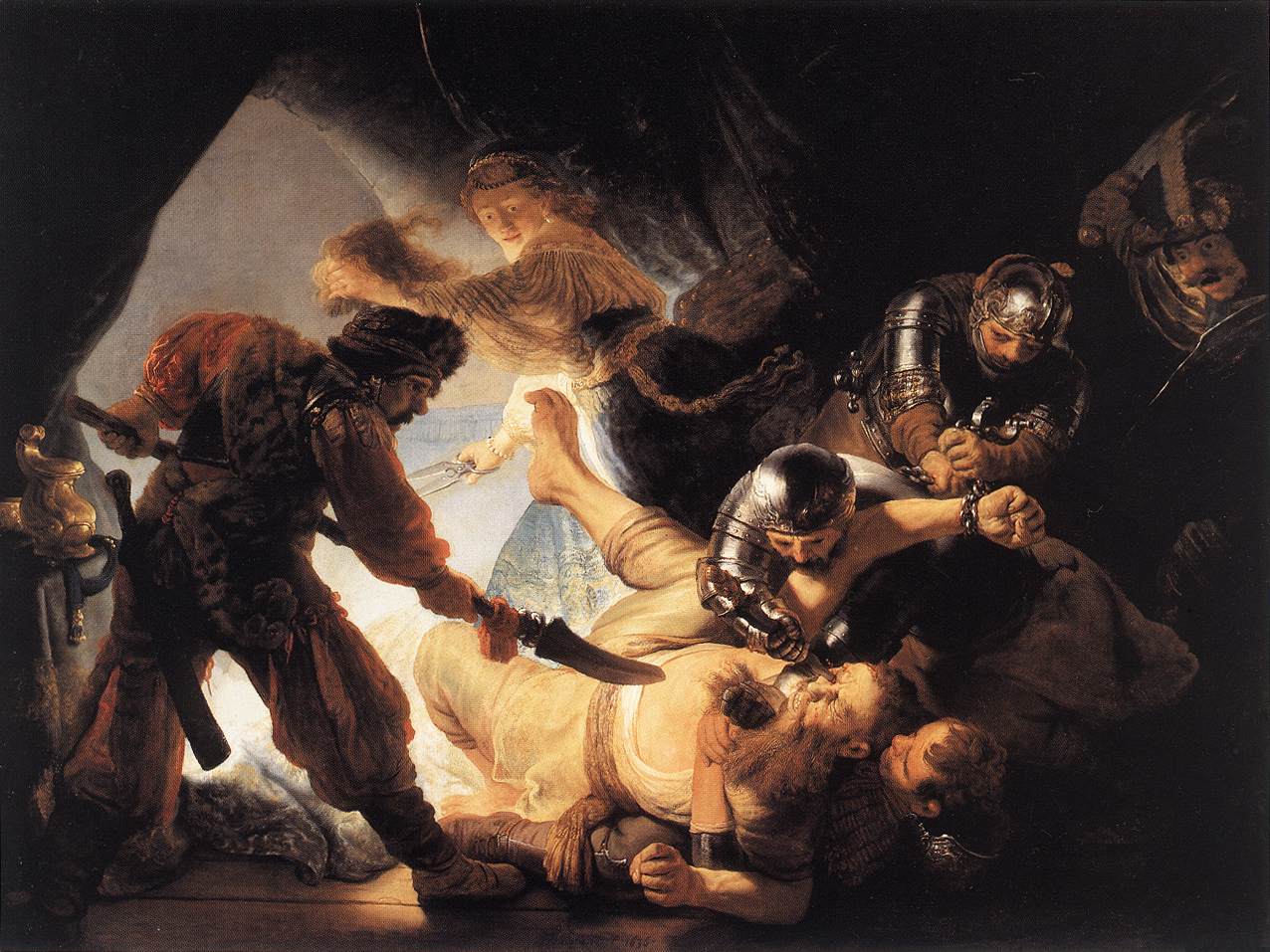
Rembrandt’s “The Blinding of Samson” (1636) is a thunderclap of Baroque drama. Across a canvas crowded with armored bodies, burning highlights, and riven fabrics, the Old Testament hero is thrown to the ground while a soldier forces back his head and another drives a dagger toward his eye. Delilah, hair unbound and dress blazing with light, recoils and yet still clutches the shears that cut Samson’s strength. The composition detonates in the instant between shouted command and irrevocable injury. In this single, explosive tableau Rembrandt compresses betrayal, loss of power, and the terrifying intimacy of violence. The painting is not merely an illustration of Judges 16; it is a meditation on how strength can be converted to helplessness and how treachery often travels in the company of tenderness.
The Biblical Moment And Its Psychological Charge
Samson’s blinding marks the narrative hinge of his story. Having confided the secret of his strength to Delilah—that his power lay in unshorn hair dedicated to God—he sleeps, shears at his locks, and awakes to Philistine soldiers waiting. Rembrandt chooses the instant of mutilation, the split second when fate is sealed and agency collapses. The scene’s psychology pivots around three axes: Delilah’s flight edged with complicity, the soldiers’ brutal efficiency, and Samson’s convulsive resistance. Each axis is legible in gesture more than symbol. The hero’s massive body twists as if trying to reassemble strength now unavailable; his bearded face, luminous and stricken, clutches our gaze precisely because it is the only face that registers shock without armor. The painting thus captures not only “what happened” but “how it felt” to have power taken away by those once invited close.
A Funnel Of Forces: Composition And Direction
The composition constructs a funnel of forces driving into Samson’s head. Four principal diagonals command the eye: Delilah’s arm and shears streaking backward, the left soldier’s scimitar slashing downward, the central soldier’s armored forearm forcing Samson’s face up, and the right soldier’s chained hands yanking against Samson’s wrists. These lines converge over the hero’s face like the jaws of a trap. Framing those diagonals is an arched curtain that parts to reveal an oculus of cold, outside light—daylight that feels indifferent to human suffering. Rembrandt sets figures on a shallow stage so that bodies fill the foreground, plunging us into the melee without a buffer of distance. The close-quarters design makes the viewer a witness within the tent rather than a spectator outside the drama.
Chiaroscuro As Moral Spotlight
The painting’s light behaves like a narrative intelligence, striking the elements that carry meaning and letting the rest sink into darkness. Delilah’s face, hands, and luminous satin sleeves catch the strongest illumination, a visual subpoena that binds her to the act. Samson’s torso and face ignite along the planes the soldiers seize, making his body read like a map of vulnerability. Armor glints in sharp, hard sparks; the scimitar flashes like a shouted word. The rest—curtains, background figures, and floor—darkens to a near-black, a void against which the crime glows. This chiaroscuro is not decorative; it declares a judgment. Light becomes accusation and witness in a scene where legal due process is absent.
The Theater Of Fabrics
Rembrandt pulls us into the story through fabric that behaves like weather. Delilah’s gown, a storm of cream and gold, swirls as she pivots; its rippling hem and catching folds make her flight legible as motion and as conscience. The thick curtain overhead cascades like night itself collapsing; its heavy braid becomes a visual chain that mirrors the actual chains locked to Samson’s wrists. Under Samson the groundcloth rucks up in creases that echo the contortions of his muscles, a tactile register of his struggle. These textiles do more than stage the scene—they amplify the emotional climate, transforming architecture and costume into agents of plot.
The Anatomy Of Violence
Rembrandt’s choreography of hands and tools is unnervingly precise. A gauntleted fist claws back Samson’s brow, thumb pressed into the eye socket to immobilize the head. Another soldier’s hands knot iron fetters around the wrists, a twist that torques the shoulders and chest, exposing the neck. The leftmost assailant, legs braced, drives the short, curved blade with the efficient posture of someone accustomed to butchery. On the ground, a Philistine henchman wedges himself beneath Samson’s ribs to pin him, his own face grim and practical. Nothing here is generic; every wrist angle and muscle pull convinces the body of the viewer that this could happen to a body. That kinesthetic truth is the painting’s most disturbing achievement.
Samson’s Body As Fallen Citadel
Rembrandt renders Samson like a toppled fortress. The weight of the hero’s mass dominates the foreground; his thighs and torso occupy nearly a third of the canvas. The physical grandeur that once ripped gates from city walls now lies overpowered by leverage rather than greater strength. This is the painter’s cruel insight: power depends on knowledge, and knowledge—once given to the wrong person—can turn the strongest body into soft prey. Samson’s musculature is modeled with Rembrandt’s classic candor, not celebrating vanity but acknowledging a body accustomed to mastery. The shock of seeing such mastery undone becomes the emotional entry point for anyone who has felt security convert suddenly to exposure.
Delilah: Flight, Remorse, And Trophy
Delilah is the painting’s most psychologically layered figure. Rembrandt freezes her mid-turn, hair unbound by the same hand that wields the shears, face lit with a mixture of triumph, alarm, and unreadable doubt. The shears themselves glitter like a second blade, less bloody but equally consequential. In her other hand she clutches the severed hair, the trophy of betrayal, a relic that is both intimate and damning. The backlighting that silhouettes her body frames her as at once an apparition and a conspirator. She is neither a villainous caricature nor an innocent bystander. Instead, Rembrandt offers a portrait of someone who has already gone too far to stop yet is newly awake to the cost.
Armor, Exotic Costumes, And The Machinery Of Power
Rembrandt outfits the Philistines in a multicultural array of helmets, brigandines, and eastern textiles. The blend is deliberate. It distances the episode from any specific European army while emphasizing timeless military technology: steel that bites, plates that protect, leather that straps bodies into purpose. The leftmost soldier’s fur cap and patterned trousers, the central fighters’ polished greaves and vambraces, the officer’s plumed helmet peering from the shadows—together they read as a catalog of power’s wardrobe. The exoticism also sharpens the contrast with Samson’s nakedness. Where armor makes a man harder, bare flesh remains susceptible, a truth that is as ethical as it is visual.
Spatial Focus And The Hole Of Daylight
One of the most chilling devices is the triangular wedge of pale daylight that cuts in from the left. It points like an arrow toward Samson’s face while simultaneously suggesting the world outside—cold, distant, and unheeding. The wedge functions as an architectural scalpel, opening the interior to an exterior that will not intervene. It also creates a counterpoint to the warm torchlight flickering from a bronze lamp beside the soldier. Warm light and cold light collide over human suffering, a coloristic metaphor for public spectacle and private pain.
The Soundscape Of The Scene
Paintings are silent, but this one is loud in the mind. You hear the rasp of armor buckles, the grunt of bodies wrestling, the clink of chain, the quick intake of Delilah’s breath, the dull thud of Samson’s shoulder hitting the ground, the hiss of a blade cutting air, perhaps even the distant shout of soldiers outside the tent. Rembrandt organizes forms to orchestrate that imagined acoustics. Hands and mouths open, fabrics whip, metal gleams—all signifiers of sound. Against this racket, Samson’s forthcoming cry becomes the center of the auditory drama we cannot hear yet unmistakably anticipate.
The Ethics Of Looking
Rembrandt places the viewer at the edge of the assault, close enough to count the rings on the gauntlet. We are inside the room but barred from action by the density of bodies and the speed of events. The painting thus exacts a moral toll: to look is to witness, and to witness without help is to feel implicated. There is no comforting horizon or devotional distance to soften the blow. The artist’s strategy turns a biblical illustration into an examination of spectatorship—what it means to see harm and be helpless, what it feels like to understand betrayal too late.
Painterly Execution And The Weight Of Paint
The surface carries Rembrandt’s authority. Flesh is built in buttery layers that catch light with a living humidity; satin is laid in long, liquid strokes that fold and glimmer; steel is not merely gray but a field of minute reflections: warm tans from flesh, black from shadow, sharp whites from lamp and daylight. Brushwork tightens at the blades and eyes, loosens over the curtains, and slows to savoring in the textures of fur and hair. Such modulation is not a show of craft for its own sake—it calibrates focus and breath. The eye sprints where edges are crisp, rests where paint opens, and returns inexorably to the knot of violence at center.
Rembrandt Versus Rubens: Two Theaters Of Samson
Comparisons with Rubens’s treatments of Samson clarify Rembrandt’s temperament. Rubens revels in heroic anatomy and sculptural momentum; his Samson is a god in crisis. Rembrandt, while no less dramatic, is more intimate and morally sour. He brings the viewer so near the injury that admiration for the hero’s physique dissolves into pity for his humanity. If Rubens gives us theater in the round, Rembrandt gives us the claustrophobic backstage where decisions are made and damages incurred. The difference is not simply stylistic; it reflects two attitudes toward power—one celebratory even in defeat, the other skeptical, aware that strength without wisdom courts disaster.
Betrayal As Domestic Gesture
One reason the painting is so disturbing is that its violence grows from domestic familiarity. Delilah’s soft sleeve, the household shears, the bed-like cloths under Samson’s back—these are not battlefield props but items of intimacy retooled for harm. Rembrandt understands that the most terrible betrayals are not public coups but private turns, when the hand that caressed becomes the hand that delivers. By foregrounding those domestic textures, he makes the scene more than myth; he transforms it into a warning about trust, secrecy, and the risks of laying down one’s defenses in the wrong arms.
The Aftermath Written In Advance
Rembrandt seeds the canvas with quiet predictions of what follows. The chains already looped onto Samson’s wrists foretell captivity; the thick ropes snaking through the scene anticipate binding; the lamp’s weak flame suggests a coming darkness; the wedge of daylight points toward the public humiliation that will parade Samson blind through the gates. Even Delilah’s backward glance functions as a rehearsal for regret. The painting captures a present tense crammed with future tense, a now that already contains then.
The Body As Theology
In the Samson story, strength is covenantal, dependent on a vow. When hair is cut and eyes are put out, the loss is not merely physical; it is spiritual dislocation. Rembrandt writes that theology in flesh. The hero’s body, stripped and thrown, becomes a lesson about the fragility of charisma without faithfulness. Yet the painting also preserves a glimmer of dignity. Even in defeat, Samson’s torso is modeled with the solemnity Rembrandt usually reserves for saints and prophets. The fall is terrible because the person mattered. That humanist insistence rescues the scene from mere gore and anchors it in moral seriousness.
The Viewer’s Escape Route And Its Cost
Is there any way out for the eye? Perhaps only along the same route Delilah takes—back through the torn curtain and into cold day. But following her with our gaze does not absolve us; it makes us share her exit, her dawning realization of consequence. Rembrandt leaves us with no consoling figure to identify with, no righteous rescuer to endorse. We are left as witnesses with conscience, and the painting’s charge is to carry that conscience forward into our own choices about trust and power.
Conclusion
“The Blinding of Samson” is Rembrandt at his most operatic and morally unsentimental. Through a composition that funnels energy into a single, terrifying act, through light that indicts as it illuminates, through fabrics that storm and armor that bites, he reconstructs an ancient story as an urgent meditation on betrayal and the collapse of agency. The painting’s realism makes the body shudder; its symbolism makes the mind reflect; its theatricality makes the heart race. Four centuries on, the scene still feels newly dangerous because it recognizes how strength can be undone not by superior force but by intimacy misused. In that recognition lies the painting’s enduring sting and its sobering truth.
