Image source: wikiart.org
Introduction
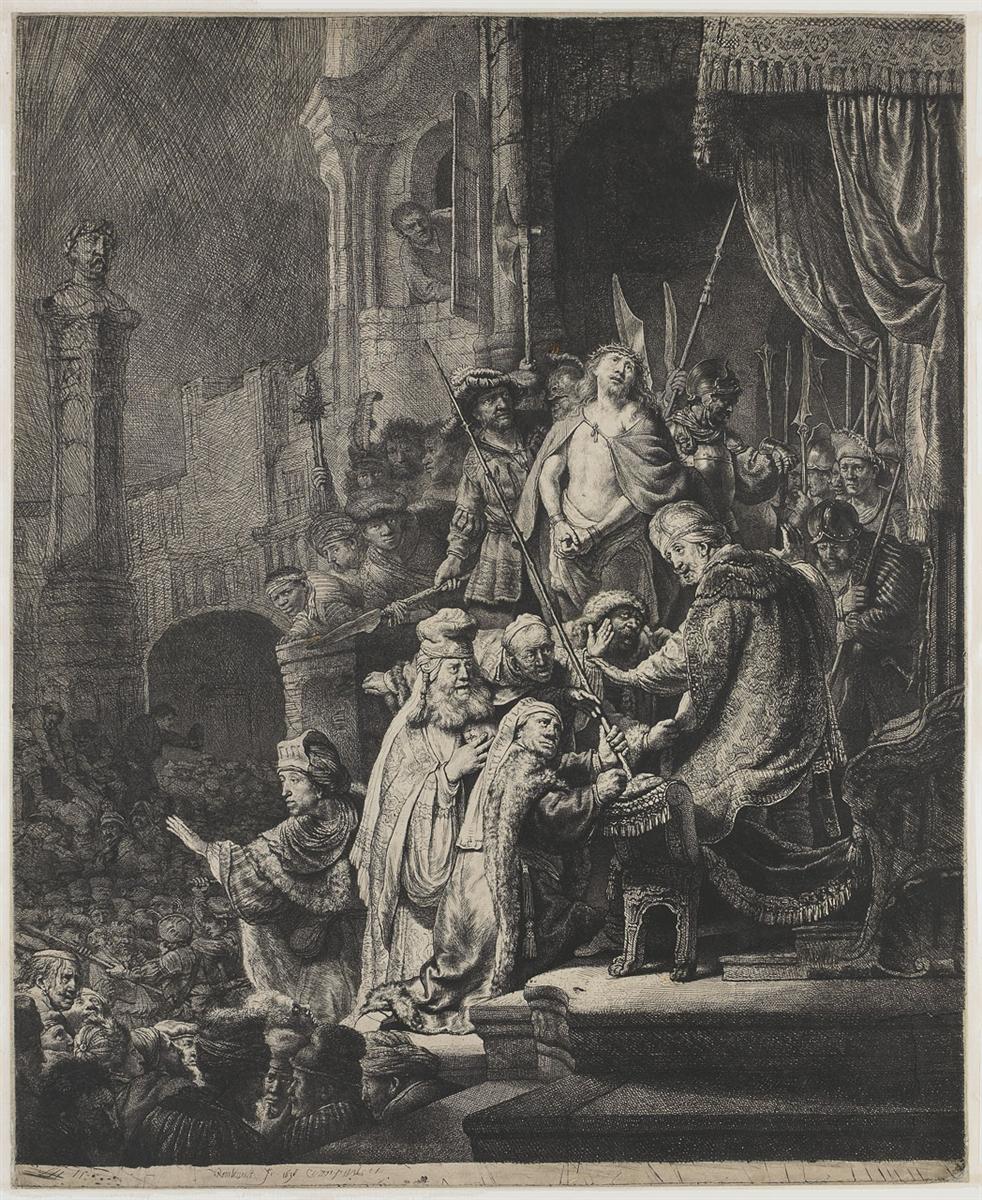
Rembrandt’s “Christ before Pilate” (1636) is one of the most ambitious narrative prints of the Dutch Golden Age. Worked on a large copperplate with a virtuoso blend of etched line, drypoint burr, and burin retouching, the image stages the climactic confrontation between spiritual innocence and political power. Rembrandt orchestrates the scene as a living theater: a roaring crowd packed into a plaza, priests pressing their case, soldiers bristling with halberds, a Roman governor enthroned beneath a ceremonial canopy—and, at the heart of the storm, the bound and scourged Christ, crowned with thorns, luminous in his stillness. The print is not simply an illustration of Scripture; it is a study in how authority is performed, how persuasion is staged, and how a single, quiet figure can command the eye against the noise of the world.
A Monumental Stage Set
The composition reads like a public square carved from stone and shadow. At the right, a tall dais rises in broad, strongly lit steps toward a canopied seat where Pilate presides. The drapery above him swells with a sculptural fullness, a sign of courtly rank and the theatrics of judgment. A diagonal procession of figures ascends toward the tribunal: temple officials in fur-trimmed robes, petitioners kneeling with outstretched arms, and soldiers whose spears and standards scribe bright verticals that cut the air like exclamation points. Beyond, to the left, the architecture falls away into arcades and balconies jammed with onlookers. A bust of Caesar surmounts a column in the far distance, an icon of imperial power watching over the event like a cold, immobile witness. The plaza is walled by dense crosshatching, the sky pressed into granular darkness so that light pools where Rembrandt wants the narrative to turn.
The Crosscurrents Of Authority
Nothing in the print is static, least of all authority, which Rembrandt treats as a choreography rather than a fact. Pilate sits, elevated, his body pulled slightly forward, one hand gesturing as he confers with the petitioners; his posture hints at the strain of political calculation. Around him, clerics and courtiers lean in with differing agendas. One figure, hat swept back, raises his hand as if delivering the crux of an argument; another bows more deeply, body language performing deference to power even as his words likely press for Christ’s condemnation. Soldiers stand at attention, not thinking but enforcing, their weapons aligned like a fence.
Across the composition, an opposite current flows through the crowd. On the lower left, figures press toward the platform, their hands thrown up, some in appeal, some in accusation, others merely craning to see. It is a democracy of expressions: anger, curiosity, boredom, zeal. In the middle distance, at a window that opens into the forum, a civilian leans out to watch, the banal gesture of a neighbor drawn by noise. Authority therefore appears on three levels—imperial in stone, judicial on the dais, communal in the crowd—and Christ stands where these currents collide.
Christ As The Eye’s North
Rembrandt works a subtle miracle of attention. Christ is not the largest figure, nor the most centrally placed, nor the most aggressively lit, but he becomes the eye’s north because every compositional vector either points to him or contrasts with him. He stands a few steps below Pilate, roped, bare-chested, head slightly tilted under the thorny crown. The lines that describe him are cleaner, the surrounding tones scrupulously modulated, so that his body reads like a clear vowel in a field of consonants. A soldier’s spear angles toward him; the nearest official’s gaze locks onto him; the rhythmic ascent of stairs leads to him. Where the crowd churns with overlapping tones, Christ’s figure is modeled with a spare economy that makes stillness legible.
This strategic quiet turns the ecce homo moment—“behold the man”—into a literal operation of seeing. The print asks: what, among all these claims and clamor, is worth beholding? Rembrandt’s answer is unambiguous. The truth, in his view, shines by being quieter than power.
The Dramaturgy Of Space
The image is constructed as a deep stage, mapped by layers of architecture. Rembrandt opens a tunnel of arcades on the left, stacks balconies upon galleries, and erects a stone façade with windows through which the city peers at its own conscience. The repetition of arches creates a pulse that pulls the eye into depth and then rebounds it toward the tribunal, as if the city itself were breathing. The lower margin is packed with heads, shoulders, and hands, a visual murmur that keeps the foreground alive without stealing focus. At the upper left, the sky is crosshatched to a silvery dusk, establishing an atmospheric lid that keeps sound trapped in the plaza. This control of spatial pressure is central to the print’s power: the event feels inescapable because the city’s stone and the crowd’s bodies conspire to hold it.
Light As Judging Intelligence
Rembrandt’s light behaves like a form of thought. It seeks out the surfaces that matter—Pilate’s face and hands, Christ’s torso and brow, the pleading gestures of the priests, the polished edges of weapons—and lets the rest slope into half-shadow. There is no theatrical spotlight; instead, the brightness arrives in local, ethically attentive patches. The canopy’s fringe glitters, a shallow show of rank; the marble steps catch a wide wash, stage-boards for the performance of law; the emperor’s bust is given only enough light to be read, not admired, a stone idea rather than a presence. In the crowd, small highlights flash off caps and noses like scattered opinions. The light’s hierarchy is Rembrandt’s judgment on the action.
The Orchestra Of Line
Technically, the plate is a compendium of etched invention. Rembrandt sets down long, supple contours for robes and limbs; he crosshatches in tight, netted textures to build darkness; he scores stone with parallel rulings; he reserves slivers of untouched paper as the brightest whites. Drypoint burr lends velvet to the deepest blacks around the canopy and in the crowd’s densest knots, while burin reinforcement sharpens edges at key silhouettes so the eye doesn’t wander. The resulting orchestra of line gives the print a tactile range that feels almost symphonic: rasping stone, silky fabric, glinting steel, human warmth. You can sense the speed changes in his hand—quick in the crowd, deliberate at the tribunal, tender around Christ’s face.
The Politics Of Gesture
Every hand here has a job. Pilate’s right hand is midway between command and inquiry, palm angled as if weighing options. The priests’ hands splay in rhetoric—fingers counting points, tips stabbing the air to punctuate accusations. The crowd’s hands wave, plead, jeer, point, and push. A soldier’s hand clamps a spear with professional indifference. Christ’s hands, bound, withdraw from the exchange altogether. Rembrandt uses this spectrum of manual language to draw a political map: talk, force, consent, and innocence are all legible through palms and knuckles. The print can be “read” at the level of hands alone and still tell the story.
Sound, Silence, And Moral Acoustics
Although silent on paper, the image is loud in the mind. You can hear the iron ring of spearbutts on stone, the layered shouts filtering from the lower left, the closer murmur of argument at the dais, the flap of canopy fabric, the lonely cough of a spectator at the balcony. This constructed noise surrounds a core of quiet where Christ stands. Rembrandt therefore composes not just with light and line but with imagined acoustics. The contrast between clamorous politics and inward silence becomes the moral contrast of the scene.
The Roman And The Jewish, The Ancient And The Modern
Rembrandt’s costumes and architecture freely mix elements noted from antiquarian sources with contemporary Dutch dress and civic spaces. The result is not anachronism by accident but fusion by design. He wants the viewer to feel that this drama belongs as much to Amsterdam as to Jerusalem, as much to his century as to the first. The furred collars and broad hats of the petitioners echo the burgher class of the Dutch Republic; the Roman bust and weapons supply the empire’s emblematic machinery. In that mixture the print argues—quietly but firmly—that questions of justice, crowd manipulation, and the misuse of power are permanent, not period-specific.
The Crowd As Character
Many narrative images use a crowd as mere filler. Rembrandt assigns it agency. Faces wheel toward the tribunal; some are caught mid-shout; a few look back at us, as if to conscript the viewer into the public’s complicity. A man at the far edge raises a hand to shield his eyes from light—a small gesture that makes the whole seem observed rather than staged. The crowd here is not a chorus delivering a single viewpoint; it is a volatile electorate, a civic organism with many tempers. Its density is essential: against such quantity, Christ’s singular figure gains moral amplitude.
Pilate’s Ambivalence
Rembrandt is too psychologically acute to make Pilate a cartoon villain. The governor’s body leans, the head tips, the hand hovers. He looks like a man caught between the calculus of survival and a glimmer of unease. In the Gospel account, Pilate declares Jesus innocent yet yields to the crowd. Rembrandt’s drawing of the face—shadowed eyes, mouth set but not cruel—catches that uncertainty. The print’s judgment is harsh on the system and the crowd, not on the weakness of a single man. Failure here is structural and contagious, not only personal.
Christ And The Politics Of Non-Performance
Christ’s refusal to perform is the scene’s scandal. Everyone else plays a role: officials dramatize indignation, soldiers posture, Pilate calculates, the crowd acts out its appetite for spectacle. Christ does none of this. He is there, fully and simply present. That presence exposes performance for what it is: a technique for avoiding the truth. Rembrandt’s art is theatrical, but his Christ refuses the theater. The power of the figure lies in the decision not to compete for attention in the ways that power normally does.
Printmaking As Public Art
The choice of etching for such a subject is itself meaningful. A print can travel, be owned by many, and be contemplated in private, beyond the distortions of a public square. In a century when political pamphlets and broadsides stirred crowds, Rembrandt offers a visual counter-pamphlet: complex, resistant to slogans, interested in conscience rather than frenzy. The plate becomes a portable tribunal of a different kind, where the viewer becomes the judge—of Pilate, of the crowd, and of themselves.
The Conversation With Rembrandt’s Later “Ecce Homo”
Nearly two decades later Rembrandt returned to the theme in a smaller, more radically lit drypoint often titled “Christ Presented to the People.” That later print compresses the scene and leans harder into chiaroscuro. By studying the 1636 version alongside it, one sees the young master’s appetite for architectural spectacle and social detail gradually refining into a distilled drama. The early print teaches how crowds, power, and ceremony work; the later one concentrates on the abyss between “behold” and “believe.” The through-line is Rembrandt’s fascination with how the eye is managed and mismanaged in public life.
The Ethics Of Looking
Ultimately, “Christ before Pilate” is an education in seeing. The composition tempts us toward the canopy’s glitter, the weapons’ shine, the priests’ theatrics. If we stop there, we’ve learned nothing; we are one more face in the crowd. The print rewards the viewer who keeps looking—past status symbols and noise—to the figure whose power is composed of patience and truth. In that slow recalibration of the gaze, the image performs its most important work: it retrains the eye to prefer the real to the spectacular.
Conclusion
With “Christ before Pilate,” Rembrandt builds a civic theater in which politics, religion, and human temperament collide. He scripts authority as a choreography, lights the scene with moral intelligence, and carves a crowd into a living organism of competing desires. Against this clamor he sets a single, quietly modeled figure whose dignity gathers the composition around him like a compass finds north. The print is not merely a biblical illustration; it is a meditation on spectatorship, a diagnosis of public life, and a defense of the kind of truth that stands, unarmed and unadorned, before power. Four centuries later, the plaza still feels crowded, the arguments familiar, the canopy’s fringe still glittering—and the quiet figure still asks us to decide what, and whom, we will behold.
