Image source: wikiart.org
Introduction
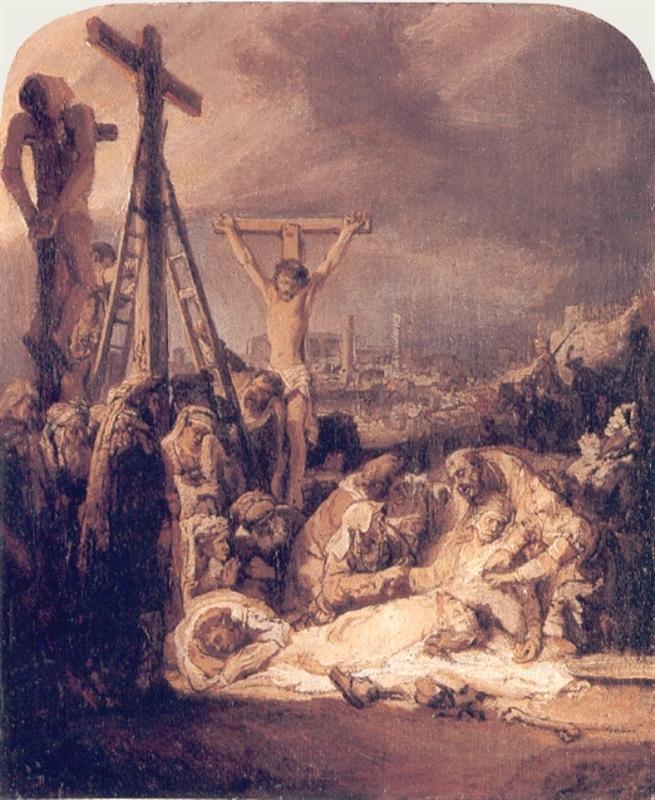
Rembrandt’s “The Lamentation over the Dead Christ” (1635) compresses the entire Passion’s emotional aftershock into a single, storm-laden tableau. Measuring modestly, the painting nonetheless feels monumental: a city glimmers in the distance; wooden ladders angle like exclamation marks against the sky; one thief still hangs, another’s cross is being raised; and at the center front, Christ’s body is lowered to the ground and wrapped, encircled by figures whose grief is specific, various, and painfully human. This is Rembrandt in his twenties, already mastering the orchestration of narrative, light, and gesture—already confident enough to subdue spectacle in favor of feeling. The work is not merely an illustration of a Gospel episode; it is a meditation on what love does after catastrophe, on how a community steadies itself at the edge of loss, and on the strange, dawning calm that attends faith when it has wept as far as it can.
The Moment Rembrandt Chooses
The Lamentation is a fluid subject in Christian art, sliding between the Descent from the Cross and the Entombment. Rembrandt chooses a transitional instant that gathers all three: the ladders still lean against the upright timber; the thieves’ crosses stand in grim counterpoint; the winding sheet unspools across the foreground; and friends crowd around Jesus to wash, cradle, and bind the body. Because the moment is liminal—neither the violence of crucifixion nor the ritual closure of burial—Rembrandt can choreograph the full spectrum of human response: action and collapse, devotion and bewilderment, tenderness and stunned observation. The painting’s power lies in this simultaneity.
A Composition Built Like A Theater Of Compassion
The composition is tripartite. At left, a vertical stack of forms—cross, ladders, a cluster of mourners—creates a dark column that both anchors and presses inward. At the center, the body of Christ lays horizontally, luminous against the earth, his pale flesh and white shroud forming a path of light that leads the eye from Joseph of Arimathea’s supporting hands to Mary’s fainting form and the faces bent in service. At right, a bank of figures and rock echoes the left-hand mass, closing the stage so that the viewer feels held with the crowd. The background city, delicately brushed beneath a barometric sky, provides a deep horizon that prevents the grief from turning claustrophobic. The whole design reads like a stage with wings: the drama is close, but history and world remain.
Light That Consoles Rather Than Accuses
Rembrandt’s chiaroscuro here is not the theatrical lightning of judgment; it is a pastoral, searching light that dignifies bodies as they lean and labor. The brightest area belongs to Christ’s torso and winding sheet, then to the faces nearest him. Darkness pools beneath the ladders and among the crowd at left, where anonymity gives way to a collective silhouette. The sky, a sullen violet-brown with bruised clouds, presses down, yet a lighter belt of atmosphere opens over the distant city, a subtle promise that the story does not end in this valley. Light functions as consolation in motion: it lands where hands serve and where love looks most intently.
Gesture As The Gospel’s Silent Narrative
The story unfolds in hands. Joseph or Nicodemus supports Christ’s shoulders with the gentleness of someone lifting a sleeping child, his fingers splayed to distribute weight. Mary Magdalene bends in to cradle the feet, her gesture simultaneously practical and reverent. Another figure unrolls the linen with a tailor’s precision; someone wipes a brow; another clasps his own head in a private implosion of grief. None of these hands are rhetorical; they are necessities. Rembrandt turns necessity into poetry, insisting that holiness after violence is made of exact, ordinary acts done well.
Bodies That Remember Violence Without Displaying It
Rembrandt refuses gore. The wounds are present but understated: a puncture in the side, bruised hands, the slump of a rib cage that has finished breathing. The restraint does not sanitize the scene; it intensifies it. Viewers feel the ache of effort in the living bodies—the bent backs, the knees on stone, the weight transferred from arm to cloth—so that Christ’s stillness becomes the clearing in a storm. The human machine of grief and care keeps moving around a center that has gone quiet.
The City On The Horizon And The Scale Of History
Beyond Golgotha’s hill, the city unrolls in a pale web of towers, walls, and roofs. It is not topographically specific; it is civitas, the city of all people, including Rembrandt’s Amsterdam. The scene therefore refuses to be a museum piece about first-century Judea. It is a contemporary meditation on public violence and private love, on how any city can carry on under a sky where injustice has just been done. The skyline is the painting’s moral horizon: civilization persists, but the cost of its peace includes this moment of extraordinary care.
The Ladders And The Logic Of Gravity
The twin ladders are more than props; they are metaphors. Their verticals, insistent and plain, pierce the scene with the logic of gravity and labor. They were the means by which the broken body was recovered from the cross; now they wait like wooden witnesses, a small, stable geometry amid human motion. Rembrandt sets them against the sky in clear silhouette, giving the entire left register a scaffolding that orders the chaos. They stand as the ethics of the picture: grief must climb, steady itself, and work.
The Crowd As A Choir Of Emotions
Rembrandt does not homogenize the mourners. One figure buries his face in a cloak, one stares outward in shell-shocked vacancy, one stretches an arm in a pleading arc, one crouches to fold cloth, one stands with hands clasped, a shape of prayer amid logistics. This heterogeneity rescues the scene from sentimentality. Grief is never one thing; faith is not uniform. By gifting each head a different angle and each arm a different task, Rembrandt composes a choral lament in which no voice is redundant.
Mary’s Collapse And The Theology Of Compassion
At the right of center, a figure—traditionally the Virgin—swoons, supported by attendants. Her collapse is neither theatrical nor passive; it is a necessary yielding after endurance. In compositional terms, her diagonal body mirrors Christ’s horizontal one, binding mother and son in a geometry of surrender. The proximity of the two suggests a theology embedded in design: compassion is a participation in another’s suffering that does not pretend to carry it, yet refuses to abandon it. The attendants’ hands under Mary’s arms echo the hands under Christ’s, making the whole foreground a liturgy of bearing.
Color As Emotional Temperature
Though earthy browns and umbers dominate, Rembrandt inflects them with small, decisive modulations: a coral note in a headscarf, a cool ash on distant towers, a greenish tint in the lowering sky, a rose warmth in flesh against the white winding sheet. These adjustments fine-tune the scene’s temperature. The white of the shroud, especially, is not chalky; it is warm with reflected skin tones, as if the cloth were already remembering the life it will soon cover. Color becomes memory and forecast at once.
Theological Ambiguity And The Ethics Of Service
The picture contains no angels, no burst of supernatural light, no explicit sign of Resurrection. Its hope is ethical rather than spectacular. Hope is hands, cloth, and shared weight. This is not to deny the transcendent, but to insist that the gateway to it is fidelity in small tasks. The painting is radically incarnational: bodies matter; they must be handled; salvation begins with someone kneeling on cold ground to bind a wound and wash a face.
Pacing And The Breath Of The Scene
The painting’s internal rhythm is slow. Nothing rushes. Even the men handling the cross and ladder move with the deliberate economy of workers who know their tools. Rembrandt achieves this tempo through overlapping diagonals that resolve into horizontals—the restful bed of the shroud, the quiet horizon of the city—so the eye never jerks, only travels. The pacing allows viewers to inhabit the figures’ breath, to feel the interval between sob and steadiness, between wordless ache and the next necessary act.
Dialogues With Rembrandt’s Other Passion Works
Placed next to Rembrandt’s “Descent from the Cross” and “Entombment” of the same year, this painting reads as the heart of a triptych on love’s labor. The Descent shows the coordination required to lower a body; the Entombment shows the final choreography of farewell; the Lamentation concentrates on touch, faces, and the immediate ethics of aftercare. Across the three, Rembrandt refines a vocabulary of ladders, cloth, diagonal bodies, and pooling light. But the Lamentation’s intimacy—its foregrounded nearness—makes it the most interior of the group.
The Sky And The Weather Of Mourning
Rembrandt’s sky is muscular, working across the panel in sloped strata of cloud. It does not merely frame the event; it participates in it. The darker upper mass presses with barometric weight, while the lighter band over the city gives a horizontal release. This dialectic of pressure and loosening echoes the experience of grief: waves that bear down followed by the momentary space to breathe. The sky is meteorology translated into psychology.
The Body Of Christ As The Picture’s Compass
Christ’s body is not arranged for display. One arm lies slack, one leg turns slightly inward, the head inclines with the helpless grace of sleep. The pose is anti-heroic, anti-mannerist, deeply compassionate. It is a body to be served, not admired. Yet it is also the painting’s compass: every gaze, gesture, and patch of light takes its measure from that center. In the logic of the composition—and, for believers, the logic of the world—love organizes around this body.
Material Presence And The Brush
Even in reproduction, one senses the liveliness of the brush. Rembrandt’s handling is varied—loaded and scumbled in the shroud, thin and sketchy in the distant city, soft and worked in faces. He lets underlayers peek through in places, a frankness that suggests both speed and confidence. The paint’s materiality matters for the subject. It acknowledges that truth is not a mirage but something you can touch—cloth that absorbs oil, wood that drinks shadow, skin that takes and reflects light.
The Viewer’s Location And Invitation
We stand close, low, at the edge of the shroud. Our vantage is not that of a spectator up a hill but of a participant who could, if asked, take a corner of the linen. This proximity is the painting’s moral invitation. It does not ask us to solve the problem of evil; it asks us to help with the body, to enter the fellowship of those who do what must be done. The spiritual demand is physical, and that is precisely its grace.
Why The Painting Still Works
Centuries later, the picture continues to speak because it temporalizes grief rather than dramatizing it. We recognize the faces: the organizer, the comforter, the undone one, the practical friend, the one who simply stays. We recognize the weather of the heart. We recognize the city that does not stop when our world does. Above all, we recognize the rightness of bending to the task. Rembrandt offers, in paint, a ritual of care that any community can learn.
Conclusion
“The Lamentation over the Dead Christ” is Rembrandt’s early masterpiece of tenderness under pressure. Its choreography of ladders, bodies, cloth, and sky yields a drama in which feeling is precise, labor is beautiful, and light lands exactly where compassion is most active. The painting does not resolve grief; it deepens it into love that works. By the time our eyes has moved from the ladders through the knot of mourners to the distant city and back to the white of the shroud, we have inhaled its ethic: be present, lift together, honor the body, trust the slow, consoling light.
